A project for the flying car that is being developed ahead of overseas.
Flying cars are a new mode of transportation being developed as next-generation mobility, with features such as "the size of a car, powered by batteries, capable of autonomous driving, and able to take off and land vertically," allowing safe use even in areas where infrastructure is not established.
The first outdoor test flight of a flying car in Japan was held at Kasaoka Fureai Airport on June 4 (Friday) at 9:00 AM.
The outdoor test flight was conducted by MASC (a general incorporated association established in 2017 and incorporated in 2021: a research group aimed at realizing an aerospace industry cluster in the Mizushima area of Kurashiki City, Okayama Prefecture; hereinafter MASC).
The "EHang 216 AAV" manufactured by EHang Holdings Limited demonstrated stable flight even in bad weather with heavy rain, showcasing its high potential.
Bingo Tocotoco was able to cover the outdoor test flight, so I will report on the first outdoor test flight of a flying car in Japan and the outline of the press conference.
The information provided is from the article published in June 2021. Please note that it may differ from current information.
What is a flying car?
In Japan, the project for flying cars is currently attracting attention, as seen in the successful public manned flight test conducted by SkyDrive Inc. in Toyota Test Field in August 2020.
The Ministry of Land, Infrastructure, Transport and Tourism established the "Public-Private Council for the Air Mobility Revolution" in 2018 to support the development of flying car aircraft in preparation for the business launch scheduled for 2023.
In such a favorable environment, what kind of flying car did MASC conduct the outdoor test flight with?
Features of flying cars
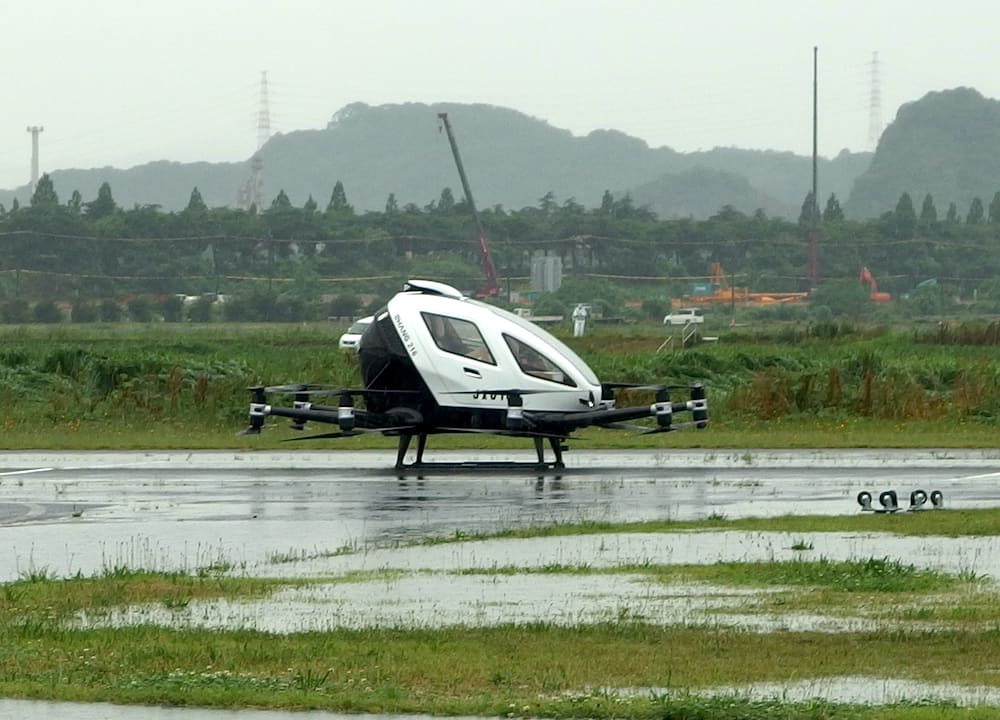
The official name of the flying car is "electric vertical takeoff and landing unmanned aerial vehicle (eVTOL)."
Flying cars have the following features:
- Powered by electricity
- Easy to operate and compatible with autonomous driving
- Capable of vertical takeoff and landing
Flying cars powered by electricity can be operated at low cost, and since they do not have internal combustion engines, they can reduce noise during takeoff, landing, and operation.
The outdoor test flight of the flying car EHang216AAV was conducted with autonomous driving without a pilot on board.
The flight route can be controlled and managed from the ground, allowing for safe transportation of goods even with autonomous driving.
Additionally, flying cars can take off and land vertically, making them operable in narrow spaces.
This means they can accommodate movement from place to place in areas where aviation infrastructure is not established.
While there are features that include advantages, there are still many challenges to overcome for the practical use of flying cars in 2023.
However, when flying cars are put into practical use, for regions like the Kasaoka Islands, where transportation of people and goods relies solely on boats, it will certainly become a new means of logistics, and I felt this while attending the outdoor test flight.
Report on the first outdoor test flight in Japan
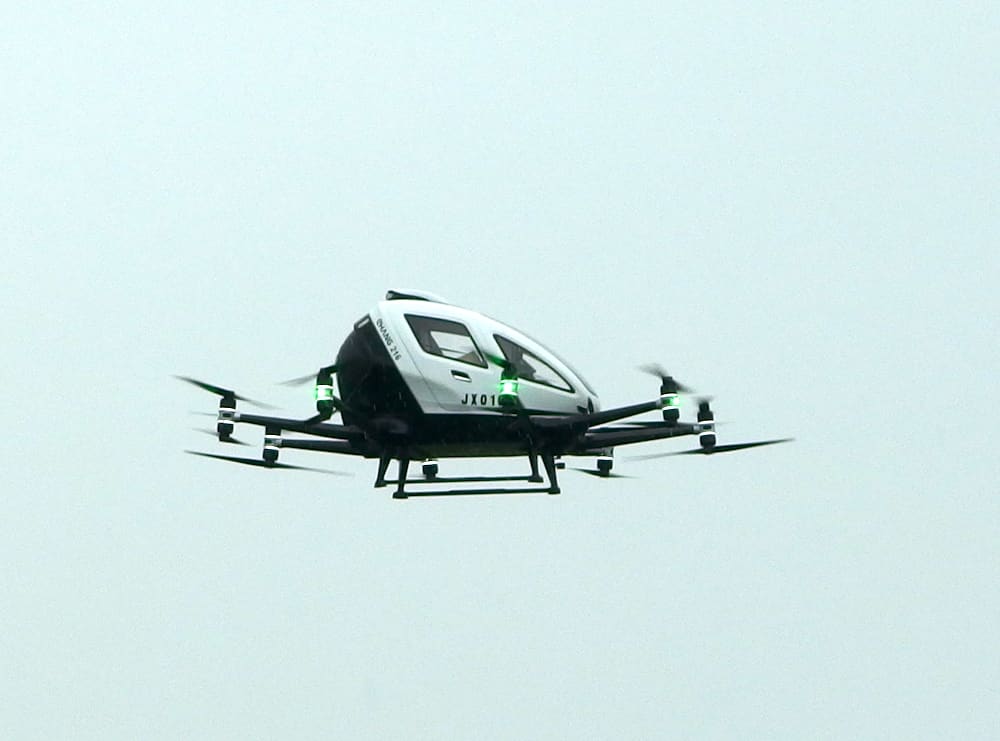
Now, let me convey the state of the outdoor test flight of the flying car!
Ceremony begins in heavy rain
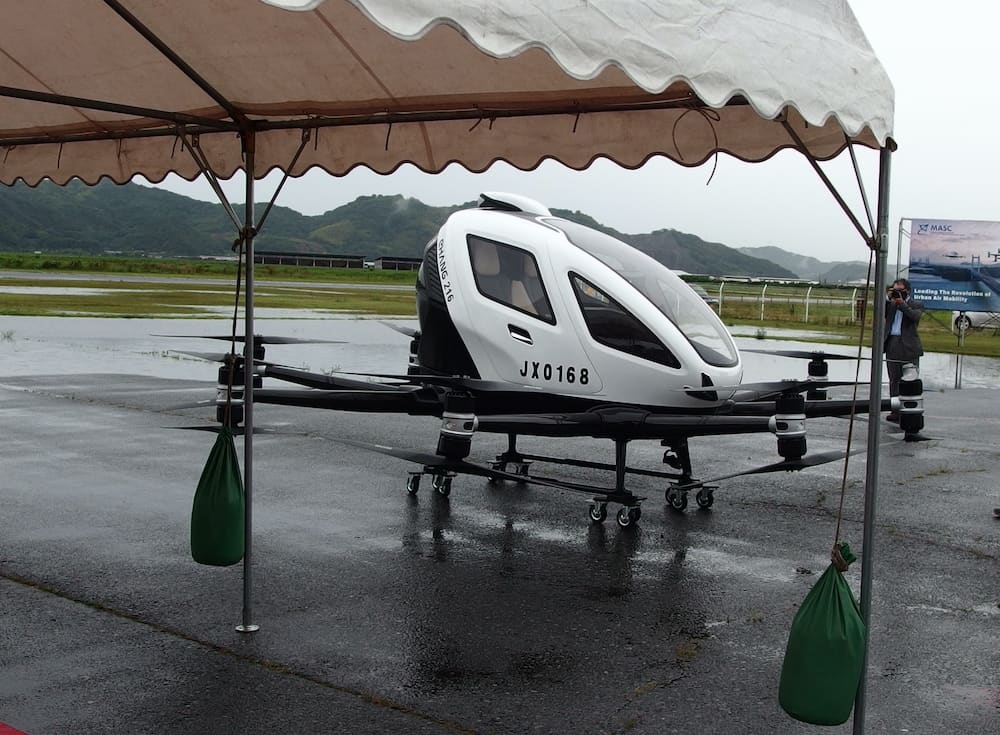
The flying car EHang216AAV appeared from the hangar.
It is a more compact aircraft than I had imagined when seen up close.
The ceremony began in front of the EHang216AAV at 9:00 AM.
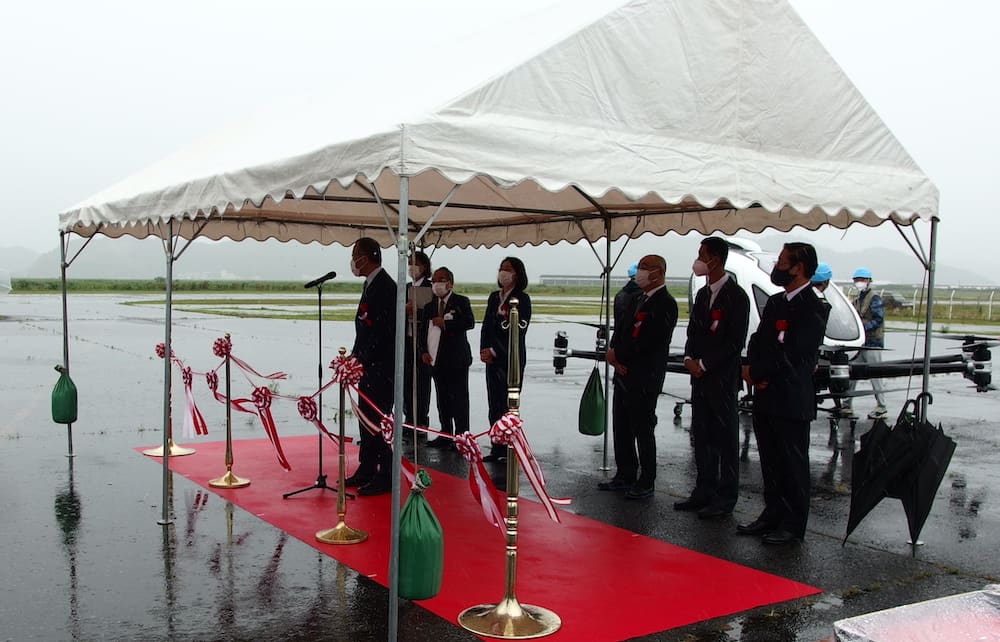
A ceremony attended by Kurashiki City Mayor Ito Kaori and Kasaoka City Mayor Kobayashi Yoshifumi.
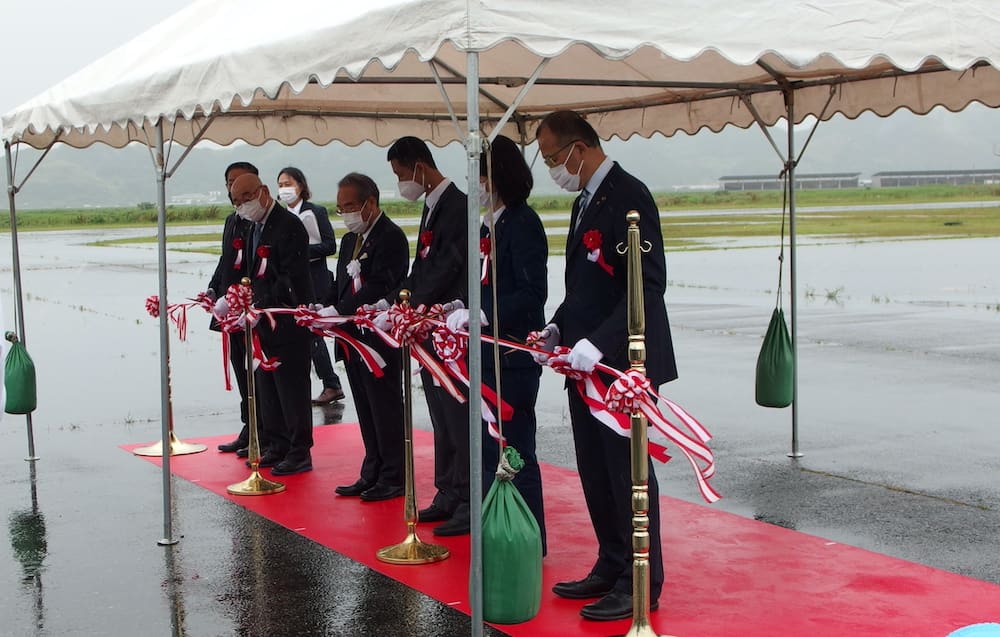
With a tape-cutting ceremony by the stakeholders, the outdoor test flight commenced.
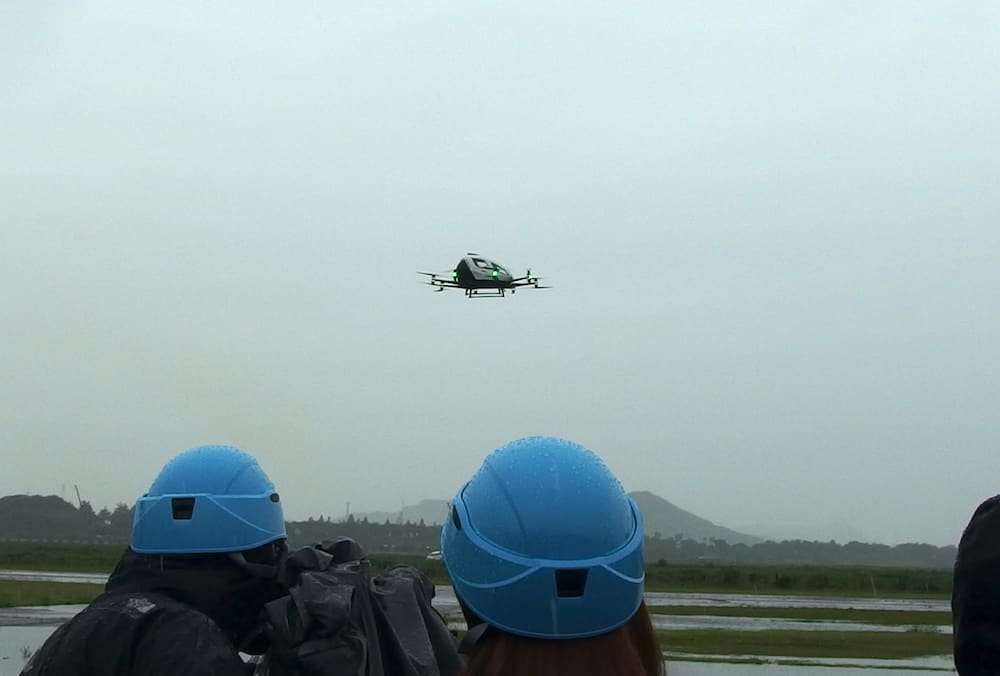
The gathered media representatives moved to a press booth away from the takeoff location, put on the blue helmets handed to them, and prepared their cameras and microphones, waiting for the moment of takeoff.
Preparation for the flying car's takeoff
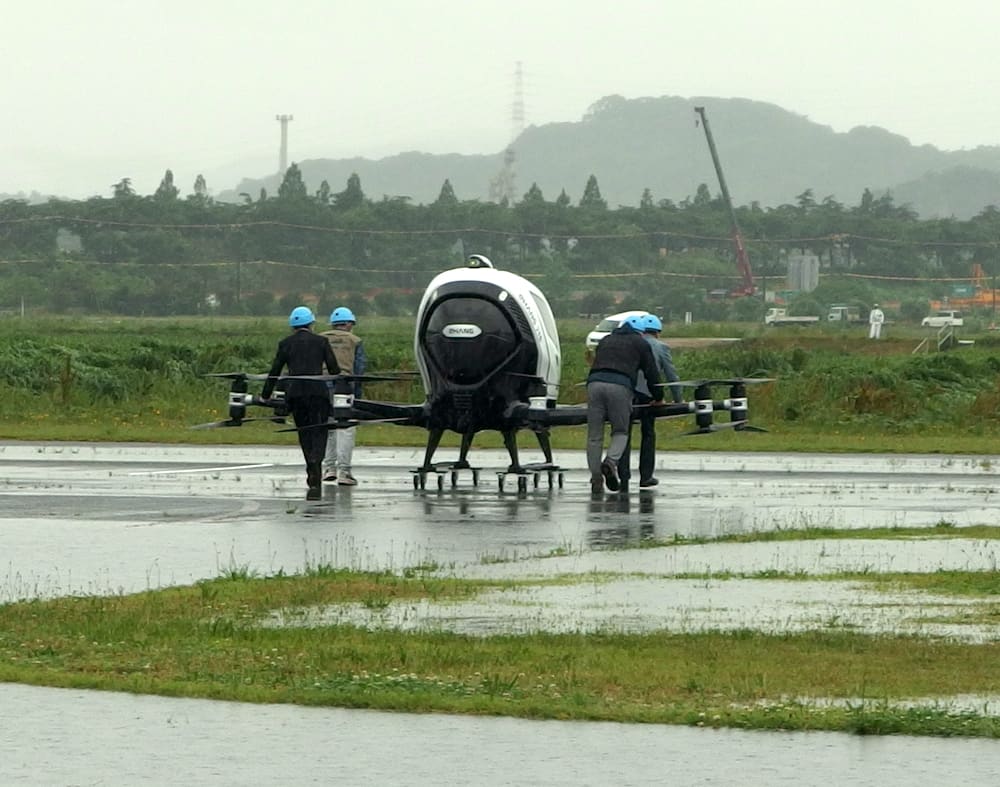
Finally, the start of the first outdoor test flight of a flying car in Japan.
Several staff members pushed the flying car EHang216AAV to the takeoff position.
The rain began to lighten at just the right moment.
This was a perfect opportunity for the first outdoor test flight of a flying car!
Finally, an announcement was made that the outdoor test flight would commence.
Start of the outdoor test flight of the flying car
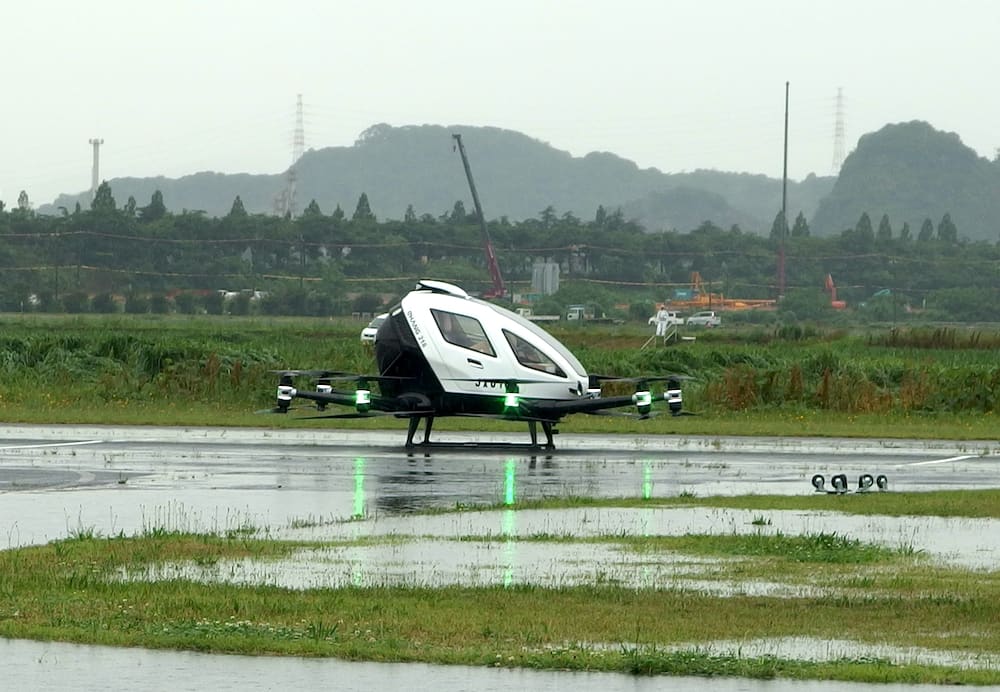
The flying car EHang216AAV smoothly ascended vertically with the count of "1, 2, 3," hovering just a few meters above the ground.
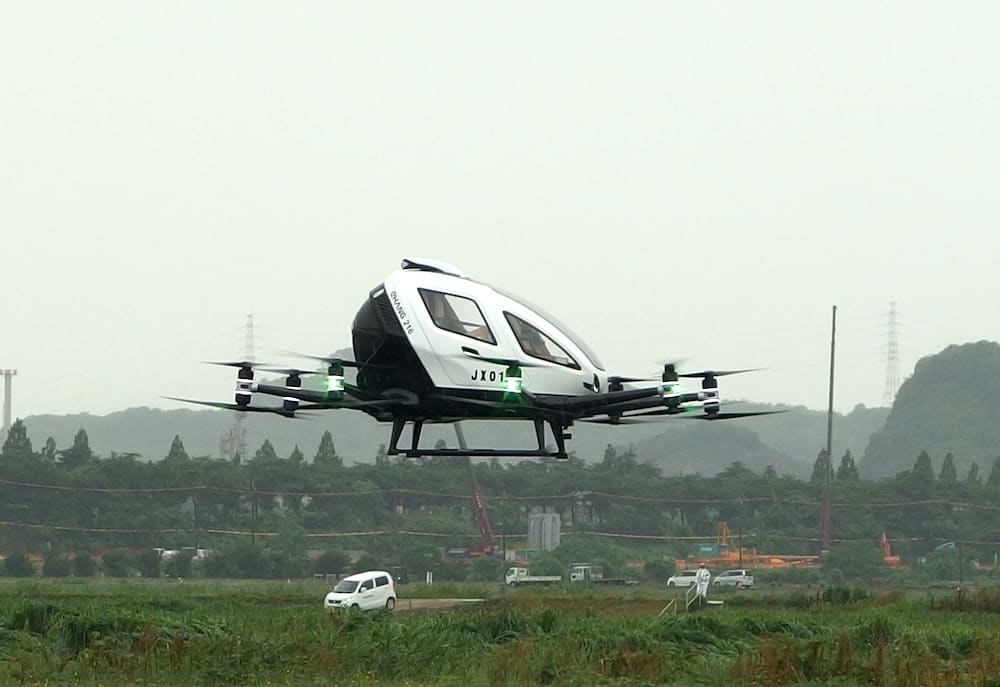
Compared to helicopters that ascend by rotating rotors, the sound of the rotors of the flying car EHang216AAV was surprisingly quiet.
Ascending to 30 meters and then moving while circling about 550 meters
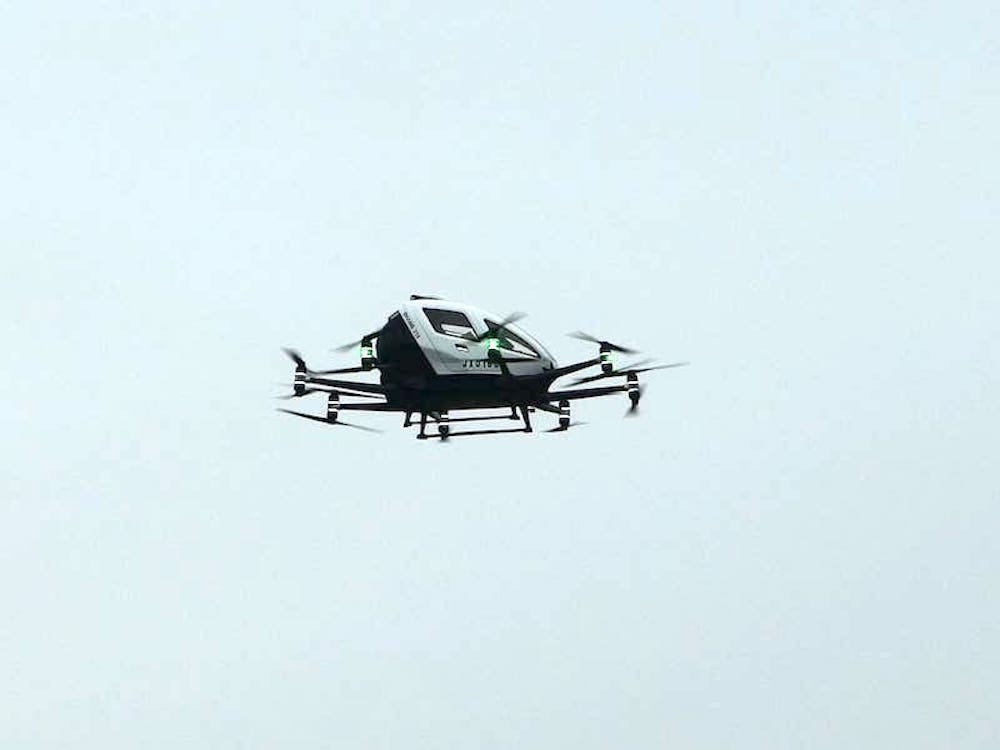
After hovering in the air, it ascended vertically and began to move horizontally.
In no time, the aircraft became smaller, and it seemed to have moved quite a distance in a short time.
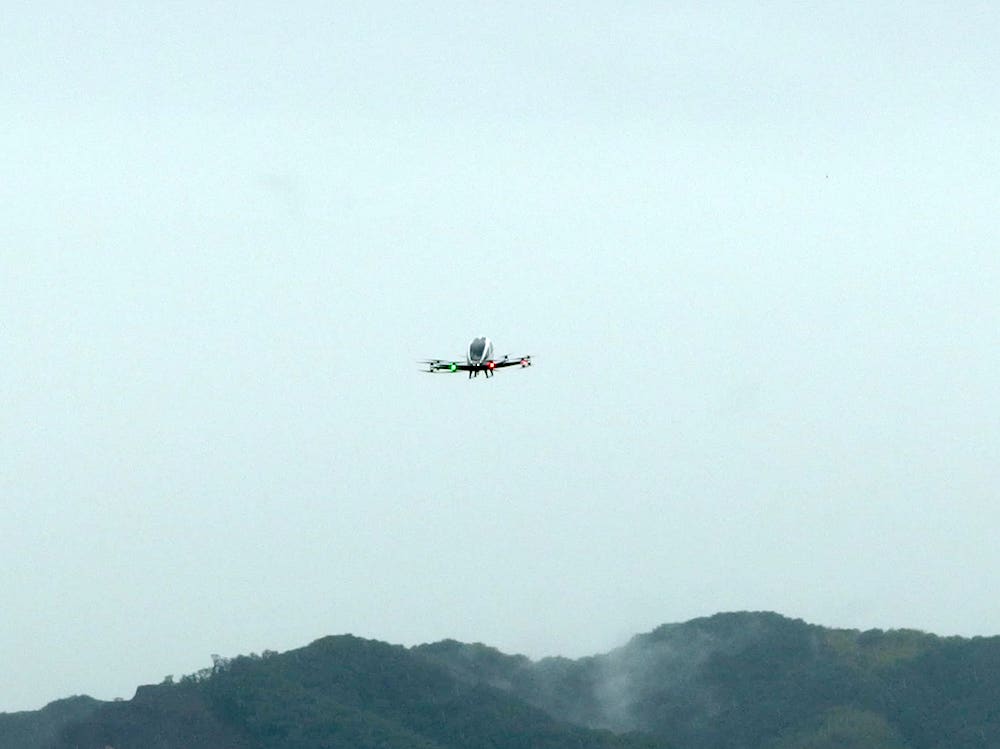
The flight distance of the demo flight was approximately 550 meters.
It was very stable without any shaking.
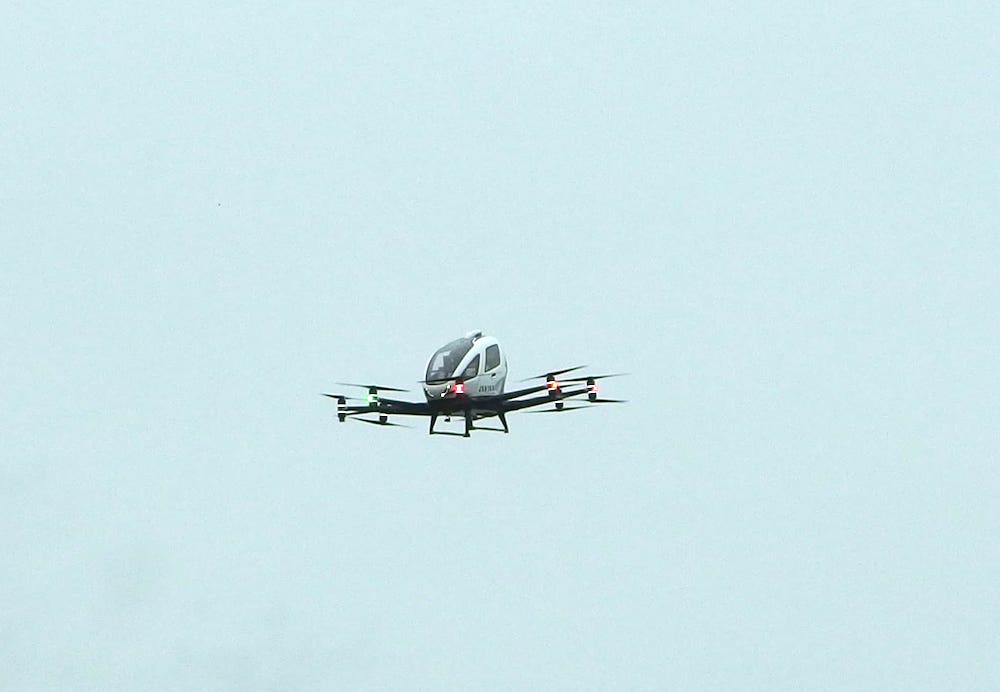
After hovering, it circled back towards us.
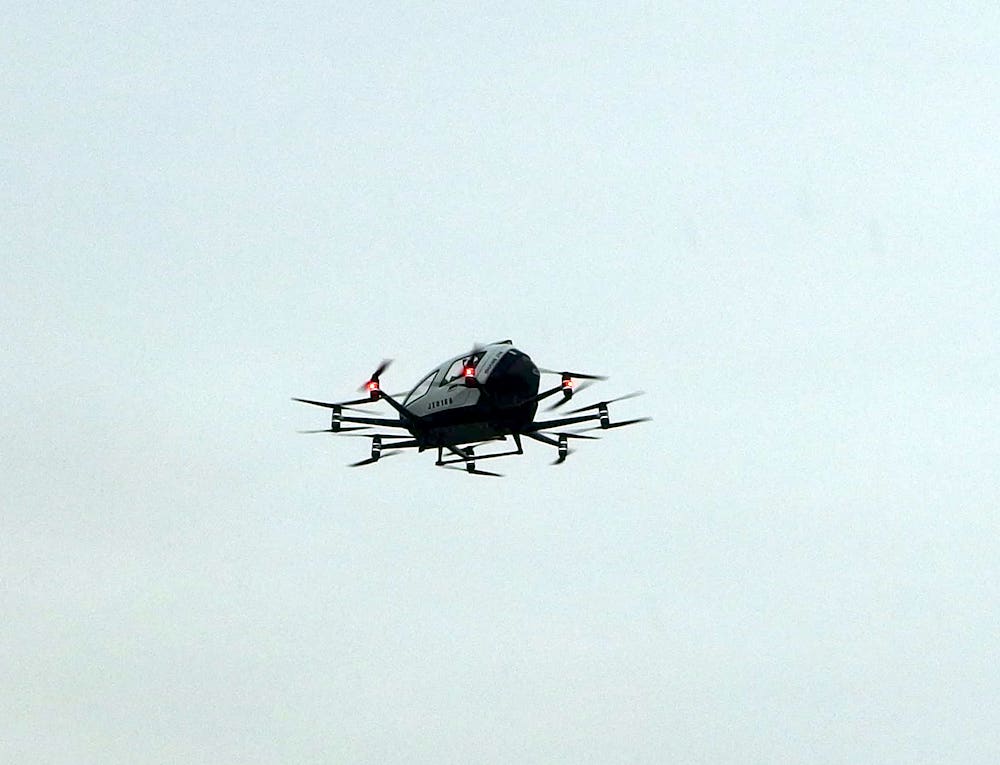
Hovering above the takeoff point, the media representatives watched.
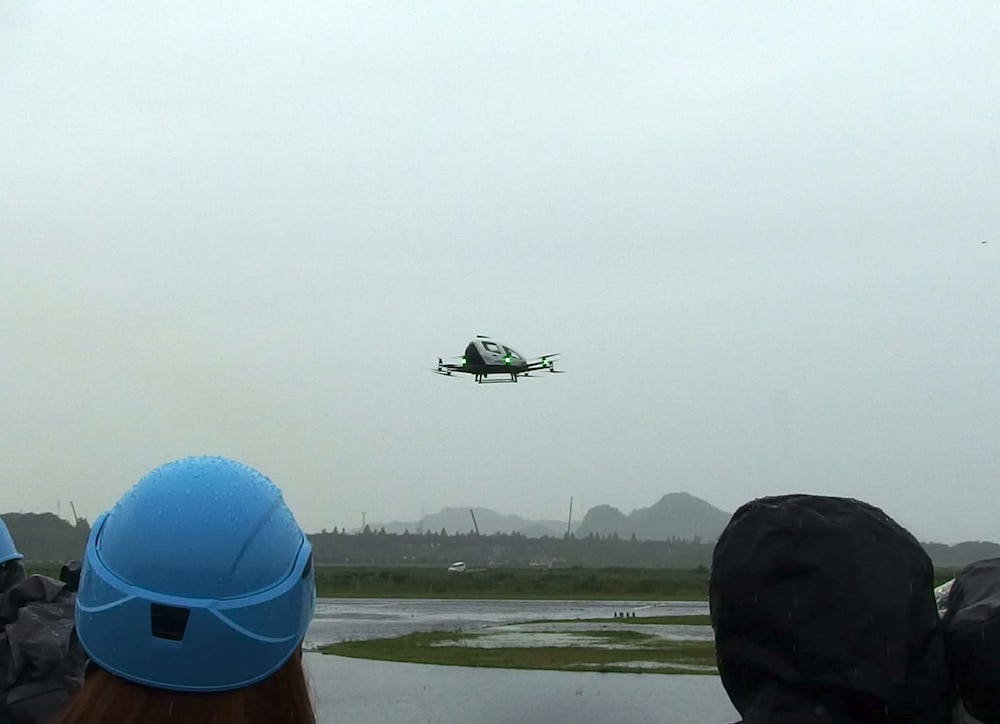
And then it descends vertically and lands.
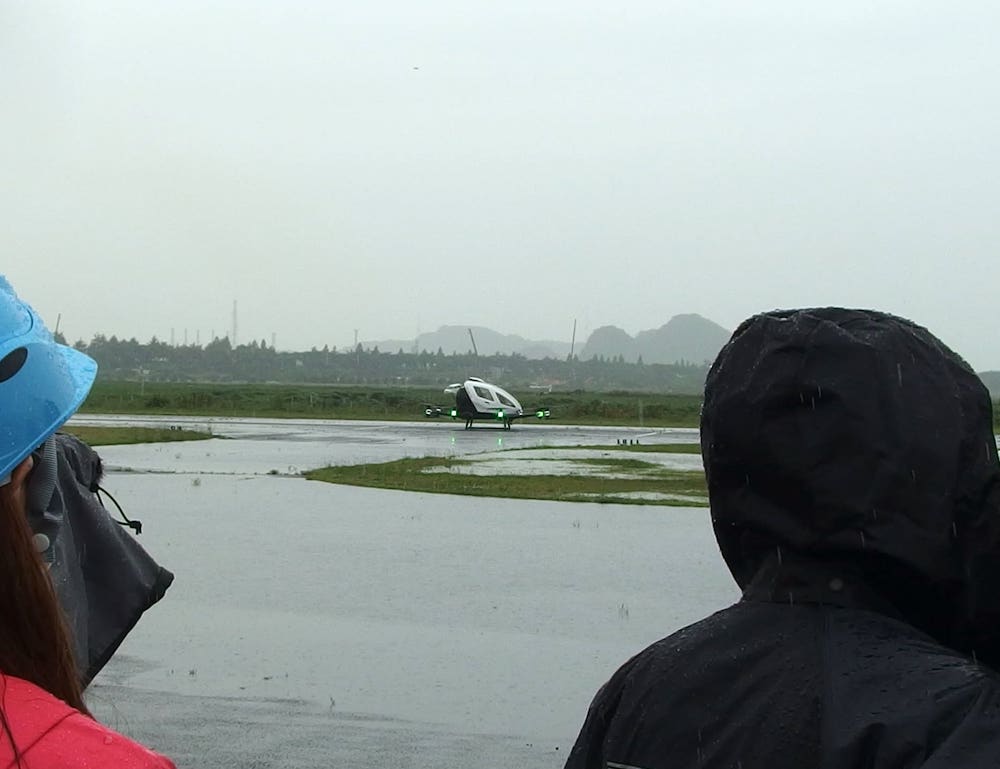
Safe landing.
The first outdoor test flight of the flying car EHang216AAV in Japan was a success!
Flying Car EHang216AAV Aircraft
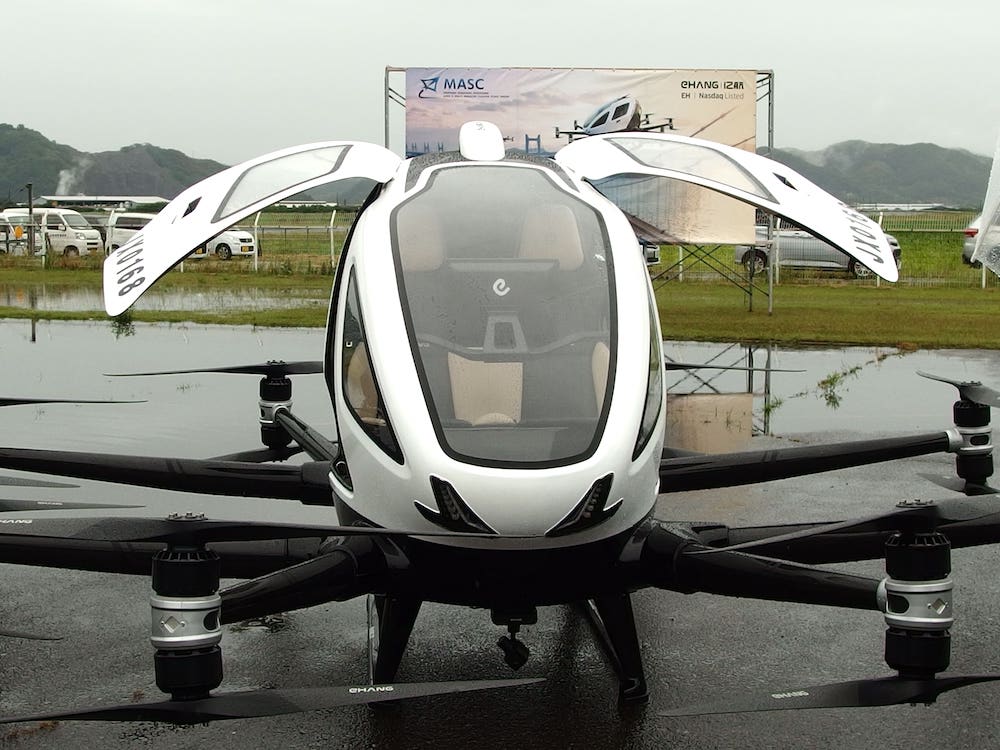
After the successful completion of the outdoor test flight, there was a photo session for the flying car EHang216AAV.
What kind of aircraft is the flying car EHang216AAV that was used for the outdoor test flight?
Performance of EHang216AAV
Based on the press release materials, I have summarized the performance of the EHang216AAV.
| Manufacturer | EHang Holdings Limited (EHang) |
|---|---|
| Length | 5.61 meters |
| Height | 1.74 meters |
| Payload Capacity | 220 kilograms |
| Maximum Takeoff Weight | 650 kilograms |
| Number of Passengers | 2 seats |
| Maximum Speed | 130 kilometers per hour |
| Range | 35 kilometers (approximately 21 minutes) of flight |
| Propulsion System | 16 electric motors (2 sets of 8 arms) |
| Number of Units Sold | 130 units |
With a range of 35 kilometers, it is expected to be used for delivering goods to nearby areas.
The Flying Car is Compact
When compared to the staff, it is clear that it is a compact aircraft.
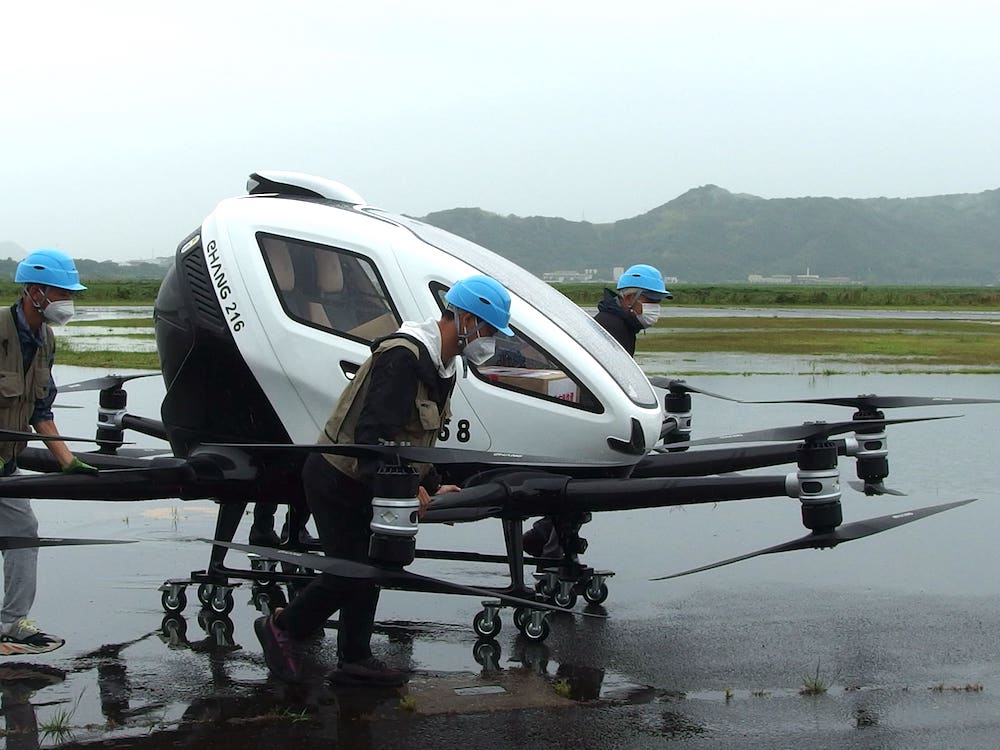
▼ It is equipped with a total of 16 electric motors, with 2 on each of the 8 arms.
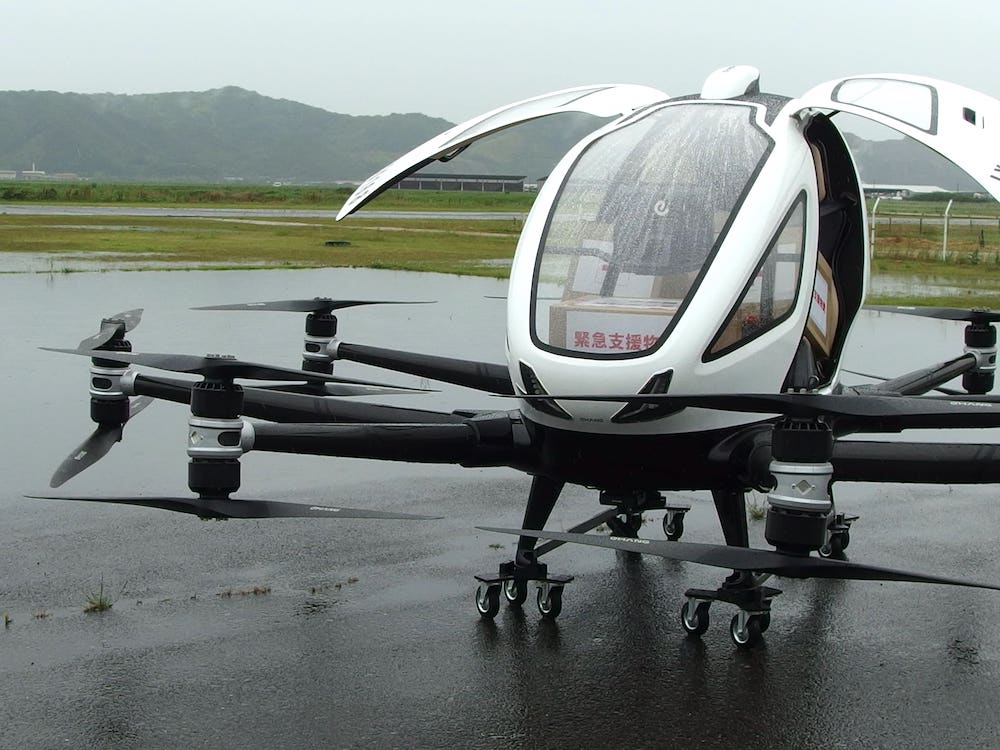
The outdoor test flight is assumed to carry cargo, so cardboard boxes are placed inside to simulate transport goods.
▼ There are 2 seats inside, allowing for 2 passengers.
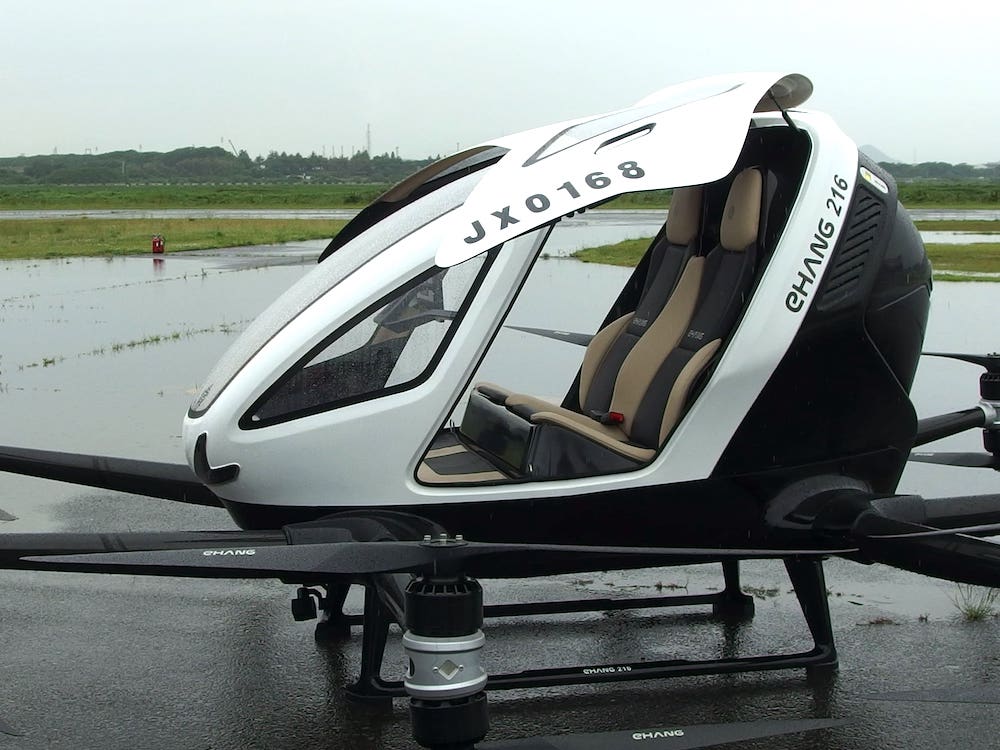
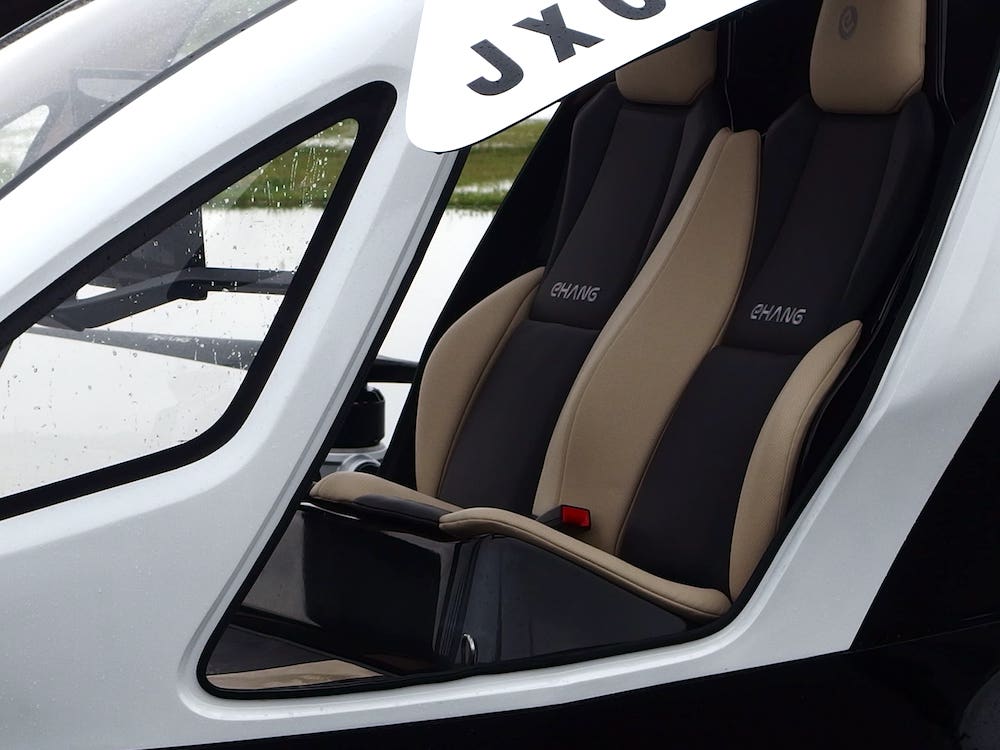
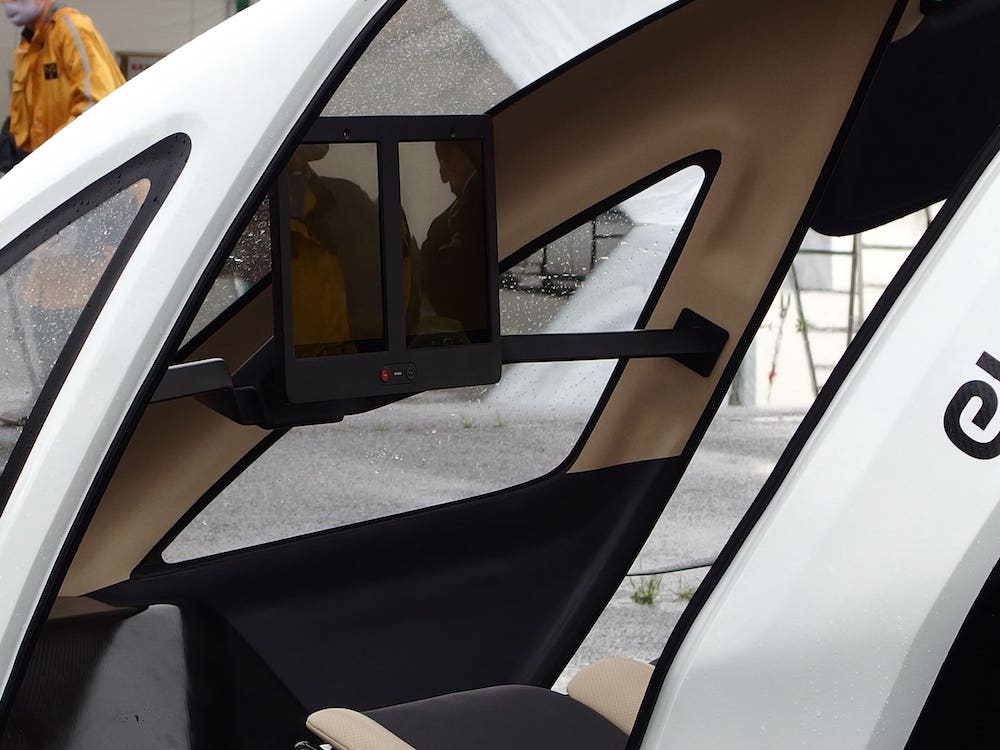
▼ There is only a monitor at the front of the cabin.
▼ When two people are on board, Mayor Kobayashi of Kasaoka City and Mayor Ito of Kurashiki City confirmed how it would be.
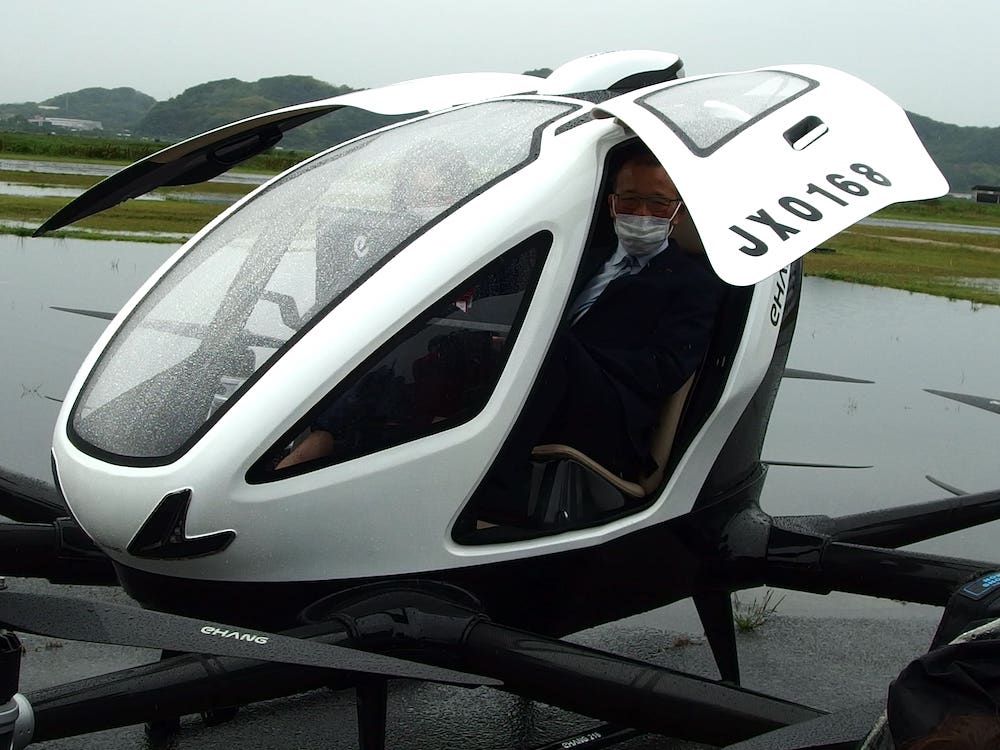
The compact and maneuverable flying car EHang216AAV.
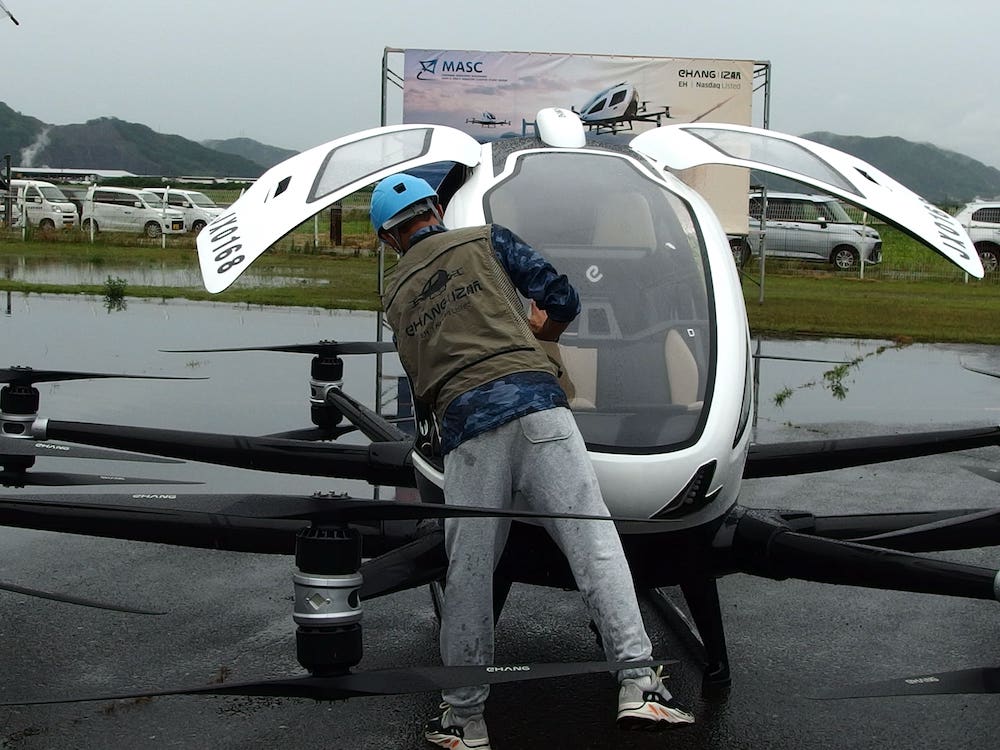
Although it is wide, its size is that of a regular car.
Seeing the aircraft, which seems to fit into the space of two parking spots, made me realize that the claim of being able to take off and land with just a certain amount of space is indeed true.
The photo session ended at 10 AM, and next, the press conference was held at the Kasaoka General Sports Center after moving from Kasaoka Fureai Airport.
Press Conference for the Flying Car at Kasaoka General Sports Center
At 11 AM, a press conference was held at Kasaoka General Sports Center by MASC and EHang Holdings Limited (EHang).
The conference started with about an hour of presentations on the business overview of the flying car, details of the EHang216AAV aircraft, and future business developments.
MASC and the Flying Car
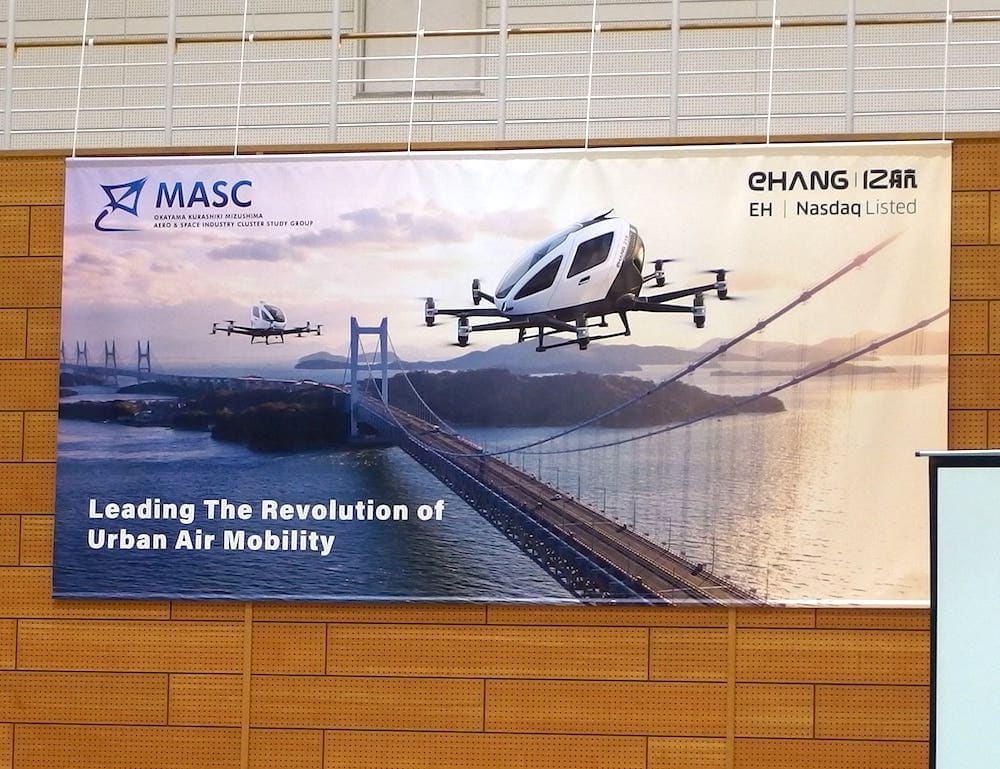
The name MASC is derived from the following keywords.
- M → Mizushima
- A → Aerospace
- S → Space
- C → Cluster
Their ultimate goal is to make the Mizushima area in Kurashiki City an aerospace business hub, and they are actively working towards this.
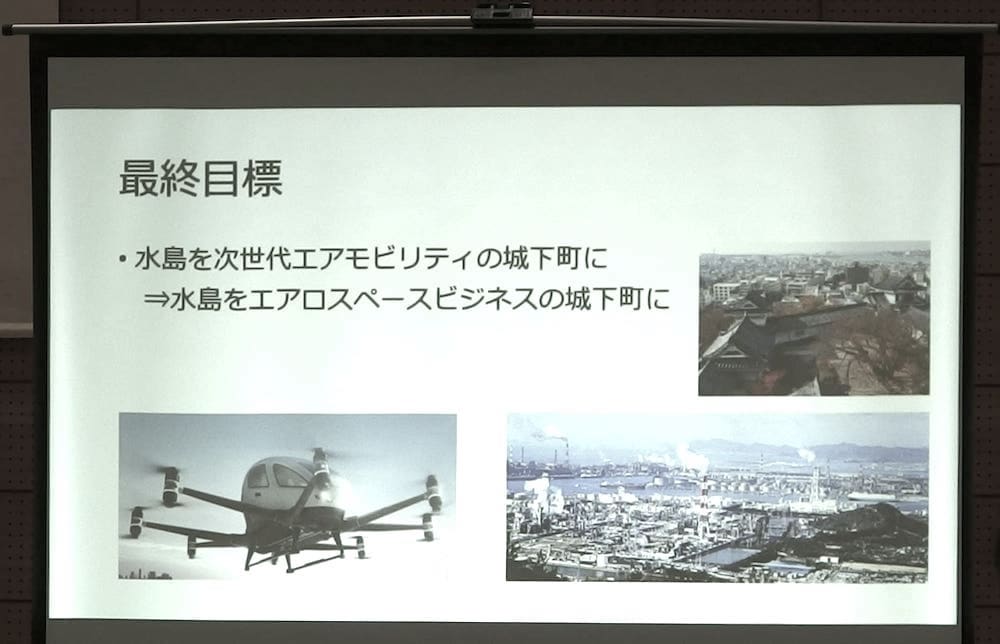
By centering on the aerospace industry, they are also considering developing local manufacturing and creating new businesses related to surrounding industries to foster advanced technology from the region.
The main activities so far are as follows.
- Social experiment for island logistics project
- Drone festival for children
- Space development workshop for high school students
- Holding of "Aerospace Business Forum in Kurashiki," etc.
MASC had been developing a drone-centered business until they acquired the flying car EHang216AAV, and they plan to expand their business using the flying car in the future.
Since there is still no legal framework for flying cars globally, MASC plans to advance the flying car business by dividing it into what can be done after the outdoor test flight and what can be done after the legal framework is completed.
▼ Here are the plans MASC has after conducting the outdoor test flight:
- Proposal of a model course combining demo flights and actual aircraft viewing with tourism resources around Mizushima and Kurashiki
- Proposal of a learning program to spark interest among local students
▼ The business development after the legal framework is completed will focus on transportation.
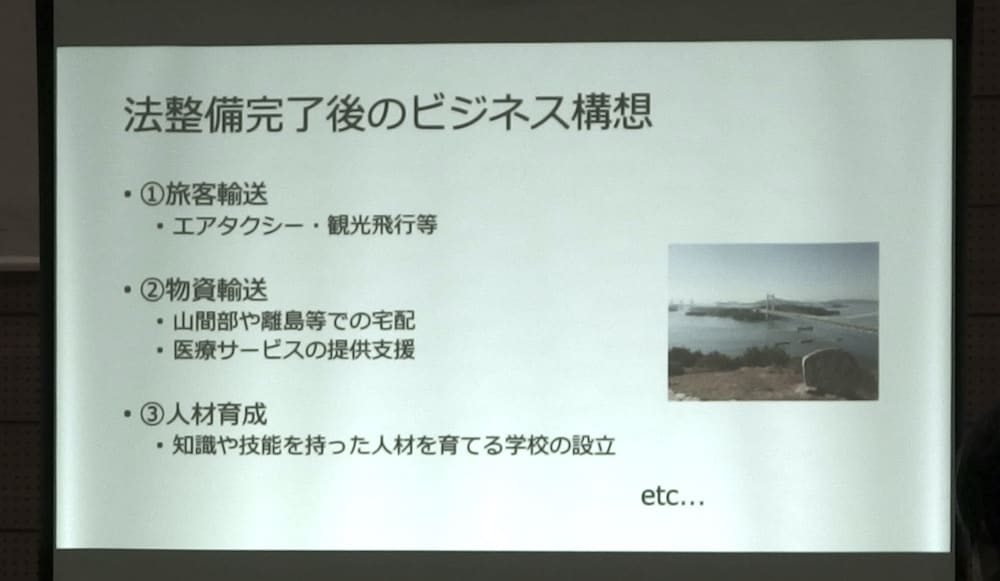
- Passenger transport such as air taxis and sightseeing flights
- Delivery of goods and medical service support in mountainous areas and remote islands
- Establishment of schools for training skilled personnel
What can be done immediately is to connect the flying car itself with tourism resources and attract tourists to the Mizushima and Kurashiki areas.
After the legal framework is completed, a business plan will be established to utilize the flying car as a means of transportation.
Utilization of the Flying Car
While listening to the explanation of how MASC envisions the utilization of the flying car, a keyword that caught my attention was delivery to mountainous areas and remote islands.
Currently, there is an urgent need to solve the issue of rapid material transport to mountainous areas and remote islands.
Although this will be after the legal framework for flying cars is completed, if faster material transport becomes possible, the flying car will surely become a much-anticipated logistics means for those living on remote islands.
Additionally, there is hope for providing rapid medical services.
Aiming to Present the Flying Car at the 2025 Osaka-Kansai Expo
MASC Chairman Kirishino Hiroshi shared his passionate thoughts about the flying car during the press conference.
MASC was established with the desire to leverage the DNA of aircraft manufacturing that has been passed down in the Mizushima area to create an aerospace industry and realize projects that connect to the dreams of the next generation.
For four years since its establishment, they have been conducting experiments with drones, but after the arrival of the flying car EHang216AAV in April 2020, they began to formulate a business plan for the flying car.
To move the business plan forward, they needed to actually fly the flying car EHang216AAV.
However, it seems that it was quite difficult to establish a flight plan due to the spread of the COVID-19 pandemic.
Then came the outdoor test flight of the flying car on June 4, 2021.
When asked by reporters about his feelings during the flight, Mr. Kirishino said, "I was crying inside" as he watched the EHang216AAV fly smoothly despite the bad weather.
MASC's guiding principle is the Setouchi "Benten Project 2025".
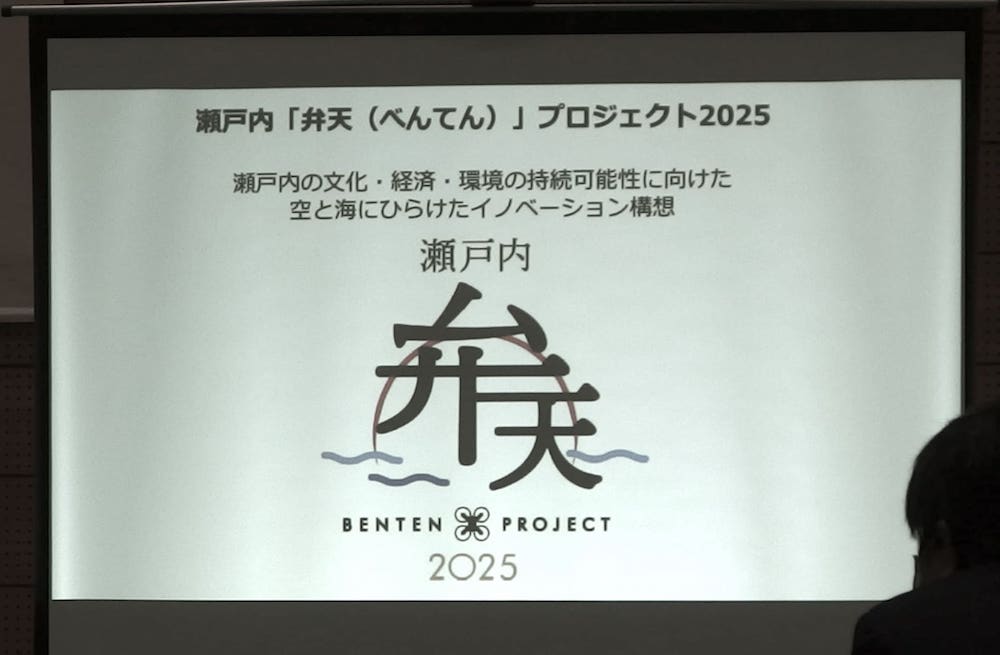
According to this project, MASC will continue its activities, and Mr. Kirishino mentioned that they aim to unveil the flying car at the 2025 Osaka-Kansai Expo.
Globally, it is expected that the flying car business will become a reality around 2025, as predicted by Mr. Okuda Akinobu, a visiting researcher at Mitsubishi Research Institute, during the press conference.
If the flying car business becomes a reality, it is believed that it will change our lives by alleviating traffic congestion, providing new means of material transport, and offering medical services to mountainous areas and remote islands.
The vision presented by the flying car was intriguing, but above all, it was a historic first outdoor test flight and press conference that conveyed the desire of Mr. Kirishino and the MASC members to invigorate the Kurashiki and Mizushima areas, as well as the Takahashi River Basin, with local technology inherited from the aerospace industry and to connect it to the next generation.





What do you want to know about Kurashiki?
Enter a word to search articles from this site