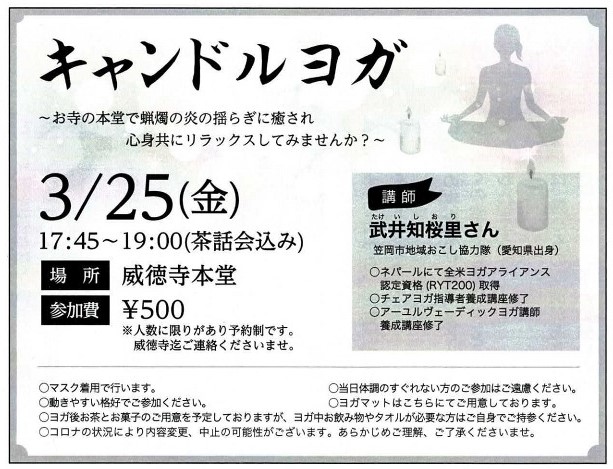
On March 25, 2022 (Friday), when the cold still lingered, an event called Candle Yoga was held at Itoku-ji Temple (Ryukozan Itoku-ji) in Kasaoka City, Okayama.
In recent years, various types of yoga such as hot yoga, power yoga, and maternity yoga have been practiced around the world.
Among them, candle yoga is not something you hear often.
It is said to be yoga themed around light, but what is its true nature!?
I will report on the yoga event held in the sacred space of the temple on a chilly night.
The information provided is based on the article published in April 2022. Please note that it may differ from the current information.
Candle Yoga Healed by the Flickering Flames
This is the first attempt at candle yoga at Itoku-ji Temple.
With thorough measures against the spread of the novel coronavirus, 14 people participated.
The Venue is Itoku-ji Temple in Kasaoka City
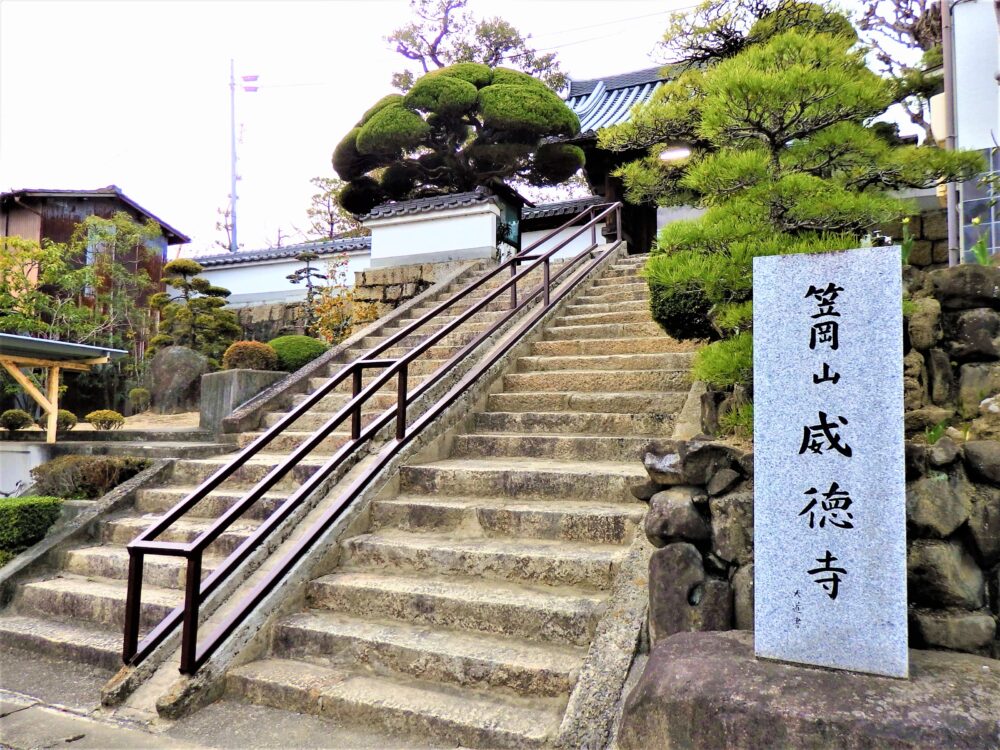
The venue for the candle yoga, Itoku-ji Temple (Ryukozan Itoku-ji), is a prestigious temple located in the Shojiba-cho area of Kasaoka City, Okayama.
It is a temple with a very deep history, believed to have been founded in the late Heian period.
Initially established as a Tendai sect temple, it later converted to the Rinzai sect and then to the Soto sect.
The principal object of worship is Namu Shakamuni Butsu, that is, the Buddha Shakyamuni.
The temple grounds are planted with seasonal flowering trees such as magnolia, iris, fragrant olive, and daffodils.
Together with the magnificent cherry blossoms of the nearby Ido Park, Itoku-ji Temple is cherished by the local community as a refined temple.
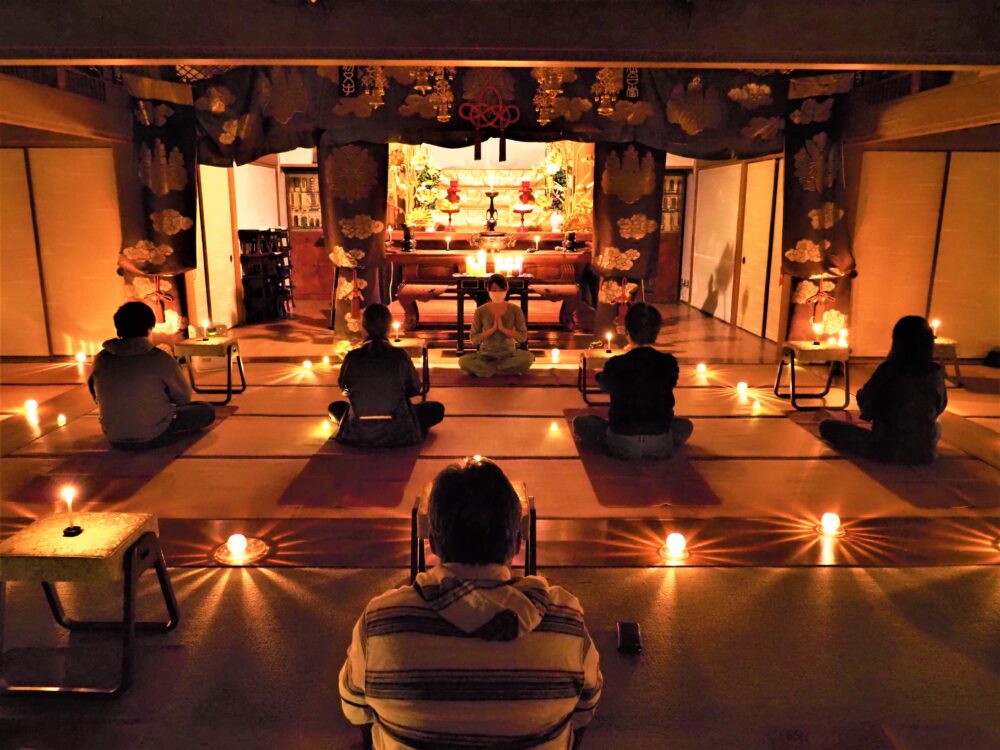
This candle yoga was held in the majestic main hall completed in 1978.
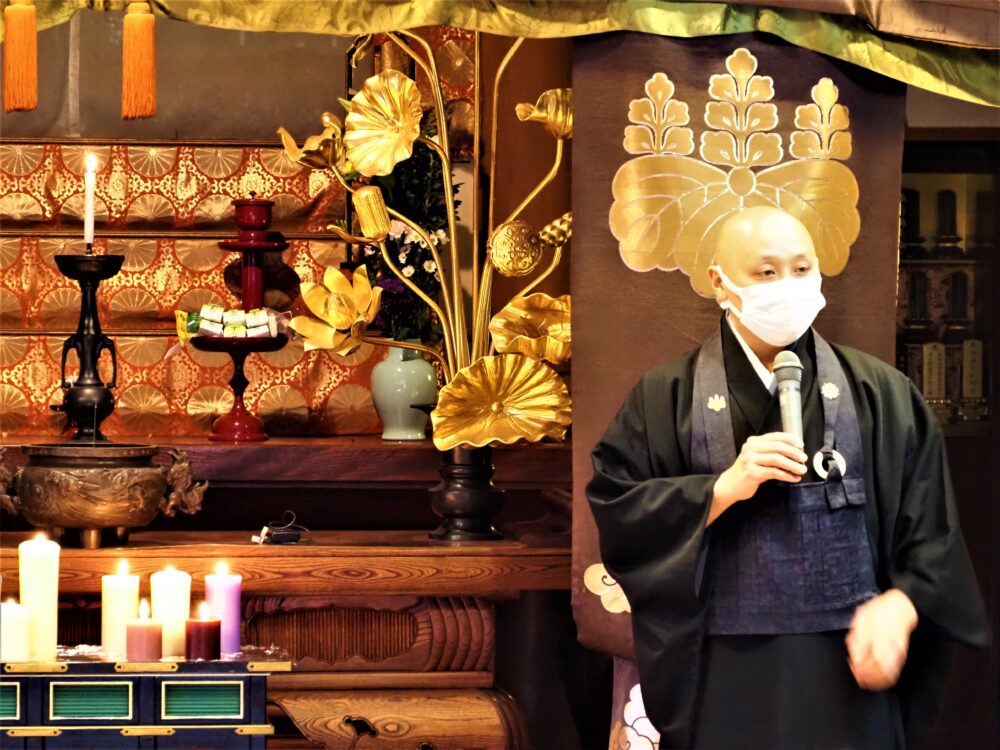
Listening to the Dharma talk by the 22nd chief priest of Itoku-ji, Katada Sogen, in the crisp atmosphere, is imbued with a flavor that seems to guide our understanding into the depths of yoga philosophy.
A Yoga Instructor Back from Nepal
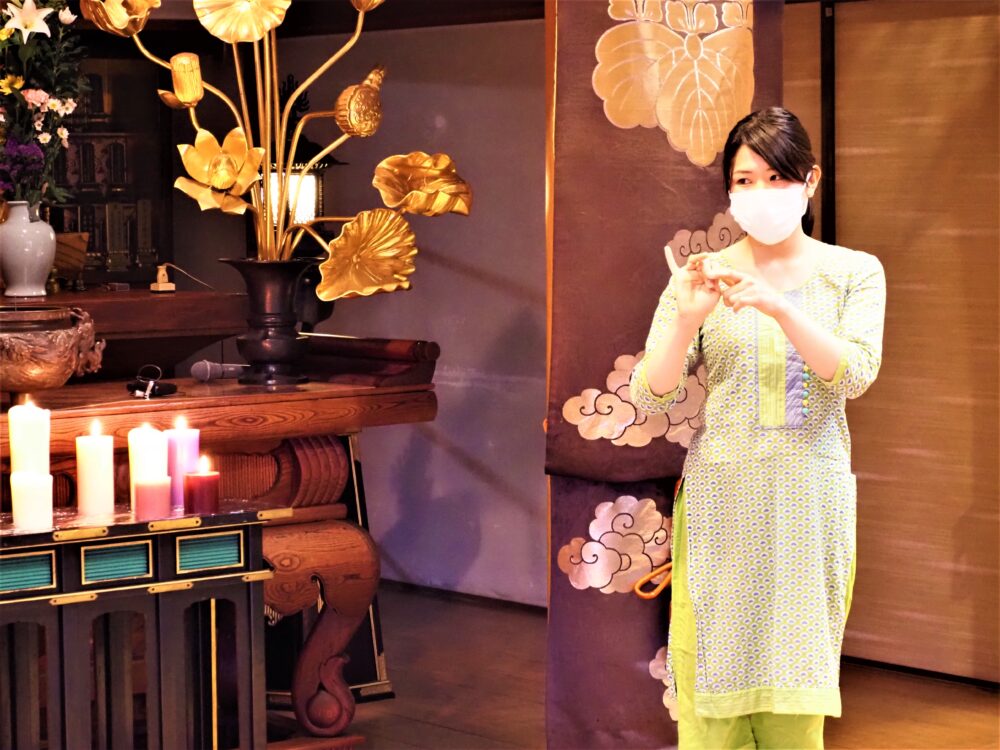
The yoga instruction on that day was given by Takeyoshi Shiori, who is also the author's wife.
She moved to Kasaoka City in June 2020 as a Community Revitalization Cooperator and is active mainly on Manabe Island in the Kasaoka Islands.
Her encounter with yoga dates back about three years.
While working in Nepal as a Japan Overseas Cooperation Volunteer (now known as JICA Overseas Cooperation Volunteer) under the Japan International Cooperation Agency (JICA), she obtained the RYT200 yoga instructor qualification certified by the Yoga Alliance.
Although she had been fond of yoga as a hobby, she began to walk the path of yoga in earnest after her experience in Nepal.
After returning to Japan, she completed advanced courses for chair yoga instructors and training for Ayurvedic yoga instructors.
Currently, she regularly holds yoga classes for local residents on Manabe Island and also on Kitagi-shima Island, which is also part of the Kasaoka Islands.
The type of yoga she practices is called Hatha Yoga, which is the most basic type.
Yoga is practiced for various purposes such as pelvic correction and weight loss.
Originally, it is said to be a path to reach the state of enlightenment in Buddhism, and the true intention is to strengthen the body.
By taking poses, one builds muscle and develops a strong body capable of enduring long hours of meditation over many years.
As a first step, it is important to be in a state of relaxation both physically and mentally.
This yoga, which emphasizes gentle movements, is perfectly suited to the sacred atmosphere of the temple.
The Encounter of the Temple and Yoga
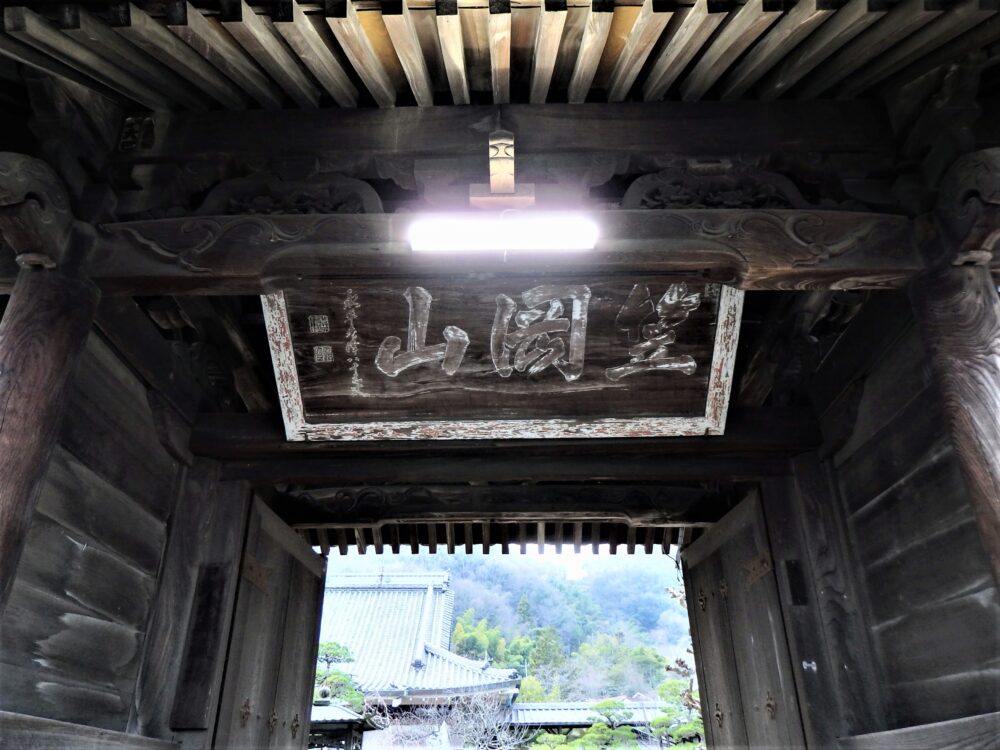
The temple and yoga actually have a deep connection.
Originating from ancient Indian Brahmanism, Buddhism and yoga philosophy share many similar ideas and are, in a sense, like siblings.
Shiori, my wife, has often encountered Buddhist teachings while practicing yoga and has always thought, "I want to do yoga at a temple!"
At such a time, we had the opportunity to meet the chief priest and his wife of Itoku-ji Temple through an event we organized called Shiru Trip, which combined cultural heritage exploration and yoga.
On the day of the event, we did yoga in the main hall for the first time and hit it off.
From the thought of being able to do uniquely designed yoga in the fantastical space of the temple, we planned this event.
Challenge Yourself with Authentic Yoga!
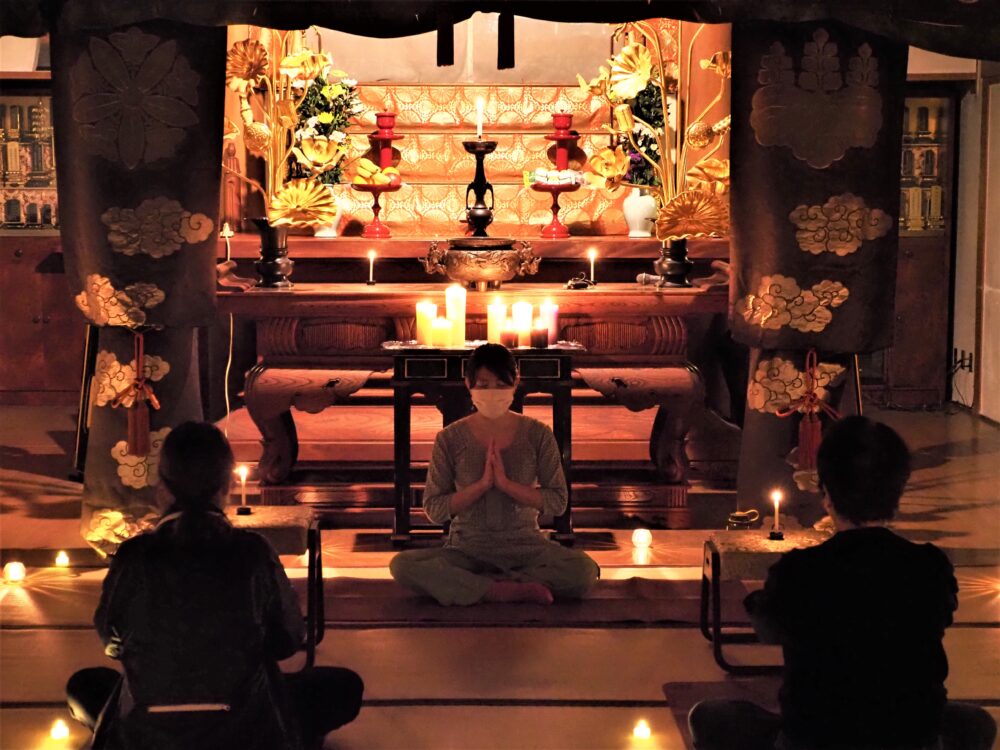
As night fell and the darkness deepened, the lights of the candles placed all over the main hall shone more vividly and fantastically in contrast.
The participants sat cross-legged on the tatami mats comfortably, fully prepared.
From the basic posture of sitting up straight with both palms placed upward on the thighs, the yoga session was about to begin!
First, we closed our eyes and consciously took slow breaths.
The surroundings were enveloped in silence.
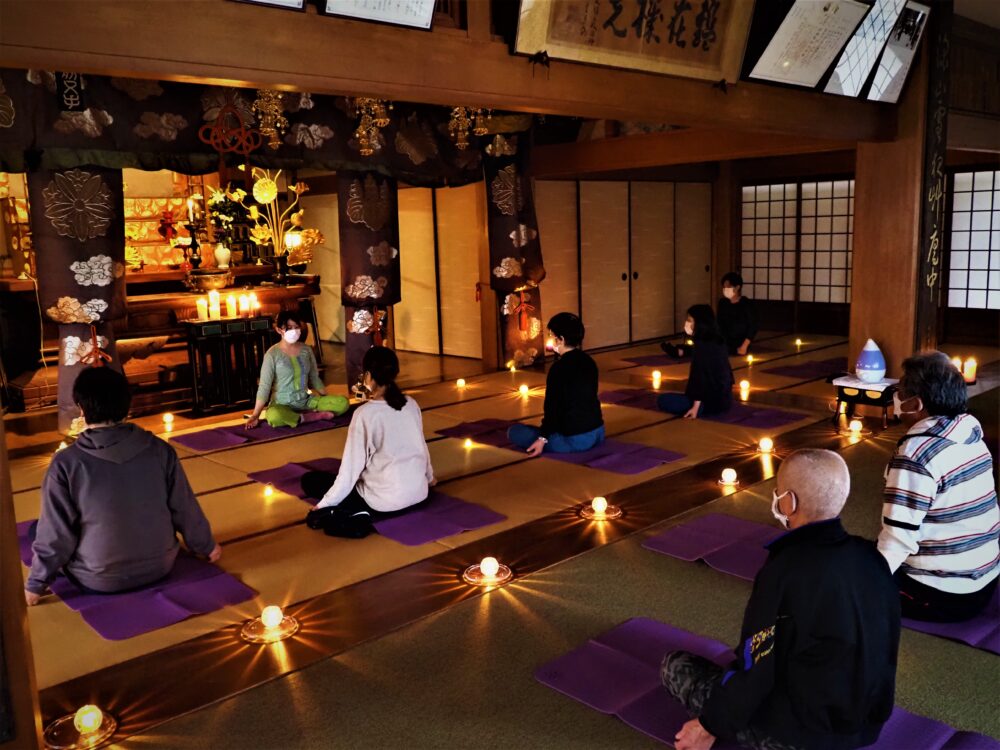
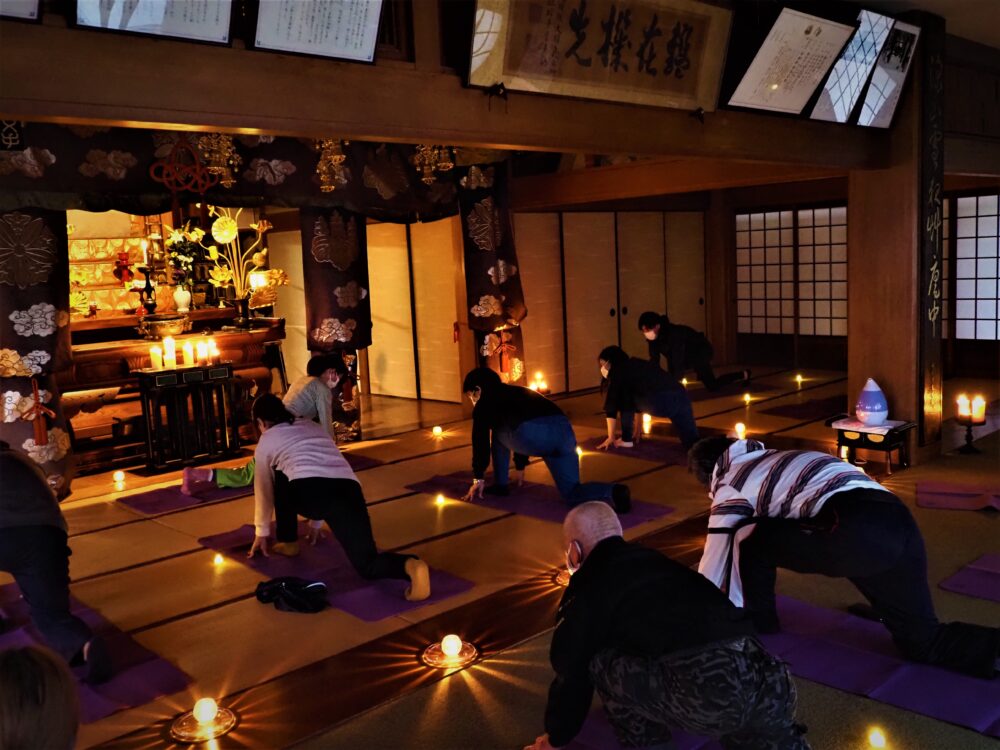
Next, we gradually added movement with poses such as "Cat and Cow Pose," "Downward Facing Dog Pose," and "Lizard Pose."
Feeling a pleasant stretch around the hips and thighs, we performed the "Crescent Moon Pose."
Gradually, our bodies began to warm up.
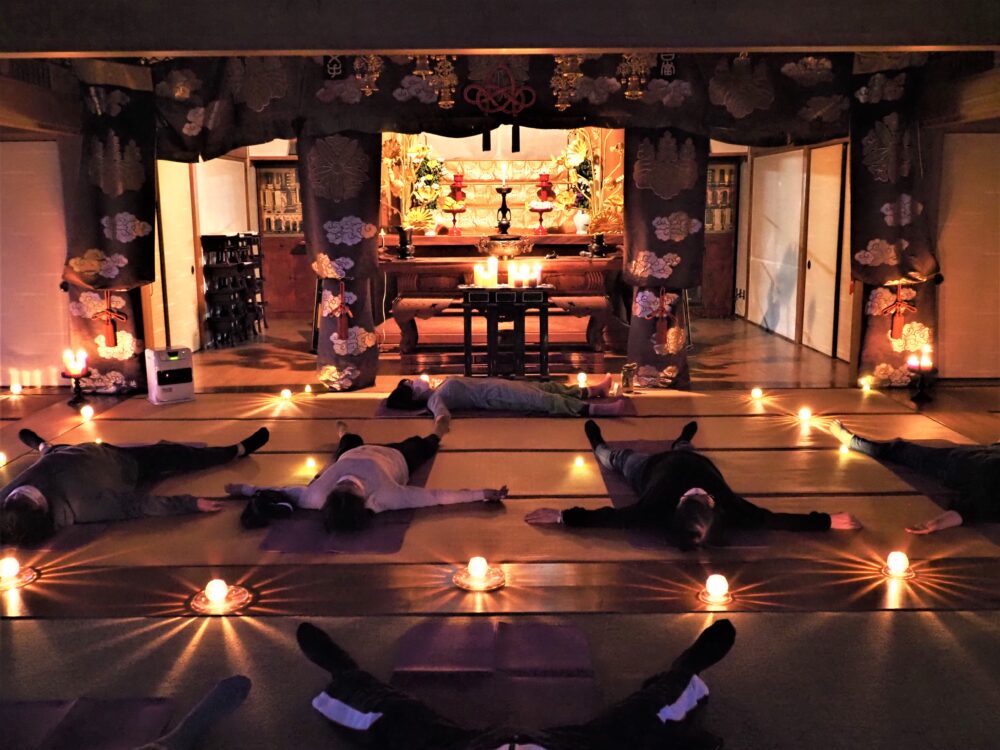
To calm our breathing and cool down our bodies, we lay back in a supine position between poses.
We took a short break in "Corpse Pose."
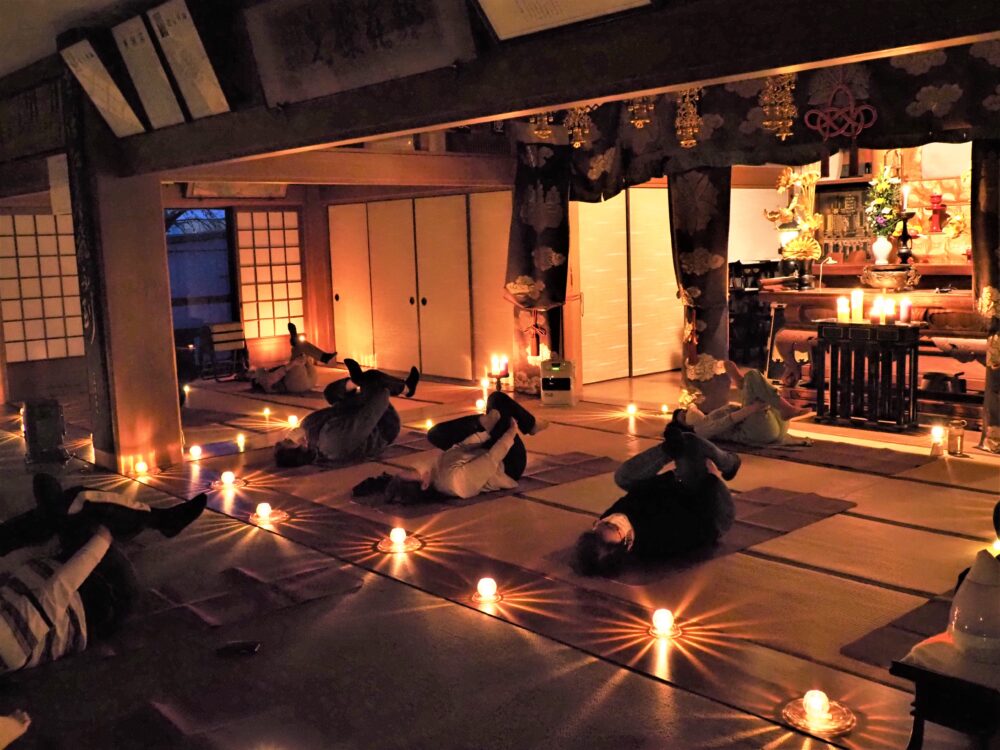
Continuing in that state, we moved on to poses such as "Bridge Pose," "Supine Bound Angle Pose," "Wind-Relieving Pose," and "Thread the Needle Pose."
It felt so good that I almost dozed off...
Finally, we slowly rose and returned to the basic posture and breathing.
I felt deeply relaxed compared to before doing yoga.
Now, after comfortably moving our bodies, we challenged ourselves with the essence of candle yoga, candle meditation!
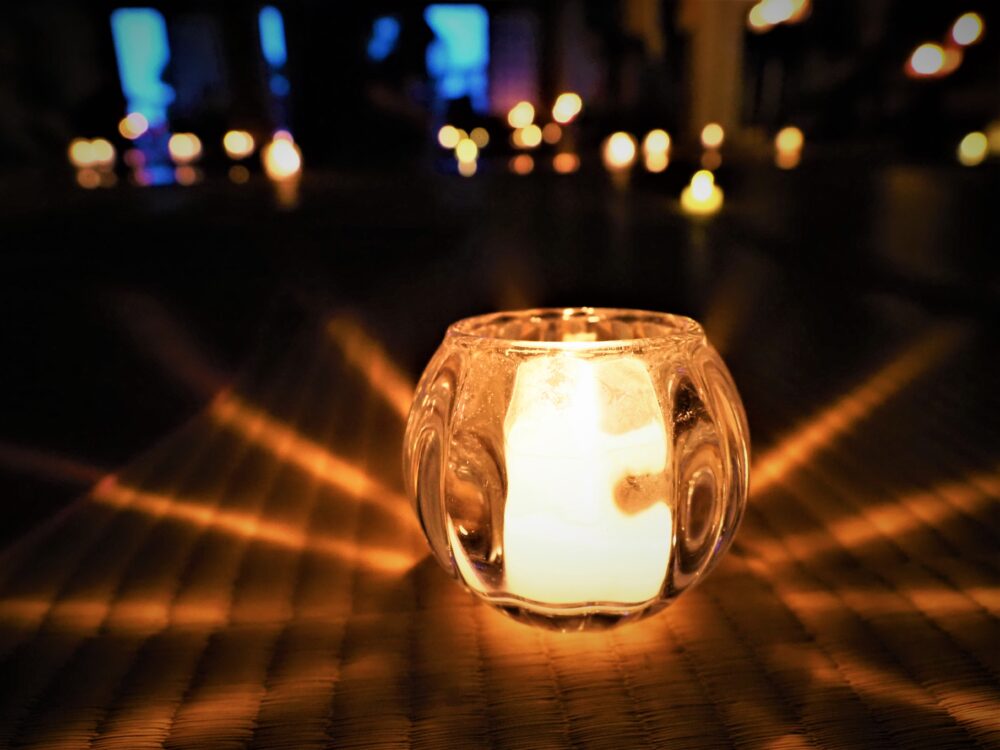
First, we sat so that the candle was at eye level and gazed softly at the light.
Then, quietly closing our eyes...
I began to see the afterimage of the candlelight.
I opened my eyes again and gazed at the candlelight.
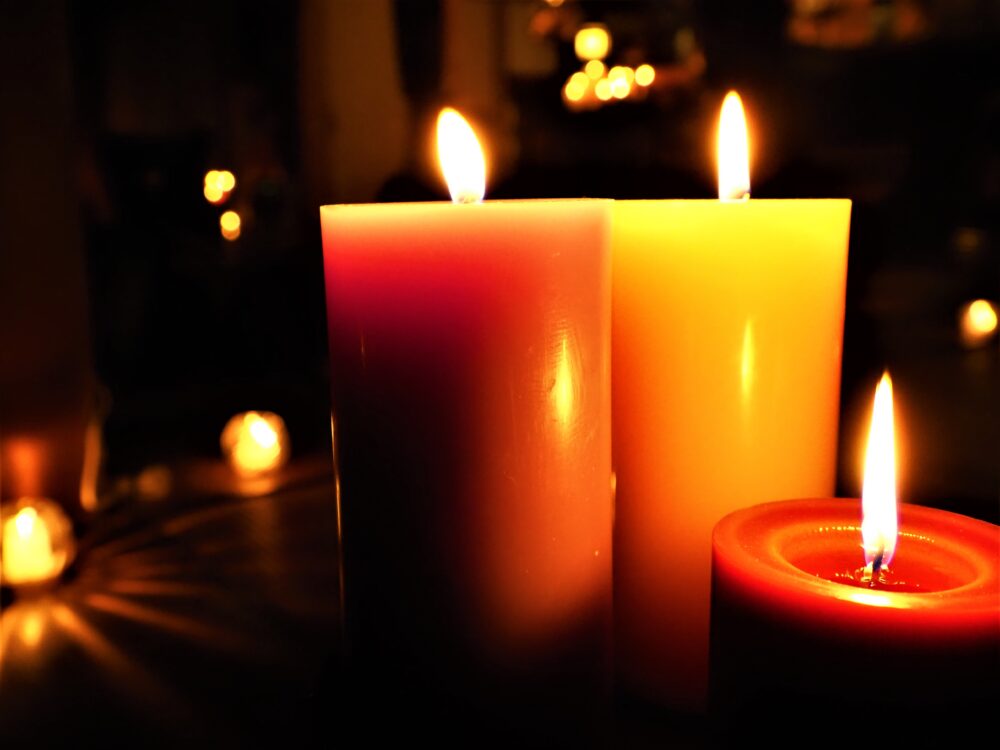
Repeating this series of actions at my own pace is candle meditation.
Candle meditation is practiced to focus on one thing and eliminate distractions.
I want to reset my mind by gazing at the candlelight so that I don't get caught up in murky thoughts.
In Sanskrit, candle meditation is called "Trataka."
It means "to gaze."
Buddhism and "Light", and Yoga and "Light"
Buddhism and yoga are like closely related siblings.
Regarding the theme of light in this candle yoga, how is it recognized from both perspectives?
In Buddhism, light mainly refers to candles as offerings.
Candles have been used in various rituals since ancient times, and their flames are said to ward off evil spirits.
For example, during a wake when a person passes away, candles are kept lit throughout the night to protect the body from demons and spirits.
Candles are also used as lights to guide the journey to the afterlife for humans to become Buddhas during the Obon season's welcoming and sending fires.
They serve as markers.
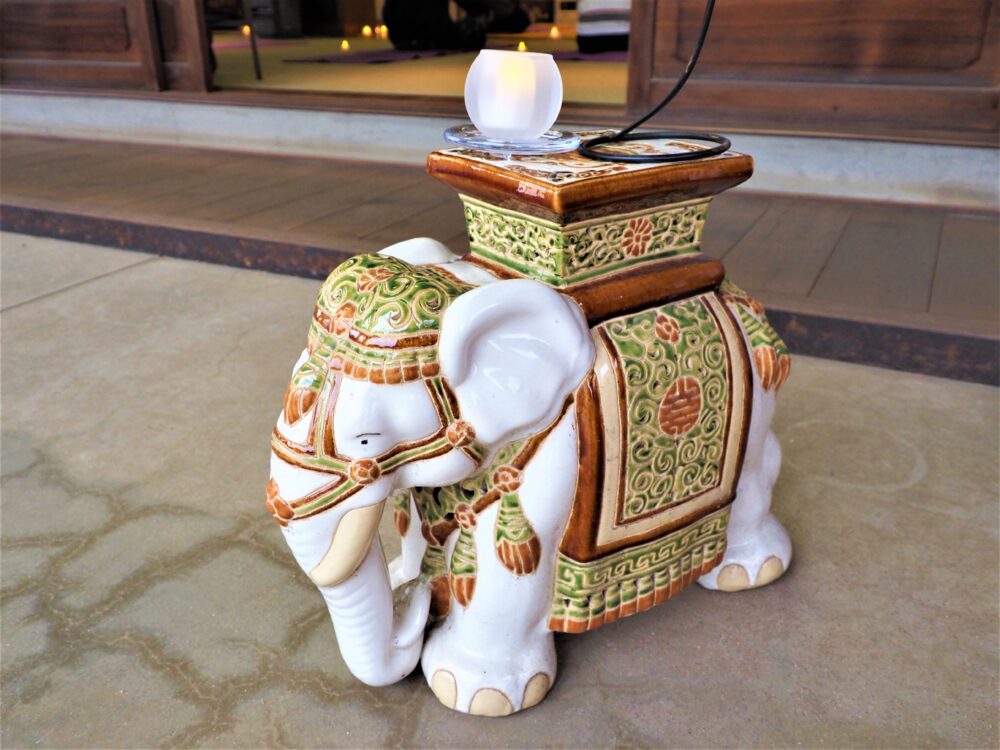
On the other hand, in yoga, light is nothing but fire itself.
In yoga philosophy, which is heavily influenced by primitive Brahmanism, it is believed that all things are composed of the five elements: water, wind, fire, earth, and space.
Of course, human beings are no exception.
As one of the most important essences that shape the universe, fire is crucial.
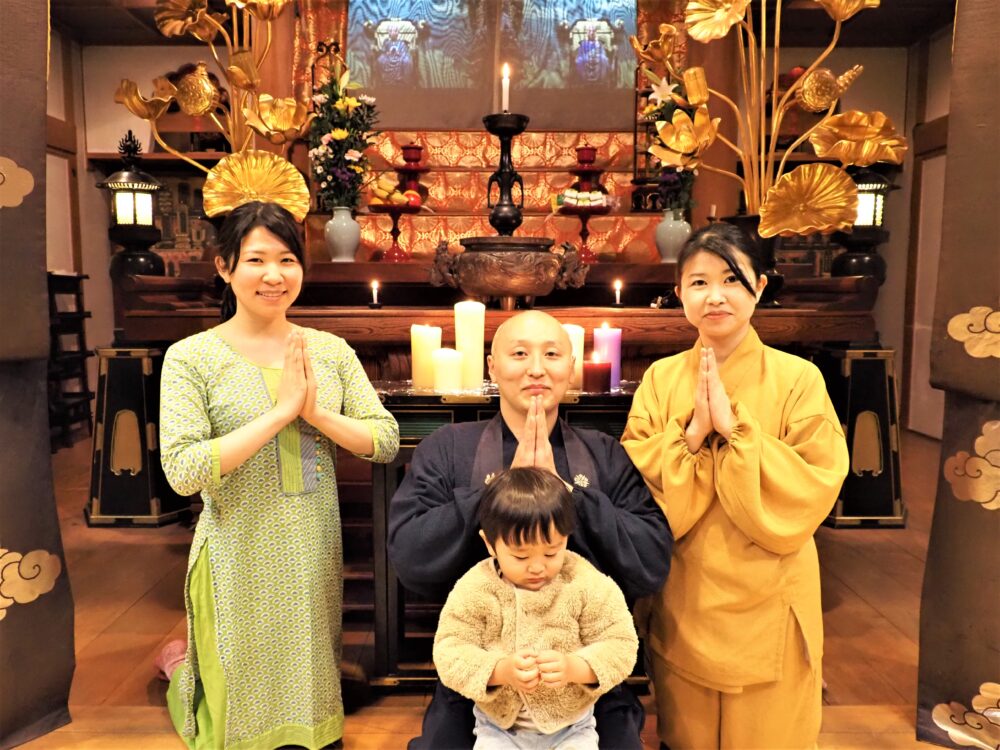
The light of Buddhism and the light of yoga.
How about incorporating various thoughts about light into yoga and reflecting more deeply on yourself?
From the Writer
This event, candle yoga, was held in the calming and extraordinary space of the temple.
With light as the main theme, it included a Dharma talk by the chief priest, practical sessions trained in Nepal, and a tea gathering, making for a rich experience.
Although it ran about 20 minutes over the scheduled end time of 7 PM, the participants seemed very satisfied.
Voices of praise arose, such as "It was my first time, but I enjoyed it!" "I was able to relax and forget the time!" "I want to participate again!"
The organizing Itoku-ji Temple and instructor's wife also expressed a desire to continue this.
There are high expectations for further developments in the future!


What do you want to know about Kurashiki?
Enter a word to search articles from this site