The “Heavy Rain Event of July 2018” occurred on July 7, 2018.
In Mabi, Kurashiki City, Okayama Prefecture, the disaster caused extensive damage: 51 people died and around 5,000 homes were completely or partially destroyed. As of March 2019, various recovery efforts were still underway.
Immediately after the disaster, many people gathered, including local residents, various support organizations, and volunteers from across Japan.
Although recovery is progressing, it seems that few people who were affected have been able to return to Mabi and resume their lives there.
Even as of March 2019, more than six months later, very few homes have their lights on.
- Light a beacon to guide Mabi’s recovery
- Reflect on the disaster and raise awareness of disaster preparedness and mitigation
- Create a place to talk together, even for those who have left Mabi, such as to live in temporary housing
With these aims in mind, we report on “Mabi Recovery Hope Lights,” a candle-lighting event that illuminates the nights in Mabi and has been held every month since August 13, 2018, about a month after the disaster.
This article focuses on the event held on February 7, 2019.
The information in this article was current when it was published in March 2019. Please note that it may differ from current information.
What is “Mabi Recovery Hope Lights,” the candle event that illuminates the nights in Mabi?

“Mabi Recovery Hope Lights” is an event organized by the Mabi Recovery Hope Project, made up of an NPO, disaster survivors, and around 20 other people.
It has been held around the 7th of every month since August 13, 2018, about a month after the disaster.
You may think of it as a “memorial service.”
A flower-offering stand is indeed set up, but one of the organizers said:
“Even if people have had to leave Mabi for one reason or another, I hope this can become a place where they come back once a month and talk in front of the candles. I think candles have that kind of power.”
they said.
Event schedule
The event begins at 7 p.m.
About 10 minutes beforehand, around 30 participants gradually began to arrive.
The venue is in front of the Mabi Branch Office of Kurashiki City Office.

The organizers had gathered 30 minutes earlier to arrange the candles and set up tents.
On February 7, 2019, the day of our visit, Okayama Governor Ryuta Ibaragi was also attending, so there were a great many members of the press.
At 7 p.m., the event began with greetings from Governor Ibaragi and Sho Hirano, representative of the Mabi Recovery Hope Project, followed by a flower offering.

People approached the flower-offering stand in silence; some shed tears, while bereaved family members spoke to their loved ones who had died. Everyone responded in their own way.

I also offered flowers, mourned the victims, and prayed for hope for recovery.
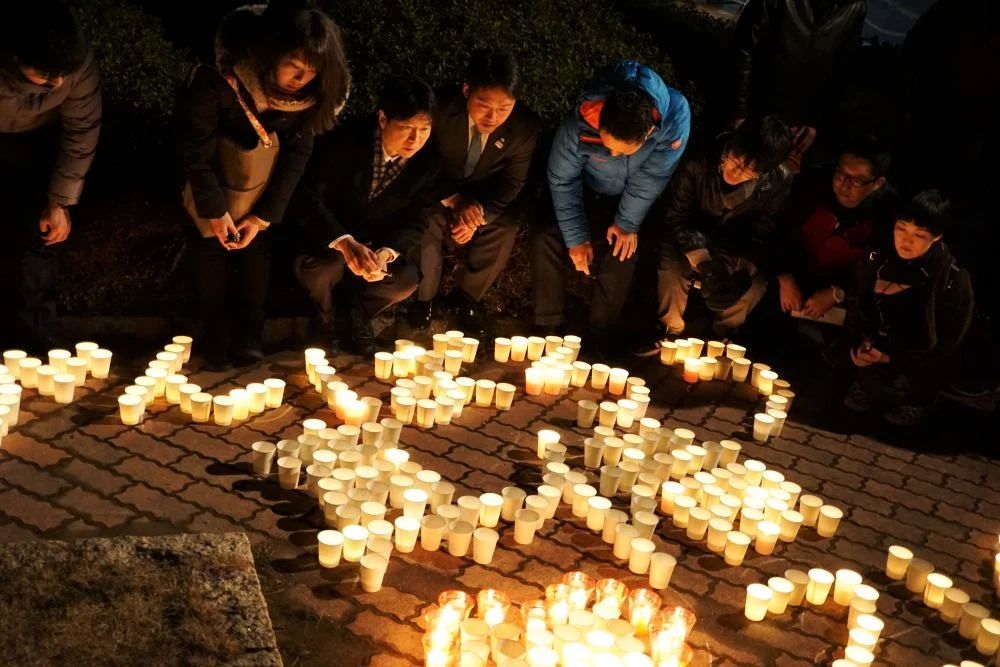
After that, all the participants lit the candles one by one, offering prayers for recovery.

Many of those attending were from Mabi. As they enjoyed the zenzai (sweet red bean soup) served to guests, they caught up on one another’s lives, asking things like, “Where and how are you living now?” and “How have you been?”

I felt that many of those attending were people who had left Mabi to live elsewhere.

The day we visited was 216 days after the disaster.
The candles spelling out “Let’s do our best, Mabi ♡ 216” gently and warmly illuminate the dark streets of Mabi.
After about an hour, at 8 p.m., Sho Hirano gave the closing remarks and the event ended.
The 8th event (March 7, 2019)

Here are scenes of the candles spelling out “Let’s do our best, Mabi—243 days” being lit.
Compared with the previous event in February 2019, there were no reporters, and it was a lovely gathering with many people from Mabi in attendance.
Next, we spoke with Sho Hirano of the Mabi Recovery Hope Project.
Interview with Sho Hirano, representative of the Mabi Recovery Hope Project
How did “Mabi Recovery Hope Lights” get started?
Hirano
I was personally affected by the disaster in Mabi, and many people left the area.
We started by reaching out to people with the idea of creating a place where they could gather, find peace of mind, and face the past, present, and future.
Our original theme was “recovery of the heart.”

Why does Mabi Recovery Hope Lights use candles?
Hirano
One of our project members took part in supporting the Great East Japan Earthquake. As an initiative that could be carried out from Kurashiki, NPOs and local volunteer groups organized “3.11 Darkness Candles,” a candle project that raised donations for the disaster-stricken areas.
The idea was to gather around the candlelight, remember the disaster-stricken areas where the power had gone out, and send support from Kurashiki. We were able to make it happen with the cooperation of a candle manufacturer.
For the Heavy Rain Event of July 2018, we adopted the theme “Let’s do our best, Mabi.” We wanted many people—including residents, citizens, and volunteers—to take part, and for this to be an ongoing effort rather than a one-off event.
We felt it was important to hold an event each month on the night of the 6th or 7th, when the disaster occurred, where people could spend time together around the candlelight, reflecting on Mabi’s past and future. That is why we launched this project.

How do you fund and run the event?
Hirano
Up through this event, held in February 2019, we relied on crowdfunding and donations.
Although members have had to cover some costs themselves, the people who provided support did so as donations, which was a great help.
The event is held every month. How long do you plan to continue?
Hirano
We plan to continue for one year, through July 2019.

As the organizer, who would you like to see take part?
I heard that you want people to feel welcome to join as a place to talk together. To be honest, as a Mabi resident who wasn’t affected by the disaster, I felt it might be difficult to attend. Is there a message you’d like to share?
Hirano
We don’t have any particular restrictions on who can attend.
We hope as many people as possible will take part.
If we say “Mabi residents and those who support and stand by Mabi,” that means everyone.
We would be glad if this event helps raise awareness of disaster preparedness and keeps the circle of support going.

From the Writer
As of March 2019, when night falls in Mabi, there are no lights apart from streetlights, traffic signals, and shops.
Even where lights are on, they are mostly only on upstairs.
Against this backdrop, the candlelight in front of the Mabi Branch Office of Kurashiki City Office seemed especially bright.
Watching the small candle flames flicker in the darkness was comforting.
On the 7th of every month, we remember the disaster and mourn those who died.
It is also a day to reflect anew on disaster preparedness, an awareness that naturally fades as time passes.
Regardless of whether we were affected by the disaster, I felt that we need to think about the importance of remembering disasters and passing their stories on, even if only once a month.
I hope the lights of as many homes as possible will return to Mabi, and that the day will come when as many people as possible can once again find a place where they can feel at ease.



What would you like to know about Kurashiki?
Enter a word to search articles on this site