When it comes to shogi, Yasuharu Oyama, the 15th Lifetime Meijin, is one of the famous people who represent Kurashiki.
He led the shogi world during the Showa era, and his record of holding titles for a total of 80 terms ranked second as of 2019, behind Yoshiharu Habu, 9-dan.
Considering how few tournaments there were at the time, his dominance was extraordinary, and this is an astonishing record.
The 15th Lifetime Meijin made a major contribution to the shogi world. One of the women’s shogi titles, co-sponsored by Kurashiki City and the Kurashiki Cultural Promotion Foundation, is the Oyama Meijin Cup Kurashiki Toka Tournament.
A challenger-selection tournament is held among all professional women shogi players and amateur women players recommended by the organizers. The winner then plays a best-of-three title match against the holder of the Kurashiki Toka title.
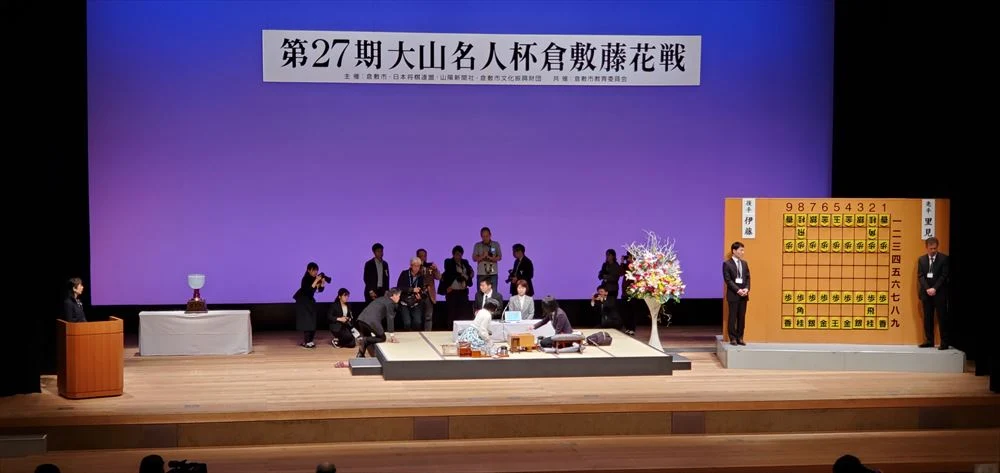
One distinctive feature of this tournament is that it includes public matches, which are very rare in shogi title matches.
Kana Satomi, Kurashiki Toka was challenged by Sae Ito, 3-dan women’s professional in the 27th Kurashiki Toka Tournament in 2019. Game 2, held on November 23, was played before a live audience at Geibunkan Hall.
I went to see the exciting public match and would like to tell you about it.
The information in this article was current when it was published in December 2019. Please note that it may differ from current information.
The Kurashiki Toka Tournament, with public matches at Geibunkan Hall

For Kurashiki Toka Satomi, this tournament has been a very good fit: she has held the title for 9 of its 26 editions.
She failed in her first challenge and lost the title twice, but reclaimed it the following year each time. As a result, she has appeared in the tournament for 12 consecutive years since her first challenge in 2008.
Challenger Ito, 3-dan women’s professional, was in excellent form, with 26 wins and 6 losses through November 22.
The title match between the two players, who are close in age, began with Game 1 on November 10 in Yonago, Tottori Prefecture, where Kurashiki Toka Satomi took the first win.
The title match is a best-of-three, and the first player to win twice takes the title.
If Satomi won on the 23rd or 24th, she would defend her title; if Ito won on both the 23rd and 24th, she would reclaim it.
The public match began at 1 p.m.
The game itself had started at 10 a.m., so the public match began at a difficult point in the middle game.

Before the public match, Kurashiki Mayor Kaori Ito and others gave greetings.
After that, the two players spoke about their determination, and the moves played during the morning were replayed.
Kifu: a record of a shogi game
At this point, photography by the press was also prohibited.
Public matches are held in various tournaments, but among title matches, only some parts of the Ryuo Tournament—which is mainly contested by male professionals and is the highest-level title tournament in the shogi world—are open to the public.
A place where you can watch a serious title match in Kurashiki is very rare.

The hall had a distinctive dry atmosphere, and the tension quickly mounted.
Photography was prohibited during the match. Apart from the occasional cough from a spectator, the only sound was the record keeper reading out each move as it was played.
It was a distinctively solemn atmosphere unique to the world of competition, unlike a classical music concert.
It is nice to be present at a serious match, but commentary on a large shogi board was being held at the nearby Geibunkan Annex Ai Theater.
I decided to take a look.
Enjoying commentary on the large shogi board at public matches in the Kurashiki Toka Tournament

Commentary on a large shogi board is an event, usually held near the playing venue, where professional shogi players and others explain the game.
For the Kurashiki Toka Tournament, it was held at the Geibunkan Annex Ai Theater, a one- to two-minute walk away on the same grounds.
Even though the match was open to the public, if the players could hear commentary on every move, it could affect the game.
That is why a separate venue is set up to provide commentary for fans.

The commentator was Tatsuya Sugai, 7-dan, from Okayama City, Okayama Prefecture.
He is a popular young player with a strong record who has also held a title.
The moderator was Rei Takedomi, 1-dan women’s professional, a student of one of the 15th Lifetime Meijin’s disciples.
They were a commentary duo perfectly suited to the Kurashiki Toka Tournament.
By my estimate, more than 200 shogi fans gathered to hear them.
The atmosphere was so lively that it felt as if “the temperature had risen just in this venue.”

Commentary on a large shogi board is about more than explaining the position.
At times, the commentators analyze each move by both players, assess the position, and predict how the game will unfold.
At other times, they discuss the players’ tendencies—whether they like attacking or defending—from the perspective of fellow professionals.
They may also share details about the players’ hobbies and preferences, or anecdotes from their everyday lives.

These days, more shogi fans are becoming what is known as “watching shogi fans”—people who enjoy watching games but do not play shogi themselves.
Public matches and commentary on a large shogi board offer a rare opportunity to enjoy professional players’ real-life mannerisms and witty explanations.
Experienced fans called out their predicted moves in loud voices to prompt commentary from 7-dan Sugai.
It is an event that fans can thoroughly enjoy, too.
As I enjoyed the commentary, the game entered its endgame.
I wanted to see how the match would turn out in person, so I decided to return to the public match venue.
Ito, 3-dan women’s professional, wins Game 2 of the Kurashiki Toka Tournament; on to Game 3
The public match venue had taken on the even more taut atmosphere unique to the endgame.
Challenger Ito, 3-dan women’s professional, who had lost Game 1, held off Kurashiki Toka Satomi’s resistance and won.
The Kurashiki Toka Tournament is a best-of-three, and the first player to win twice takes the title.
Having lost Game 1, Ito won this game to tie the score at one win apiece, leaving the title to be decided in Game 3 the following day.
Commentators Sugai, 7-dan, and Takedomi, 1-dan women’s professional, also came to the public match venue.
After reviewing the game, Ito’s final comment—“I’m relieved, because if I hadn’t won today, there wouldn’t have been a tomorrow”—left a strong impression.
With the deciding game the next day, there was no time to relax, but perhaps she had a brief moment to let go of the tension.
Game 3 is not open to the public; commentary on the Kurashiki Toka Tournament is held in the hall

If Kurashiki Toka Satomi had won Game 2, she would have defended her title then and there, and Game 3 would not have been played.
On November 24, Ito’s victory meant that Game 3 would be played.
Game 3 was not open to the public.
Commentary on a large shogi board was held in the hall at Geibunkan Hall, where Game 2 had been played.
As on the previous day, the commentators were Sugai, 7-dan, and Takedomi, 1-dan women’s professional.
I couldn’t stay until the end because of time constraints, but I visited the venue to get a sense of what was happening.

Commentary began in the middle game again that day. It was striking to see the two commentators speaking freely in a venue larger than the one used the previous day.
The fans in the hall seemed relaxed, in stark contrast to the public match the day before.
I watched for a little while, then soon left.
When I later checked the online broadcast, Satomi had made a sharp attack and won, defending her Kurashiki Toka title for the 10th time overall.
Winning the title 10 times in a tournament with a 27-edition history is an incredible achievement.
There are seven women’s titles, and with this defense, she retained her status as a five-crown champion.
She is now a leading force in women’s shogi.
Five-crown champion: as of November 2019
Visit Kurashiki to watch a rare public match in the Kurashiki Toka Tournament
The Kurashiki Toka Tournament is co-sponsored by Kurashiki City, and the title itself includes the place name “Kurashiki” and “wisteria,” a flower associated with Kurashiki. It is easy to see how deeply rooted this title is in the local community.

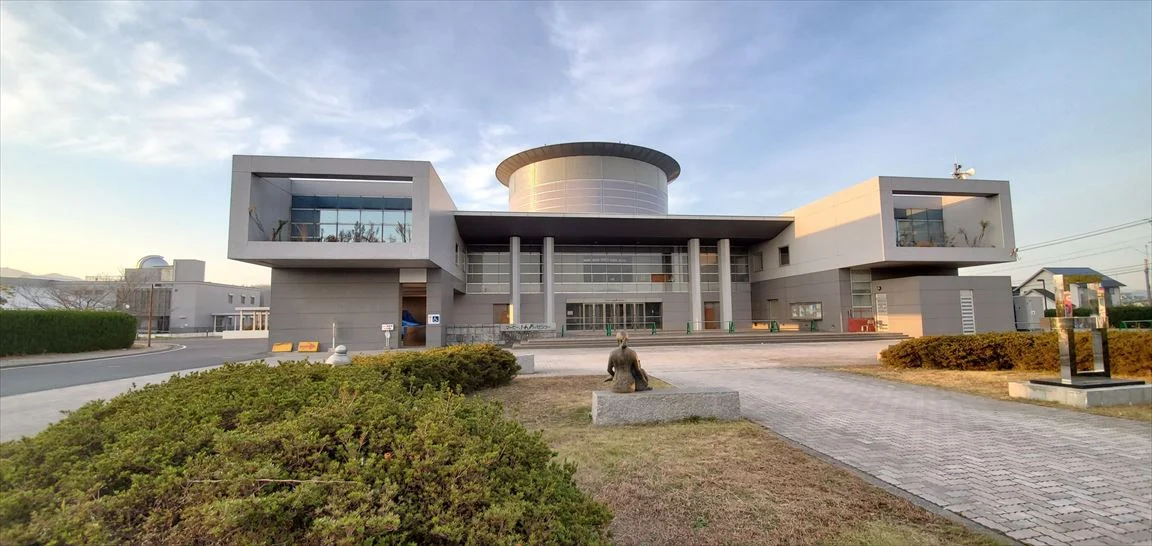
Also, Geibunkan Hall houses a museum dedicated to the 15th Lifetime Meijin, where visitors interested in shogi can learn about his achievements and see the shogi board he used.
Public matches are held on a weekend sometime in November each year.
Why not enjoy Kurashiki’s autumn scenery, watch a solemn title match in the traditional mind sport of shogi, and immerse yourself in its culture?
27th Oyama Meijin Cup Kurashiki Toka Tournament Public Match Information
| Name | 27th Oyama Meijin Cup Kurashiki Toka Tournament Public Match |
|---|---|
| Date | Held on a Saturday from mid- to late November. See the organizer’s website for details. |
| Location | 1-18-1 Chuo, Kurashiki City, Okayama Prefecture |
| Admission (tax included) | Free public match viewing |
| Website | Oyama Meijin Cup Kurashiki Toka Tournament (Japan Shogi Association) |



What would you like to know about Kurashiki?
Enter a word to search articles on this site