It is still fresh in our minds how people across Japan followed the Olympic and Paralympic Games held in Paris, France, last year (2024). Now, starting Saturday, November 15, 2025, the Deaflympics, the Olympics for people with hearing impairments, will be held.
This memorable Games, marking its 100th anniversary, will be held in Japan for the first time.
Four athletes and a coach from Okayama Prefecture, including Kurashiki City, will compete.
We attended a Deaflympics Caravan event held in Asakuchi City on Saturday, August 30, 2025, and interviewed athletes afterward.
Please note that the information presented here was current when this article was published in November 2025. It may differ from current information.
What are the Tokyo 2025 Deaflympics?

The Deaflympics is an international sporting event organized by the International Committee of Sports for the Deaf (ICSD) and held every four years, for athletes with hearing impairments (hereafter referred to as “Deaf athletes”).
The name is a portmanteau of “Deaf” and “Olympics.” “Deaf” means “unable to hear” in English.
The official name of this Games is the “25th Summer Deaflympics Tokyo 2025.”
Over the 12 days from Saturday, November 15 to Wednesday, November 26, 2025, around 6,000 people involved in the Games from 70 to 80 countries and regions will gather, and 21 sports will be held.
The Tokyo 2025 Deaflympics has three visions:
- Share the appeal and value of Deaf sports and connect them with people and society
- Make the Games a bridge to the world and the future
- Realize an inclusive society where “everyone can make use of their individuality and demonstrate their abilities”
Three Deaf athletes and one coach from Okayama Prefecture will compete.
- Ishimoto Ryuichiro
Track and field (400m hurdles) - Sato Shusuke
Track and field (high jump) - Komori Aya
Women’s soccer - Yasuda Yukiko
Women’s bowling (coach)

In August 2025, the Deaflympics Caravan vehicle arrived in Okayama Prefecture
The Olympic and Paralympic Games have a torch relay before the event, but the Deaflympics does not.
So for these Games, a caravan vehicle set off on Sunday, June 15, 2025, from the venue of the National Conference of the Deaf in Iwate. Heading for Tokyo, the host city, caravan vehicles decorated with Deaflympics promotional wraps are racing across Japan from north to south.

The caravan vehicle traveled through Okayama Prefecture for six days, from Monday, August 25 to Sunday, August 31, 2025. It was handed over from Tottori Prefecture in Nagi Town, Katsuta District, Okayama Prefecture, and on the final day it was passed on to Kagawa Prefecture.
Check the image below for the detailed schedule.

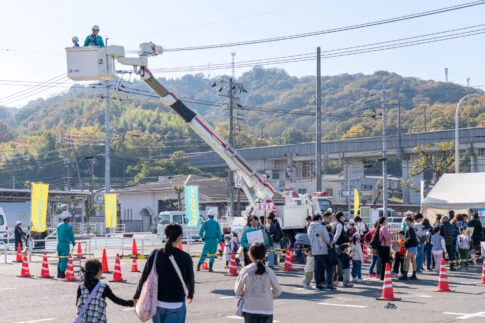
Deaflympics-related events are being held across the country alongside the caravan’s tour. In Okayama Prefecture, the “Deaflympics Caravan” was held at the Asakuchi City Health and Welfare Center on Saturday, August 30, 2025.


An event where hearing and deaf people came together
In the morning session, all participants gathered in the third-floor hall for a quiz about the history of the Deaflympics and a sign-language talk by former Deaf athletes.
At the ceremony, the Asakuchi City mayor and the deputy mayor of Satosho greeted the audience, incorporating sign language, creating a warm atmosphere in the hall.


The quiz about the Deaflympics was multiple choice.
It was conducted in sign language by a deaf person (a person with a hearing impairment whose first language is sign language). To make it enjoyable for both hearing and deaf people, the questions and answer choices were also provided through spoken-language interpretation, summary writing, and slides.

The questions covered a wide range of topics, from what anniversary this Deaflympics marks and when it will be held to the Deaflympics symbol and the origins of sign-language expressions. Participants struggled mightily. Everyone was eliminated partway through, so in the second half, everyone learned about the history of the Deaflympics together.
Sign-language talk by former Deaf athletes

The sign-language talk by former Deaf athletes featured the following two former bowling athletes.
- Yasuda Yukiko
- Hosokawa Kenji
Yasuda will participate in the Tokyo 2025 Deaflympics as coach of the women’s bowling team, while Hosokawa will participate as a support staff member for the bowling competition.
In addition to questions about bowling in sign language from Deaflympics Caravan staff, they were asked questions such as the following, drawing on their experience competing in international events.

How did you communicate with athletes from other countries?
Yasuda (surname only)
We communicate using gestures. Asian sign languages in particular are similar, so it’s easy to get the message across.
Hosokawa (surname only)
I also relied a lot on gestures. When people who can’t hear communicate with each other, they can often understand one another somehow. There is also a shared language called International Sign, which I’ll teach you about this afternoon.
Could you tell us about any challenges unique to international competitions?
Yasuda
In bowling, which I do, the slipperiness of the area called the “approach,” where you walk before throwing, varies from place to place, so it needs to be checked carefully. I take several pairs of shoes and balls with me when I compete.
Hosokawa
I’m careful about what I eat. When you’re overseas, the food doesn’t always agree with you.

What are your hopes for the Tokyo 2025 Deaflympics?
Yasuda
China, Taiwan, and Ukraine are strong competitors in women’s bowling. Especially in the team event, our whole national team will work together to win the gold medal.
Hosokawa
My role is to reduce the burden on the athletes so they can focus on competing. I want to draw on my experience as an athlete and devote myself to supporting them.
International Sign & Japanese Sign Language experience
Sign-language lessons were held in the afternoon.
Many people rushed to the venue in the afternoon, seeing it as a chance to learn sign language firsthand from deaf people who use it every day.

As someone with a hearing disability who uses sign language in my daily life, I was especially looking forward to the International Sign Language class. I had only ever used American Sign Language when communicating with Deaf people overseas, so this was my first time learning International Sign Language, which is said to be understood around the world.
During the Deaflympics, Deaf athletes and Deaf supporters from around the world will visit Japan. If I spot Deaf friends signing at or near the venue, I’d like to try talking to them in International Sign Language.

Deaf Life Support Experience
The venue also had an experience corner featuring items that people with hearing disabilities use to compensate for everyday sounds.
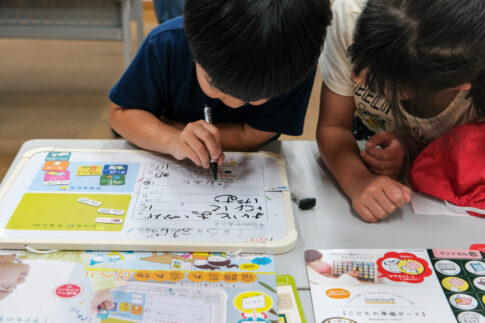
Children gathered around writing boards and vibrating alarm clocks, eagerly trying them out.

A variety of panel exhibits, including replicas of medals touring the country

The venue also displayed panels about the history of the Deaflympics, whose caravan car tours the country, as well as replicas of the medals.

Among the exhibits, I also spotted illustrations by some of Japan’s leading manga artists, including Takahashi Rumiko and Aoyama Gosho.


This was part of the project “MANGA cheer on Deaf Sports”, created by manga artists who share the desire to encourage all Deaf athletes, both in Japan and abroad, and to spark interest among people who have never encountered Deafness or Deaf sports.
Because children with hearing disabilities have difficulty learning Japanese through spoken language, many say they learned everyday conversational expressions from manga. The works by manga artists, whose creations are familiar to Deaf people, captivated many visitors.
Interview with Deaflympics track and field representatives
With less than a month to go before the competition, in late October 2025, we asked Ishimoto Ryuichiro and Sato Shusuke, representatives in the 400-meter hurdles at the Deaflympics, about their hopes for the Games.
“I can’t wait for the Deaflympics!” Ishimoto Ryuichiro

We spoke with Ishimoto Ryuichiro, who is from Shimonoseki City, Yamaguchi Prefecture, and is currently a third-year student in the Faculty of Education at Okayama University and a member of its track and field team.
What first got you involved in Deaf track and field?
Ishimoto (surname only)
I’ve attended the same schools as hearing students throughout my life, but for one year I went to the kindergarten department of my local school for the Deaf. I stayed in touch with my classmates after leaving the school, and they also told me about Deaf track and field.
I was curious, so I looked up the records of Japan’s Deaf track and field team. My personal best in the 400-meter hurdles was faster than the current Japanese Deaf track and field record, so I thought, “I want to compete against the world!” That’s what got me started in Deaf track and field.
Have you been doing track and field for a long time?
Ishimoto
I was good at sprinting in school sports days from a young age and was often selected for relay races. My father was a track and field athlete, too, so I chose the track and field club without hesitation when I started middle school, and I’ve continued ever since. My father also competed in the 400-meter hurdles.

What are your hopes for the Deaflympics?
Ishimoto
After all the training and camps, I feel I’m in the best condition I’ve ever been in. I’m not feeling much nervousness or pressure about competing in my first international competition; I’m simply filled with excitement.
The highlight of my race is how well I get going at the start. I’ll use that strong start to carry me through after the 200-meter mark and do my very best.
I hope you’ll cheer me on.
“I want to bring a gold medal back to Okayama!” Sato Shusuke

We spoke with Sato Shusuke, who graduated from Okayama Prefectural School for the Deaf and is a member of the track and field team at Hirabayashi Metal Co., Ltd.
What first got you involved in Deaf track and field?
Sato
I attended a school for the Deaf, but at the time I didn’t know about the Deaflympics or Deaf track and field. Even so, I’d been doing the high jump since middle school and competed in the same meets as hearing athletes.
I posted about it on social media, and someone Deaf who I was connected with there told me about Deaf track and field. I joined a training camp, and that’s how I got started.
Has anything changed since you got involved in Deaf track and field?
Sato
I’ve become more serious about my sport than ever before.
Last year (2024), I competed in my first international competition in Taiwan, the 5th World Deaf Athletics Championships, and was overwhelmed by the physiques and jumping ability of the foreign athletes.
I finished fifth, which wasn’t the result I’d hoped for, so in preparation for these Deaflympics, I’m not only stepping up my training but also paying attention to my diet and rethinking how I build my body.

What are your hopes for the Deaflympics?
Sato
I’ve trained hard, using the disappointment of my last international competition as motivation.
At the Deaflympics, I’ll win a gold medal and bring it back to Okayama.
Competition dates for athletes and a coach with ties to Okayama Prefecture
The competition dates and venues for athletes and a coach with ties to Okayama Prefecture are as follows.
- Ishimoto Ryuichiro
Friday, November 21 and Saturday, November 22
Komazawa Olympic Park General Sports Ground Athletics Stadium - Sato Shusuke
Tuesday, November 18
Komazawa Olympic Park General Sports Ground Athletics Stadium - Komori Aya
Saturday, November 15; Monday, November 17; Wednesday, November 19; Friday, November 21; Sunday, November 23; Tuesday, November 25
J-Village (Iwaki City, Fukushima Prefecture) - Coach Yasuda Yukiko
Monday, November 24 and Tuesday, November 25 (team event)
Higashiyamato Ground Bowl
Cheer on the Tokyo 2025 Deaflympics

The Tokyo 2025 Deaflympics open on Saturday, November 15. Tickets for the opening and closing ceremonies have sold out, but the opening ceremony, directed by Ohashi Hiroe, a descendant of Keinosuke Ohashi, who lived at Ohashi House in the Bikan Historical Area, will be broadcast on NHK Educational TV from 8 p.m. that day.
All events are free to watch.
There are no plans for television broadcasts in Okayama Prefecture, but at previous Deaflympics many events were livestreamed on platforms such as YouTube, so be sure to check.
I was struck by how both Ishimoto and Sato said, “As deaf athletes challenging our own limits, we want to convey our courage to hearing people through the way we compete.”
I can’t take my eyes off the 12 days of the Deaflympics, being held in Japan for the first time.
25th Summer Deaflympics Tokyo 2025 Information
| Name | 25th Summer Deaflympics Tokyo 2025 |
|---|---|
| Dates | November 15 (Monday)–26 (Wednesday), 2025 |
| Location | Tokyo, Shizuoka Prefecture, and Fukushima Prefecture |





What would you like to know about Kurashiki?
Enter a search term to find articles on this site