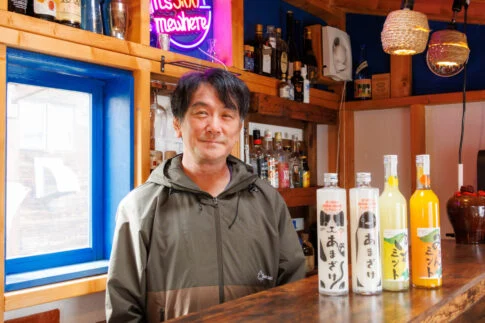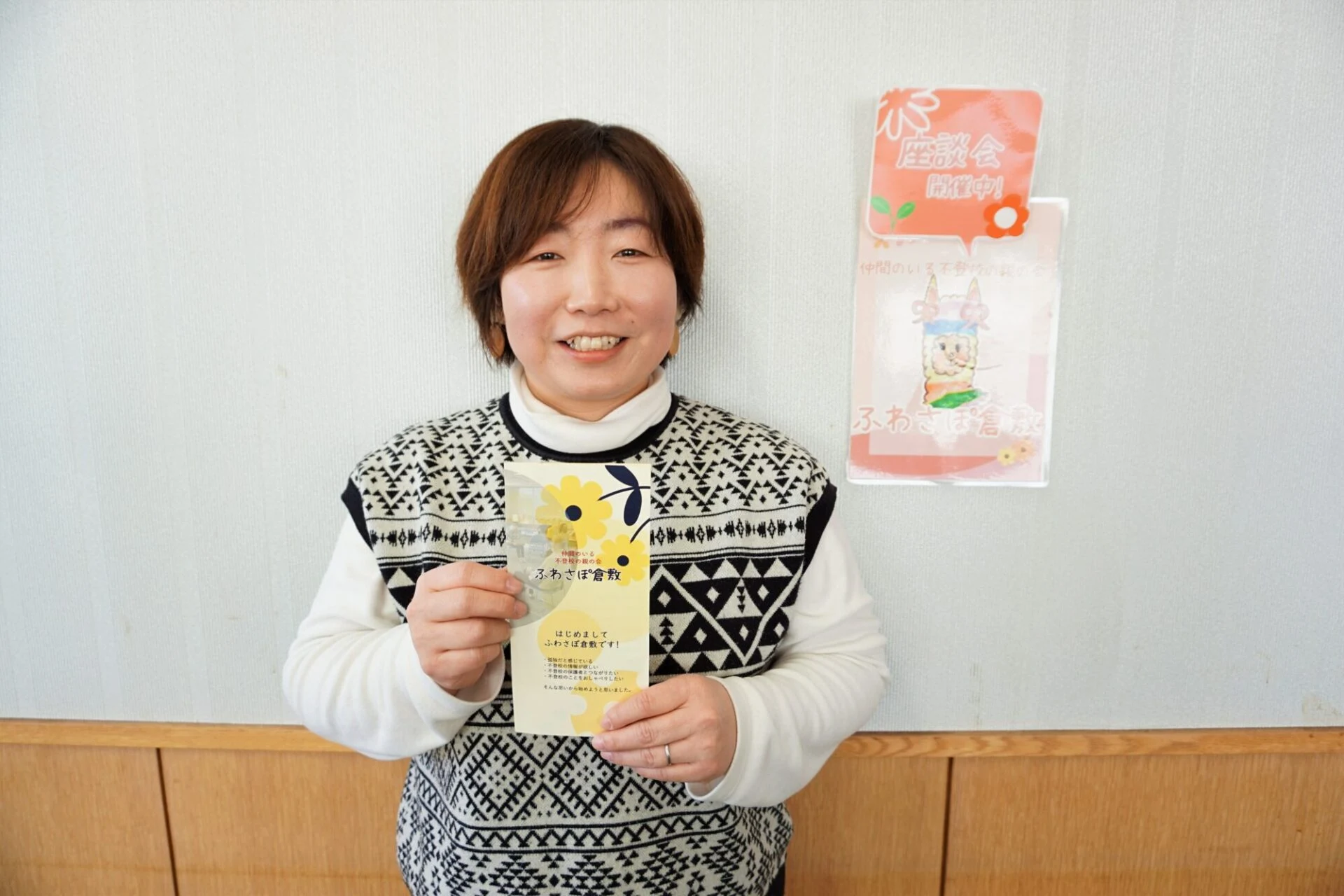
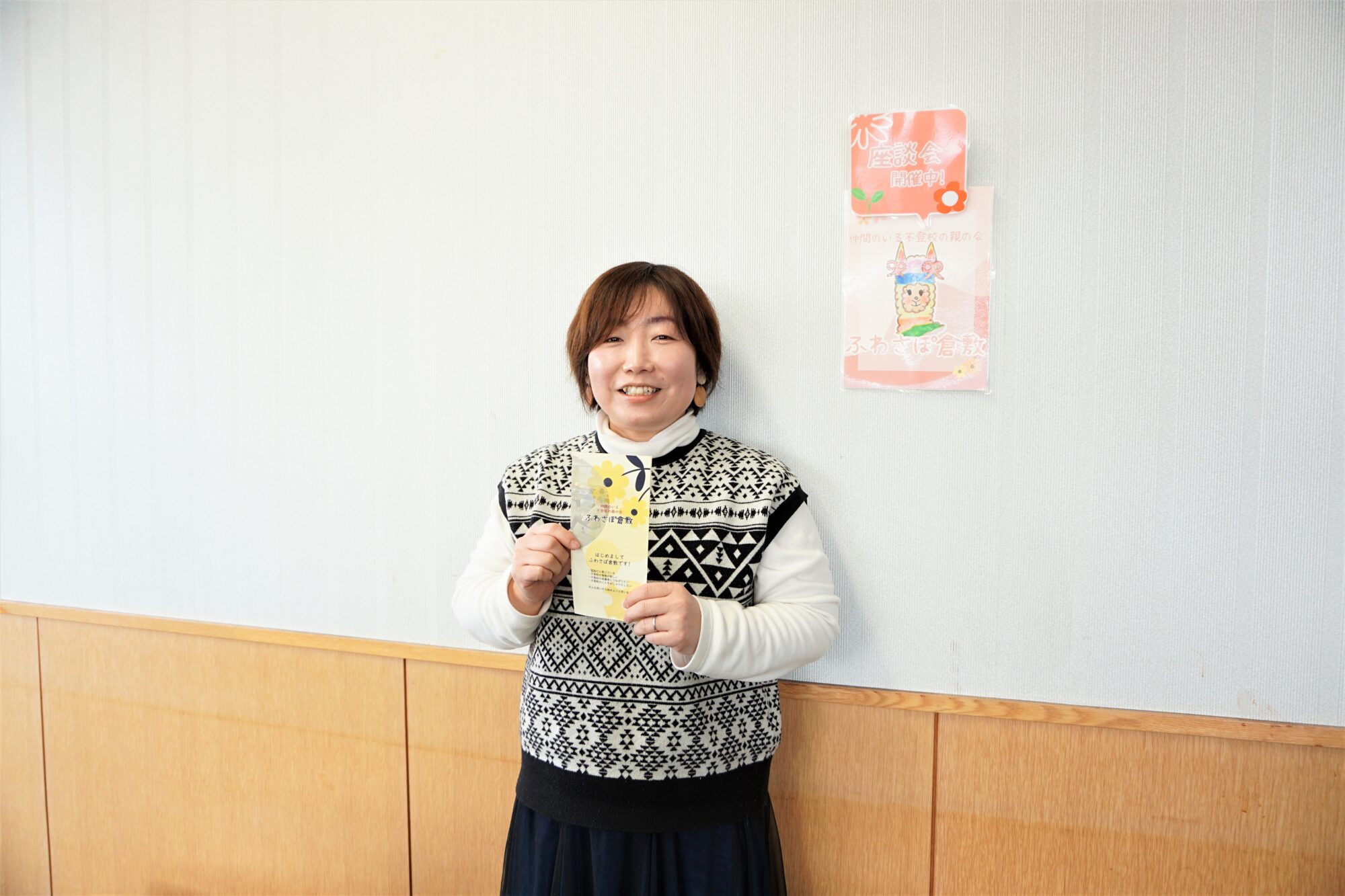
Interview with Kitamura Yasuyo, representative of the parent group "Fuwasapo Kurashiki" for children who do not attend school
Kitamura established a support organization for parents of children who do not attend school.
Here, we introduce the background of its establishment and her thoughts on the activities.
How the parent group "Fuwasapo Kurashiki" was established
Can you tell us what prompted you to start Fuwasapo Kurashiki?
Kitamura
My daughter became unable to attend school when she was in the second grade.
I thought she would be able to go back to school soon, but that was not the case.
While consulting with various people, I was told, "Mothers must be smiling."
At that time, I thought, "It's okay for mothers to cry because they are going through tough times, but if I have to be smiling when I participate in the group, it feels like I'm being pushed to try harder, which makes me feel even more lost."
So, I thought it would be nice to have a place that accepts people as they are, saying that it's okay to cry or feel whatever they feel, and that’s why I started this group.
Can you tell us what is valued in the discussion meetings?
Kitamura
Not denying feelings is important.
Even if a mother cries, it’s a place where that’s okay, and we value accepting everything, including the mother’s feelings.
In the early days when a child becomes unable to attend school, mothers often don’t know what to do and their feelings fluctuate.
However, as time goes by and they gradually open their hearts, every mother starts to have thoughts like, "Is it okay to be like this? Should I respect my child's wishes?"
At that point, I hope that the mothers can engage in activities that utilize their strengths and think about what they want to do.
Sometimes fathers also attend the discussion meetings.
There are times when only fathers come, or couples come together, but some fathers are there because they are accepting of their child's situation, while others come because they don’t know what to do.
Compared to fathers who work outside, mothers tend to spend more time with their children.
In such cases, I hope that fathers will be allies so that mothers don’t have to bear everything alone, and I also hope they can continue to treat mothers and children as they usually do.
As you continue the discussion meetings, do you have any thoughts now?
Kitamura
I think it’s tough to consult while feeling that mothers might be blamed for their children not being able to attend school.
I believe there is a desire for empathy among parents, to connect with each other and say, "I was the same way."
From my own experience, what was most beneficial was being able to talk about similar circumstances and meeting seniors who had gone a little further, which gave me a sense of security.
I want everyone to feel what I felt, and I think that’s why I wanted to create such a space.
So, I’m always concerned about whether the participants in the discussion meetings were able to talk properly.
Especially when many new people attend, I feel that we need to be creative in our discussion meetings.
As a follow-up, we have made it possible to use the chat function on LINE.
Wanting to deliver activities to those who cannot participate
You mentioned LINE, but I feel that you are also focusing on information dissemination through the official website and social media.
Kitamura
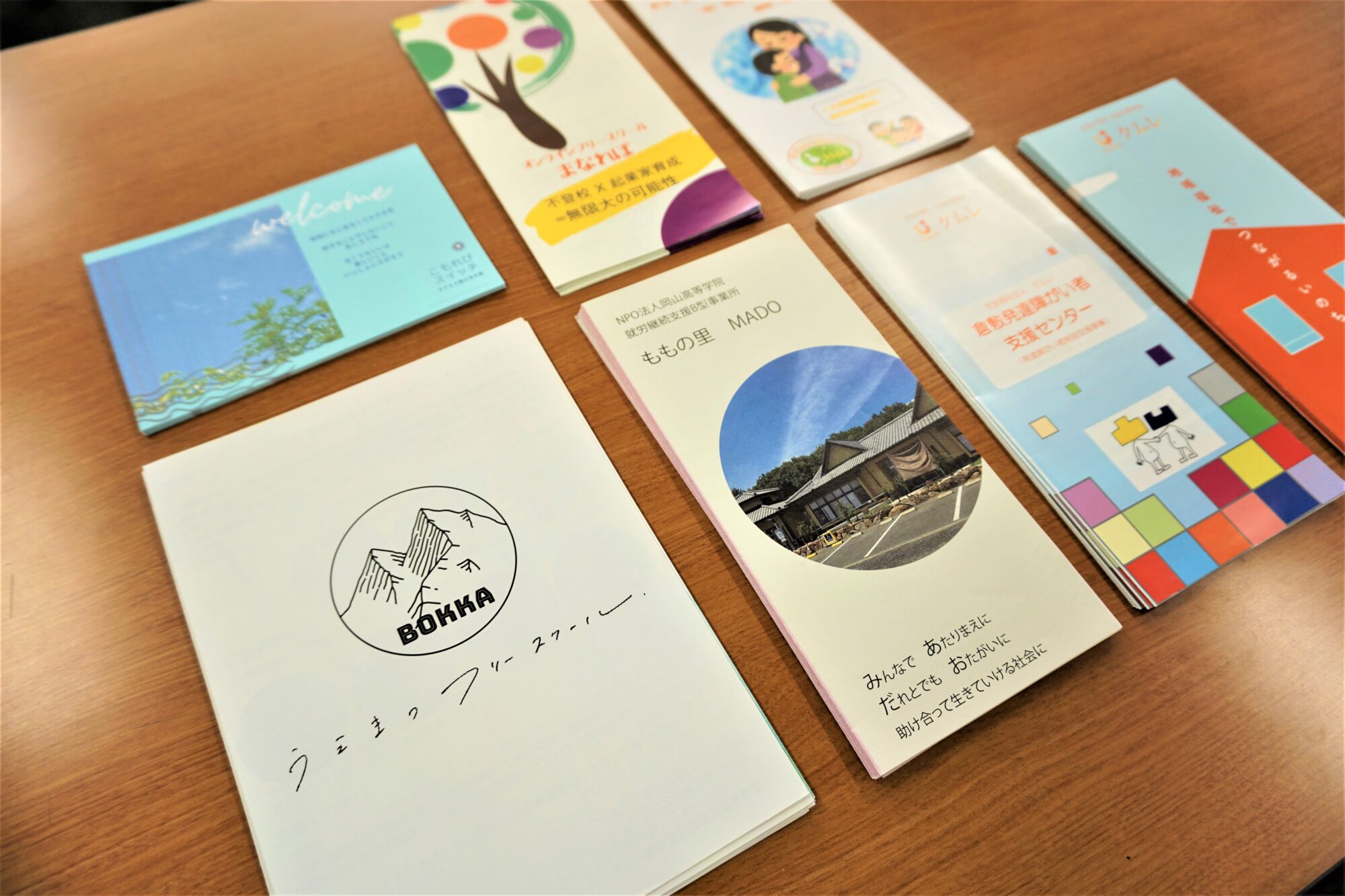
I am always thinking about how to deliver information to those who need it but have not yet received it.
Among those who cannot come or participate, how can we convey the content of the activities?
I feel that those who cannot attend may be struggling alone, facing their children, and I hope that we can reach them even a little.
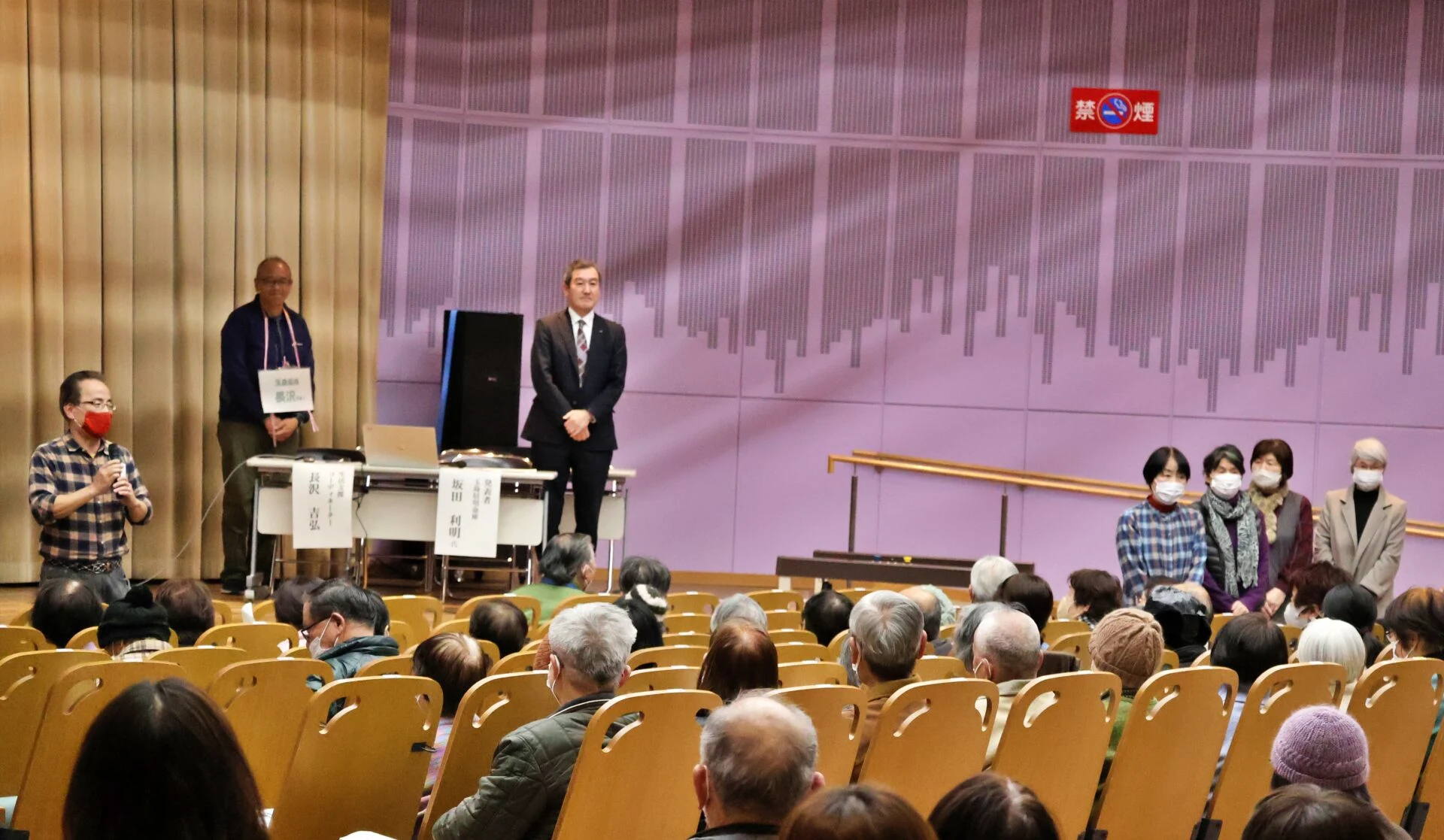
At the outreach discussion meetings, there were participants who said they came because they were from Hayashima or Tamashima.
I want those who come to the meetings to take back useful information, and I think that if we share it on social media, it might reach those who cannot attend in the same way.
On the web, I am also compiling information related to non-attendance.
I feel like I am acting on behalf of those who may want to know about the activities of various organizations.
- LINE
Indeed, besides holding discussion meetings, you are participating in various activities of other organizations.
Kitamura
As the biggest vision of our organization, I want to create a community where child-rearing can be done without isolation.
When I thought about what we could do for that, I realized that the first step is to let people know that the organization Fuwasapo Kurashiki exists.
When children are unable to attend school, mothers become anxious. If it’s hard to get information at school, they wonder what everyone else is doing.
Some people feel a high barrier to attending discussion meetings, or they may have a negative impression thinking it’s a place for those who do not attend school.
Therefore, I hope that by knowing about us, regardless of whether they are attending school or not, it can lower the barrier.
By collaborating with organizations that support child-rearing, not limited to non-attendance, I hope to let people know about Fuwasapo Kurashiki and have mothers think of it as a kind of protection.
It’s not about prevention, but rather knowing about it before it becomes a problem.
Aiming for child-rearing without isolation
Can you tell us about child-rearing without isolation?
Kitamura
When I reflect on my own child-rearing, I remember feeling that I was trying very hard and couldn’t consult with anyone.
I think mothers who have been helped by everyone during their child-rearing can ask for help if something happens.
On the other hand, those who are trying hard alone, especially serious ones, find it even harder to consult and end up isolating themselves.
Considering this from my own experience, I believe that it’s better to be able to consult naturally from before childbirth than to wait until something happens.
Even during the discussion meetings, there are serious mothers who try hard and finally manage to speak.
I wonder if they didn’t have anyone to consult with around them, so I started connecting with organizations that support during and after childbirth, beginning with letting people know about Fuwasapo Kurashiki.
Is it about creating a community where everyone can raise children together, not just at the time of school enrollment?
Kitamura
Yes.
Conversely, if we talk specifically about non-attendance, I want to increase the number of people who understand families with children who do not attend school.
While going to school may be seen as the norm, we need to create an environment that accepts that some children may choose otherwise, or else mothers will continue to bear everything alone and deepen their isolation.
When mothers feel they have to manage everything on their own, it can worsen the parent-child relationship.
I hope for a kind society where people of all ages can recognize that there are ways to live without going to school.
Right now, it’s just that they are not attending school. It would be nice if there were various options beyond school.
Can you tell us about your future activities?
Kitamura
From the next fiscal year (2023), I would like to start by extending the discussion meeting time and create activities like circle activities led by those who are good at what they do.
Some people can talk even when there’s nothing going on, but others may not.
While doing some hands-on work, sometimes the real feelings come out, saying, "Actually..."
It’s okay to focus on just doing hands-on work without talking.
It can also be a space to enjoy your own time away from your children.
Additionally, I think it would be good to have a place where those with non-attendance experience can share their experiences.
Mothers likely have thoughts about what they want their children to do, but they rarely have the opportunity to hear what their children actually think.
Those with non-attendance experience can deepen their self-awareness by expressing themselves, and mothers can listen to their children’s stories, which would be beneficial for both.
Conclusion
From Kitamura's story, I felt a strong desire to do what can be done to ensure that parents and guardians do not struggle alone.
As society is moving towards diversification, Kitamura says she feels that focusing solely on the inability to attend school may not be the right approach.
However, for now, those who are struggling need to gather under the flag of non-attendance, and if they don’t, they may not know what to do, so I will continue to raise the flag without wavering.
This closing remark was very impressive.
Looking at the basic guidelines issued by the Ministry of Education, Culture, Sports, Science and Technology in response to the School Attendance Opportunity Securing Act enacted in 2017, there is a phrase that states the need to ensure that non-attendance is not perceived as problematic behavior.
While there is a movement to expand options for learning outside of school, many parents and guardians were taught that going to school is the norm, and it seems that many feel anxious or worried about not attending school.
I hope for a society where various options are accepted for children and parents who are struggling due to not being able to attend school, as well as for those who are not.
Data on the parent group "Fuwasapo Kurashiki"
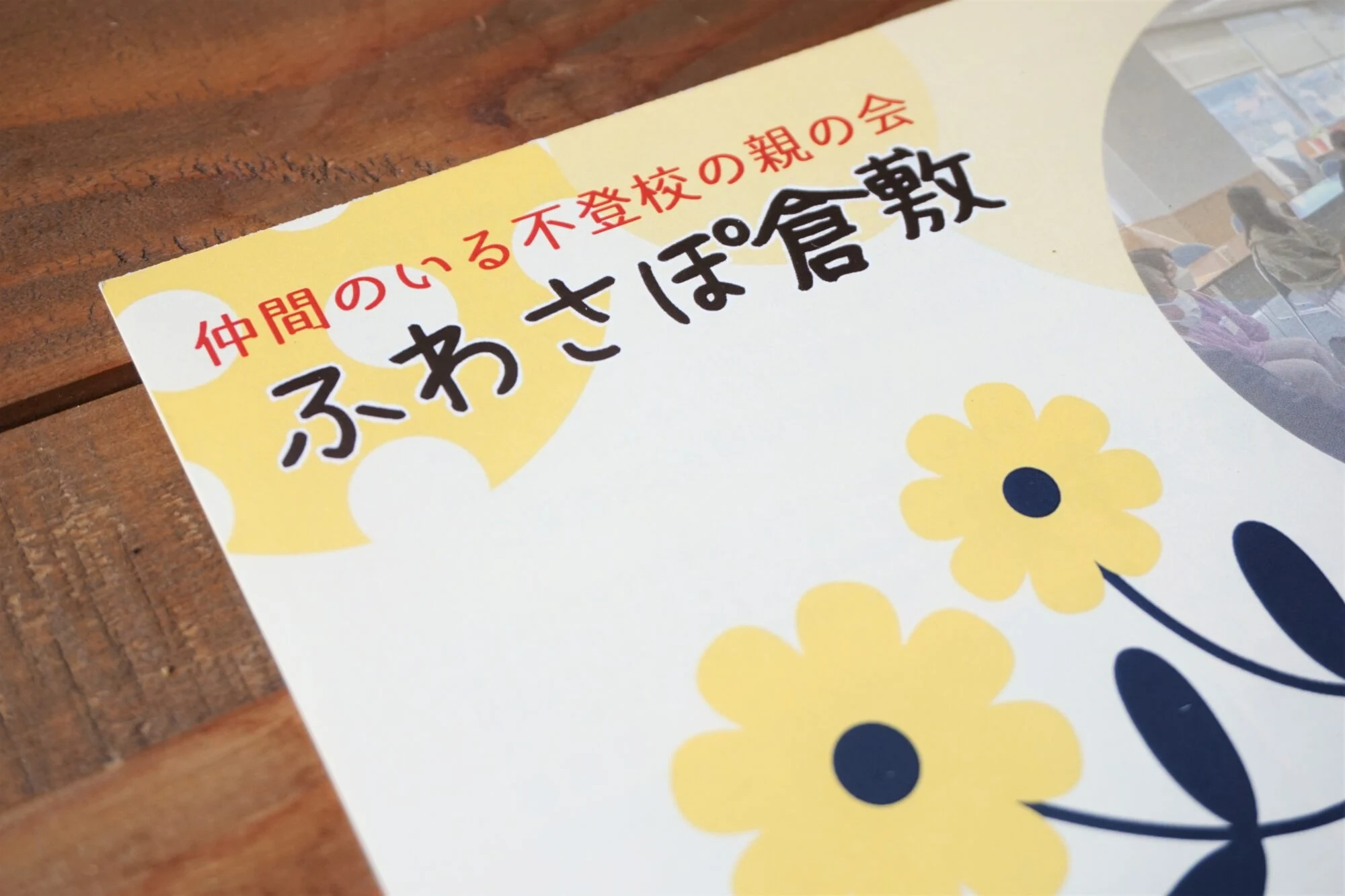
| Organization Name | Parent group "Fuwasapo Kurashiki" for children who do not attend school |
|---|---|
| Representative Name | Kitamura Yasuyo |
| Year Established | 2019 |
| Address | 180 Sasao, Kurashiki City |
| Website | Parent group "Fuwasapo Kurashiki" |