Interview with Yuka Akashi

Why did you start a bookstore in this location?
Akashi
I was already good friends with the Denim Brothers, who run “DENIM HOSTEL float,” and had visited several times since they first opened the hotel.

Last summer, I stayed at float for two weeks, and that made me fall in love with this town all over again.
Then Mr. Shimada of the Denim Brothers invited me, saying, “There’s a vacant property right next to float, so let’s do something there,” and introduced me to the property. That’s how it all began.

There’s a big cherry tree by the entrance, and I thought how beautiful it must be in spring.
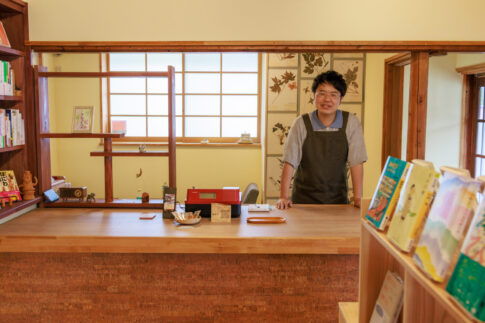
I wanted to try running a bookstore in this peaceful place where you can see the sea.

What inspired the store’s name, “aru”?
Akashi
I chose the name because I hoped the people who visit would find meaning in the store’s existence. I wanted it to simply “be there.”

How do you choose the books sold at aru?
Akashi
Basically, I choose books that I think people would enjoy reading in the peaceful setting of the Seto Inland Sea.
I feel that many people come to the Seto Inland Sea to rest and recharge, or to find some peace of mind.
That’s how I feel whenever I come to the Seto Inland Sea, too.
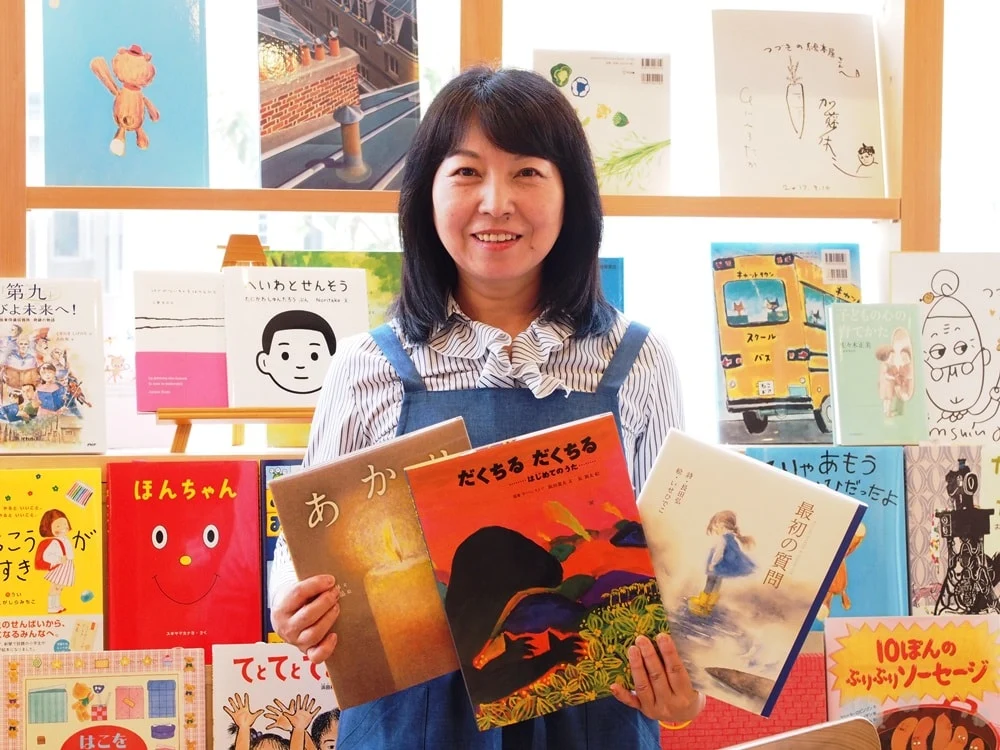
So rather than business or self-help books, I choose books such as photo collections, poetry, essays, and novels—books that help you unwind a little.

As of August 2021, the new books I carry are limited to those made by people I know.
I want to stock books made by people I know personally, books I can genuinely recommend as “good”.
It’s been four months since we opened, and I feel like the store is gradually changing along with our customers.
When I’m choosing books to stock, I picture the faces of our regular customers.
“That person liked food essays. Maybe I’ll get more food essays,” for example.
I enjoy seeing the store change in response to the people who visit, while still keeping my own preferences.
It’s a small store, so I get lots of chances to talk with customers, and sometimes I choose books based on how our conversations go.

Do you have any favorite writers?
Akashi
Books broaden my world, so I read books by all kinds of people, young and old, men and women.
I especially love the writing of Ramo Nakajima, Atsuko Suga, and Kaori Ekuni.

What do books mean to you, Akashi?
Akashi
I grew up in a fairly strict household and lived according to society’s expectations. Books taught me how vast the world is, and that “it’s okay to live more freely.”
These days, I think of them more as conversation partners.
I often turn to them for help when I’m thinking about something I don’t understand.

What do you like about living between two places?
Akashi
Life in Kojima, Kurashiki City, and life in Tokyo are truly opposites.
Tokyo is crowded, with lots of cars and tall buildings, and the sky feels small.
I live alone and work in reporting and editing, so I’m the one who goes out to meet people.
In Kojima, the sky is wide, there are fewer people, I live communally, and at the store I’m the one waiting for people to come in.
They’re opposites, but both are everyday life and out of the ordinary.
There are so many different ways to live, and it makes me feel that I don’t have to be tied down.
Time spent with books is enriching

I’ve loved books since I was little and often went to the school library.
I got excited by the dreamlike dishes in picture books, was moved by the memoir of a man who protected cranes in Hokkaido, and cried imagining partings I hadn’t yet experienced.
There’s only so much we can experience ourselves in one lifetime, but books have taught me many times more than that.

In recent years, however, I’ve been reading more to “gather information efficiently,” and haven’t been able to take my time savoring the words.
When I was feeling frustrated about this, I first visited aru. The book that caught my eye and drew me in was a lifestyle essay by a stylist, published in 1998.
It was a book I would never have come across, even if I had set out to “look for” it.
But throughout it were words that made me think, “It would be lovely to live that way.”
After buying it, I put it by my desk and sometimes flip through it, letting it brighten my heart.

Books can introduce us to new worlds, give us words that resonate, and help us reaffirm what we want to cherish.
I think books are truly wonderful.
At aru, you may find a book that helps you unwind.
Look out at the sea and take your time immersing yourself in the world of books.
About aru

| Name | aru |
|---|---|
| Address | 1421-18 Karakoto-cho, Kojima, Kurashiki City, Okayama Prefecture |
| Parking | Available Free municipal parking for about 40 cars nearby |
| Hours | Open irregularly; hours vary ※Check the official Instagram |
| Closed | Irregular holidays |
| Payment methods |
|
| Website | Official Instagram |

What would you like to know about Kurashiki?
Enter a search term to find articles on this site