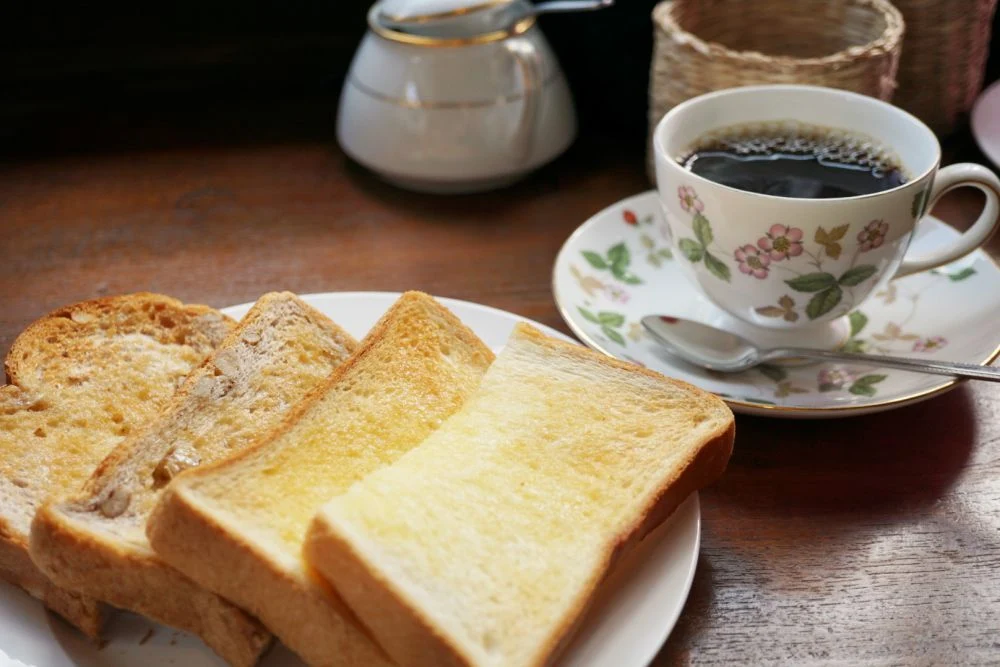
Interview with Akihide Takamoto, owner of Coffee House Gojitoma

What inspired him to open a coffee shop
What inspired you to open a coffee shop in Mabi?
Takamoto
When I was a university student, I worked part-time at Tsukiji, a long-established coffee shop in Kyoto Prefecture, and spent my days going to the movies while frequenting Inoda Coffee.
I somehow managed to graduate from university, and instead of getting a job, I made a living working part-time at coffee shops.
I ended up returning to my hometown of Mabi, and married Yumiko, whom I had met through an acquaintance. I went to greet her parents.
Her parents asked me, “How are you going to support our daughter?”
Fair enough, since I was living what you might call a freelance lifestyle today.
So I blurted out, “I’ll open a coffee shop and support her!” (laughs)

After that, there was no turning back, and I opened Coffee House Gojitoma in May 1980, one month after we got married.
I was 27 at the time.
Nearly 40 years since opening: how he has kept the coffee shop going for so long

It will soon be 40 years since you opened.
What is the secret to keeping a coffee shop going for so long?
Takamoto
Being able to endure poverty, I suppose.
If you want to make money, a coffee shop is not the business to get into.
It means long hours on your feet from morning until night.
Several people have come to me saying they want to open a coffee shop, but I tell them, “You’d be better off not doing it.”
It’s a mystery how I’ve managed to keep going this long.
I suppose I’ve been lucky, and I’ve stayed healthy all this time.

Have you faced any hardships or difficulties in keeping it going?
Takamoto
The disaster we suffered this time—the July 2018 heavy rains—made me realize how difficult it is to keep going.
Since the disaster, I wake up every morning with a sense of loss.
Sometimes I wonder, “Why am I still running a coffee shop?”
But I keep going because I want to be of help to someone.
The film Ikiru, which made him think about being of help to others
Takamoto
Actually, when I was 18, in 1971, I saw a film by director Akira Kurosawa called “Ikiru,” and thought, “Someday, I’ll open a coffee shop.”
The film is about a man who spends his days doing routine government office work, then learns he has six months to live after being diagnosed with cancer. He struggles and fights until his death.
Inspired by the words “Why not try making something?”, he eventually sets out to build a park.

In the end, spending money just to satisfy your own desires doesn’t feel like enough. I think people can only truly feel that they are “alive” when they do something useful for others.
I’ve gotten older and there’s less I want for myself, and the desire to be of help to someone has welled up in me. I suppose that’s all there is to it.
He wants people to visit in person, see with their own eyes, and feel with their minds

The records played in Gojitoma are part of its appeal, too.
Could you tell us what makes records different from CDs and what you value about them?
Takamoto
CDs cut out sounds that the human ear cannot hear.
What’s good about LP records is that the unnecessary sounds that the human ear cannot hear are still there.
I think people sense “emotion,” “subtlety,” and a “stylish atmosphere” in the parts they can’t hear.

You see that picture on the wall? Your eyes recognize it as “just a drawing of a dandelion,” but don’t you feel something in the parts that aren’t drawn, too?
It’s the same with writing.
I think people can feel things in the spaces between the lines of text.
My hobbies—watching films and listening to music—are all ways of looking inward and examining myself.
I find that really interesting.

Young people today can easily see and learn about all kinds of things through social media, right?
But I want them, as much as possible, to go there in person, see with their own eyes, and feel it with their minds.
You might think it’s a waste of time, money, and effort, but when you actually go and look back on it later, I’m sure you’ll think, “That was so much fun!”
About his carefully crafted, fragrant coffee

Could you tell us what you pay particular attention to when it comes to coffee?
Takamoto
If even the slightest deliberate movement comes into play, the coffee is 100 percent ruined.
I think it’s important to build up daily practice so that the coffee can be brewed automatically as soon as you flip the switch.
Once, when I tasted coffee made by one of my apprentices, seven-tenths of it was blank.
I told him that he needed to fill in those gaps.
Roasting coffee beans is very difficult, and it’s also difficult to brew roasted coffee well.
It takes an enormous amount of effort and study to bring out the best in coffee.
I still have a long way to go myself.
The words of regular customers that encouraged him to reopen
You were affected by the July 2018 heavy rains. What made you decide to reopen the shop?
Takamoto
In reality, I thought, “We can’t reopen. It’s too difficult.”
But the regular customers who came by all asked, “When are you reopening?”
So the people around me left me no choice (laughs).

He wants to serve a cup filled with gratitude that can help someone
Finally, could you tell us how you feel about the future?
Takamoto
The future… What do you think I should do?
I’m troubled because I don’t know myself, so I’d like you to tell me.
That’s why I sometimes ask customers, “What should I do?”
And most of them tell me, “It’s enough just to have a shop here in Mabi.”
So I guess I have to keep going.

If I had no gratitude in my heart, I would have closed a shop like this long ago.
I wonder now what would have happened if I had gone on living an ordinary life as I did before the disaster.
The disaster brought me many hardships, but it also made me think about many things.
Before the disaster, I never did this, but now it’s part of my daily routine to put my hands together at the family altar every morning and express my gratitude for the people I met the day before.

I’m overcome by a sense of loss every day, but it’s because I feel gratitude that I’m able to keep the shop going.
It’s not just us; when I listen to the people who visit the shop, everyone has their worries and their own difficulties.
Seeing how wonderful the volunteers were and being given the chance to experience genuine kindness made me want to be like them. I began to hope I could brew and serve a cup of coffee that would be of help to someone.
From the Writer

The master’s conversation never runs dry or gets boring. He’ll playfully exclaim, “Really?!” or listen with shining eyes, saying, “Oh, I see!”
The close-knit couple who run this lovely coffee shop are also my ideal of a married couple.
Sipping coffee brewed by the master, who faces life’s worries and hardships each day yet lives sincerely and with gratitude, and taking it easy in the relaxing interior.
I also recommend enjoying a chat with the master and his wife at the counter.
Why not visit in person and enjoy this relaxing, restorative space?
Coffee House Gojitoma Information

| Name | Coffee House Gojitoma |
|---|---|
| Address | 748-4 Yata, Mabi, Kurashiki City, Okayama Prefecture |
| Contact | 086-698ー6225 |
| Parking | Available 15 spaces |
| Hours | Saturday, Sunday, Monday 12 noon (12:00 p.m.)–6:00 p.m. |
| Closed | Tuesday, Wednesday, Thursday, Friday, and public holidays Check the shop’s Facebook page for operating days. |
| Payment methods |
|
| Reservations | Accepted |
| Seating | Counter: 5 seats Tables: 20 seats |
| Smoking | Non-smoking (smoking permitted only in designated areas) |
| Restroom | Western-style toilet |
| Website | Gojitoma |



What would you like to know about Kurashiki?
Enter a search term to find articles on this site