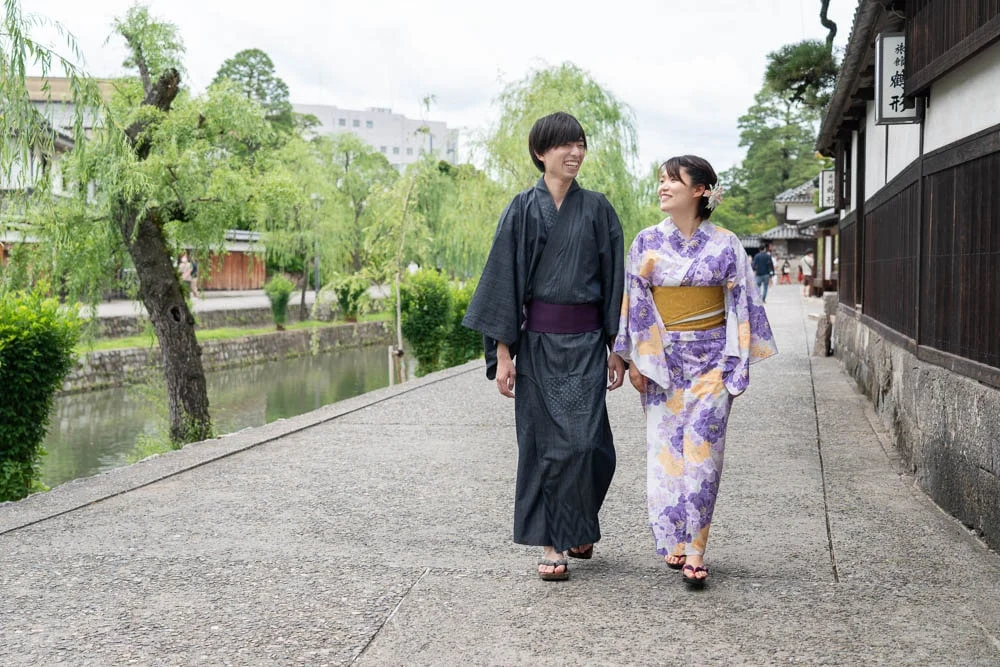
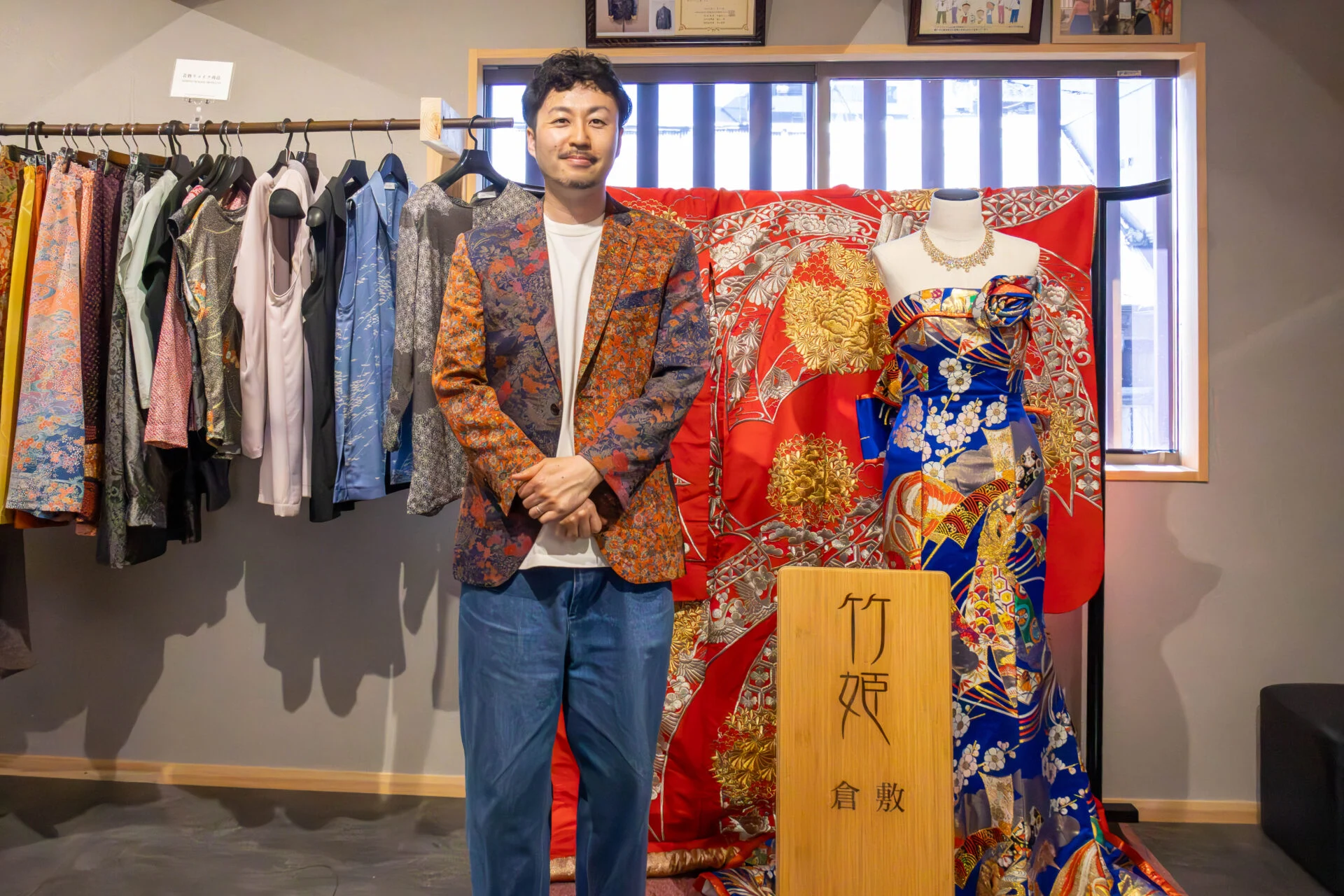
Interview with shop manager Akiko Hongo
After our model tried the experience, we spoke with shop manager Hongo.

You make your own original denim kimono, right? I imagine it must be difficult to make a kimono out of denim.
Hongo
It was difficult.
When I first opened the shop in 2016, I only carried regular kimono and yukata.
But since this is a shop in Kurashiki, I thought it would be better to be able to say, “You can wear kimono that you can’t rent in Kyoto or Tokyo.”
I started making denim kimono myself, but it was incredibly difficult.
What specific challenges did you face?
Hongo
First, it was difficult to find someone I could ask to make them.
Regular kimono are sewn by kimono tailors.
But denim fabric has to be sewn by machine, so I couldn’t ask a kimono tailor.
People who sew by machine had never made a kimono before.
Eventually, I found a denim-processing company that could take on the work and started making them, but then getting the sizing right was difficult.
Denim shrinks, you know.
At first, I cut the fabric to the exact measurements, but when it was washed, it shrank so much that it ended up about the size of children’s clothing.

We calculate how much it will shrink, cut the fabric larger, and then sell the kimono after it has gone through the washing process.
Partway through, the company that had been handling the sewing and processing could no longer do the work, so we had to have someone else sew them.
That person had never made a kimono before, so we put them through a lot of trouble at first.
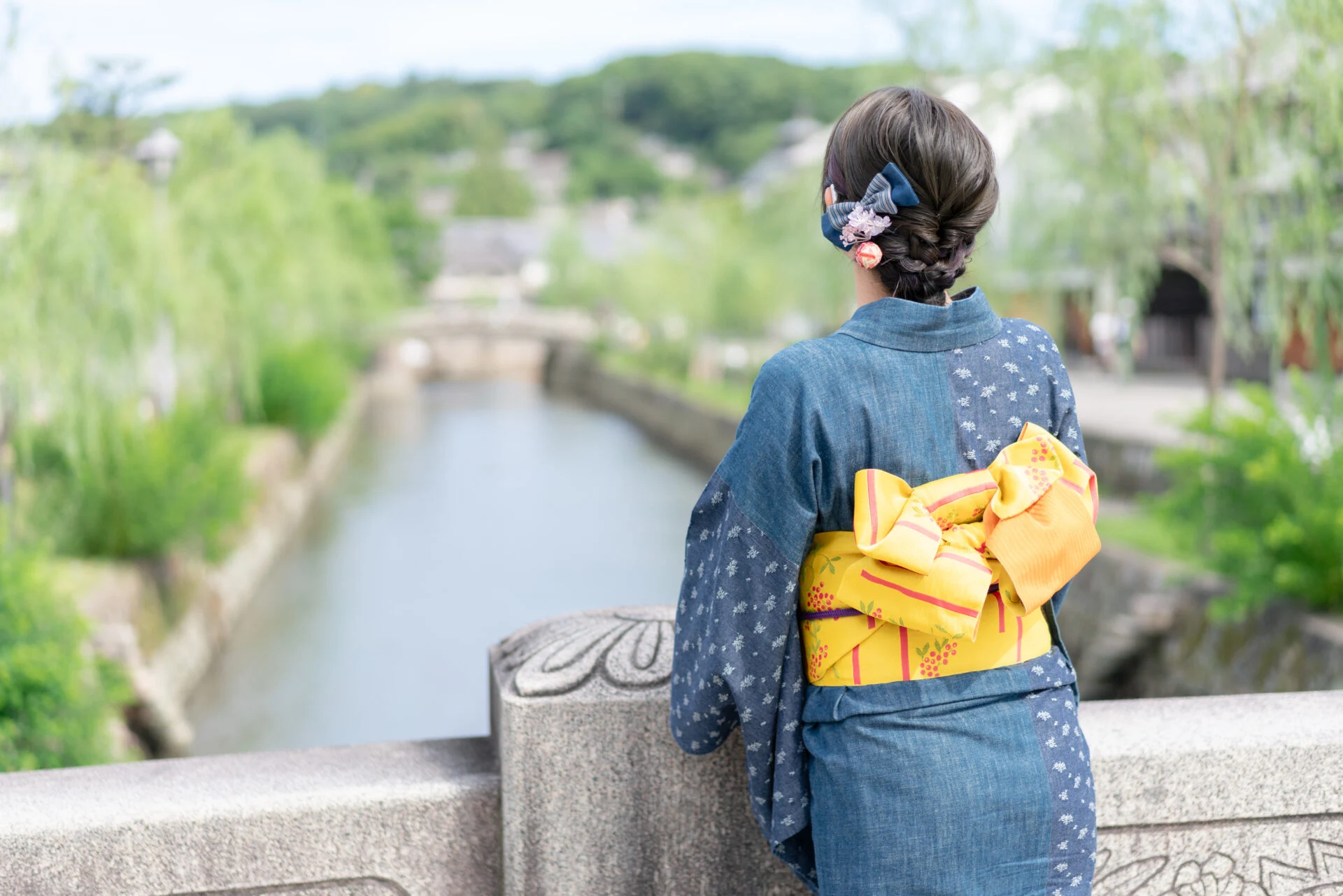
Now we commission artists in Fukiya, Takahashi City, Okayama Prefecture, a bengara-producing area, to dye white denim with bengara, and offer a variety of denim kimono.

Are denim kimono rentals popular?
Hongo
They’re popular.
You can’t wear them in other areas.
The fabric used for denim kimono is truly lovely.
It’s woven to be very supple, like Oshima tsumugi (a high-end silk fabric known as the queen of kimono).

What are the characteristics of the Kojima obi?
Hongo
It’s very firm, so it’s easy to create a well-defined shape when you tie it.
Regular half-width obi tend to go floppy, but the Kojima obi doesn’t, so you can make decorative knots.
They’re very well received.
It seems like they would go well with all kinds of kimono.
Hongo
Because they’re denim, they’re really easy to coordinate.
When you’re wondering, “What kind of obi should I wear with this kimono?” the Kojima obi feels just right: “The Kojima obi would be good,” or “The Kojima obi would make it look stylish.”
They’re really useful.

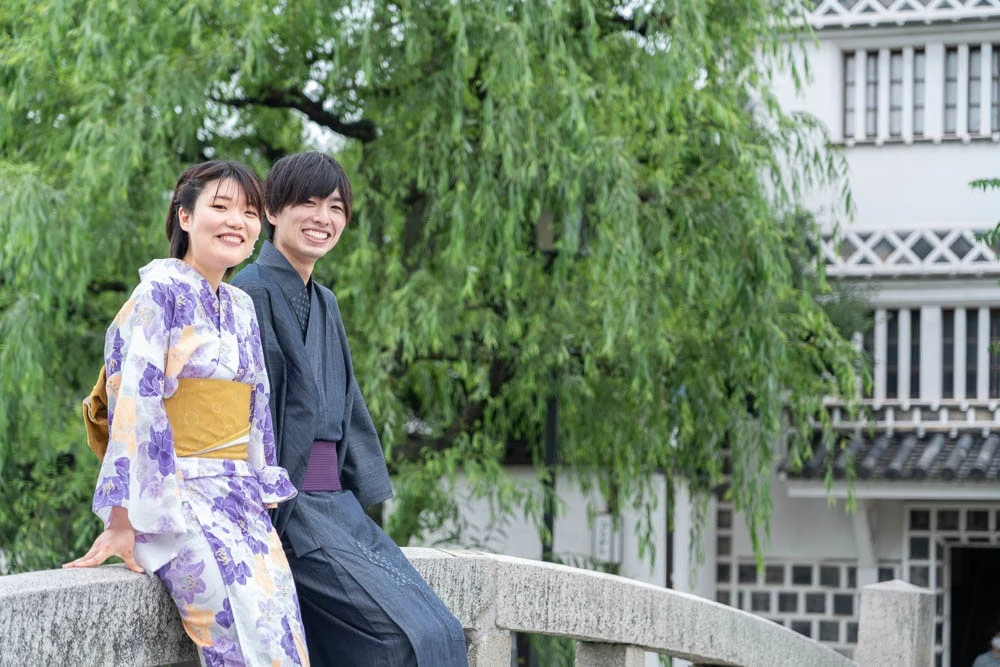
The model said, “It wasn’t uncomfortable and was more comfortable than I expected.” Some people remember feeling uncomfortable the first time they wore a kimono for their coming-of-age ceremony and think that “kimono are uncomfortable.”
Hongo
Dressing for a coming-of-age ceremony is a special case, and people tend to tie everything tightly so it “absolutely won’t come undone.”
So some people come away thinking, “It was hard to move and uncomfortable.”
But with a regular kimono, you don’t need to tie it that tightly.
People who rent from Kimono Roman often tell us, “It’s not as uncomfortable as I expected, and I can move around easily.”

That’s wonderful. What made you start this work, Ms. Hongo?
Hongo
I worked in the clothing industry for about 20 years.
After that, I worked at a kimono rental shop, but due to various circumstances, I had to leave.
But kimono rentals make people so happy, and it’s such enjoyable work.
I thought, “I’d like to do it myself,” and opened the shop in 2016.
So you switched from Western clothing to Japanese clothing.
Hongo
Yes. Kimono and Western clothing have things in common, don’t they?
Things like putting together an outfit, and how wearing them can change how you feel.
“I want to make women look wonderful” is a feeling I’ve held consistently since I worked in the clothing industry.

A lovely outfit lifts your spirits, doesn’t it?
Hongo
I hope people enjoy choosing their outfit, enjoy getting dressed, and then head out feeling absolutely thrilled.
Kimono are Japan’s traditional clothing, so I hope more Japanese people will wear them too.
This really is enjoyable work.
I love this job.

From the Writer
With Japanese clothing, you can enjoy combinations you might hesitate to try with Western clothing, and feel different from usual.
Wearing a kimono while traveling or taking a stroll is so much fun!
Even if you don’t know much about kimono, you can feel at ease because you’ll get advice.
Be sure to rent a kimono from Kimono Roman and explore the streets of Kurashiki.
- Model: Hi-kun
Kimono Roman details

| Name | Kimono Roman |
|---|---|
| Address | 2-23-1 Achi, Kurashiki City, Okayama Prefecture |
| Contact | 090-9502-4455 |
| Parking | None |
| Hours | 10:00 a.m.–6:00 p.m. Rental registration closes at 5:00 p.m. Rental kimono must be returned by 5:30 p.m. |
| Closed | Irregular holidays Business calendar available on the official website and Facebook |
| Fees (tax included) | Kimono rental from ¥3,900 (before tax) |
| Payment methods |
|
| Reservations | Accepted Reservations have priority; walk-ins are also welcome |
| Restroom | Western-style toilet |
| Childcare | The room can be partitioned with a curtain and used as a nursing room |
| Website | Kimono Roman |

What would you like to know about Kurashiki?
Enter a search term to find articles on this site