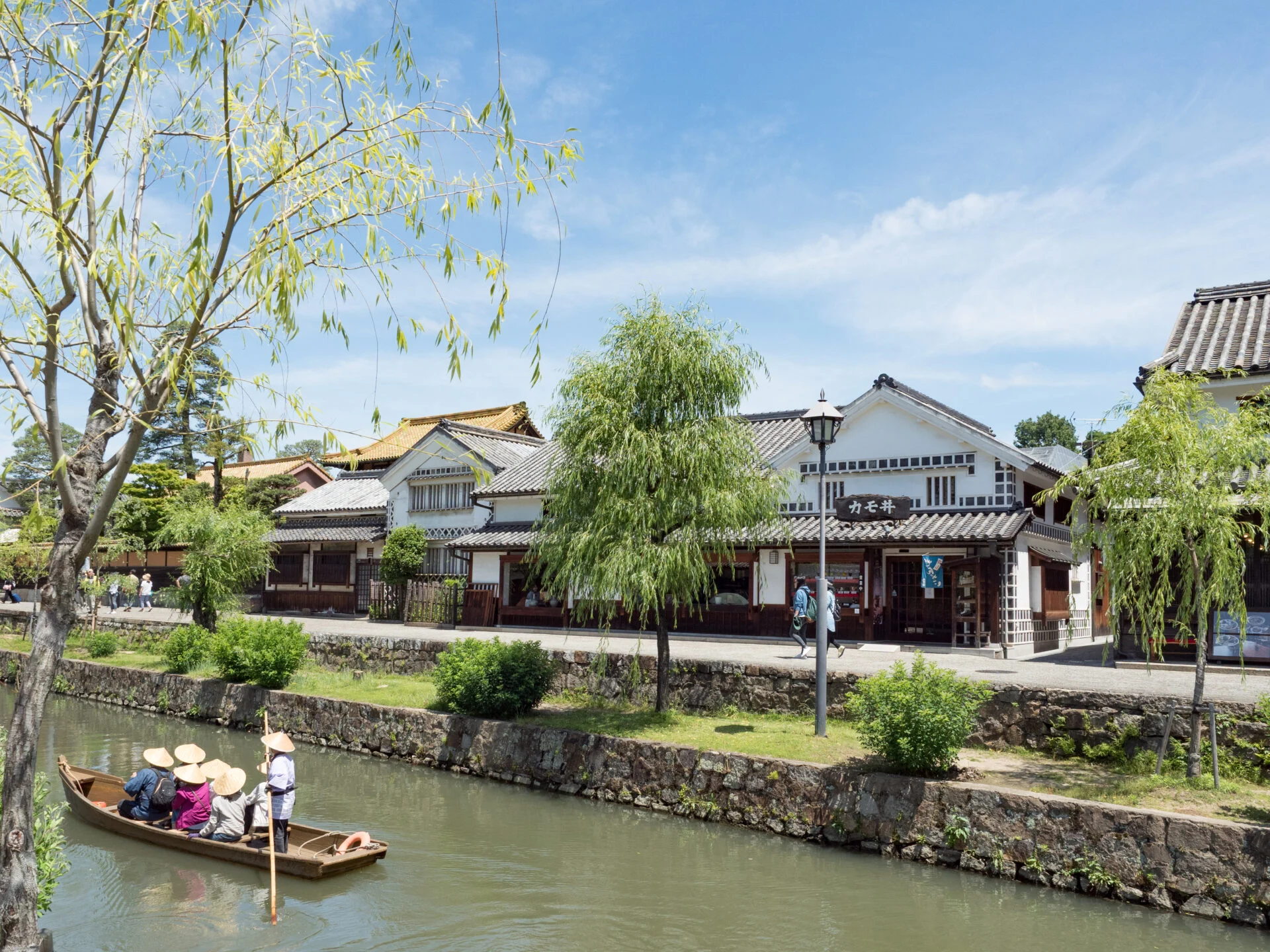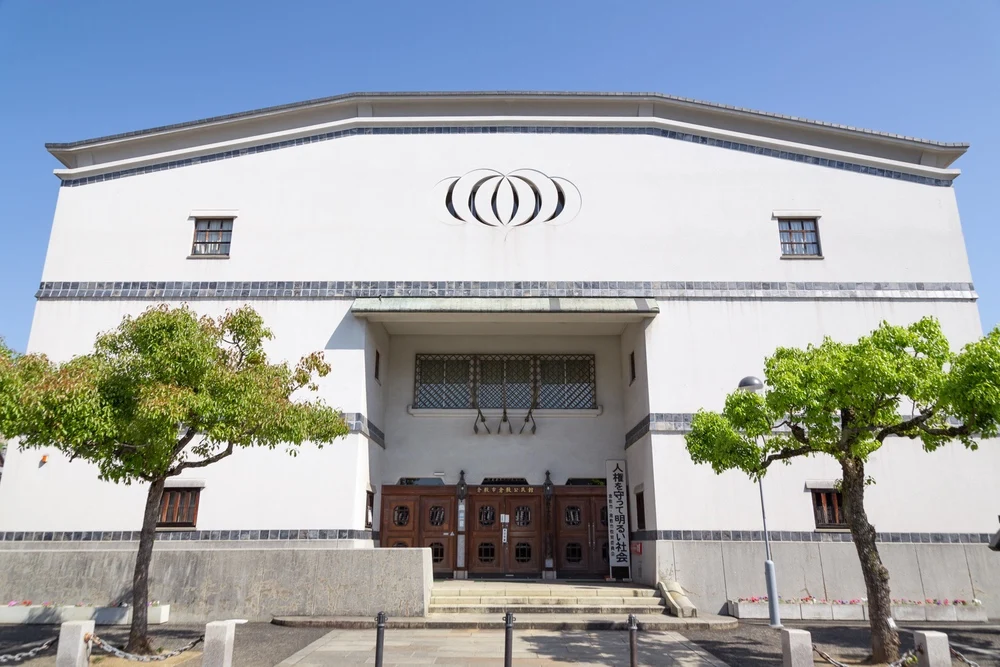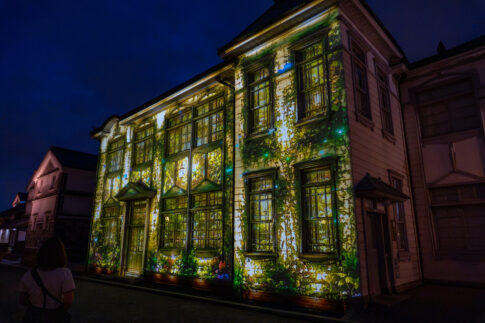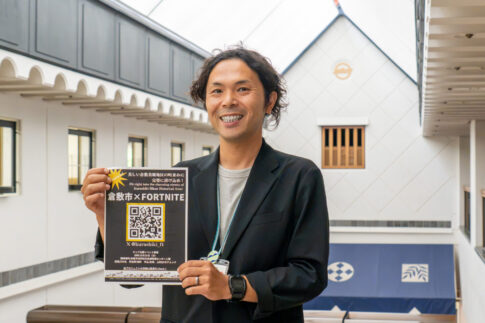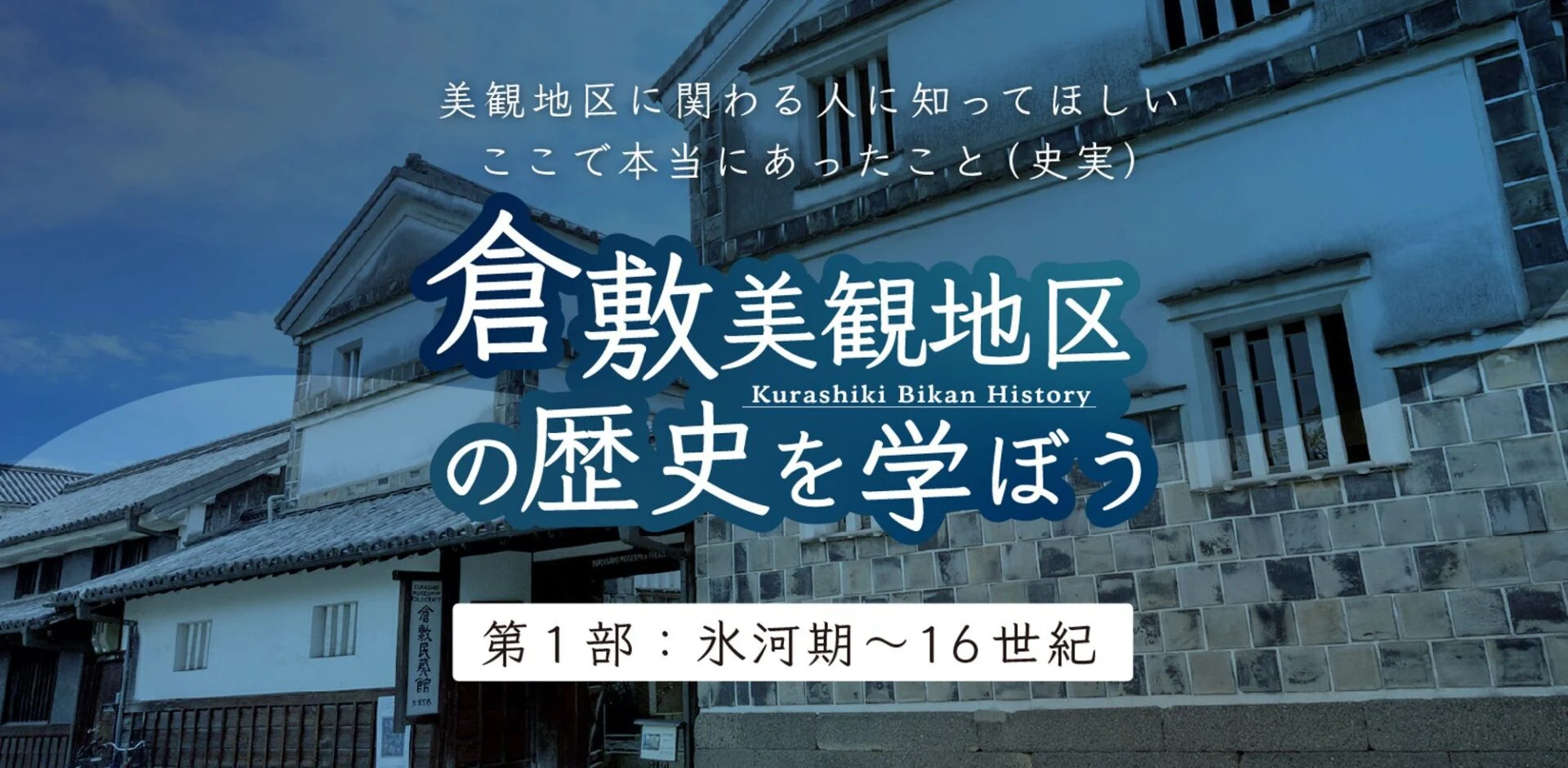
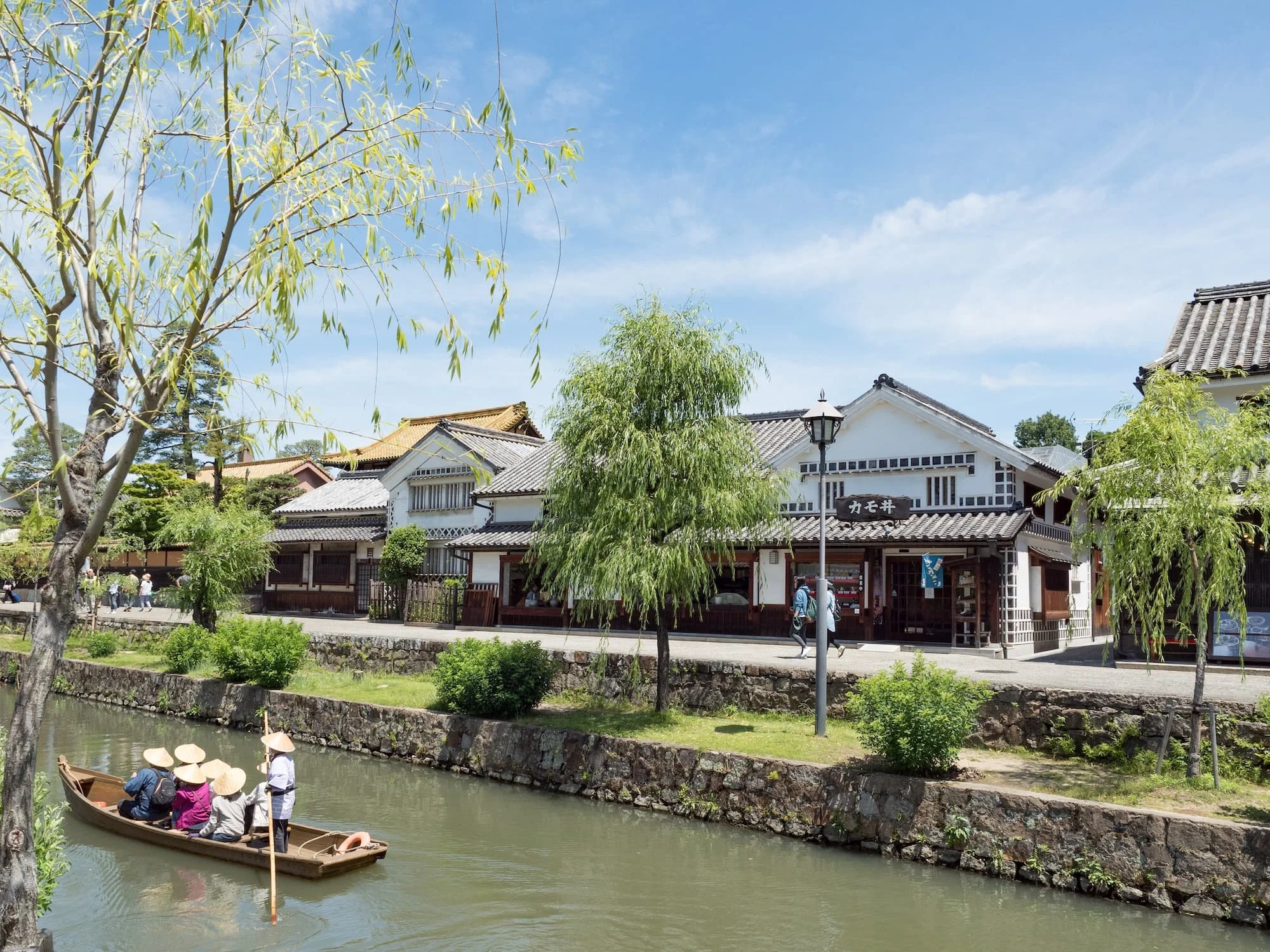
The Bikan Historical Area in Kurashiki is a place that conveys the townscape harmonizing white-walled residences and Western-style architecture that have remained since the Edo period to the present day.
Townscapes like the Bikan Historical Area were commonplace in pre-war Japan, but they gradually disappeared during the post-war period of rapid economic growth. In 1968 (Showa 43), Kurashiki took the lead in the nation by enacting the "Kurashiki City Traditional Scenic Preservation Ordinance," choosing to preserve this townscape.
However, the Bikan Historical Area is not a "town frozen in time." It is a "living town" that incorporates new elements in line with the times, not just focusing on tourism, but also where residents live.
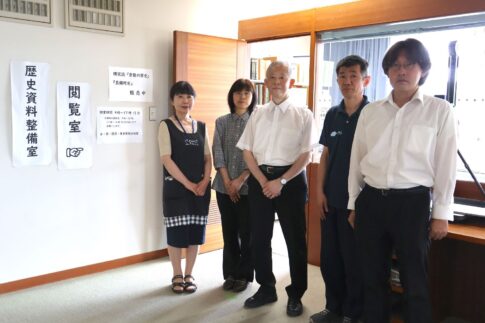
"Let's Learn About the History of the Bikan Historical Area" is based on the reports and slide materials presented by Taro Yamamoto from the Kurashiki City Historical Materials Maintenance Office and Noriyoshi Fujiwara from the Kurashiki City Board of Education at a study session held by the voluntary organization "This Town Time Travel Club" in the 2025 fiscal year, summarized by Kengo Toi, the representative director of the Haretoco General Incorporated Association, based on discussions among club members.
This was created with the hope that learning based on research results obtained by interpreting historical materials will serve as a foundation for understanding the historical facts and traditions related to the Bikan Historical Area.
Message from Akane Ohara, Representative of "This Town Time Travel Club"
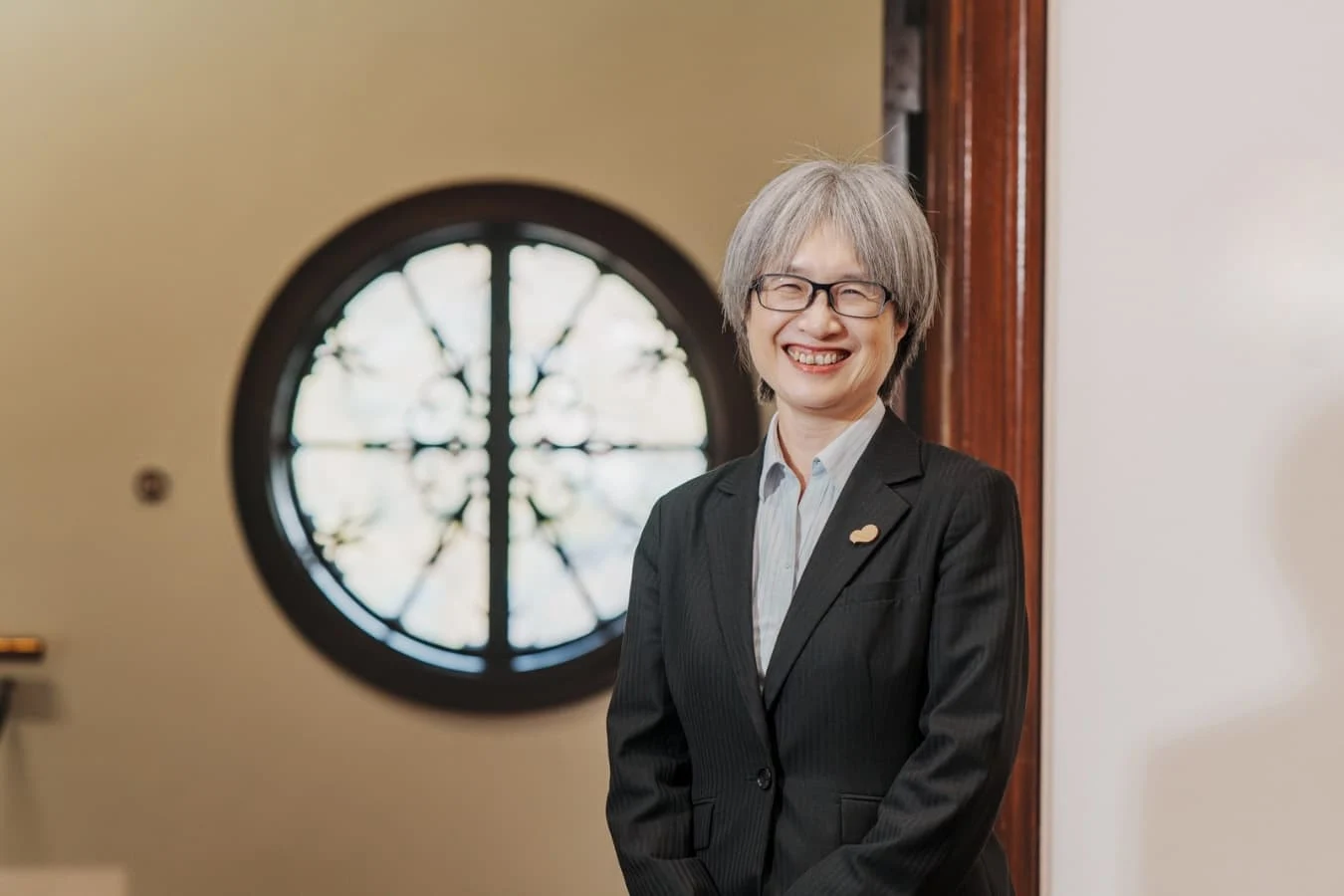
The Bikan Historical Area has nurtured a rich story unique to the area through the layering of people's lives and activities like strata.
The background of its captivating narratives also includes various traditions and interpretations.
We believe that rather than denying these, carefully tracing the historical facts that form the foundation of the stories can provide clues to savor this land more deeply.
Sharing the accumulation of facts in a form that as many people as possible can access is our hope, as it may assist in the new creations and activities of those who love this place.
We hope this article will enrich each of your connections with the Bikan Historical Area.
Definition of the Bikan Historical Area
In this article, the "Bikan Historical Area" is defined as the area designated by the national government as the Kurashiki City Kurashiki River Traditional Building Preservation District (Type 1 Scenic Area) (the area with a blue background in the figure below).
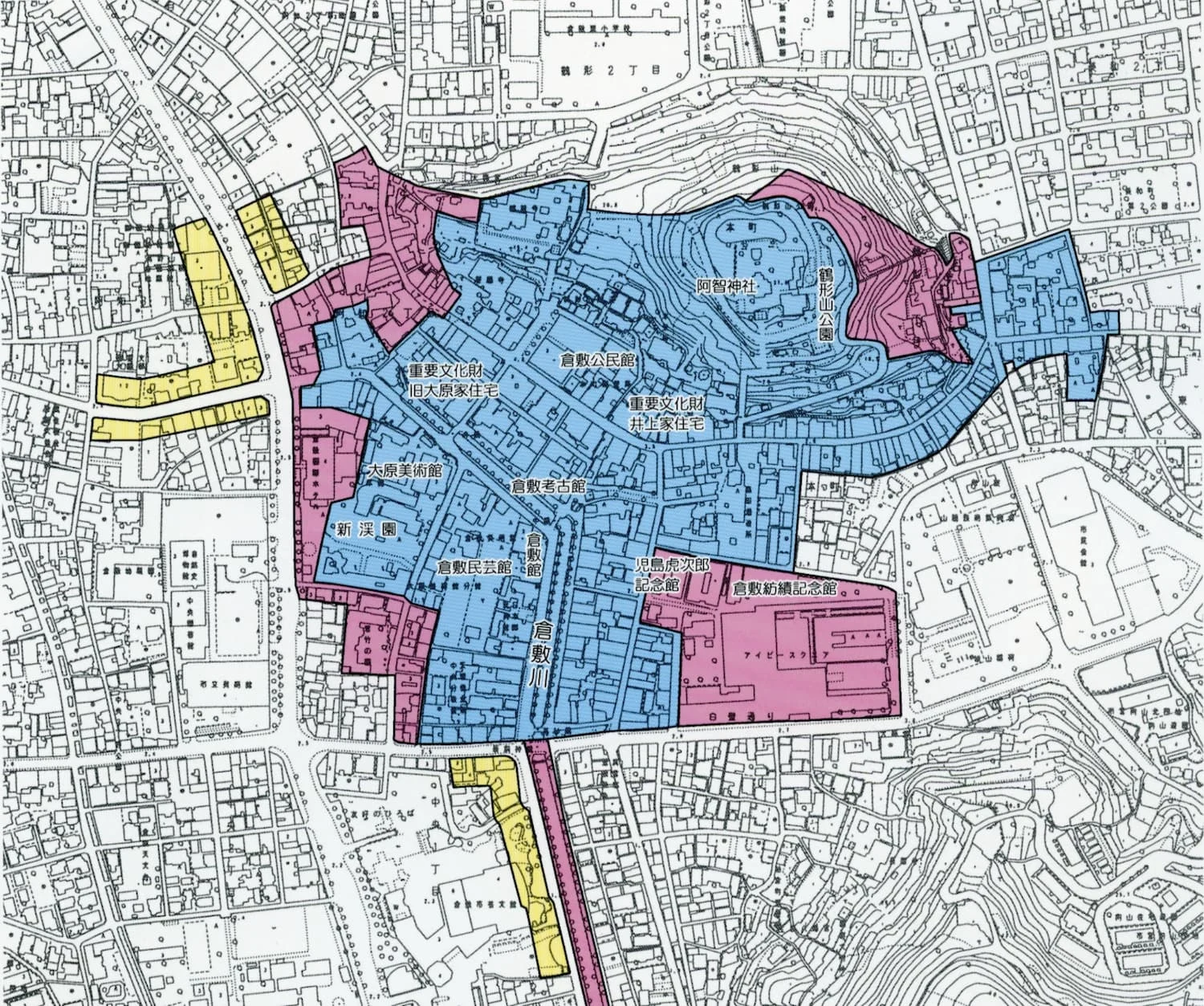
Blue: Traditional Building Preservation District 15.0ha
Pink: Traditional Scenic Area 6.0ha
Yellow: Background Area 2.2ha
(Image provided by Kurashiki City Board of Education)
In Kurashiki, from around 1965 (Showa 40), there was a growing call to create rules to protect the historical townscape, leading to the establishment of the "Kurashiki City Traditional Scenic Preservation Ordinance" in 1968 (Showa 43), the second in the nation (the first was Kanazawa City's "Traditional Environment Preservation Ordinance") (enforced in 1969). This ordinance requires the mayor's consent for any changes to the exterior of buildings.
Subsequently, in 1975 (Showa 50), a partial revision of the Cultural Properties Protection Law led to the establishment of the "Traditional Building Preservation District System." Furthermore, in 1978 (Showa 53), the "Kurashiki City Traditional Building Preservation District Preservation Ordinance" was enacted (enforced in 1979), and the area was designated as a nationally important traditional building preservation district.
Origin of the Place Name "Kurashiki"
"Kurashiki" is an abbreviation of "Kurashiki-chi," meaning a distribution center for goods temporarily stored when transporting annual tributes from the manor (similar to a "warehouse district" today). Therefore, it is not a place name or word with a special meaning, but rather a "term."
The term "Kurashiki" existed in various places in western Japan during ancient and medieval times, with the most famous being the current Onomichi, established for the shipment of tributes from Ota Manor.
As a place name, Kurashiki exists as an old name for the current Kurashiki City and Hayashino in Okayama Prefecture, and the name "Kurashiki" appears as a place name referring to the area around present-day Kurashiki City as far back as the late 16th century.
- August 1585, 13th year of Tensho: "Memorandum on the Beginning of the Eight Villages"
"At that time, the eight villages were Hamamura, Koi-sho, Higashi-Achi, Mita, Nishinosho, Ikkaichi, Nikkaichi, and Hayashima, and at that time, if it was said that water was managed from Kurashiki Village, ..."
From "History of Hayashima 3, Document Edition" P.42 - September 29, 1566, 9th year of Eiroku: "Diary of the Entry into Bichu Province, Niimi Manor"
"... from Kurashiki to Shiwaku ..."
From "Newly Compiled History of Kurashiki City, Volume 9" P.430 - June 8, 1575, 3rd year of Tensho: "Letter from Takakage Kobayakawa"
"I urgently request that you rely on the assistance of A-san in the matter of the constant mountain, and if you can endure it, when I arrived at Hamakurashiki yesterday, this morning at the hour of the rabbit, I found that the three sons of Ryutoku had all been defeated, and I am glad about this matter, ..."
From "New Kumamoto City History, Document Edition, Volume 2, Ancient and Medieval" P.633
From the Ice Age to the 15th Century
History of the Bikan Historical Area
The current area around the Bikan Historical Area first appears in history in the late 16th century.
It is said that the area around the Bikan Historical Area was land during the Ice Age. The sea level was about 100 meters lower than it is now, resulting in the continent and the Japanese archipelago being connected, and the area around the Seto Inland Sea was also land. Therefore, it is believed that the Naumann elephant also inhabited the area, and fossils of Naumann elephants have actually been retrieved from the seabed of the Seto Inland Sea.
During this time, humans also seem to have moved to the Japanese archipelago in search of warm places. Since the area around the Bikan Historical Area was also land, it is possible that people lived there. At that time, humans were moving in search of warm places and food, and the concept of "settlement" was weak, so traces of their lives have not been found.
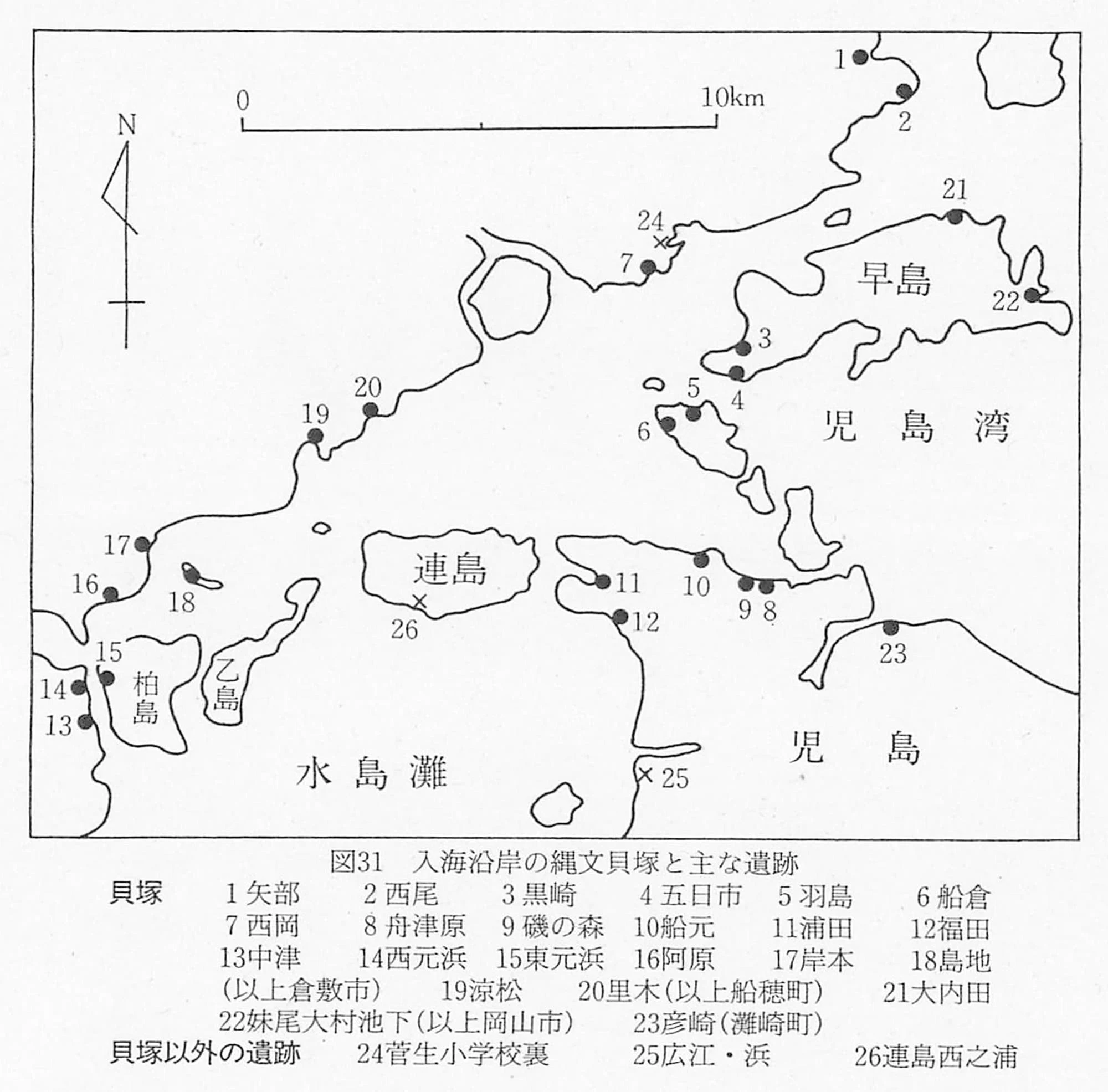
(Quoted from "Newly Compiled History of Kurashiki City," Volume 1, Page 59, written by Tadahiko Makabe and Yoshiko Makabe)
About 6,000 years ago, during the Jomon period, the Ice Age ended, and the land that was once above water became sea. The area around the Bikan Historical Area was the same, but areas now called mountains, such as Tsuragata Mountain and Mukaiyama, and areas now called islands, such as Hashima, were islands at that time, where Jomon people are believed to have lived.
Evidence of this can be found in the remains of the Hashima Shell Mound and the Funakura Shell Mound, particularly the Funakura Shell Mound, which has deep strata, suggesting that relatively many people lived there for a long time.
Subsequently, from the Heian period to the Kamakura period, many manors (lands privately controlled by nobles, temples, and influential figures) were established throughout the region, and the northern part of present-day Kurashiki City was also developed as a manor. During this time, the political center was in Kyoto, so the surrounding areas gradually developed as "places at a reasonable distance from Kyoto." In present-day Nishiachi in Kurashiki City, there is a temple called Henjyo-in, said to have been founded during the Heian period, indicating that land was gradually increasing.
Notably, the most famous event in the late Heian period around Kurashiki is the battles of Fujito and Mizushima during the Genpei War.
15th Century
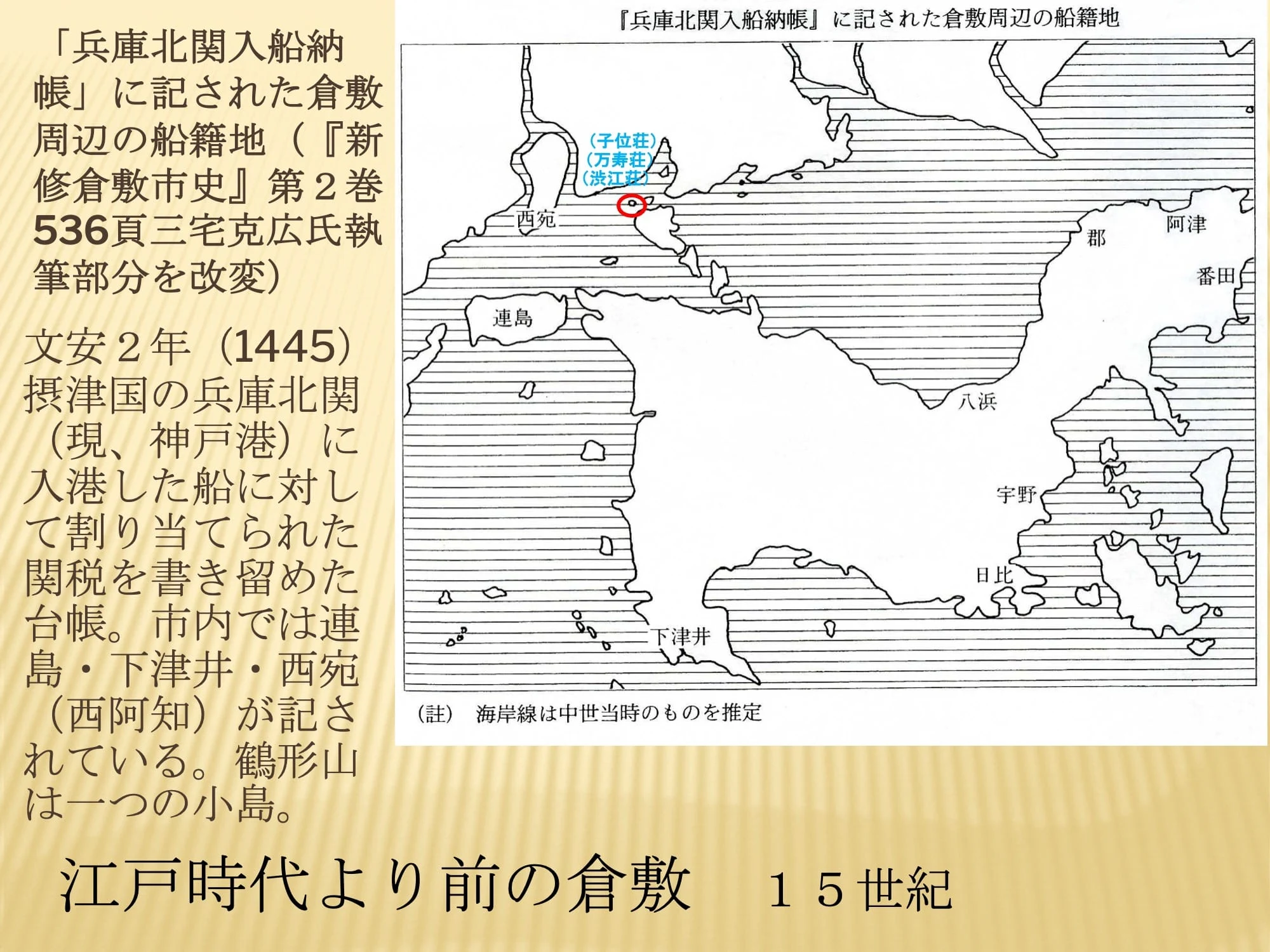
In the 15th century (1400s), the area around the Bikan Historical Area was still sea. However, due to the flooding of the Higashi-Takahashi River (now a discontinued river, which existed before the river improvement works carried out from the Meiji to Taisho periods), sediment began to accumulate, gradually expanding the land to the north of the Bikan Historical Area.
People seeking new lands began to settle on the expanded land.
One might think, with a modern perspective, "Wouldn't it be nice to live in a new land by the sea?" However, until the Meiji period, the center of logistics was not land but sea.
As a result, towns and islands along the coast were prosperous through trade. Until the advent of railways in the Meiji period, water transport was the mainstream, so it is important to view the land from the sea rather than the sea from the land.
From this perspective, it can be said that areas like Kojima and Tsurajima in Kurashiki were prosperous regions.
Late 16th Century
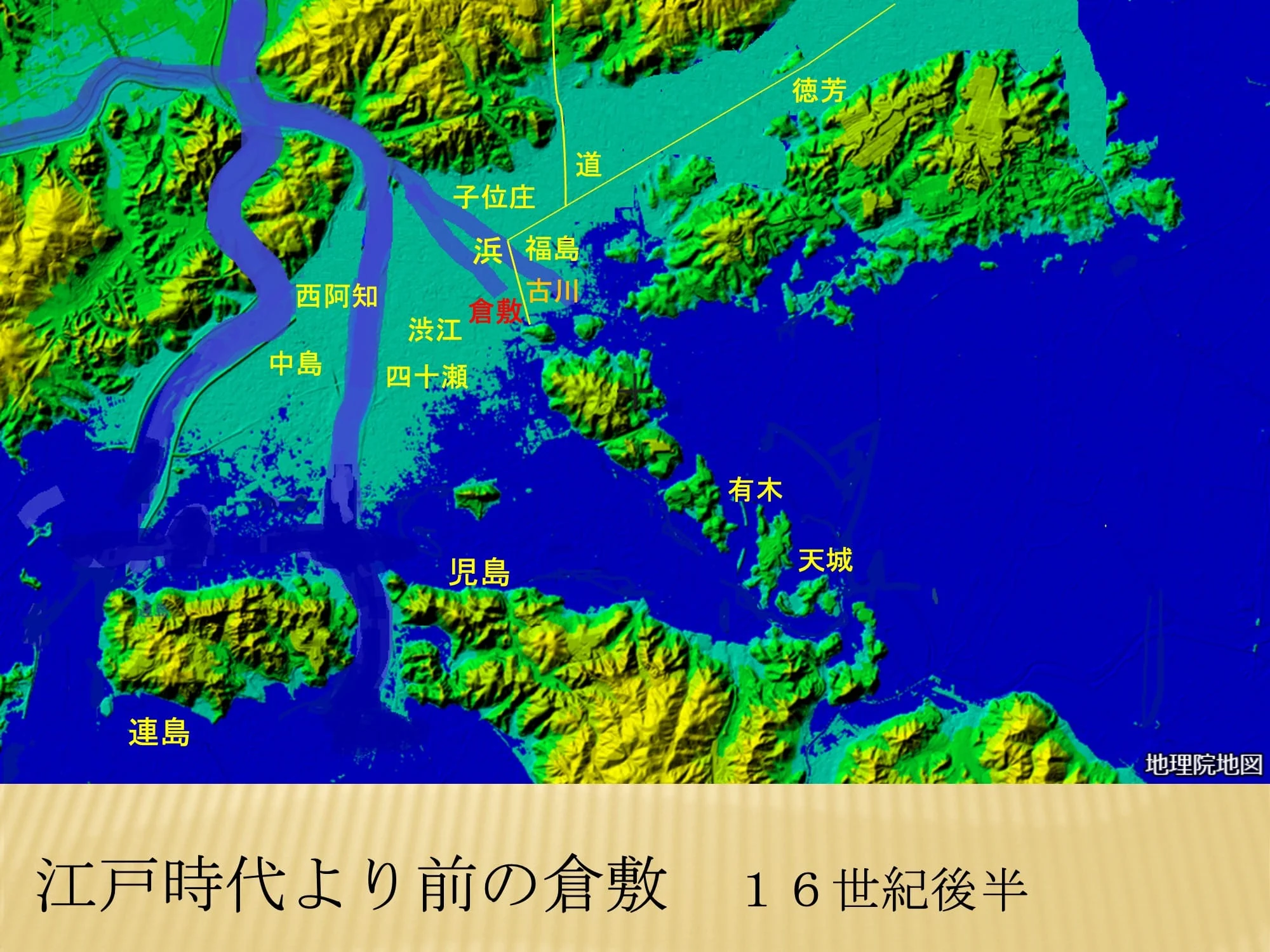
As the 16th century began, the alluvial land expanded to the area of the Bikan Historical Area due to sediment accumulation.
The land in Kurashiki subsequently increased dramatically due to land reclamation, but the area around the Bikan Historical Area was not reclaimed land but alluvial land (the name of Hamamachi in Kurashiki City is thought to be a remnant of the time when it was by the sea).
※Current areas like Nitta and Sasaoki in Kurashiki City are reclaimed land.
Since the Bikan Historical Area was close to the sea, it began to prosper as a port.
From the late 16th century, the town gradually began to form. Because it was a port, a market was first established in the current Honmachi area. From there, the town expanded.
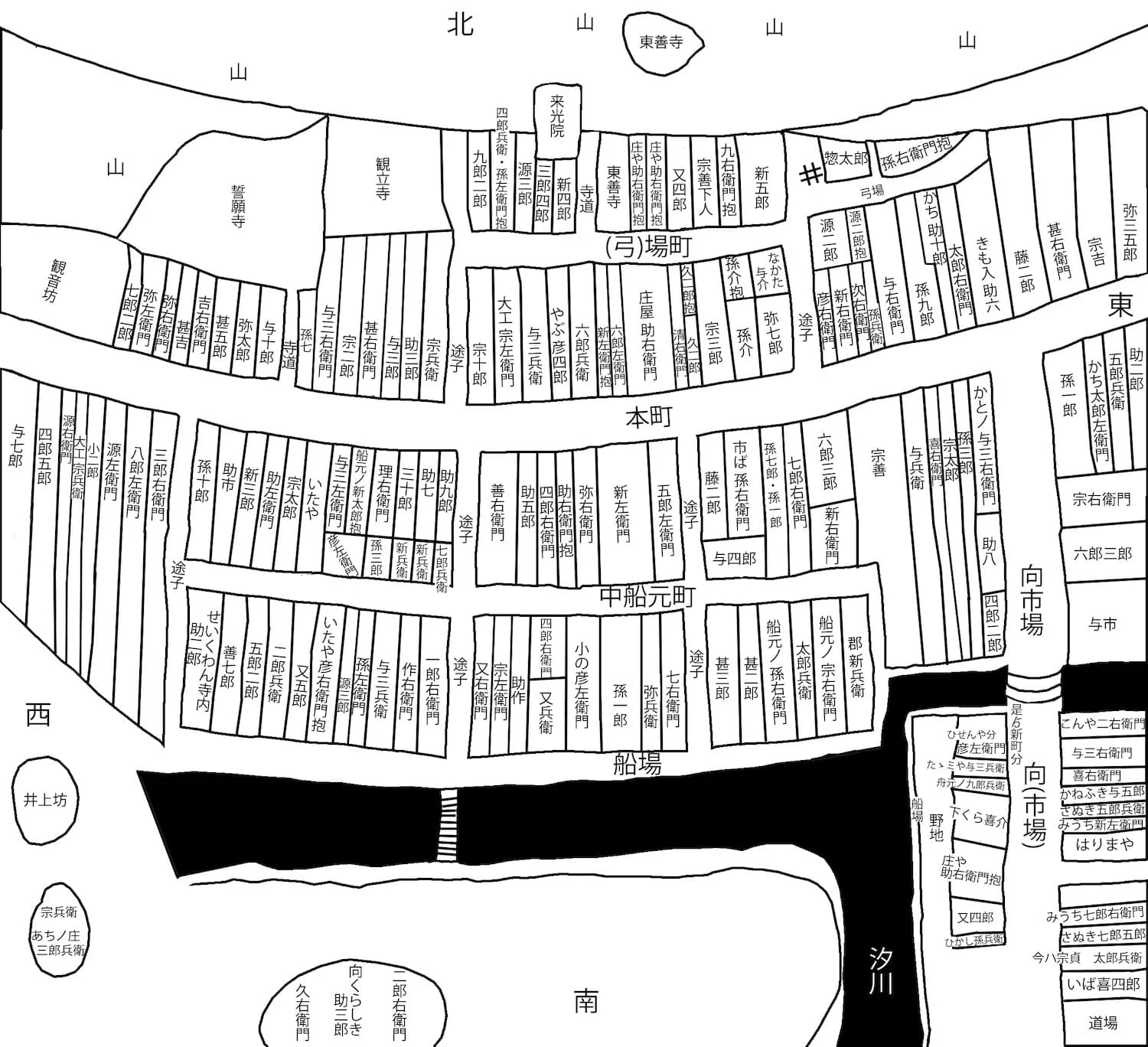
(Image provided by Kurashiki City Historical Materials Maintenance Office)
After the water siege of Bichu Takamatsu Castle, most of Bichu Province was under the control of the Mori and Ukita clans, and Kurashiki was part of the Ukita domain.
"Part 2: Edo Period" will follow.
The full article can also be viewed from the feature page below.
Members of the This Town Time Travel Club
- Akane Ohara
Vice President, Sanraku Co., Ltd. - Hiroko Kadotori
Director, Ohara House Katalyzer - Toshihiko Inagaki
First-Class Architect Office Trim Design - Tamako Oga
President, Japanese Folk Toy Museum - Yuichi Akiba
President, Kurabiz Co., Ltd. - Mariko Takaishi
Kurashiki City Regional Revitalization Cooperation Team - Kengo Toi
Representative Director, Haretoco General Incorporated Association
Advisors and Article Supervisors
- Taro Yamamoto
Chief, Historical Materials Maintenance Office, General Affairs Department, Kurashiki City - Noriyoshi Fujiwara
Curator, Kurashiki City Board of Education - Masatake Nishimura
Advisor, Cultural Industry Bureau, Kurashiki City