These days, people are said to have fewer ties with their neighbors.
While you may think, “It’s easier when I’m busy and don’t have to deal with unnecessary social obligations,” have you ever also wondered, “Where should I go for advice about that problem in my community…?” or “Even when I have a problem, there’s no one or nowhere I can easily turn to when it really matters…”?
Kurashiki City has a new system for neighbors to help one another, bringing together food, household goods, and “kindly meddlesome people” in the community.
It’s called the “Kurashiki Mutual Neighbor Pantry Project” (Gokinjo).
“Gokinjo” seems to mean “neighborhood,” but you may be wondering what else the project involves.
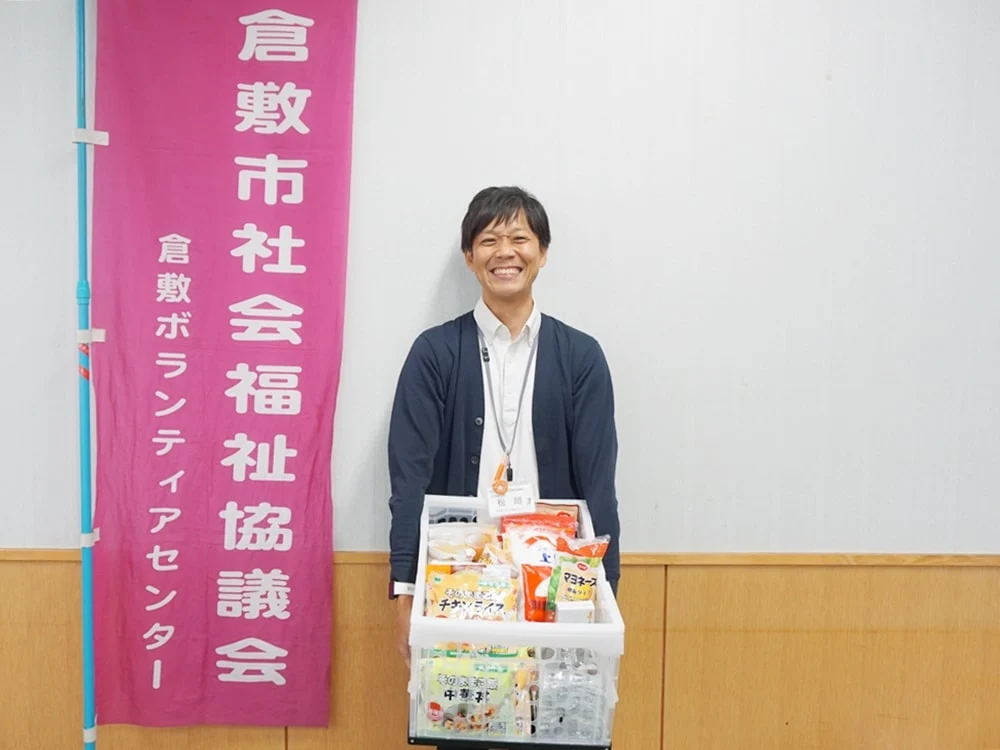
We spoke with Takeshi Matsuoka, a community support coordinator at the Kurashiki City Council of Social Welfare, a social welfare corporation.
The information presented here was accurate when this article was published in October 2021. Please note that it may differ from current information.
What is the Kurashiki Mutual Neighbor Pantry Project?

The Kurashiki Mutual Neighbor Pantry Project (hereafter, the Mutual Neighbor Pantry) is a new initiative that helps people overcome everyday difficulties—such as work-related concerns, parenting challenges, and making friends—not alone, but together with people in their community.
It connects what people in the community can do, bringing food, household goods, and “kindly meddlesome people” right alongside each person’s daily life (in their neighborhood). It is a system in which neighbors help one another and look out for and support each other.
The Mutual Neighbor Pantry began in January 2021.
“Pantry” means “a room for storing food and other supplies.” As the name “Pantry Project” suggests, the initiative distributes food, but it also incorporates a system for providing places where people can spend time together.
Food and household goods donated by various supporters and advocates are used to identify, discuss, and address problems faced by people in their local neighborhoods.
▼The project has three main features:
- Recruiting food and household goods donors
- Recruiting Mutual Neighbor Pantry supporters
- Working with consultation and support organizations
Let’s take a closer look at what it involves.
Recruiting food and household goods donors
The Mutual Neighbor Pantry receives food and household goods from a variety of companies, organizations, and individuals.
It gathers items nearing their best-before dates, products with misaligned packaging seals, surplus vegetables, and more, then delivers the goodwill of companies and producers to the target communities.
As of September 2021, donations had been received from around 130 companies, organizations, and individuals.
▼The food and household goods donated so far include the following:
- Rice
- Nonperishable foods (canned, instant, and retort-pouch foods)
- School supplies
- Many other household goods
If you would like to donate, please contact the Kurashiki City Council of Social Welfare.
Phone: 086-434-3301
Recruiting Mutual Neighbor Pantry supporters

In addition to recruiting food and household goods donors, the project is also recruiting Mutual Neighbor Pantry supporters.
A “Mutual Neighbor Pantry box,” filled with food and household goods collected from the community, is placed with each supporter.
The supporter then distributes the food and household goods to people who request them.
Those eligible to request items are people in the “neighborhood” where a Mutual Neighbor Pantry box is located.
Through the exchange that neighbors can offer, the project aims to provide support by “noticing,” “listening,” “supporting,” and “connecting.”
▼Examples of support activities to date include:
- Offering advice and support for people’s difficulties using items from the Mutual Neighbor Pantry box
- Using the box as a place for people of different generations to gather regularly and connect
- Holding children’s cafeterias using donated food
- Making welfare check-in visits in coordination with local community watchers, and many other activities
When the project launched in January 2021, there were around four or five locations. By October 2021, that number had grown to 60.
The locations are not made public so that people can be matched with those seeking support.
▼Examples of places where Mutual Neighbor Pantry boxes are located include:
- Consultation offices for people with disabilities
- Legal consultation offices
- Social welfare corporations
- Child-rearing support centers
- Local community watchers, and many others
At locations with a Mutual Neighbor Pantry box, people experiencing difficulties in the community can drop in, talk things through at their own pace, and receive food and other items. The box thus serves as a place where people can spend time together.
If you would like to host a box, please contact the Kurashiki City Council of Social Welfare.
Phone: 086-434-3301
Working with consultation and support organizations

Collecting and distributing food and household goods is very important.
But what makes the Mutual Neighbor Pantry stand out is that it doesn’t stop there: its greatest feature is “working with consultation and support organizations.”
During the interview, I felt this was the most important aspect.
When the Mutual Neighbor Pantry works with organizations responsible for consultation and support, it becomes easier to identify problems faced by individuals and communities.
Food assistance and welfare check-ins can then spread throughout Kurashiki City, across the boundaries of systems, affiliations, and eligibility.
In other words, Mutual Neighbor Pantry supporters aim to create a “place where people can share their difficulties,” while consultation and support organizations work together to create a “receptive system” that ensures no one’s problems are overlooked.
▼The consultation and support organizations include:
- Organizations supporting people experiencing financial hardship
- Public health centers
- Educational institutions
- Consultation services for single mothers and fathers, and many others
We spoke with Takeshi Matsuoka, Senior Coordinator in the Community Welfare Division’s Living Support Section at the Kurashiki City Council of Social Welfare, about the activities of the Kurashiki Mutual Neighbor Pantry Project.
Matsuoka and the other community support coordinators support activities such as community salons that connect people with their local area, as well as mutual support initiatives.
What inspired the creation of the Kurashiki Mutual Neighbor Pantry Project?
Kurashiki Mutual Neighbor Pantry Project details
| Organization name | Kurashiki Mutual Neighbor Pantry Project |
|---|---|
| Address | Contact: Kurashiki City Council of Social Welfare │ Inside Kurashiki Health and Welfare Plaza, 180 Sasaoki, Kurashiki City, Okayama Prefecture |
| Contact | 086-434-3301 |
| Website | Kurashiki Mutual Neighbor Pantry Project |


What would you like to know about Kurashiki?
Enter a word to search articles on this site