At Okayama Prefectural Kurashiki Makibi Special Needs School in Mabi, Kurashiki City (hereafter referred to as “Makibi Special Needs School”), exchange and collaborative activities with the local community are valued.
In the vocational course in the upper secondary department, students have been making and selling bread in class since the school opened in the 2014 school year, with the aim of helping them develop the skills to work in society.
The second bread sale of the 2025 school year was held on Wednesday, July 9.
The information presented is as of the article’s publication in August 2025. Please note that it may differ from current information.
About Okayama Prefectural Kurashiki Makibi Special Needs School

Makibi Special Needs School is a prefectural special needs school located about 300 meters from Kibinomakibi Station on the Ibara Railway.
The school has departments for students with intellectual disabilities and physical disabilities. As of April 2025, the 2025 school year, 370 children and students from elementary through upper secondary school were enrolled.
School districts are designated for the elementary and lower secondary departments, but students from anywhere in Okayama Prefecture can attend the vocational course in the upper secondary department.
Bread sales at Makibi Special Needs School
The bread is sold by students enrolled in the vocational course in the upper secondary department for students with intellectual disabilities.
The vocational course in the upper secondary department focuses on vocational education through specialized subjects and other studies, with the aim of helping students achieve social independence through employment. It is the only course in Okayama Prefecture that makes and sells bread.

Makibi Special Needs School was one of the schools affected by the July 2018 heavy rains.
In the years immediately after the disaster, bread production and sales were suspended for about two years, but they resumed in March 2021 and continue regularly today.
The bread sale dates for the 2025 school year are as follows:
- Wednesday, May 28
- Wednesday, July 9
- Wednesday, September 17
- Wednesday, November 5
- Wednesday, December 10
- Wednesday, January 28
When bread sales resumed, the owner of pain porte in the local town of Mabi began teaching the students.
The variety of breads they can make is growing day by day, and direct instruction from a professional has helped them produce and sell bread with an authentic taste.
The bread sale on Wednesday, July 9, 2025
Wednesday, July 9, was the second bread sale of the 2025 school year.
I arrived at almost exactly the scheduled gate-opening time of 11:40 a.m., but a long line had already formed in front of the entrance, with local residents waiting excitedly.

Vegetables and leather goods also available while waiting in line for bread
As I walked toward the line, I saw tables set up alongside it.
Looking more closely, I saw vegetables and leather goods displayed on the tables.


The vocational course in the upper secondary department at Makibi Special Needs School is divided into three fields:
- Distribution Services
- Food Services
- Environmental Services
The students in Food Services are responsible for this bread sale, while the leather goods are made by students in Distribution Services.
The vegetables are grown by students in the Life Skills Course of the upper secondary department for students with intellectual disabilities. Their education focuses on social independence through work-based and daily-life unit studies, with the aim of developing skills for work and everyday life.

Students also direct traffic on campus
The students’ contributions go beyond selling goods.
They also direct traffic for local residents driving in and out of the school grounds.

Students from various courses across the school worked together to make the day of the “bread sale” a success.
Students before the store opens
As cars continued to arrive on campus and leather goods and vegetables were sold, the students in charge of the bread sale carried out their final checks.

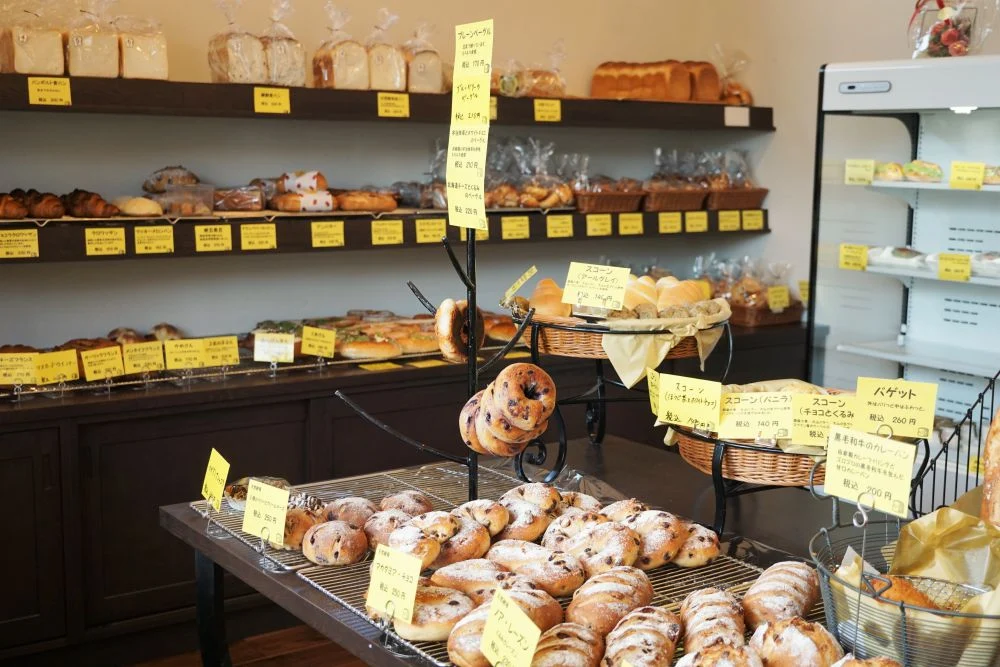
After arranging dozens of kinds of bread, they checked again where each kind was, so they could quickly find it if customers asked for recommendations.
After practicing their customer-service greetings aloud together, they took their places and got ready.

Amid the excitement, the first customers came in at noon.
There was a long line, but only a few people could enter the store at a time.
This gave the students a calm environment in which to guide customers and handle checkout.
This was also beneficial for customers.
As each group finished paying, new customers could enter, giving everyone time to look carefully at the bread and choose what they wanted to eat.
Choose five carefully selected kinds of bread, place them on a tray, and head to checkout
On some days, a limit is set on the number of items each person can buy so there is enough bread for everyone in line.
On Wednesday, July 9, 2025, each person could buy up to five breads.

“My family looks forward to the bread here, too.”
“I’m planning to share some with my neighbors.”
With happy comments like these, customers counted the bread on their trays and bought the maximum of five.

Local residents, graduates, and parents… More customers with each sale
As I watched a teacher showing visitors where to find slippers at the entrance, I occasionally saw them chatting warmly with customers.
Many of the visitors were graduates who had attended Makibi Special Needs School through the previous school year and taken part in the bread sales, parents whose children currently attend the school, and local residents involved with the school as volunteers and in other ways.

According to the teachers, about half of the customers are people with an existing connection to the school, such as graduates and parents, while the other half are local residents.
I spoke with several people, and almost all were repeat customers. They all agreed that “the number of customers has grown with each event.”
Freshly baked, piping-hot bread—time to dig in!
Of course, I bought five kinds of bread and some baked goods.

The cream bun was made with fresh custard cream prepared at Makibi Special Needs School, as well as bread baked there.

The bread is chewy, and the cream is just sweet enough, making it easy to eat.

This red bean paste bun has butter as a secret ingredient. It’s a rich bread that’s irresistible for fans of “red bean paste and butter.”
I bought baked goods as well as bread.
That’s because there’s a limit of five pieces of bread per customer, but baked goods are counted separately and can be purchased in addition.

The crisp, crumbly sablés were also of the same high quality as those sold in a shop.

From the Writer
Many of the customers I met that day had visited at least once before.
They said they had first come because they “wanted to support the children,” but after tasting the bread, they decided to return because “I want to eat this bread again.”
As someone with a disability and a former special needs school teacher, I bought some to show my support, but I was amazed by how delicious the bread was after just one bite.
These breads were so well made that they needed no special justification, such as “because people with disabilities are working hard” or “because they’re made at a special needs school.”

At the bread sale at Makibi Special Needs School, you can enjoy delicious bread while helping students develop the skills they need to work in society. I think I’m going to become a regular, too.
bread sale at Okayama Prefectural Kurashiki Makibi Special Needs School Information
| Name | Bread sale at Okayama Prefectural Kurashiki Makibi Special Needs School |
|---|---|
| Dates | 【2025 Bread Sale Dates】 May 28 (Wed), July 9 (Wed), September 17 (Wed), November 5 (Wed), December 10 (Wed), January 28 (Wed) 12:00 p.m.–12:50 p.m. |
| Location | 4682-1 Yata, Mabi, Kurashiki City, Okayama Prefecture |
| Admission (tax included) | Bread is sold for 50 to 150 yen |
| Website | Okayama Prefectural Kurashiki Makibi Special Needs School |

What would you like to know about Kurashiki?
Enter a search term to find articles on this site