
A shop you’re sure to see at least once when you visit the Bikan Historical Area is “Kamoi Restaurant.”
In an outstanding location right by the Kurashiki River, it’s always bustling, from lunchtime through tea time.
With Japanese dishes that appeal to every generation, it’s perfect for an outing with three generations of the family.
There’s mamakari sushi, warm sushi, and Bukkake udon made with Kamoi’s special black soybeans.
Why not enjoy a delicious moment in the Bikan Historical Area while admiring the changing scenery outside the window?
The information presented was current when this article was published in November 2018. Please note that it may differ from current information.
Right by the Kurashiki River! “Kamoi Restaurant” in the heart of the Bikan Historical Area

“Kamoi Restaurant” is distinguished by its beautiful white walls.
The atmospheric building is a renovated old storehouse, and the current owner is the second generation to run the restaurant.
Even if you don’t know the name Kamoi, you may recognize this exterior.

There are food displays at the entrance, making it easy to get an idea of the menu.
Incidentally, next door to Kamoi is “Yurinsou,” a villa of the Ohara family, and across the bridge is the “Ohara Museum of Art”—placing the restaurant right in the center of the Bikan Historical Area.

The interior is spacious, with wide passageways, and there’s a ramp at the entrance, so wheelchair access is available.
The overall decor is a calm, modern Japanese style, with irori-style table seating and washi-like lighting.

The Kurashiki River is visible outside the window. It’s nice to gaze out at the beautiful scenery.
The large windowside seats are prime spots for enjoying the changing seasons.

The tatami room has up to 12 seats. Tatami seating is a welcome option when dining with small children.
The entire restaurant is non-smoking, so children and older guests can relax with peace of mind.
Being easy for three generations to visit together may be one of Kamoi’s distinctive features.

The first floor has a generous 80 seats (including 12 tatami seats). Even so, lines often form on holidays.
The restroom on the first floor is barrier-free, so it can also be used by wheelchair users.
Udon, sushi, tempura, and more… A wide-ranging menu. You can also stop in for tea
Kamoi Restaurant offers a wide-ranging menu, including sushi, Japanese set meals, and tea-time options.
Here’s a selection of items with photos.
Menu and prices as of November 2018

Sushi, seafood rice bowls, sashimi, and more. A regular sushi set costs 1,000 yen (before tax), making it easy on the wallet.

You can’t miss Okayama’s famous mamakari!
One of Kamoi’s popular dishes is “mamakari sushi.” You can also order it as a single item.
By the way, do you know where the word “mamakari” comes from?
Mamakari = borrowing rice.
It’s a small fish so delicious that people say you’d borrow rice to eat it.
Kamoi’s top recommendations also include chirashi sushi called “Daikan sushi” and “warm sushi.”
If you come to Okayama, this is sushi you should try at least once.

Bukkake udon, which originated in Kurashiki.
This Kurashiki soul food is made by pouring a sweet-and-savory broth over udon, but Kamoi’s version seems to have a unique twist…! (More on that later.)

There’s also a wide variety of set meals.
The lavish “Kurashiki Set Meal,” featuring seasonal Okayama ingredients, is a must-try!

There’s also the “Kamoi Set Meal,” named after the restaurant.
A note says, “*Incidentally, it doesn’t contain duck,” so perhaps people sometimes get the wrong idea.
Kamoi’s recommended “mamakari set meal” is packed with mamakari: grilled fish, sashimi, tempura, and more!
Mamakari is usually served marinated in vinegar, but it’s rare to get to try it as sashimi or tempura.

There are all kinds of sweets that children are sure to enjoy. It’s also an easy place to stop in for tea, making it very convenient.
Kamoi welcomes many customers from outside the prefecture, as well as local residents. In particular, they hope visitors will enjoy Okayama specialties such as
mamakari and chirashi sushi
to their heart’s content.

Incidentally, payment is accepted by various forms of electronic money and credit cards.
Black udon!? Kamoi’s special Bukkake udon with a unique twist

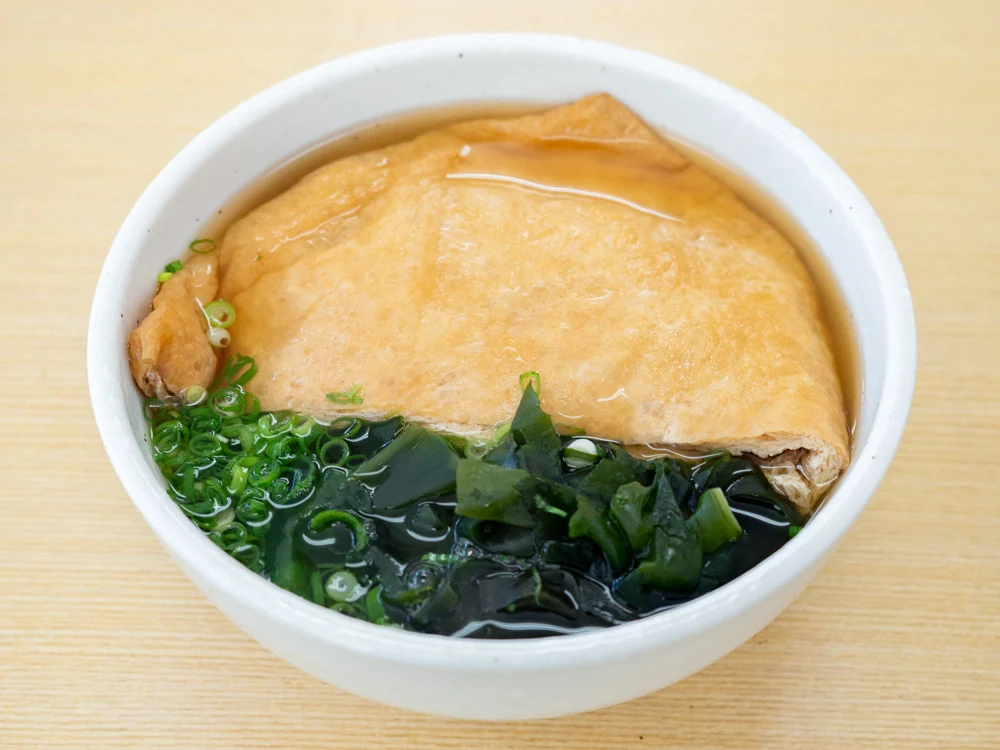
This is the “Tempura Bukkake udon” made with Kamoi’s special noodles, priced at 1,000 yen (before tax).
A single serving of Bukkake udon costs 500 yen (before tax).

The noodles are what make this dish distinctive! Can you see how they have a slight blackish tint?
The secret behind the color is black soybean kinako.
Kinako made from Okayama Prefecture’s Mabi Tanba black soybeans is kneaded into the noodles, giving them their black speckles.

The udon with black soybean kinako has a dense, chewy texture and a distinctive springiness!
The firm noodles pair well with the slightly sweet broth.
As you chew, the noodles spring back with a lively bounce, making them quite different from ordinary udon.
I felt that Kamoi’s udon goes especially well with the Bukkake broth.

The tempura comes in five varieties: shrimp, shishito pepper, sweet potato, lotus root, and eggplant.
Everything is freshly fried and crispy. Eat it with the udon and you’ll be full.
A beautifully colorful Kurashiki bento. The tofu tempura is delicious!

This is the Kurashiki Bento, priced at ¥1,300 (before tax). Just hearing the word “bento” is exciting.
The bento includes a tiered box with simmered dishes and tempura, along with rice, pickles, and clear soup.

The shrimp, pumpkin, kelp, konjac, and other ingredients are simmered together with a hint of sweetness, giving the dish an elegant flavor overall.
The grilled fish is tender, flaky Spanish mackerel. You can enjoy another Okayama specialty here.

Next to the simmered dishes is the tempura.
It includes lotus root, eggplant, shishito pepper, sweet potato, kakiage, and the unusual addition of tofu tempura.
This tofu tempura is served as is, not in a broth. I wonder what it tastes like.

When I tried it, piping-hot tofu emerged from the crispy coating.
The tofu flavor is richer than when eaten on its own—and it’s creamy, too.
Lighter than agedashi tofu, this dish lets you enjoy the flavor of the tofu even more.
Winter-only nukuzushi: a comforting dish with a gentle flavor

This is Kamoi Restaurant’s recommended winter-only nukuzushi, priced at ¥1,000 (before tax).
It seems to be called nukuzushi because it is warm sushi, steamed in a bamboo steamer (nukui means “warm”).
It’s a regional dish found from the Kansai region westward, but it’s not something you often see on restaurant menus, is it?
I’ve personally loved nukuzushi for a long time, so I’m delighted to have found it at Kamoi Restaurant!

The ingredients are a lavish assortment that seems to capture the flavors of Okayama in a nutshell.
There’s conger eel, mantis shrimp, Spanish mackerel, shrimp, koya tofu, mountain vegetables, and the bright yellow of shredded egg.
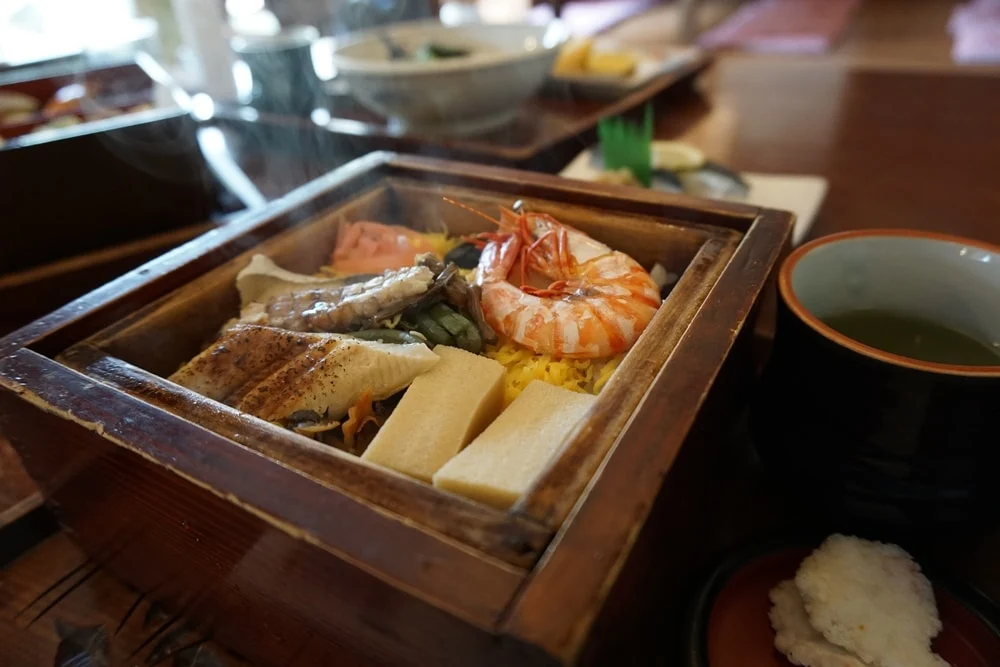
Piping-hot steam! Along with it comes the lovely, mellow aroma of vinegar.
With the first bite, a comforting, gentle flavor spreads through your mouth.
The sharp aroma of vinegar is softened by the heat, and the warm rice is soothing to the stomach.
Nukuzushi is just the thing to eat on a cold winter’s day. I hope you’ll give it a try.

And don’t forget the mamakari sushi. Two pieces as a single order cost ¥250 (before tax).
At Kamoi Restaurant, the vinegared rice in the mamakari sushi is exquisite, crumbling softly in your mouth!
The mamakari is also cured in vinegar just right.
Even though I was full from the Kurashiki Bento, it was so delicious I couldn’t help reaching for more.

Located in the heart of the Bikan Historical Area, Kamoi Restaurant is an easygoing place to drop in on a whim.
I thought it might be a fancy restaurant, but it turned out to be a comfortable place that’s just right for families.
Local Okayama flavors such as mamakari and bukkake udon with black soybean kinako are also perfect for introducing visitors from outside the prefecture to the region’s cuisine.
With its beautiful views and reliably good Japanese food, this is the kind of place that will make you love the Bikan Historical Area even more.
Kamoi Restaurant Information
| Name | Kamoi Restaurant |
|---|---|
| Address | 1-3-17 Chuo, Kurashiki City, Okayama Prefecture |
| Contact | 086-422-0606 |
| Parking | None |
| Hours | 10:00 a.m.–6:00 p.m. (last order 5:20 p.m.) |
| Closed | Wednesday Also closed on the second Monday of the month. Please inquire about reservations for banquets. |
| Payment methods |
|
| Reservations | Accepted |
| Seating | Table seats: 68 Tatami-room seats: 12 |
| Smoking | Entirely non-smoking |
| Restrooms | Western-style restroom, accessible restroom |
| Accessibility | Ramp, accessible restroom |


What would you like to know about Kurashiki?
Enter a search term to find articles on this site





































