Many people know that the dye used to give denim its blue color is made from a plant called indigo.
But how many people know that indigo can be eaten?
JAPAN BLUE, which operates the jeans brand Momotaro Jeans, has launched “Indigo Cuisine,” an initiative that lets people enjoy indigo not only in clothing but also in food.
Takemoto Chihana visited Momotaro Jeans Kojima Ajino Main Store, which houses CAFÉ JAPAN BLUE GARDEN, and enjoyed Indigo Cuisine.
Here, we introduce this new genre of “Indigo Cuisine,” along with the café and how it came to be developed.
The information presented was current when this article was published in April 2023. Please note that it may differ from current information.
About CAFÉ JAPAN BLUE GARDEN

CAFÉ JAPAN BLUE GARDEN is a café attached to the Momotaro Jeans Kojima Ajino Main Store on Kojima Jeans Street in Kurashiki City.
Its specialty is “Indigo Cuisine”: sweets and drinks made with indigo, the plant used to dye denim blue.
Along with the Momotaro Jeans Kojima Ajino Main Store, which reopened after renovations on April 27, 2021, CAFÉ JAPAN BLUE GARDEN launched “Indigo Cuisine” as a new initiative.
Store manager Matsuda Yuma will tell us about the highlights and products at CAFÉ JAPAN BLUE GARDEN.

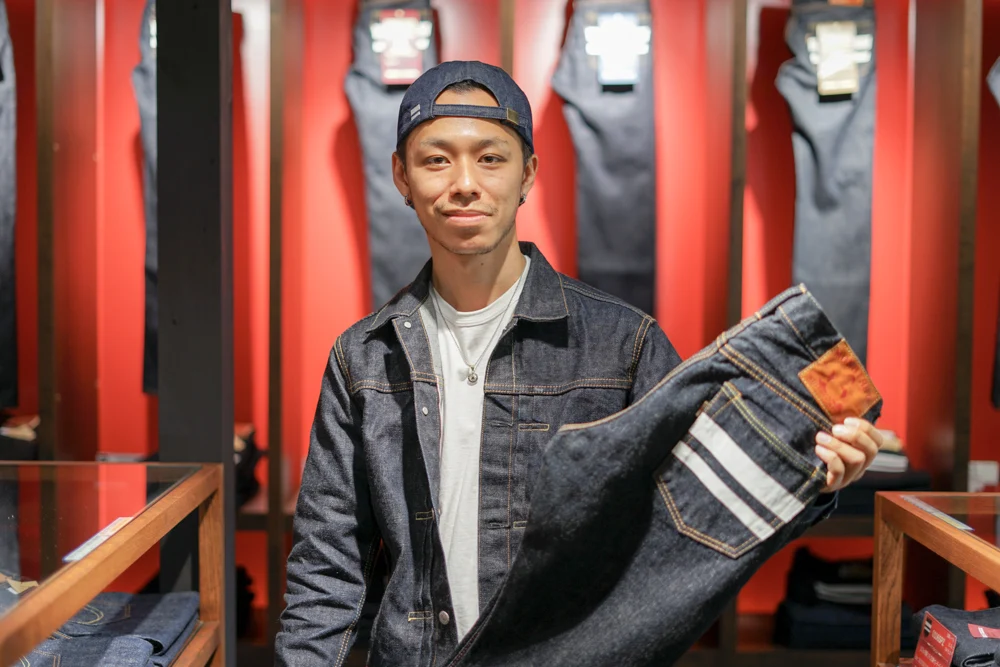
CAFÉ JAPAN BLUE GARDEN
Exterior

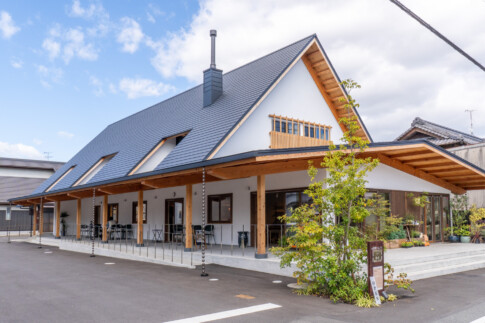
CAFÉ JAPAN BLUE GARDEN is on the right as you face the entrance of the Momotaro Jeans Kojima Ajino Main Store.
The Momotaro Jeans Kojima Ajino Main Store is in a renovated post office, while CAFÉ JAPAN BLUE GARDEN is in a renovated traditional house.
▼ The white building in the background is the Momotaro Jeans Kojima Ajino Main Store, and the building in the foreground is CAFÉ JAPAN BLUE GARDEN.

By the way, the plants growing in the planters in front of the café are indigo.
▼ It seems they are not blue in their natural state.

Interior
The first thing that catches your eye when you enter is the wooden counter.
▼ The wall facing the counter is decorated with “Shin Denim,” wallpaper made from denim fabric.

CAFÉ JAPAN BLUE GARDEN offers its products for takeout only.
You can enjoy your purchases while walking along Kojima Jeans Street or in the backyard at the rear of the café.
▼ The espresso machine was made by the Italian manufacturer La Marzocco (LA MARZOCCO).

La Marzocco values craftsmanship and makes its espresso machines by hand.
It was made by a company that shares JAPAN BLUE’s commitment to jeans crafted by hand.
By the way, the espresso machine’s color is inspired by white peaches, and it is a one-of-a-kind custom-made model.
The backyard
The backyard is small and has a charming feel.
▼ A wooden table and chairs sit along the wall of the café, where you can take a break and enjoy your purchases.
※ The table has since been removed.

Indigo is also grown in the backyard.
When the writer visited, the indigo plants were in bloom.
▼ Indigo flowers are a vivid pink.

The story behind Indigo Cuisine
The history of indigo
JAPAN BLUE President and CEO Manabe Hisao trained in Tokushima as an indigo-dyeing artisan.
In the past, indigo was also eaten as a medicinal herb in Tokushima, and it seems that indigo was part of everyday life not only in clothing but also as part of the diet.
Manabe sometimes tasted the dye liquid extracted from indigo to check its condition, so eating indigo felt natural to him.
He came up with Indigo Cuisine out of a desire to “share with people today the potential of indigo, which has been part of people’s diets since ancient times.”
The Indigo Cuisine initiative began with the vision of Manabe, who has worked with indigo for many years as an indigo-dyeing artisan.

How Ai Tea was developed
Indigo apparently does not taste like familiar Japanese teas such as green tea or black tea.
To make indigo enjoyable in modern life, they therefore worked with Okayama Tsujiri-en, specialists in tea production, to develop the product together.
They found that the flavor changed depending on the roasting temperature and grinding method, and aimed for a taste that would be familiar to Japanese people.
The result was Ai Tea, a new kind of tea that is neither Japanese green tea nor black tea.

The indigo used in Ai Tea is grown in Tokushima Prefecture.

CAFÉ JAPAN BLUE GARDEN menu
Drinks
Here are the drinks served at CAFÉ JAPAN BLUE GARDEN.
| Item | Price (tax included) |
|---|---|
| Blue Ramunade (Iced) | 660 yen |
| <Limited time> Indigo Chai Latte (Iced/Hot) | 550 yen |
| Matcha Latte (Hot/Iced) | 550 yen |
| Hojicha Latte (Hot/Iced) | 550 yen |
“Blue Ramunade” is a sparkling drink whose refreshing blue color catches the eye.

Coffee
CAFÉ JAPAN BLUE GARDEN serves specialty coffee made with beans that meet established standards for cultivation, harvesting, quality control, and other criteria.
The beans are blended from four countries: Colombia, Guatemala, Rwanda, and Peru.
The blend is adjusted for acidity and balance, aiming for a flavor that is neither too bitter nor too sour.
The beans are medium-roasted, producing a clean-tasting coffee.
| Item | Price (tax included) |
|---|---|
| Americano (Hot/Iced) | ¥500 |
| Café latte (Hot/Iced) | ¥550 |
| Café mocha (Hot/Iced) | ¥660 |
| Espresso tonic (Iced) | ¥660 |

Coffee beans are also available for purchase.
They cost ¥1,800 for 100 grams and ¥2,800 for 200 grams, tax included.
The packaging is made from Shin Denim, which is also used as wallpaper.
Inspired by JAPAN BLUE’s desire to make denim fabric a more familiar part of everyday life, the coffee beans are wrapped in denim fabric.
Aikocha Tea

CAFÉ JAPAN BLUE GARDEN also sells Aikocha Tea leaves.
Each 1-gram packet costs ¥250.
Aikocha Tea is made with indigo grown in Tokushima Prefecture.
Sweets
There are four types of indigo-inspired sweets in total.
The sweets were developed in collaboration with PIAGET, a pastry shop in Kojima, Kurashiki City.
| Item | Price (tax included) |
|---|---|
| Denim Baumkuchen | ¥176 |
| Denim Macaron | ¥275 |
| Denim Peach Sablé | ¥143 |
| Denim Meringue Coconut | ¥165 |

Enjoy Indigo-Inspired Food!

After trying indigo-inspired food at CAFÉ JAPAN BLUE GARDEN, here are some of the items on offer.
What does indigo taste like? I was about to find out for the first time.

Place your order at the counter inside, and they will prepare it for you.
Then take your order to the charming back garden.

The first item I ordered was CAFÉ JAPAN BLUE GARDEN’s signature drink, “Blue Ramuneade.”
▼This sparkling drink stands out for its vivid blue color.
Just as it looks, it has a refreshing mouthfeel, with a fizzy kick and tartness.
The tartness comes from lemon.
▼It is made with Setouchi lemons from Kurashiki Kosen Co., Ltd., a long-established beverage maker in Kurashiki.

Next, I ordered an indigo matcha latte.
※The indigo matcha latte is no longer available; matcha latte is currently served instead.
▼It was a pale green color.

It has a creamy mouthfeel and a mellow flavor similar to soy milk.
From its appearance, I expected it to taste like tea, but it had no astringency.
Finally, I tried Aikocha Tea.
I was curious to see what color would come from the indigo tea leaves.
▼It was a lighter red than ordinary black tea, giving it a warm appearance.

It had a clean taste, with none of the astringency found in Japanese tea or black tea.
It was a gentle flavor, hard to imagine coming from the dye that gives denim its vivid blue color.
I was able to enjoy indigo’s dual nature.
A Visit to CAFÉ JAPAN BLUE GARDEN
I knew that indigo is the plant from which the dye used to color denim blue is made, but this was my first time seeing the plant itself.
This is just my own assumption, but I had a rather chemical impression of the color blue, so I was surprised to learn that indigo, the raw material, can be eaten.
But when I tried it as a tea, it had a light, gentle flavor.
I had imagined it would be strongly astringent or bitter, so it was a pleasant surprise.
Visit CAFÉ JAPAN BLUE GARDEN, where you can try the new genre of “indigo-inspired food,” and taste indigo for yourself.

- Model: Takemoto Chihana
CAFÉ JAPAN BLUE GARDEN Information
| Name | CAFÉ JAPAN BLUE GARDEN |
|---|---|
| Address | 1-12-16 Ajino, Kojima, Kurashiki City, Okayama Prefecture |
| Contact | 086-476-7980 |
| Parking | Available ・Dedicated parking is about a 1-minute walk from CAFÉ JAPAN BLUE GARDEN ・Parking for up to 20 cars ・Free |
| Hours | 10:00 a.m.–5:00 p.m. |
| Closed | Irregular holidays Closed over the New Year period |
| Payment methods |
|
| Seating | Outdoor benches Tables: 3 |
| Smoking | Entirely non-smoking |
| Restroom | No restroom |
| Website | CAFÉ JAPAN BLUE GARDEN (Instagram) |


What would you like to know about Kurashiki?
Enter a word to search articles on this site