Have you heard of “IGUSA GLASS”?
It is glass colored by burning “igusa” (rushes), the raw material for tatami mats, into ash and melting it into the glass.
We visited a glass studio in Kurashiki City that makes IGUSA GLASS and spoke with the artist, Tomoki Minakuchi.
The information presented here was current when the article was published in October 2022. Please note that it may differ from current information.
How IGUSA GLASS came about

I first encountered IGUSA GLASS at Ohara House Katalyzer (the former Ohara family residence).
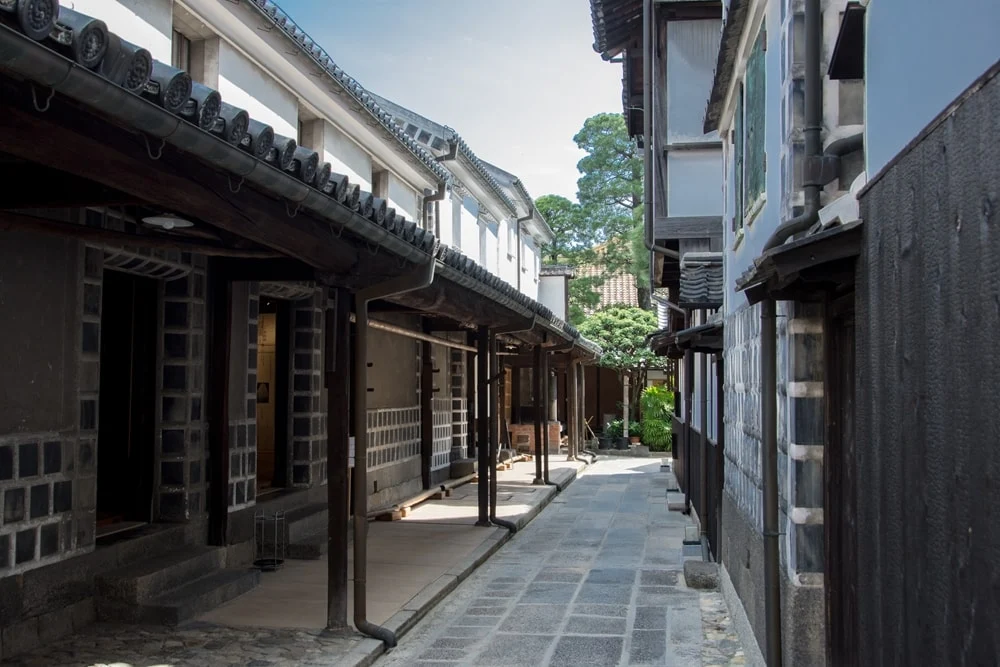
The glass of water served at the book cafe in Ohara House Katalyzer was in a beautiful green glass.

I was told it was “IGUSA GLASS,” made using ash from igusa grown in Kurashiki, and became interested.
Southern Okayama Prefecture was once a major igusa-producing area and is considered the oldest production area in Japan. According to tradition, igusa has been cultivated in Kurashiki for as long as 1,800 years.
How did IGUSA GLASS come into being, and what thoughts go into making it?
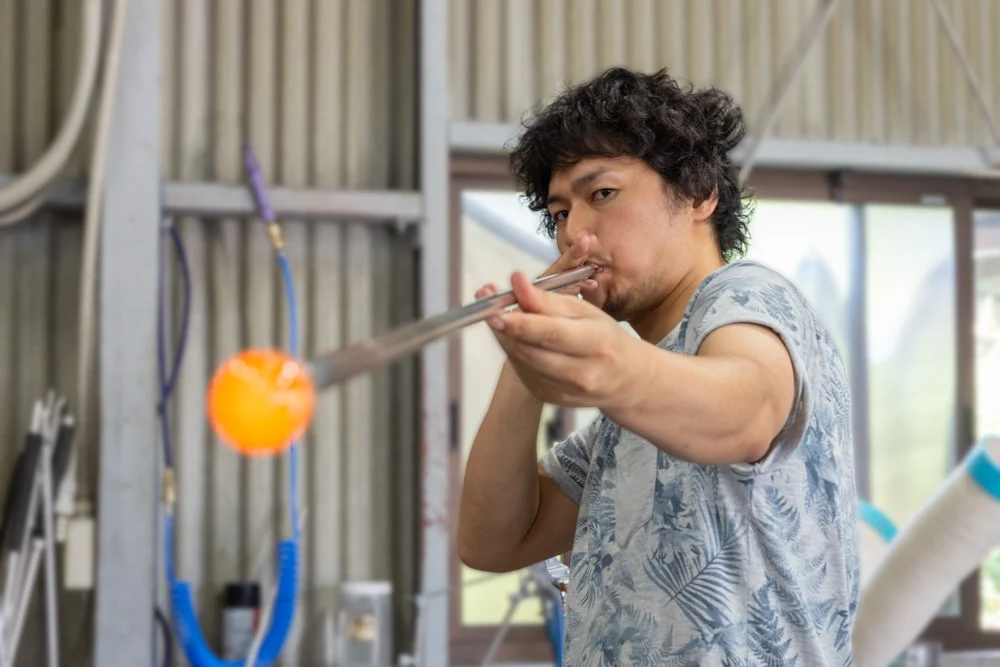
I visited Gurasuta TOMO, a glassblowing studio in Mizushima, Kurashiki City, where IGUSA GLASS is made.
Glassblowing studio “Gurasuta TOMO” and glass artist Tomoki Minakuchi

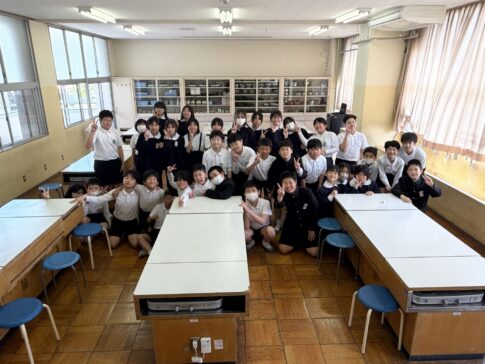
The temperature on the day of the interview was around 30°C. The studio was hotter than outside because its blazing-hot furnace is always running, but that day, elementary school students visiting on a workplace tour watched with great interest as the glass was being made.

Gurasuta TOMO is run by Tomoki Minakuchi.
Minakuchi is from Ehime. While attending an art high school, he discovered the appeal of three-dimensional objects. He encountered an exhibition by a glass artist at a gallery run by an acquaintance and became interested in glass.
After that, he tried glassblowing and visited glass studios several times to talk with people there, deepening his interest in glass.
In 2000, he enrolled at Kurashiki University of Science and the Arts to study glass. It was in Kurashiki that he met his mentor.
He was working at his mentor’s studio when the mentor died suddenly in 2005. At the request of the mentor’s family, he took over running the studio. He says it was a precarious situation, as he knew nothing about things like sourcing supplies.

Minakuchi established the studio Gurasuta TOMO in 2007 and now creates a variety of blown-glass works.
His work has also been featured in numerous media outlets.
Minakuchi’s glassworks

Minakuchi’s works have a cool, sharp beauty.
His original technique, which he named “Ginyo-hen,” creates silver patterns floating against a black background, like a galaxy!

As you change the viewing angle, the colors and atmosphere seem to change too, giving the work a captivating appeal.
It is the kind of work you want to hold and admire up close.

In addition to Ginyo-hen, he creates a variety of works, including objects, vessels, and candleholders.

As of October 2022, Minakuchi’s works could be purchased at the following locations in Kurashiki City:
- Gurasuta TOMO
- Ivy Kobo
- Ohara House Katalyzer
- kobacoffee (Koba Coffee)
They are also sold outside Kurashiki City, and can be purchased at exhibitions or commissioned directly from the artist.

You can also pay with PayPay when buying directly from Gurasuta TOMO.

IGUSA GLASS

How IGUSA GLASS is made
IGUSA GLASS began with a meeting between Minakuchi and Toshifumi Imayoshi, who is his contemporary and works at IGUSA LABO.
IGUSA LABO is the only company in Kurashiki that handles the entire process, from growing igusa to manufacturing igusa products.

Here is a general outline of how it is made.
- The igusa, treated with natural mud dye, is dried.
- The dried igusa is burned to ash in a special kiln.
- The ash is refined and mixed with glass powder.
- When melted, a chemical reaction turns it a beautiful green.
It may sound simple when written out, but apparently it took many rounds of trial and error before they could make it consistently.
The story behind its development is introduced later in the article.
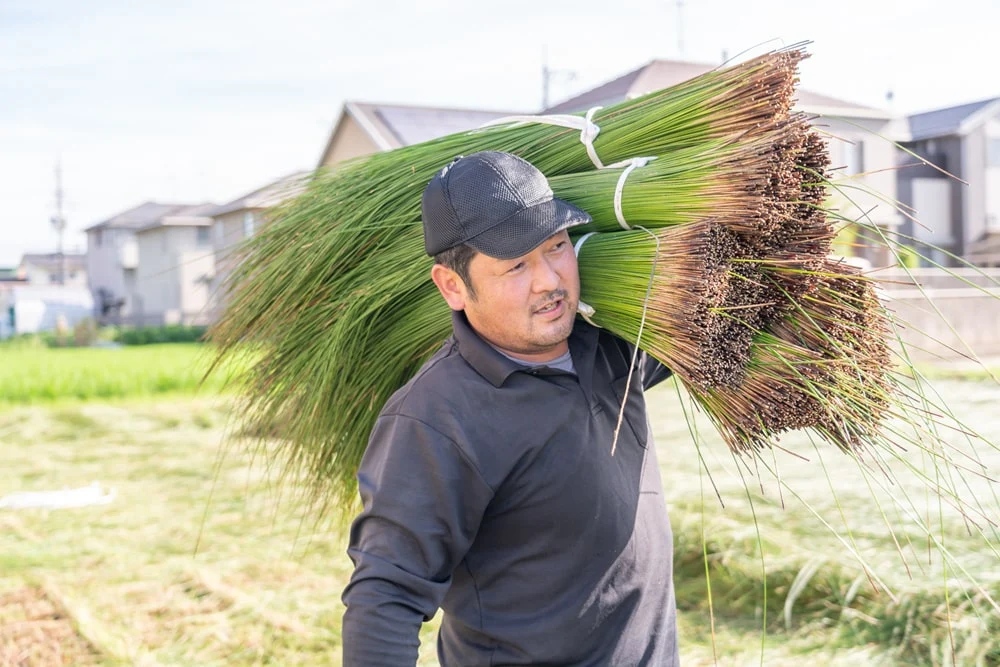
Features and product range of IGUSA GLASS

As of October 2022, the lineup includes glasses such as sake cups, water glasses, rocks glasses, tumblers, and beer glasses, as well as plates.
The glass sizes and prices are as follows.
| Shape | Size | Price (before tax) |
|---|---|---|
| Sake cup | 50 mm diameter × 70 mm height | ¥3,000 |
| Water glass | 50 mm diameter × 80 mm height | ¥3,000 |
| Rocks glass | 85 mm diameter × 105 mm height | ¥4,500 |
| Long glass | 50 mm diameter × 105 mm height | ¥3,500 |
| Tumbler | 70 mm diameter × 115 mm height | ¥3,500 |
| Beer glass | 76 mm diameter × 135 mm height | ¥4,000 |
Their simple, stylish shapes bring out the beauty of the glass’s texture and color.
These glasses never go out of style and are easy for people of all ages and genders to use every day.
Next, we spoke with Tomoki Mizuguchi about his work and the past and future of “IGUSA GLASS.”
Gurasuta TOMO Information
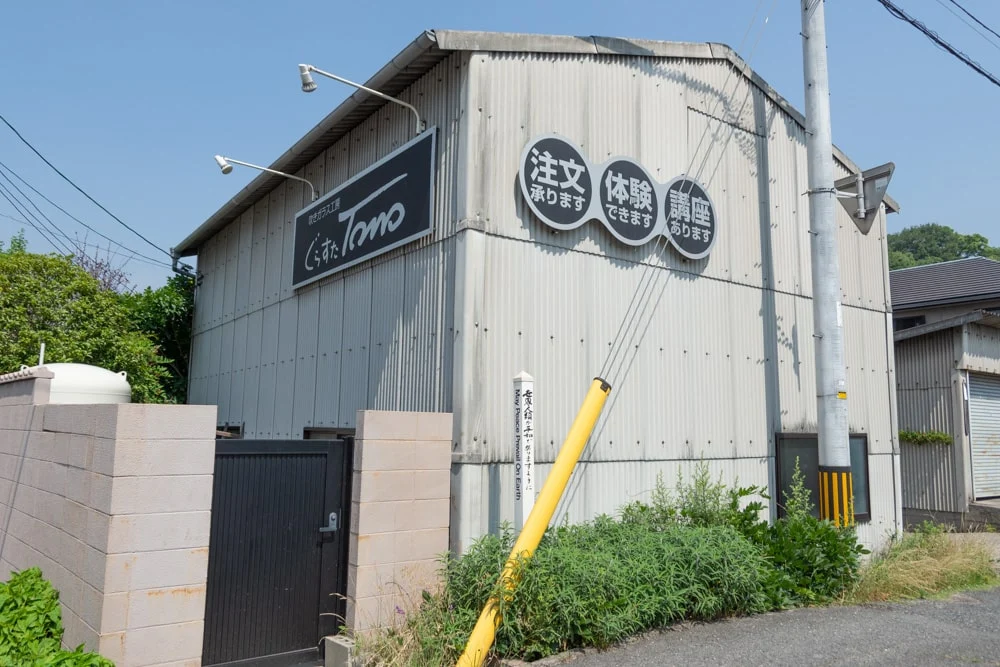
| Name | Gurasuta TOMO |
|---|---|
| Address | 2-13-33 Hiroe, Kurashiki City, Okayama Prefecture |
| Contact | 080-1945-6046 |
| Parking | Available Advance notice required |
| Hours | 10:30 a.m.–7:00 p.m. Phone inquiries: 9:30 a.m.–8:00 p.m. (We may be unable to answer the phone while working or during exhibitions.) |
| Closed | Irregular holidays |
| Payment methods |
|
| Website | Glassblowing Studio Gurasuta TOMO |


What would you like to know about Kurashiki?
Enter a word to search articles on this site