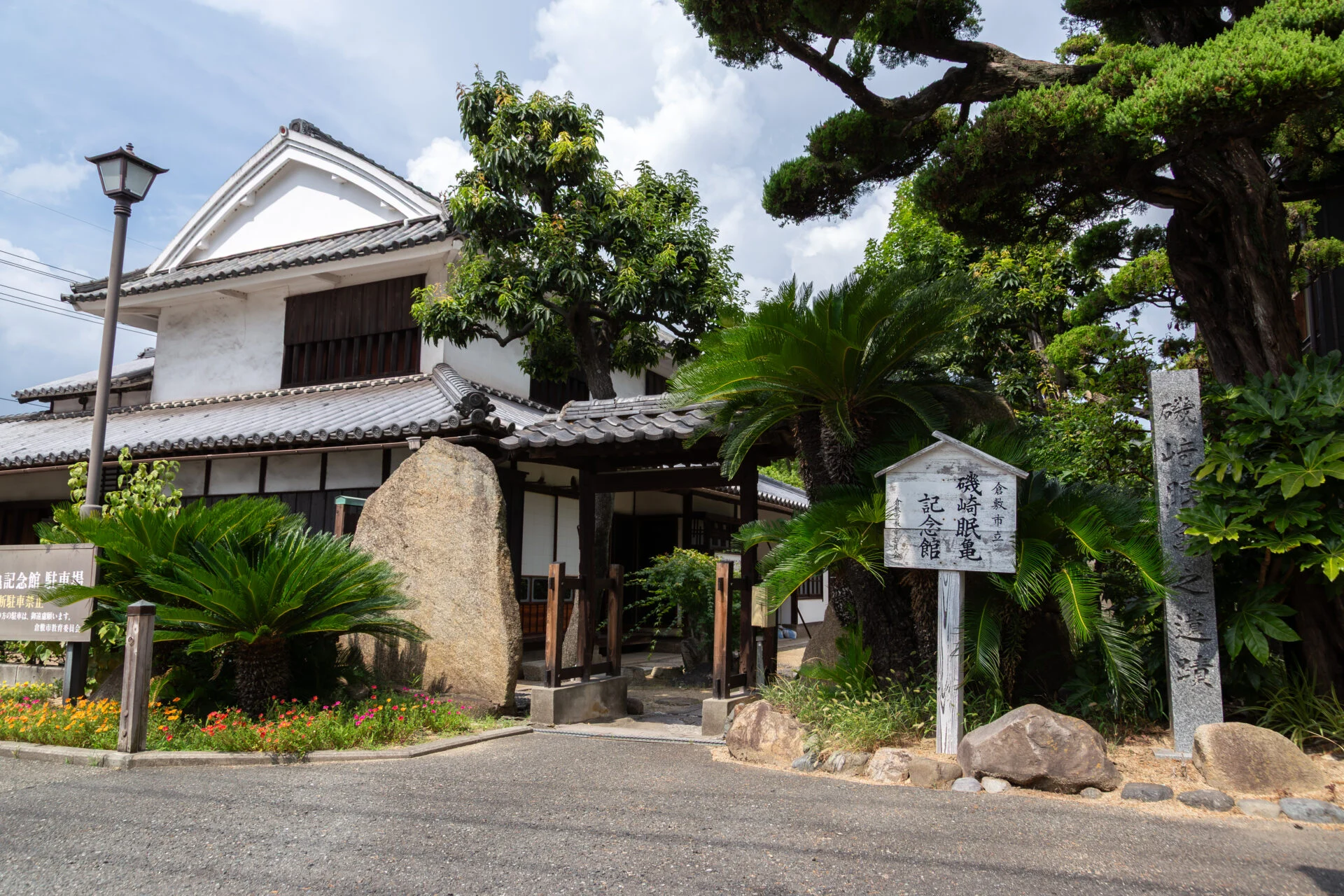
Kinkanen—have you heard of it?
A type of hanamushiro (woven rush mat) that once ranked third among Japan’s exports during the Meiji period, it was Okayama Prefecture’s first full-scale patterned-woven rush mat, invented by Isozaki Minki, who was from Chayamachi.
Rush mats were used to protect tatami, but Kinkanen was a luxury item because it was made using a special process and loom. Before the war, it was produced mainly for wealthy customers and for export.
Production has ceased because there are no successors today. However, the old house once used as a research and development base became the Minki Isozaki Memorial Hall, where Kinkanen is still exhibited in Chayamachi.
We’ll introduce what kind of person Isozaki Minki was and what Kinkanen is, along with highlights of the Minki Isozaki Memorial Hall.
The information presented is current as of the article’s publication in September 2025. Please note that it may differ from current information.
What Is Kinkanen?
Kinkanen is a type of rush mat woven with igusa rushes. Only mats woven on a dedicated loom under the following two conditions may be called “Kinkanen.”
- The warp is 3 shaku wide (91 cm)
- At least 360 warp threads are used
The rushes woven between them had to be thin and strong. In particular, the “three high-quality rushes” (Takasu-yama, Obitaka, and Hayataka) were often used.
Kinkanen, invented by Isozaki Minki in 1878, declined due to the strict requirements described above, a lack of successors, and a decrease in rush production. “Tokaido Fugaku,” made around 1926 and presented to mark Emperor Showa’s accession, became the last surviving work.

A reconstructed loom for making Kinkanen also survives, but neither the original techniques nor the original loom have been passed down, and it is also known as the “phantom rush mat.”
Who Was Isozaki Minki?

What kind of person was Isozaki Minki, the inventor of Kinkanen?
From a Kokura-ori Weaving Family in Kurashiki
Isozaki Minki was born in the late Edo period in what is now Chayamachi, Kurashiki City.
His family home was a Kokura-ori weaving business, but both his parents died when he was young. He once entered the samurai society in Edo, but did not fit in. On his way back to Okayama, he stayed in Osaka.
There, he bought British-made spun yarn newly imported after the port opened and devised a new way to weave Kokura-ori, which had become difficult to produce using traditional methods.

The Kokura-ori devised by Minki had a remarkably beautiful sheen. Its success enabled him to build the house that is now the Minki Isozaki Memorial Hall.
Inventing Kinkanen at the Expense of Sleep and Even Bathroom Breaks
After returning to Kurashiki, Minki devoted himself upstairs to inventing a machine for weaving new patterned rush mats. The invention took place on the second floor of what is now the Minki Isozaki Memorial Hall.
Unusually for the Meiji period, there was even a toilet on the second floor, suggesting that Minki was so absorbed in his research that he begrudged not only time for sleep but even time to use the bathroom.

Isozaki’s patterned rush mat, completed in 1878 and named “Kinkanen,” was four times as finely woven as tatami. However, its exquisite craftsmanship made it expensive, and there was little demand for it in Japan.
He therefore tried to expand overseas, including to Paris and San Francisco, and by exhibiting at world’s fairs. As a result, in 1902, rush mats ranked third among the ten leading Japanese exports to the United States.
The mats became so popular that they even influenced American politics: the U.S. president at the time sought to impose high tariffs, fearing that imports of rush mats would put pressure on the domestic carpet industry.
Kinkanen Was Japan’s First Patent Application
Kinkanen was invented through great effort.
If someone copied the technique and made an inferior version, the original’s value would decline.
Concerned about this, Isozaki also laid the foundation for the patent system to protect his technology. His loom was assigned patent number 23 and Kinkanen patent number 24, but they were Japan’s first patent applications.

In recognition of these achievements, he received the Medal with Green Ribbon from the government in 1897 and died in 1908 at the age of 75.
Highlights of the Minki Isozaki Memorial Hall

Here we introduce the Minki Isozaki Memorial Hall, where you can see the actual “phantom rush mat,” Kinkanen, in the room where it was invented.
A Merchant House Designated a National Registered Tangible Cultural Property
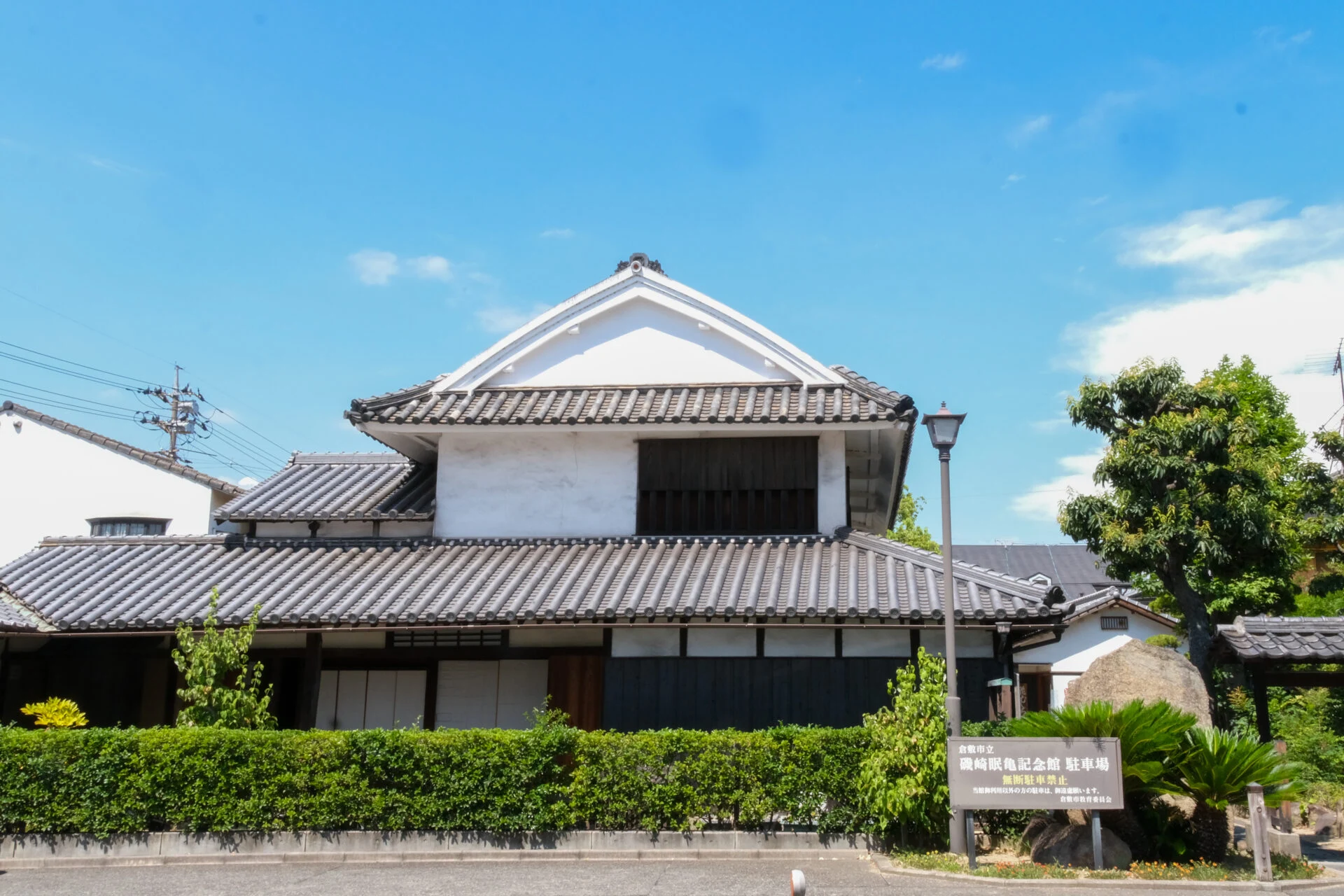
When people think of merchant houses in Kurashiki City, the streetscape of the Bikan Historical Area often comes to mind. But Chayamachi also has a merchant house that has been preserved and repaired since 1874. It is the Minki Isozaki Memorial Hall.
The Minki Isozaki Memorial Hall, distinguished by its gently curved roof, is full of playful touches, including a moon-shaped window.

The interior ceilings are also stylish despite their traditional design, with different types of boards used.
First-Floor Exhibition Room Featuring Materials Related to Kinkanen

The first-floor exhibition room displays valuable materials, including a timeline that gives an overview of Isozaki Minki’s life and a detailed patent certificate.
The reconstructed Kinkanen loom, based on Isozaki’s design drawings, is also a highlight.

The loom gives you an idea of just how many 367 warp threads are.
The First-Floor Tatami Room Offers a Glimpse of Isozaki’s Love of Sake Alongside His Dedication to Research

Take off your shoes and step up from the exhibition room into the tatami room, where a calligraphy piece hangs with the admonition, “Drink sake, but don’t let it drink you,” offering a glimpse of Isozaki’s love of sake.
The original Kinkanen designs are also filed on the table and are available for browsing.

A sloped staircase with a 9-degree incline

After finishing viewing the exhibits on the first floor, I opened the door to see the Kinkanen on the second floor, and a sloped staircase with a 9-degree incline appeared.

It was built to transport the rushes needed for Kinkanen, the wood needed for the loom, and the loom itself. This wooden sloped staircase is a rare and valuable feature in Japan.
Also, because you have to turn a corner before reaching the second floor, you cannot see the interior of the second floor from the first. It is said that this also served as a countermeasure against industrial espionage by those trying to steal the techniques. It could be called a modern-day “ramp,” but since it is unusual in everyday life to climb a “staircase with a 9-degree incline,” you can experience a strange sensation of floating.
As you climb the sloped staircase, there is a small window just before the second-floor exhibition room, through which you can catch a glimpse of the first floor.


Isozaki, who spent all his time in the second-floor exhibition room (workshop), apparently also used this spot to check on visitors and others.
It feels just like a ninja house.
Second-floor exhibition room

The second-floor exhibition room displays precious original works of Kinkanen.


Kinkanen is woven in the same way as Nishijin-ori from Kyoto, but rushes are woven in instead of thread. As a result, the pattern is visible on the reverse side as well.

During our visit, a staff member specially showed us the reverse side of the Kinkanen, but visitors are normally not allowed to touch it.
The works, woven from rushes into intricate patterns, are all breathtaking.
Today, only replica looms exist, and there is no one who can weave Kinkanen. These are precious surviving works, and no new pieces will ever be made.
Documents show that Isozaki’s history of making Kinkanen was featured as “Isozaki Minki of Okayama Prefecture” in an elementary school textbook (1913), teaching the importance of persevering and making an effort, and that a story about him was published in the magazine Shojo Club, which also featured Osamu Tezuka.

Also recommended: original rice crackers for sale and a hands-on rush mat weaving experience

The Minki rice crackers sold at JR Chayamachi Station are gently flavored egg crackers.
They are also available for purchase at the Minki Isozaki Memorial Hall.


The Hanamushiro Workshop in one corner of the garden also offers rush mat weaving experiences. Reservations are required, so be sure to book in advance.
We spoke with Sagawa Keizo, chair of the Isozaki Minki Memorial Association, about the Minki Isozaki Memorial Hall, which is packed with highlights and looks just like a ninja house.
Minki Isozaki Memorial Hall Information
| Name | Minki Isozaki Memorial Hall |
|---|---|
| Address | 195 Chayamachi, Kurashiki City, Okayama Prefecture |
| Contact | 086-428-8515 |
| Parking | Available |
| Opening hours | 9:00 a.m.–4:30 p.m. |
| Closed | Mondays Year-end and New Year holidays |
| Admission (tax included) | Free admission |
| Reservations | Available Groups and those wishing to try weaving mushiro mats should make a reservation by phone in advance. |
| Smoking | Entirely non-smoking |
| Restrooms | Western-style toilet |
| Website | Kurashiki City Isozaki Minki Memorial Hall |

What would you like to know about Kurashiki?
Enter a search term to find articles on this site