
Did you know that Okayama Prefecture is home to a place associated with the famous onmyoji Abe no Seimei (Abe no Seimei)?
At Abe Shrine (Mt. Abe) in Asakuchi City, there is a legend that Abe no Seimei built a residence there to observe the stars.
The story of the “The Unfortunate Landlord at Seimei’s House” series begins in Asakuchi City.
We spoke with its author, Karasuma Shimei.
This story features many Okayama specialties, as the protagonist forges warm bonds with gods and supernatural beings.
In the interview, we heard fascinating stories, including why the author chose Okayama as the setting and what they hoped to convey through the work.
It is sure to be an enjoyable read, even for those who are not from Okayama Prefecture.
The information presented was accurate when this article was published in March 2021. Please note that it may differ from current information.
A story about an exceptionally unfortunate protagonist set in Okayama
The third volume of the novel “The Unfortunate Landlord at Seimei’s House” (by Karasuma Shimei), set in Okayama, was released in January 2021.
It won the Ayakashi Award at the 2nd Character Fiction Awards.
Okayama appears in the story in many ways, including Abe Shrine in Asakuchi City, associated with the onmyoji Abe no Seimei, other locations in the prefecture, sweets, sake, and local specialties.
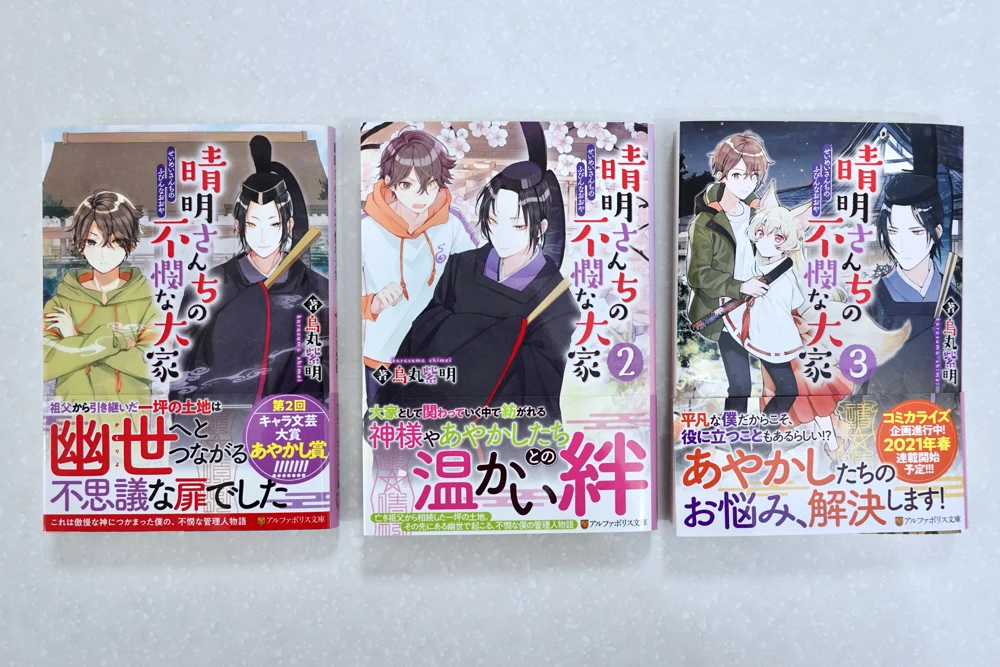
The story features many sweets and local specialties.
Although the specific product names are not given, Okayama residents will surely recognize them right away and say, “Oh, those!”
You can enjoy the story even if you have never visited Okayama Prefecture, and it is also fun to look for the local specialties featured in the story when you visit.
The comic adaptation was released on Alphapolis on Thursday, March 18, 2021.
This is a must-read for book lovers, whether or not they are from Okayama Prefecture.

Synopsis
Makibi Kichijo, a young man with the “unfortunate trait” of constantly having things go wrong for him.
He inherited a “one-tsubo” plot of land from his late grandfather. In fact, this land is a doorway to Kakuriyo, the hidden world of spirits.
Beyond it stood a vast shinden-zukuri mansion left behind by the genius onmyoji Abe no Seimei, along with numerous “gods” and “supernatural beings.”
As events unfold, Makibi is also made the “landlord” of the mansion.
From the introduction to The Unfortunate Landlord at Seimei’s House | Novel | Alphapolis Bunko
The protagonist forges bonds with gods and supernatural beings
The story begins with the protagonist, Makibi Kichijo (Makibi Kichijo), arriving at Kamogata Station to see the tiny plot of land—just one tsubo—that he inherited from his grandfather.
Inheriting this “one-tsubo” plot of land brings about a major change in Makibi’s life.
Despite his auspicious-sounding surname, Makibi Kichijo is someone who is constantly beset by bad luck—a person who could be said to have the “unfortunate trait.”
“Bad luck” doesn’t quite cover it. Nor can it be explained simply by saying he tends to “draw the short straw.”
From page 5 of Chapter 1, Volume 1
Perhaps the most unfortunate thing is that, despite struggling with his own job search, he is made the master (landlord) of the mansion left behind by Abe no Seimei.
I was born in Okayama Prefecture, but had no idea there was a place in the prefecture associated with Abe no Seimei.
This work is full of episodes in which the protagonist interacts with supernatural beings and gods—sometimes flustered, sometimes moved to tears, sometimes laughing—and that make the gods feel close at hand.
Makibi is portrayed as an ordinary person, but he has a kind of talent for empathizing with people and winning their trust.
In that sense, it may be a story about Makibi Kichijo forging bonds with gods and supernatural beings.
Interview with Karasuma, author of “The Unfortunate Landlord at Seimei’s House”
The story and research
Could you briefly tell readers who are about to start the “The Unfortunate Landlord at Seimei’s House” series what the story is about?
Karasuma
It is the story of an ordinary person who ends up inheriting what Abe no Seimei left behind to protect Japan after his death.
Of course, the protagonist has no talent whatsoever for handling such things.
He is forced to inherit something far beyond his capabilities and told to devote himself to protecting this country.
It is a story about this ordinary, unfortunate protagonist struggling while forging bonds with gods and supernatural beings.
Did you visit Asakuchi City, where Abe Shrine is located, to research the story?
Karasuma
I have visited every place mentioned by name in the story, as well as every place that served as a model, even if its name is not given.
I actually walked around Kamogata Station, which appears at the beginning of Volume 1, and the surrounding streets.

You live in Hyogo Prefecture. Is it difficult to set a story in a place where you do not live?
Karasuma
It is certainly difficult to arrange research trips. And we are now living in a time when people hesitate to travel because of the COVID-19 pandemic.
My housemate is from Okayama, so they have been helping me in various ways.
How did you come up with the protagonist’s name, Makibi Kichijo?
Karasuma
Makibi comes from Kibi no Makibi, who was born in Yata, Mabi, Kurashiki City, Okayama Prefecture, and is considered the founder of Japanese onmyodo.
Since the protagonist has an exceptionally unfortunate trait, I wanted to give him a name that sounded auspicious. I looked up real surnames and settled on Kichijo.
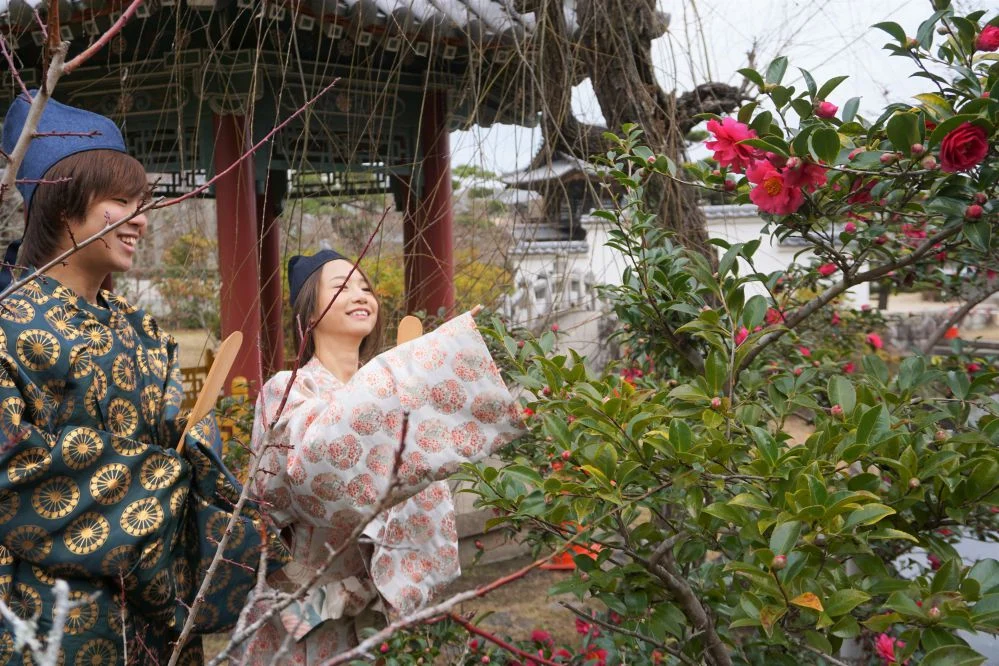
Sweets in the story and the flavors of Okayama
Was the idea of making Makibi a sweets lover inspired by Okayama?
Karasuma
That was part of it, but I also wanted to give the protagonist the distinctive quality of being “exceptional in a completely useless way.”
In the story, he is simply drawn along by the gods and supernatural beings, playing a small part in introducing Okayama sweets.
Many sweets appear in the story. Are there any sweets from Okayama that you particularly like?
Karasuma
I can’t use actual product names, so I keep them vague in the story, but the waffles from “Hakujuji” are irresistible.
I really could eat those endlessly.

Apart from sweets, are there any Okayama foods you particularly like?
Karasuma
Yellow chives!
It makes me sad to think that they are hardly sold outside Okayama.
I tried them in various dishes, including sashimi, and they were incredibly delicious.

The drinking scene in Chapter 3 of Volume 2 is memorable, too. Do you have a favorite alcoholic drink?
Karasuma
Actually, I can’t drink alcohol.
However, I have worked part-time at an izakaya and as a waiter at a French restaurant, so I know about alcohol.
Since I can’t drink myself, I wrote the scenes where the gods hold banquets as the kind of drinking party I long for.
The “unfortunate trait” setting
I had never encountered Makibi’s “unfortunate trait” setting before. How did you come up with it?
Karasuma
I sometimes find myself in that kind of situation.
For example, even though it is still early evening, the coffee machine at a convenience store is being cleaned, and I end up getting home after five stores in a row have been unable to sell me a cafe latte…
That personal experience gave me the idea for the “unfortunate trait” setting.
I understand you were interested in works such as the Kojiki. Before visiting Okayama, did you know about local legends such as the legend of Ura?
Karasuma
I knew about the legend of Ura.
I think it was when I researched Momotaro after getting a school assignment to “write what happens next in the Momotaro story.”
Were there any works that influenced you when writing “The Unfortunate Landlord at Seimei’s House” series?
Karasuma
The basic concept had already taken shape by 2013, and I adapted it into character fiction in 2018. That became this work.
For learning the craft of character fiction, I referred to Mai Mochizuki’s “My Family Is the Gion Shrine Visitors” series and Midori Yuma’s “Asakusa Oni Yome Nikki” series.
Unlike general literary fiction, this genre features distinctive characters, like those in manga and anime, among the protagonist and the people around them, as well as distinctive settings. We define this genre of novels as “character fiction.”
From The 4th Character Fiction Awards | Alphapolis – The Digital Floating City –
I hear the work is being adapted into a comic.
Karasuma
It was released on Alphapolis on Thursday, March 18, 2021.
Anyone can read it by registering with Alphapolis, so I hope you enjoy it alongside the novel!
Places the author hopes to write about and impressions of Kurashiki
You mentioned that you would like to continue writing about Okayama’s scenery and local specialties. What places would you like to feature in your work?

Karasuma
When choosing places to feature in my stories, I often focused on legends associated with those locations.
There are so many wonderful places in Okayama, so going forward, I’d like to actively feature places that are easy to visit, too.
If you were to visit the locations featured in the story based on the information available through Volume 3, it would be quite a grueling trip.
Kurashiki Tocotoco is a web media outlet that mainly covers Kurashiki City. What is your impression of Kurashiki?
Karasuma
In fact, I love the Bikan Historical Area so much that I’d like to write another work set there.
Its Edo-period residences and storehouses with white walls and namako walls, its well-maintained streets and waterways, and its retro-modern Western-style architecture dating from the Meiji period onward all coexist.
I can’t get enough of that exquisite balance.
Not just in its scenery, but in so many ways, you can enjoy both “the good old days” and “stylish, cutting-edge things” at the same time.
It’s truly a place I love.
Future aspirations and goals
Please tell us about your future aspirations and goals.
From the Writer
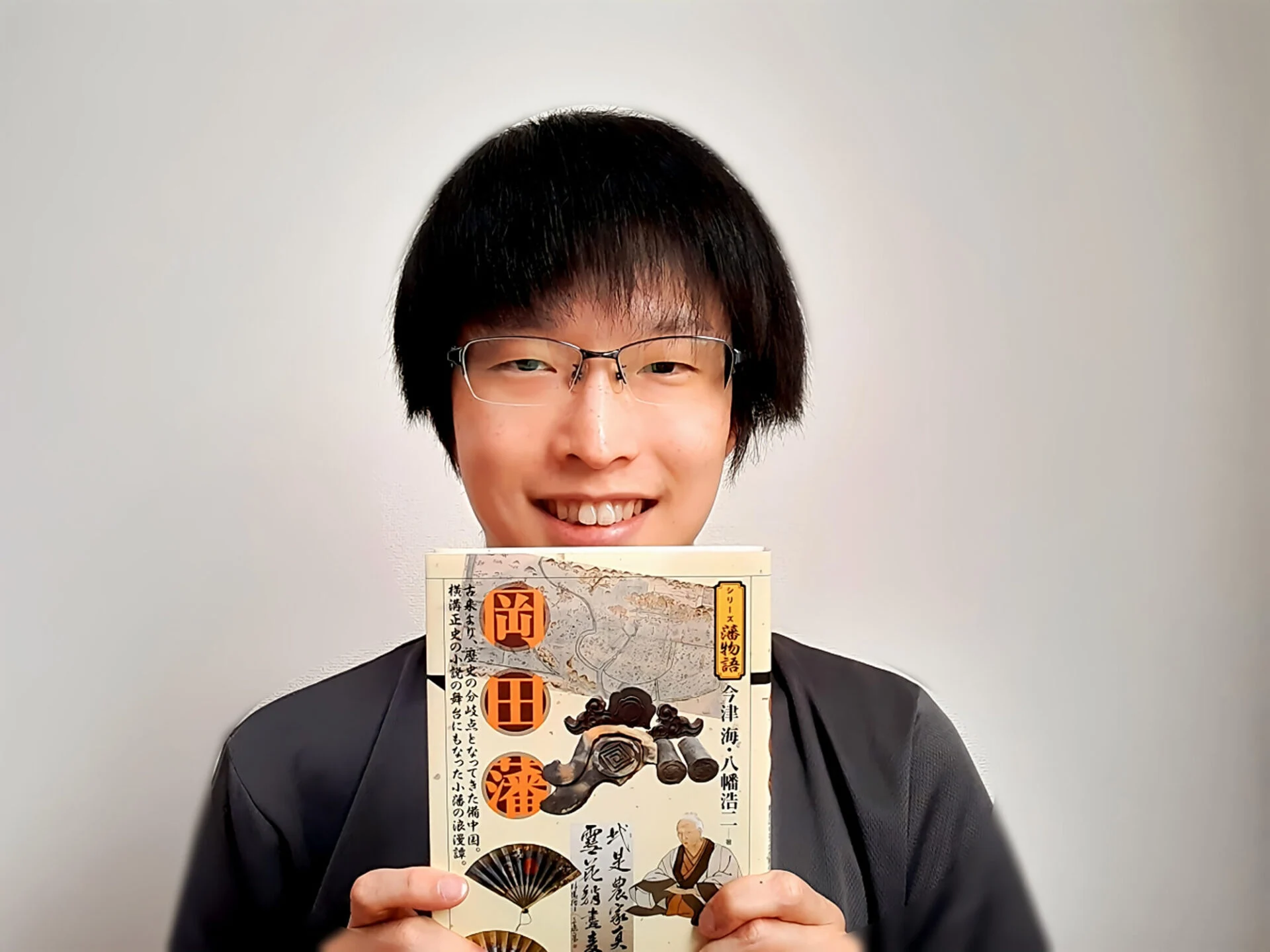
The author, Karasuma, lives in Hyogo Prefecture.
Even so, they have shown such interest and affection for Okayama Prefecture, and written such captivating stories.
Not only people from other prefectures who want to visit Okayama, but also those who live in Okayama Prefecture will discover new charms.
In fact, I was introduced to this story through my reporting and became engrossed in it myself.
I’m looking forward to more of the story, as well as the manga adaptation!
I’m even more excited to see what happens next, and I hope to follow the future of Kichijo Makibi’s landlord business.

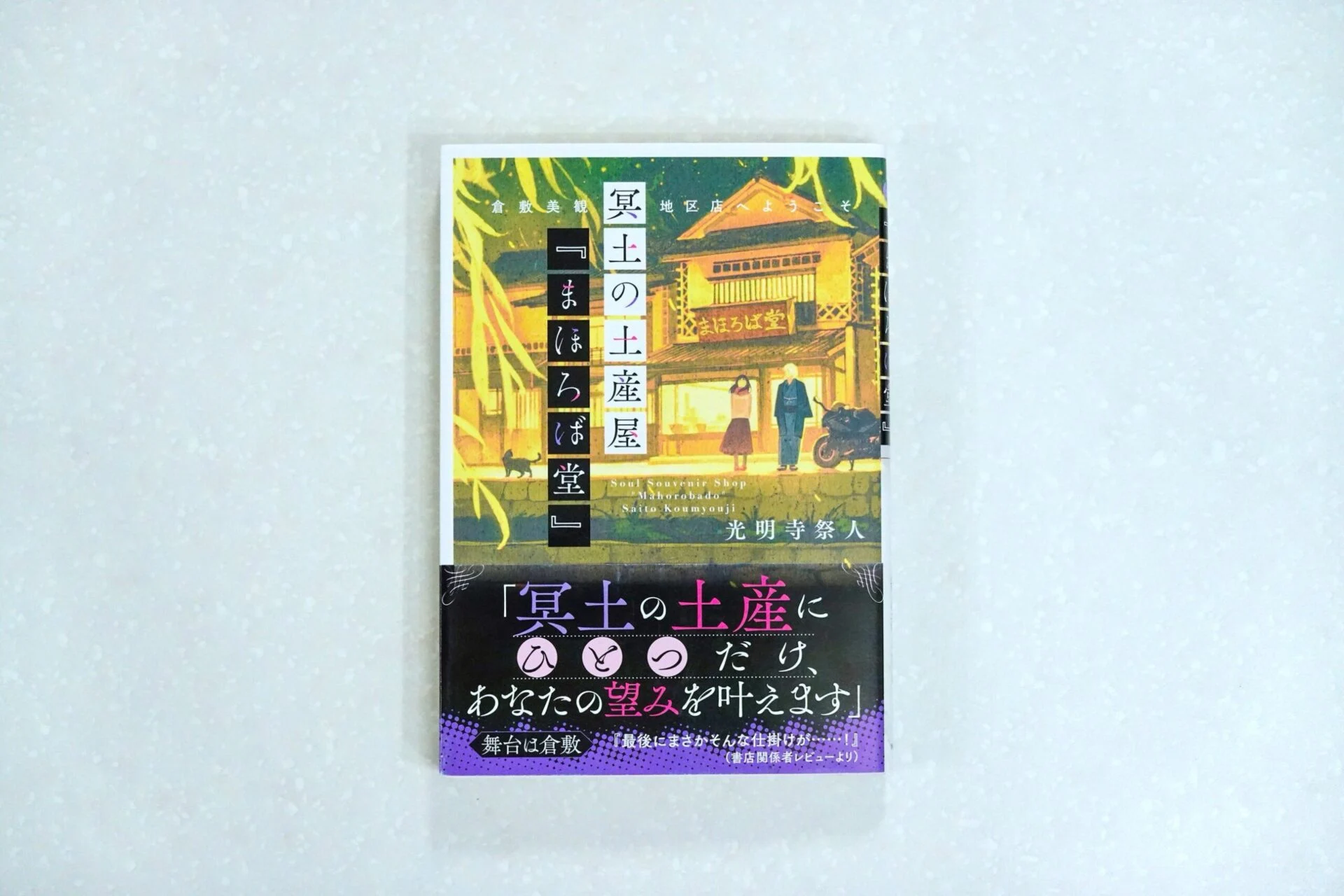
What would you like to know about Kurashiki?
Enter a word to search articles on this site






































I want more people to discover “The Unfortunate Landlord at Seimei’s House” and hope to continue the series with Volumes 5 and 6.
In the character fiction world, whether the next volume will be published is decided only after taking a hard look at sales figures.
That remains true even when a manga adaptation has been approved.
So, even making it to Volume 3 is actually quite an achievement, but I want to keep telling this story.
I hope more people will discover and come to love “The Unfortunate Landlord at Seimei’s House.”