To get a feel for the atmosphere of Kurashiki’s Bikan Historical Area, it’s best to visit in person, isn’t it?
But there may be times when you can’t travel for various reasons.
In that case, one option is to read a novel set in the Bikan Historical Area.
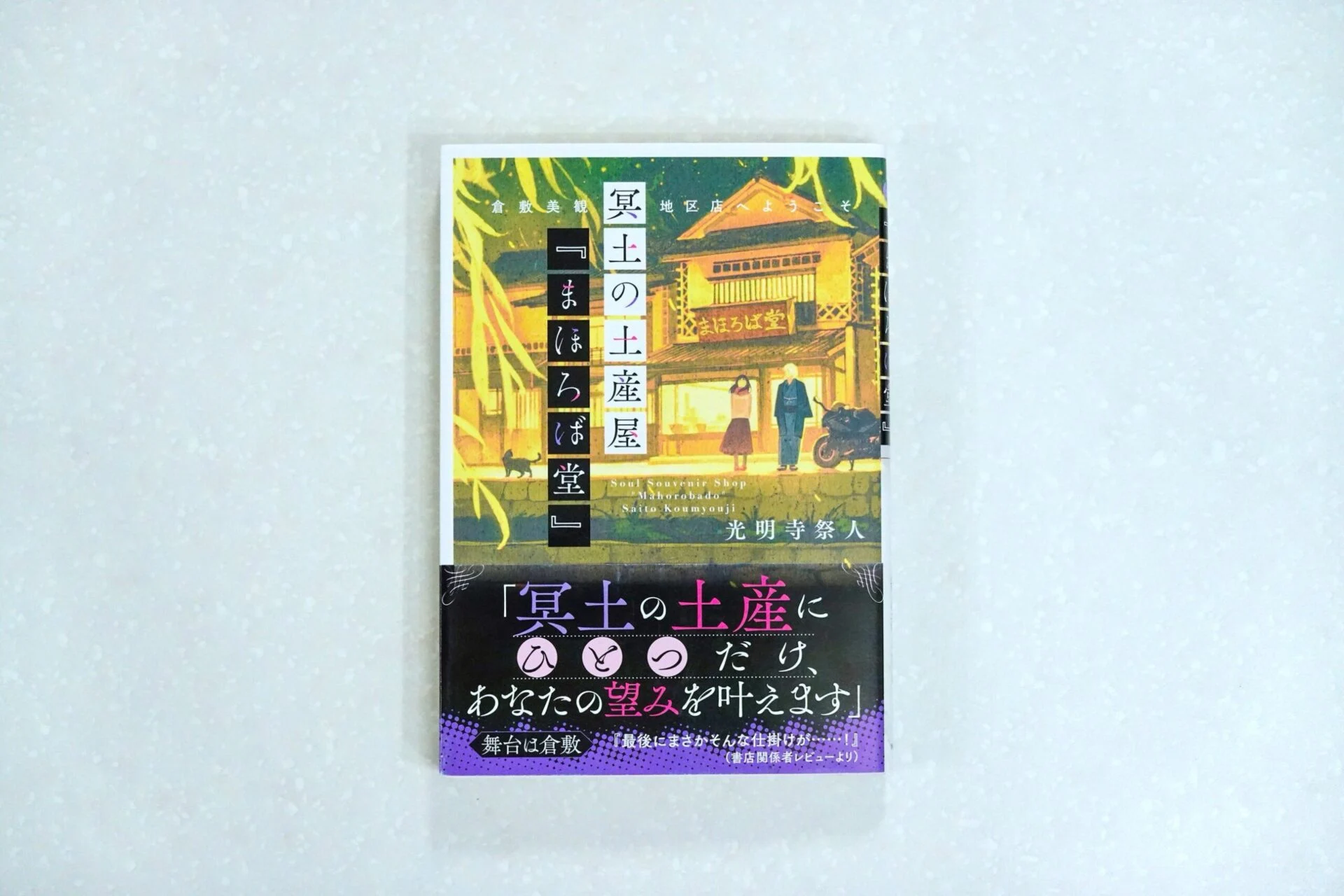
The novel set in the Bikan Historical Area, “Welcome to the Afterlife Souvenir Shop ‘Mahorobado,’ Kurashiki Bikan Historical Area Branch” (hereafter, “Mahorobado”), was published in September 2020.
The shop featured in the story, “Mahorobado,” is a souvenir shop located in the Kurashiki Bikan Historical Area.
However, the title includes the words “of the afterlife.”
What kind of story could it be?
The author, Komyoji Saito, lives in Kurashiki City.
We interviewed him about why he chose Kurashiki as the setting, what readers should look out for, and his feelings about his hometown of Kurashiki.
The information presented here was current when this article was published in October 2020. Please note that it may differ from current information.
The story of “Welcome to the Afterlife Souvenir Shop ‘Mahorobado,’ Kurashiki Bikan Historical Area Branch”

Nozomi, an office worker employed as a temporary staff member, happens to meet Mahorobado, a souvenir shop in the Kurashiki Bikan Historical Area, and its owner, Aotsuki Mahoro.
The story features many scenes of Kurashiki, including the Bikan Historical Area, as well as local specialties and souvenirs. If you know Kurashiki, you’re sure to think, “Oh!”
Even if you don’t know Kurashiki, the vivid descriptions bring the scenes to life.
And so begins the exchange between Nozomi and the mysterious souvenir shop.
In a corner of the historic and atmospheric tourist destination known as the “Kurashiki Bikan Historical Area,” there is a shop that sells things money can’t buy. The long-established souvenir shop, “Mahorobado.” That is the name of the shop Nozomi, a lonely, debt-ridden office worker on the brink of unemployment, encounters.
An old clock announces the time with a deep bong in the stillness of the night. If you come here after it has chimed seven times, the handsome owner, Aotsuki Mahoro, dressed in an indigo-dyed kimono, will grant one of your wishes while treating you with the utmost hospitality.
But what you must pay in return is something more precious to you than anything else—.
Welcome to the Afterlife Souvenir Shop “Mahorobado,” Kurashiki Bikan Historical Area Branch | Kotoha Bunko | MICRO MAGAZINE
As the synopsis says, the setting of this work is the long-established souvenir shop “Mahorobado.”
There are many souvenir shops in the Kurashiki Bikan Historical Area.
The story’s title includes the words “afterlife souvenir shop,” which might give you the impression that “the word ‘afterlife’ sounds scary…”
But don’t worry. It’s a lovely story that will warm your heart and leave you feeling relieved when you finish reading.
Spots around the Kurashiki Bikan Historical Area featured in “Mahorobado”
Here are a few spots around the Kurashiki Bikan Historical Area that appear in “Mahorobado.”
▼First, the shopping street, which is used as a transition between scenes in the story.

This is the shopping street Nozomi walks along toward the Bikan Historical Area after arriving in Kurashiki.
She crosses the pedestrian bridge in front of Tenmaya Kurashiki and heads into Kurashiki Shopping Street.
Looking around, she sees old-fashioned shops and izakaya lined up along the street.
The scene has a distinctly Showa-era feel.
From the book: p. 14
▼Next is the Kurashiki Bikan Historical Area, the main setting of this work.

Mahorobado is said to be located along the Kurashiki River.
She walks along the riverbank in the Bikan Historical Area. The townscape is steeped in history. The low late-autumn sunlight and the murmuring Kurashiki River are especially dazzling.
From the book: p. 30
▼As you walk along the Kurashiki Riverbank, you can also see the punting boats, a sightseeing highlight recommended by Komyoji.
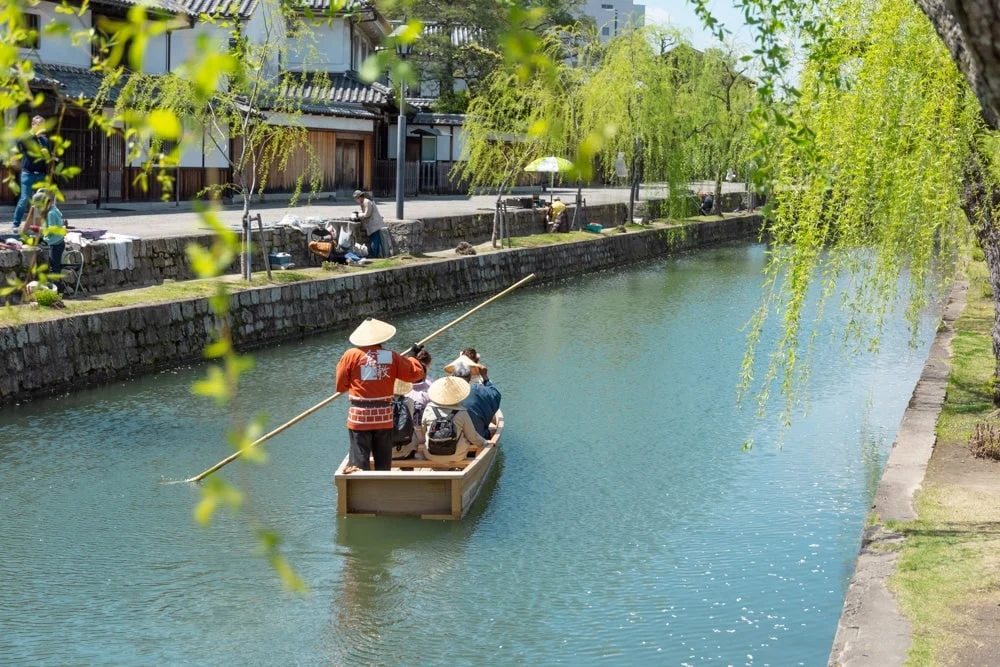
The story also includes an episode in which the protagonist, Nozomi, rode a punting boat with her family as a child, so keep an eye out for it!

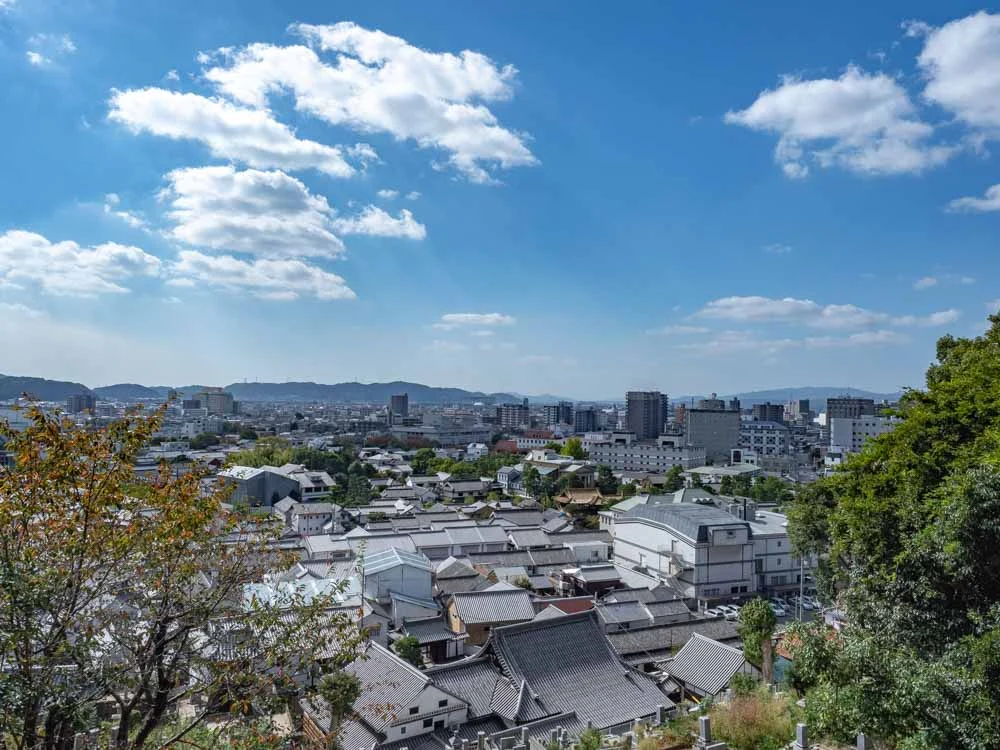
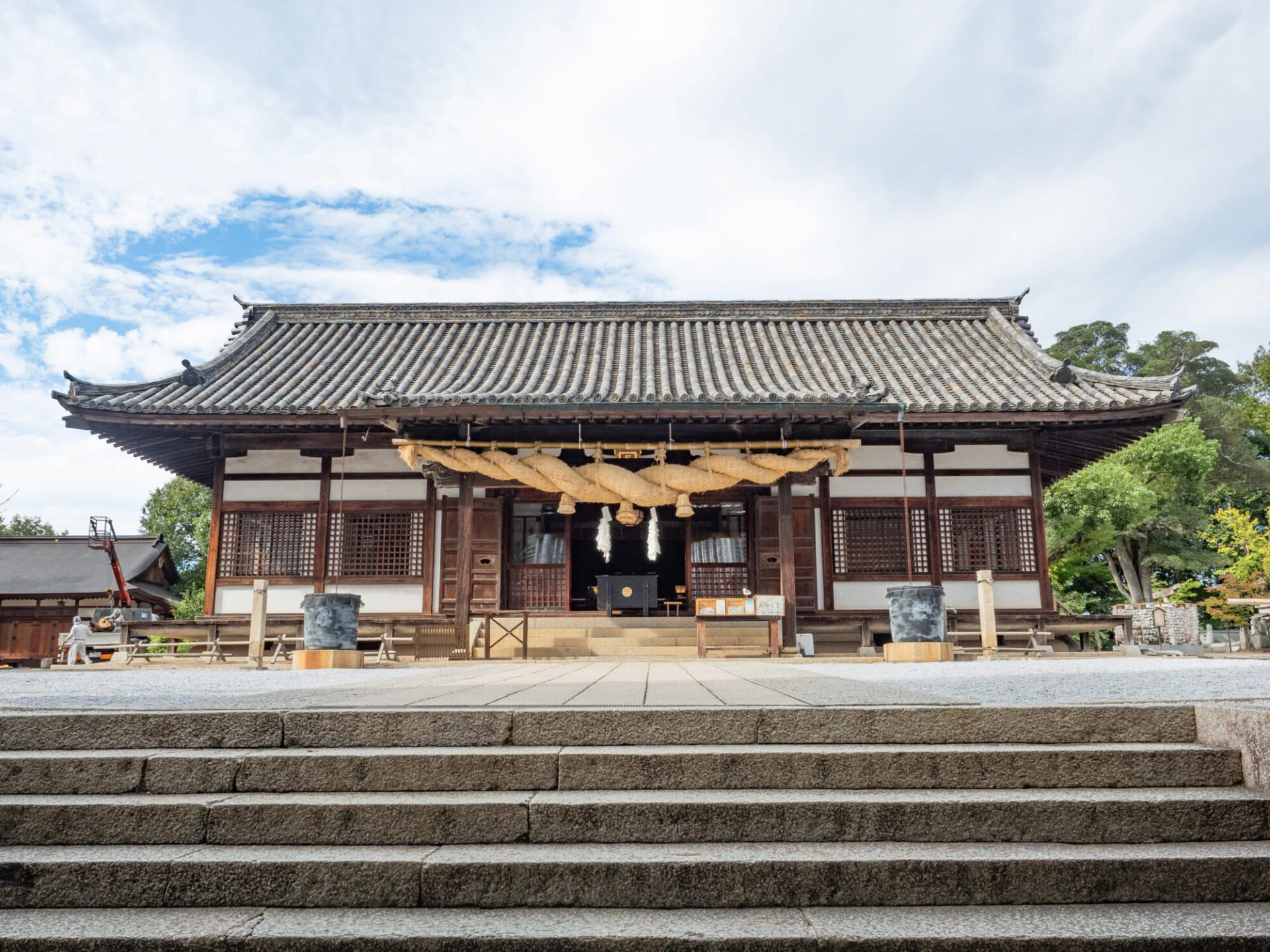
▼Achi Shrine appears in a scene where Nozomi stands gazing down over the city of Kurashiki.

▼Perhaps the view looked something like this?
Interview with Komyoji Saito

We conducted this interview at the “Former Ohara Family Residence (Ohara House Katalyzer Book Cafe),” along the Kurashiki River.

I read your work. It was very enjoyable, and it matched the atmosphere of the Bikan Historical Area perfectly.
When did you come up with the idea for this story?
Komyoji
I used to visit the library in Kurashiki, near the Bikan Historical Area, quite often in my free time.
On my way back, I would sometimes stroll around the Bikan Historical Area or take a break there.
That’s when the phrase “afterlife souvenir shop” came to mind, and the story grew from there very quickly.
“Mahorobado” falls into the light literary fiction genre. I wanted to write mysteries and human dramas, so I mixed those with elements popular in light literary fiction to create “Mahorobado.”
Light literary fiction: A genre between literary fiction and light novels, often focusing on romance and workplace stories. Also known as character novels.
You currently live in Kurashiki City. Are you originally from Kurashiki as well?
Komyoji
I’m from Okayama City, and moved to Kurashiki because of family circumstances.
I think it was good for the work that I could see Kurashiki, which has now become my hometown, through different eyes.
The protagonist, Nozomi, lives in Okayama City, and I think I was able to convey the feeling of “being in the same prefecture, but not having visited Kurashiki or the Bikan Historical Area very often.”
I hope readers can also experience the freshness I felt after moving here from Okayama City.

The cover illustration is lovely and suits the work perfectly. You can enjoy it even more if you look at it again after reading the story.
I’ve passed through the Bikan Historical Area at night several times, and I think it perfectly captures the atmosphere of the story.
Komyoji
The cover illustration was drawn by the popular illustrator Gemi, after discussions with the editor.
When I originally posted it on the web (Shosetsuka ni Naro), I made my own cover for it.
At the time, I chose the colors for the shop owner, Aotsuki Mahoro, with Kurashiki Glass and denim in mind.
I paid close attention to the visuals when writing this work, “Mahorobado.”
Originally, I imagined Mahorobado as a shop on a back street, but I moved it to the Kurashiki Riverbank because I wanted readers to be able to picture the scenery.
I also added scenes of the protagonist, Nozomi, sightseeing at the editor’s request when the work was published as a book.
“Mahorobado” was originally posted on the novel-sharing website “Shosetsuka ni Naro.”
It was published as a book in September 2020 after a publisher made an offer.

The story features many sweets, including Fujito Manju and Murasuzume.
Are there any Kurashiki sweets you would recommend?
Komyoji Temple
I added the parts about sightseeing when the story was published as a book, but the descriptions of the sweets are unchanged from the web version, partly because I’ve always liked them.
My recommendation is “Rikuno Hoju.”
Ryokan Temari also plays a part in the story.

Is there a place you’d like people visiting Kurashiki City for the first time to go?
Komyoji Temple
Above all, I’d like people to walk around the Bikan Historical Area, take in the scenery, and experience its atmosphere.
I also recommend taking a ride on a punting boat.
I’d be happy if reading this work made people think, “I’d like to visit the Bikan Historical Area.”
The scene where Nozomi misses her stop on the JR Sanyo Line and ends up in Kurashiki, then enters the Bikan Historical Area from the shopping arcade, left a strong impression on me.
Komyoji Temple
One literary technique is to describe a character passing through something at the entrance to a story, using that to convey a transition.
Since the story is set in a “souvenir shop for the afterlife,” I made the shopping arcade the entrance to a tunnel, so the story would shift as the characters passed through it.
Kurashiki is a place that makes a striking setting for a novel, and the characters in “Mahoroba-do” are appealing, so I hope it becomes a series!
Komyoji Temple
I’ve posted up to volume two of the series on the web.
I’ve also already decided how I want the story to develop.
I have lots of ideas, and there are many things I’d like to write about, such as the history of Kurashiki and the history of Mahoroba-do.
Okayama Prefecture, including Kurashiki, has many fascinating places, and I’d love to feature them in my work.
What are your aspirations for the future?
Komyoji Temple
I’d like to publish the “Mahoroba-do” series as books.
I want to keep writing while cherishing what lies at the heart of my work: “drama born from mystery.”
I love Kurashiki, so I hope to continue setting my writing there.
I’m currently promoting “Mahoroba-do,” so once things settle down, I’d like to write other works as well.
From the Writer
Whether you’re a local or visiting the Bikan Historical Area for the first time, you’re sure to enjoy it even more after reading “Mahorobado.”
The story also includes plenty of familiar “that’s so true” moments that Kurashiki City and Okayama Prefecture residents will recognize, so see how many you can spot.
Mr. Komyoji is a fan of Soji Shimada, a writer from Fukuyama City, where the author lives.
I was also engrossed in Soji Shimada’s works, so we had a lively conversation about the Fukuyama Rose Mystery Literature Award, hosted by Fukuyama City.
I’d love to read—and look forward to—a classic mystery set in the Bikan Historical Area (a classic mystery is one centered on solving puzzles and uncovering tricks).
Why not explore the Bikan Historical Area with “Mahorobado” in hand?


What would you like to know about Kurashiki?
Enter a word to search articles on this site