Handmade noodles and hand-stretched noodles—do you know the difference?
Handmade noodles are made by kneading wheat flour into a flat dough and cutting it into noodle shapes with a knife, while hand-stretched noodles are made by stretching the dough from a ball shape without using a knife.
This process stretches the fibers (gluten) and creates a smooth texture.
Kamogata-cho in Asakuchi City, Okayama Prefecture, has been a major production area for hand-stretched noodles since the Edo period.
In the past, the sight of noodles being dried outside, known as kado-boshi, was commonly seen.
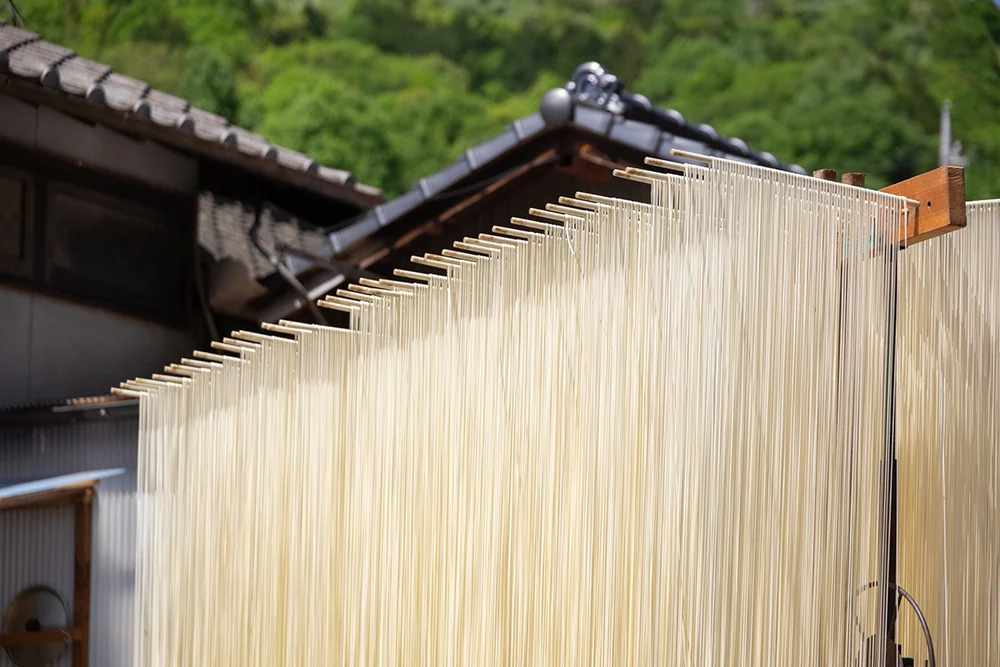
As mechanization has progressed, kado-boshi has become rare, but it is still practiced at Kawata Kenichi Noodle Factory.
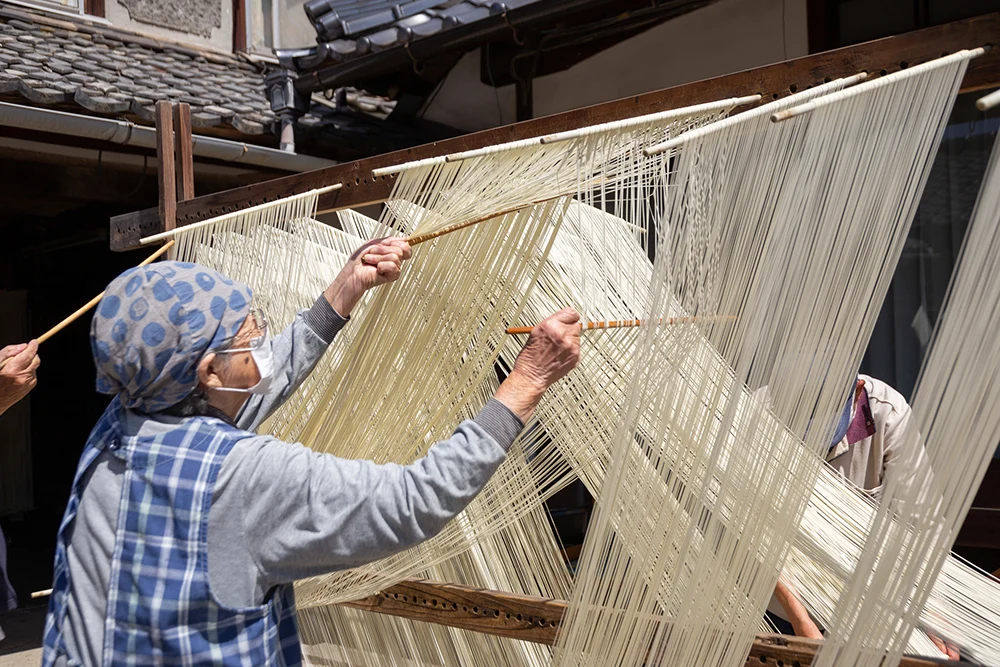
I experienced making hand-stretched noodles at Kawata Kenichi Noodle Factory, which continues the traditional methods.
About Kamogata's hand-stretched noodles
Kamogata, the town of hand-stretched noodles
Kamogata-cho in Asakuchi City, located in the southwestern part of Okayama Prefecture, is known as the town of hand-stretched noodles.
The "Kamogata-cho Hand-Stretched Noodle Festival" is held every year at the end of June, although it was canceled in 2020 and 2021 due to the spread of COVID-19. Local noodle vendors set up stalls, and it attracts many visitors.
Among Kamogata-cho, the Kosaka Higashi district has been a major production area for hand-stretched noodles since the Edo period.
Wheat was cultivated as a secondary crop after rice, which established hand-stretched noodle making as a side business during the off-season (winter).
The presence of the Sugitanigawa River, which was just right for operating water wheels used to grind wheat flour, was also a factor in this establishment.
In the past, there were reportedly as many as 40 water wheels lined up along the river.
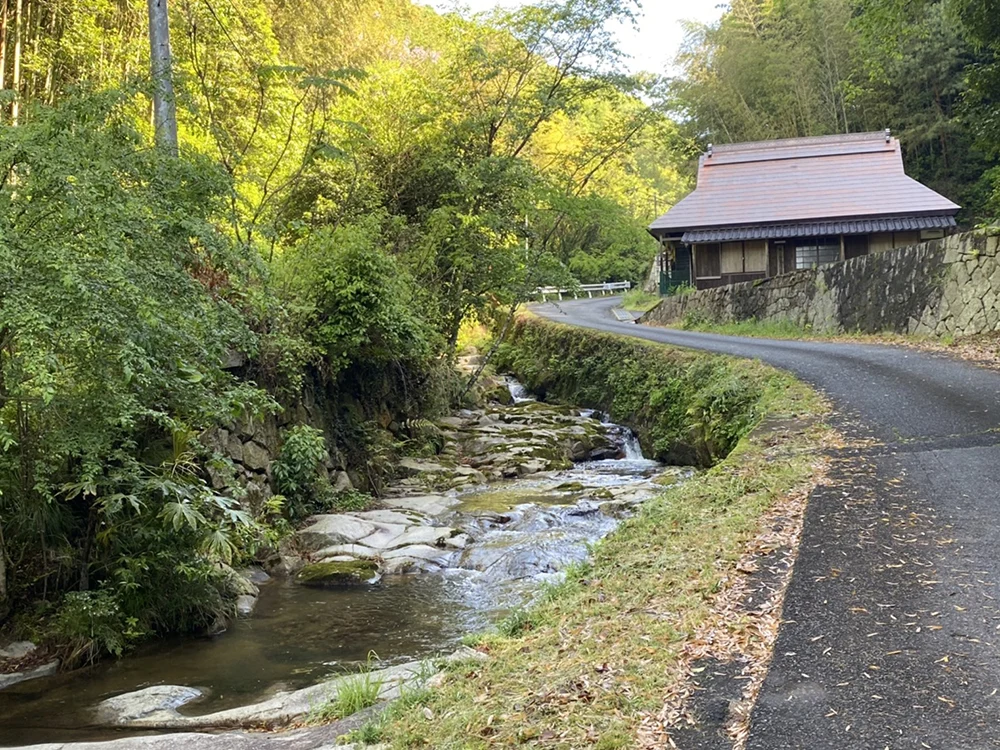
The climate of this region, which has low humidity and many sunny days, is perfect for making hand-stretched noodles.
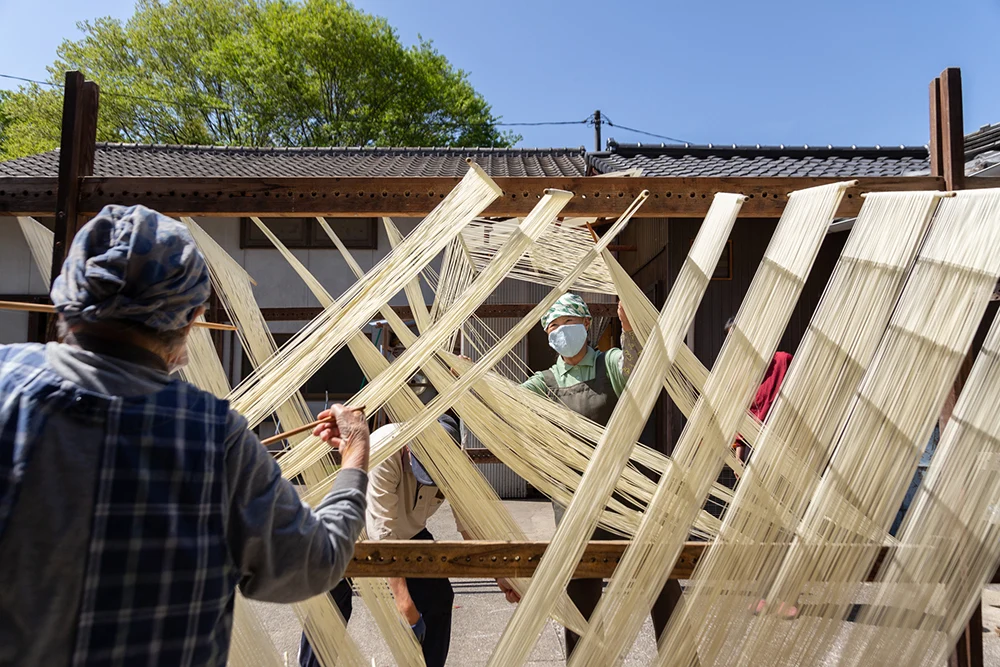
The process of stretching noodles outside and drying them in the sun is called kado-boshi.
The kado-boshi scenery became a winter tradition and was seen in various places in Kosaka Higashi.
It was a lively noodle town where noodle craftsmen from Banshu (southwestern Hyogo Prefecture), who inherited the tradition of making hand-stretched noodles, and craftsmen who made wooden boxes necessary for shipping, would come and go.
As of April 2021, there are 13 businesses in the Kamogata-cho Hand-Stretched Somen Producers Association.
Each business is experimenting with different types of wheat flour and blending ratios to create their unique noodles.
The process of making hand-stretched noodles has become more mechanized, and it is now common to conduct the entire process indoors.
Amidst this, Kawata Kenichi Noodle Factory is one of the few noodle factories that continues the outdoor kado-boshi.
Kawata Kenichi Noodle Factory
Kawata Kenichi Noodle Factory is a small noodle factory quietly located in a narrow alley with little traffic.
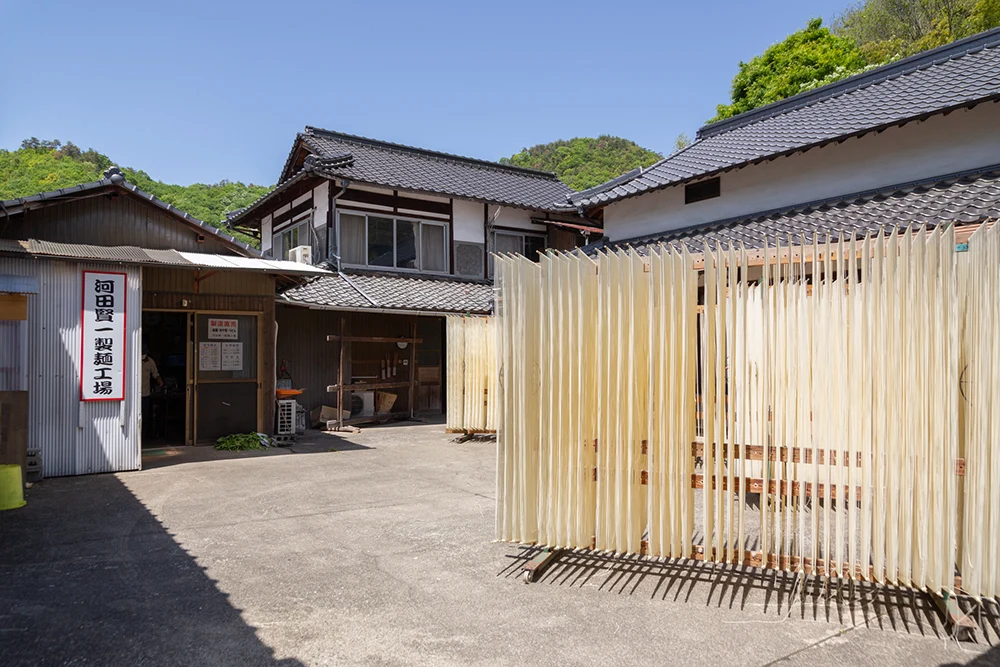
The great-grandfather of Kawata Hiroshi started making hand-stretched noodles as a family business in 1873 (Meiji 6).
Kawata has been running the noodle factory for 27 years. Before that, he worked at a steel mill, maintaining machinery.
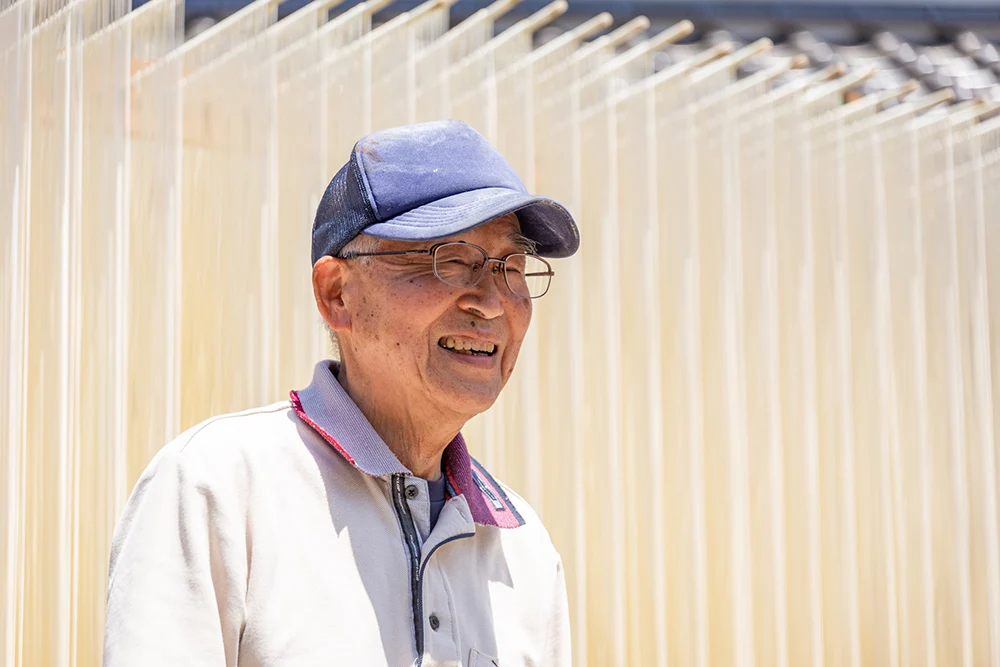
For Kawata, making hand-stretched noodles has been a job he has seen closely since childhood. He helped out during his elementary and middle school years.
As of April 2021, he works daily with a staff of seven to make hand-stretched noodles. Among them, there is a veteran who has been working for nearly 70 years!
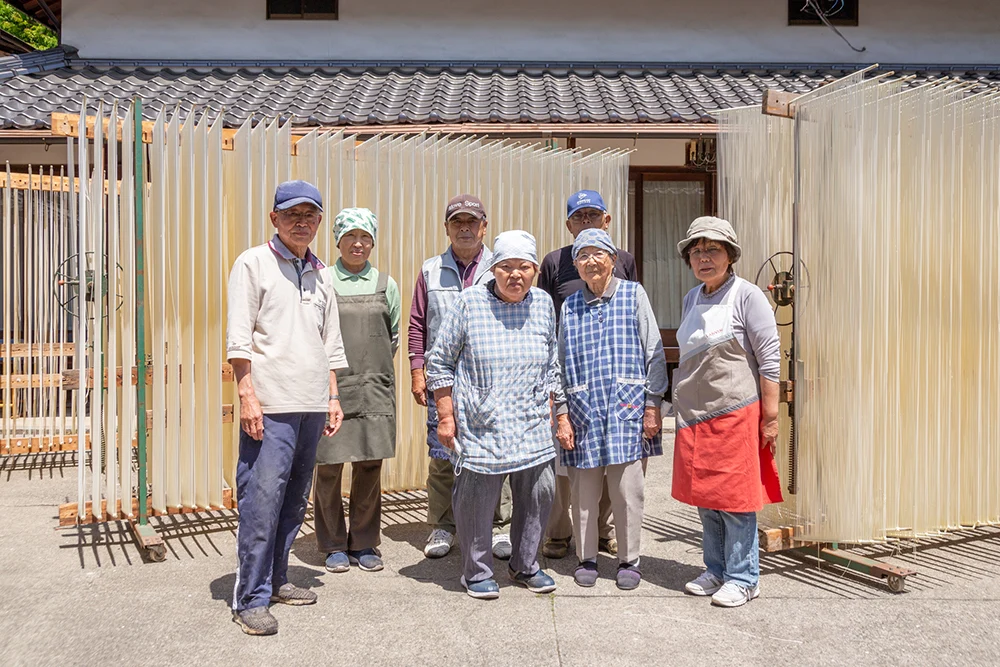
"Thanks to the favorable natural environment and our small-scale management, we have been able to continue traditional methods," Kawata says.
The hand-stretched noodles, which have a wheat flavor and a smooth texture, receive orders from fans all over the country.
The process of making hand-stretched noodles
At Kawata Kenichi Noodle Factory, noodle making starts at 2 AM.
In this region, it is often sunny in the morning, so the kado-boshi must be completed by around noon.
In the stillness of the midnight, the temperature and humidity for the day are checked, and the amounts of water and salt for the wheat flour are determined.
The temperature and humidity often differ from the forecast, making this blending quite challenging.
Well water is used for the noodles. It comes from the underground water of the mountains in the Mt. Yosho range nearby. It is water blessed by nature.
After kneading the wheat flour, water, and salt with a machine to form a large dough ball, the dough is stretched into noodles through six stages using machines.
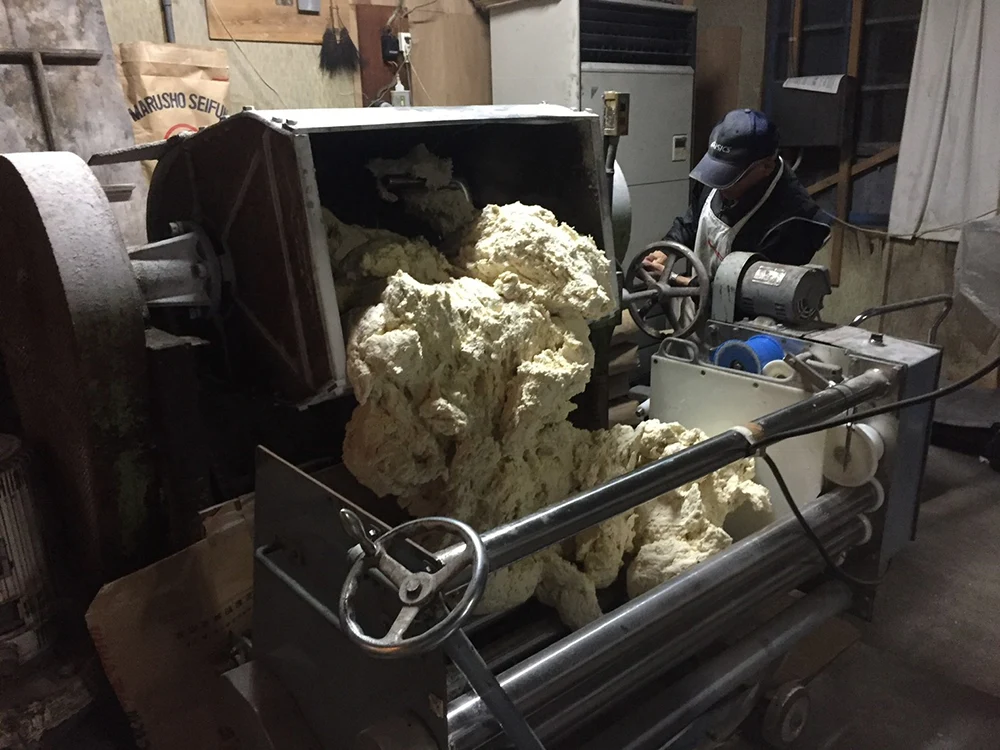
Initially, the thickness is like that of a rope.
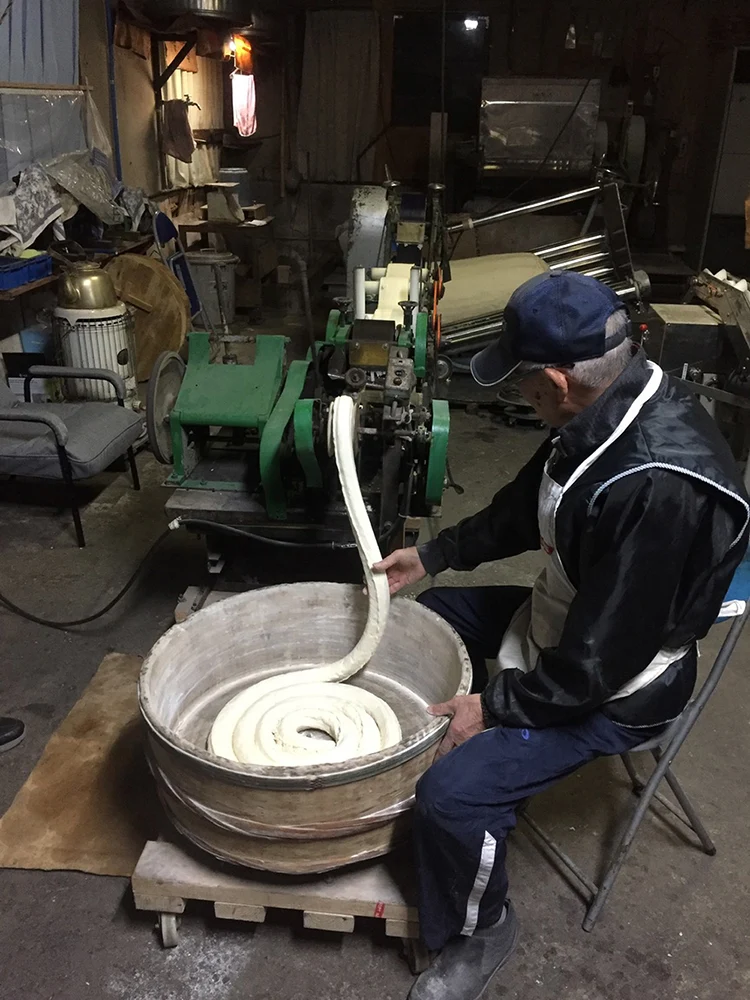
Continuing while checking the degree of fermentation, the noodles are finished to the thickness of udon.
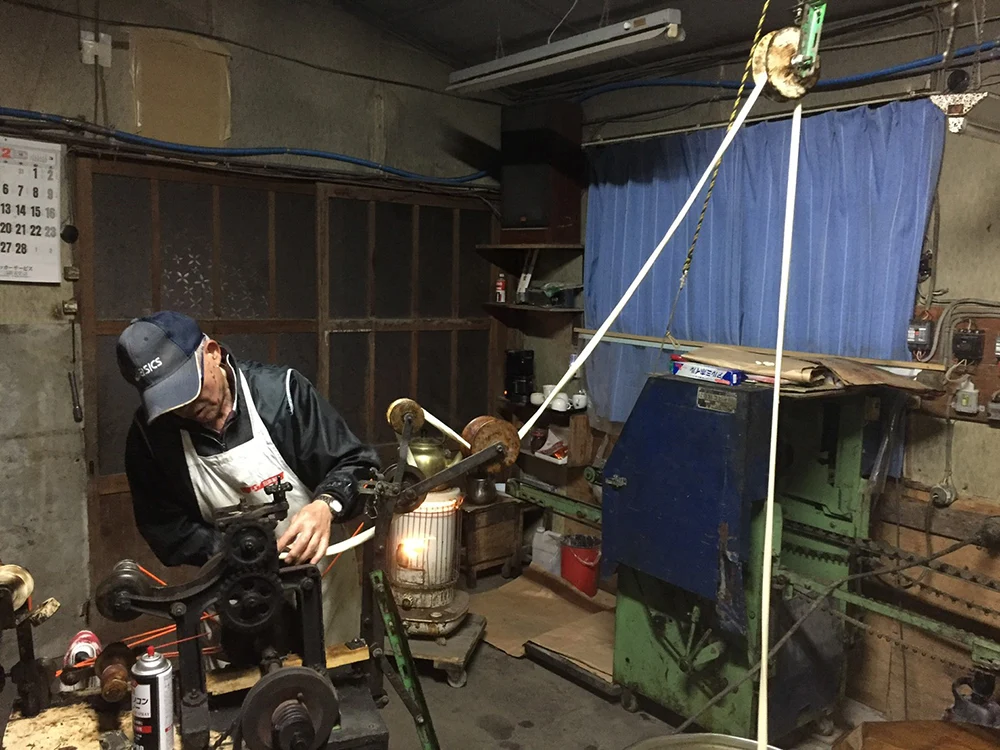
By repeating the stretching and fermentation, the noodles gain flexibility.
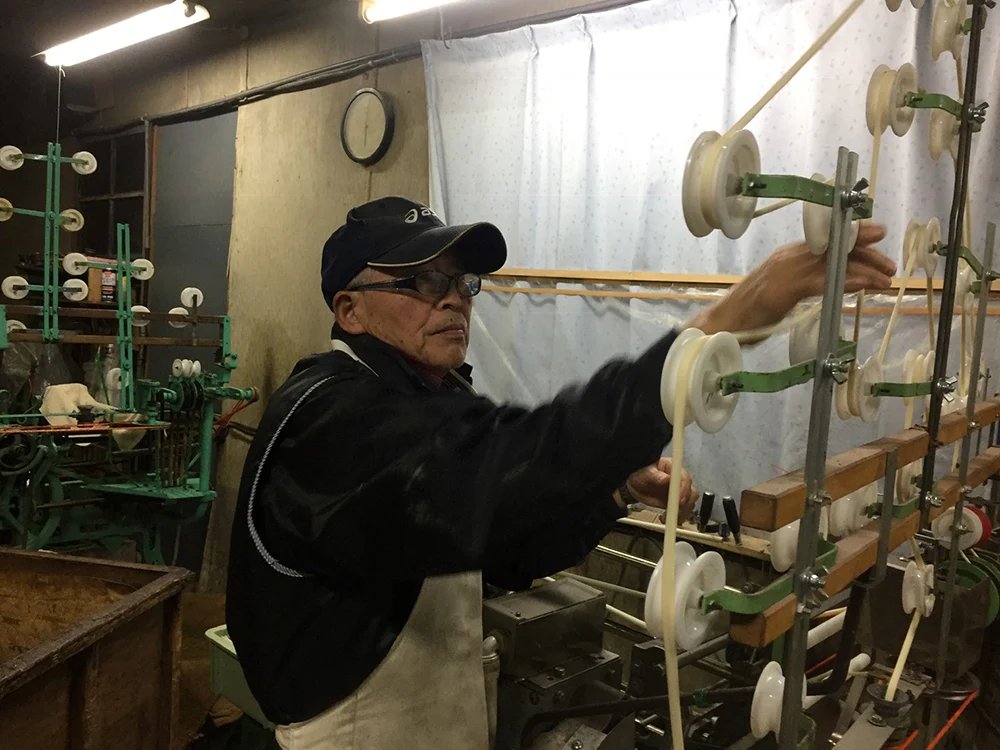
Once the thickness reaches about 0.5 centimeters, it finally proceeds to the kado-boshi stage.
In the days before machines, everything was done by hand, requiring much more time and physical strength.
Here is a summary of the process of making hand-stretched noodles.
| Process | Details |
|---|---|
| 1. Nakadate | Adjusting water and salt based on temperature, humidity, and weather predictions |
| 2. Kneading | Kneading wheat flour, water, and salt with a machine, and fermenting |
| 3. Itagi | Cutting and stretching into a board shape approximately 11 cm wide and 4 cm long with a machine, then shaping into a round shape with a diameter of about 6 cm, and fermenting |
| 4. Aburaeshi | Thinning to a diameter of about 4 cm with a machine, applying cooking oil, and fermenting |
| 5. Hosome | Thinning to a diameter of about 2 cm with a machine, and fermenting |
| 6. Konashi | Thinning to a diameter of about 1 cm with a machine, and fermenting |
| 7. Kakeba | Wrapping the noodles, which have been thinned to a diameter of about 0.5 cm, in a figure-eight shape around two rods with a machine |
| 8. Nebitsu | Placing in a nebitsu (wooden box) for about 1.5 hours of fermentation |
| 9. Kobiki | Stretching the noodles to about 60 cm with a machine after removing them from the nebitsu |
| 10. Nebitsu | Fermenting again in the nebitsu for about 1.5 hours |
| 11. Kado-boshi | Stretching the noodles outdoors in the sun, gradually thinning them to about 2 meters |
| 12. Drying | Moving from outdoors to indoors and drying for about one day |
| 13. Kowari | Cutting to 19 cm on a cutting board |
| 14. Taba | Bundling into 50-gram bundles and packing into boxes |
You can see that there are many processes involved.
Especially up to the kado-boshi stage, the process of stretching and fermenting the noodles is repeated many times to give them a firm texture.
Including all processes up to drying, it takes about 30 hours.
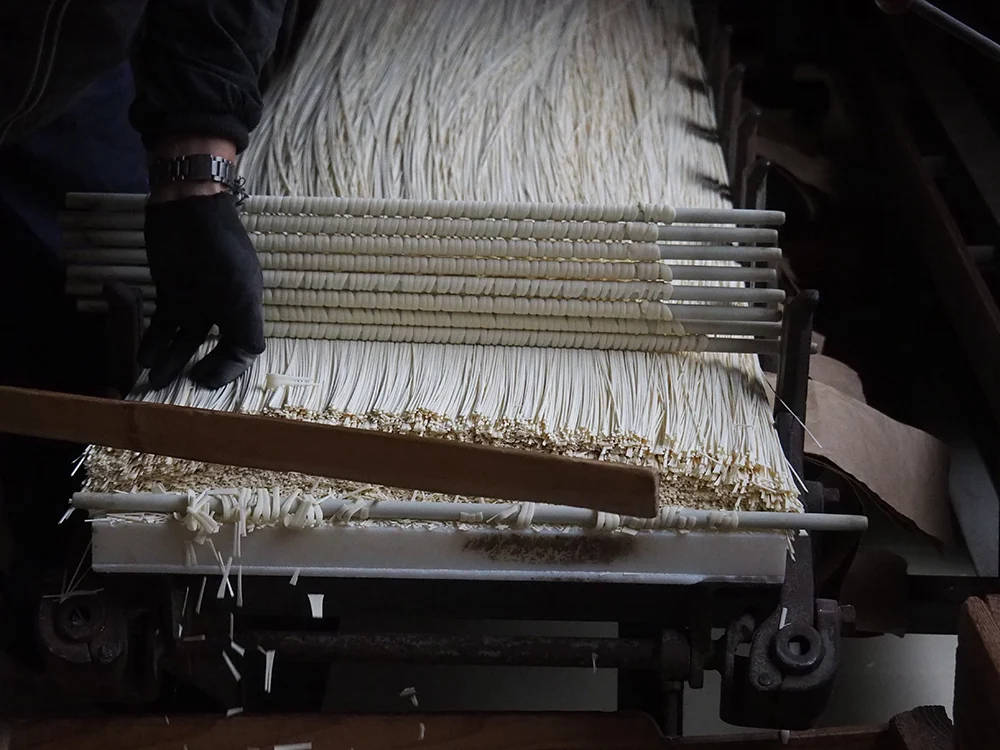
During this time, I experienced the final process of shaping the noodles, known as kado-boshi.
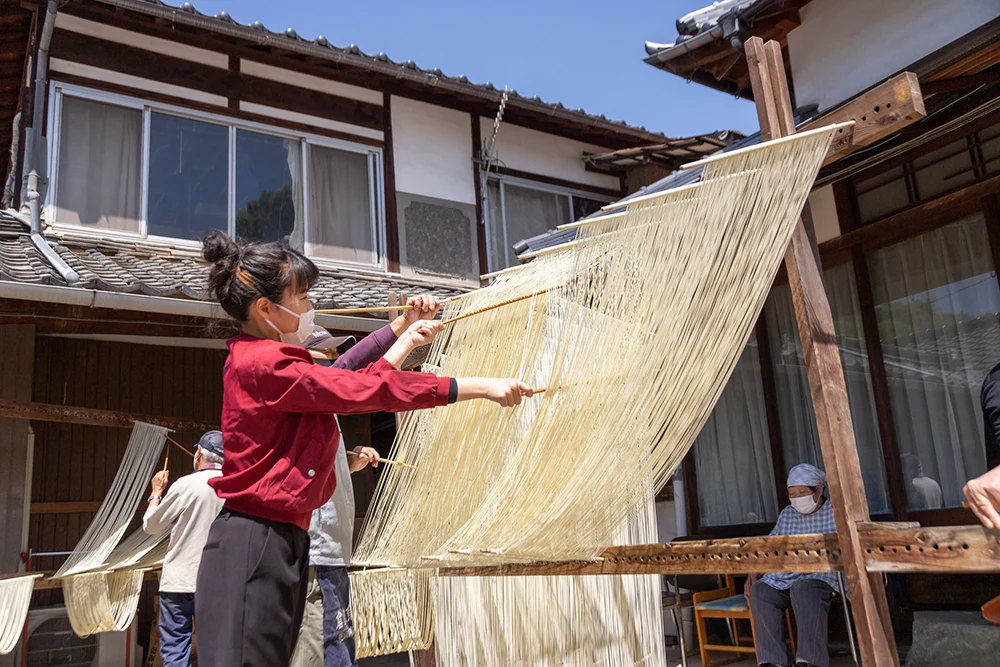
Experience making hand-stretched noodles "kado-boshi"
About the "kado-boshi" experience
At Kawata Kenichi Noodle Factory, the "kado-boshi" time is basically from 10 AM to 11:30 AM on Mondays, Wednesdays, and Fridays. During this time, you can experience making hand-stretched noodles.
1 kilogram of somen (20 bundles) is included as a souvenir, and the experience is available for 2,000 yen (tax included) per person.
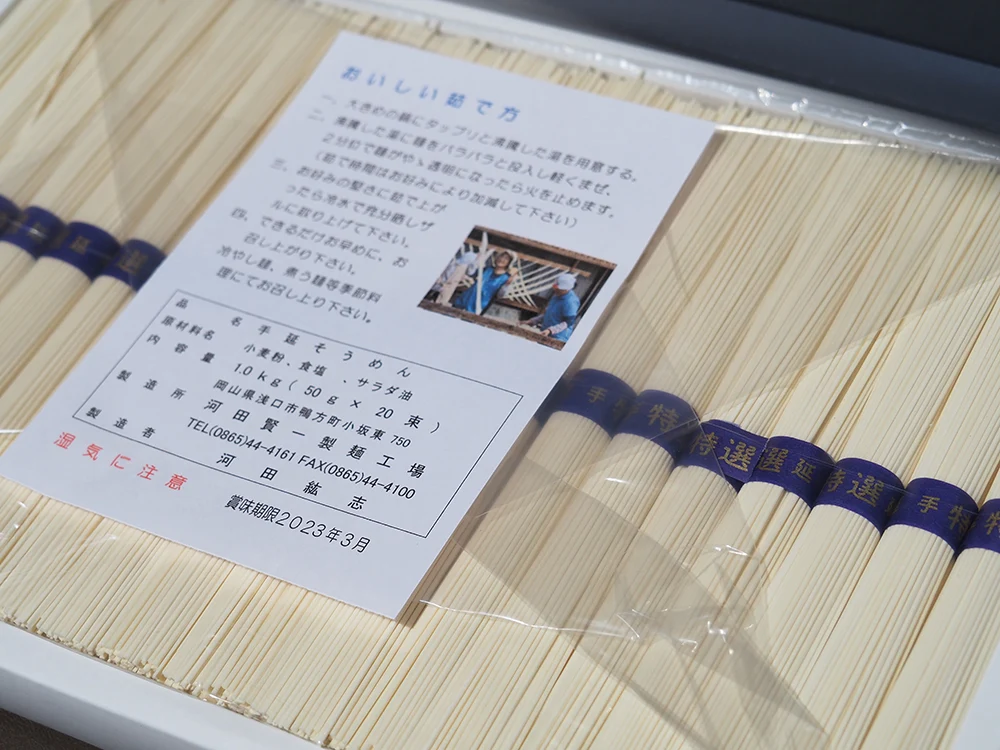
However, reservations are limited to three people per day.
Reservations should be made at least one week in advance. If the kado-boshi cannot be done due to weather conditions, you will be notified by the day before.
The aroma of wheat spreads during kado-boshi
Kawata Kenichi Noodle Factory produces somen, hiyamugi, and udon.
The day I visited was the day they made the thinnest somen.
At Kadoboshi, the noodles are stretched to about 2 meters from an initial length of about 60 centimeters.
To stretch the noodles, they use a tool called hata.
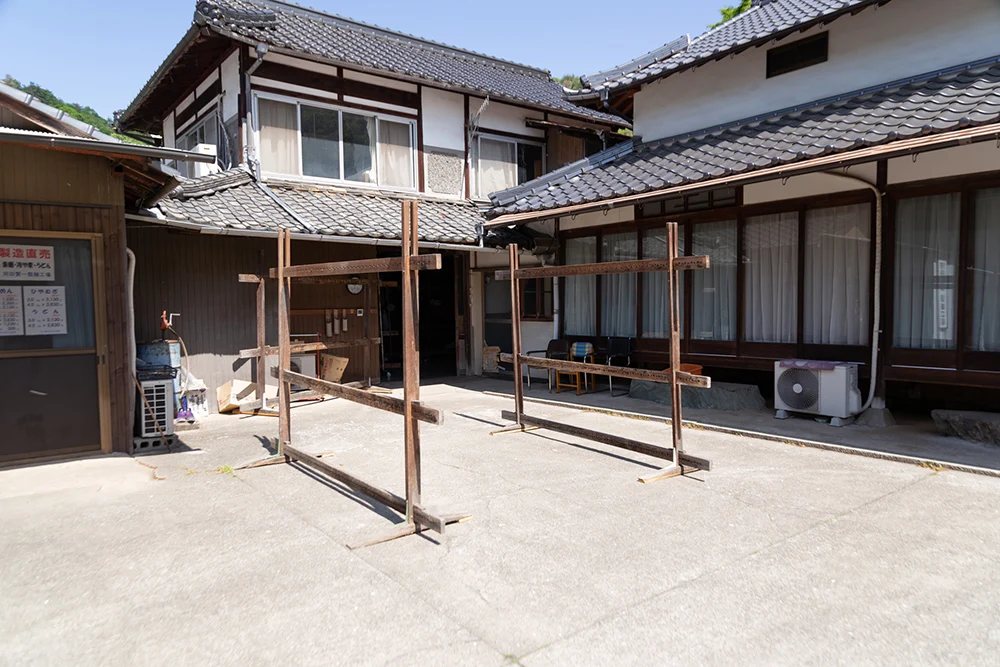
The stick wrapped with noodles is inserted into a hole and secured.
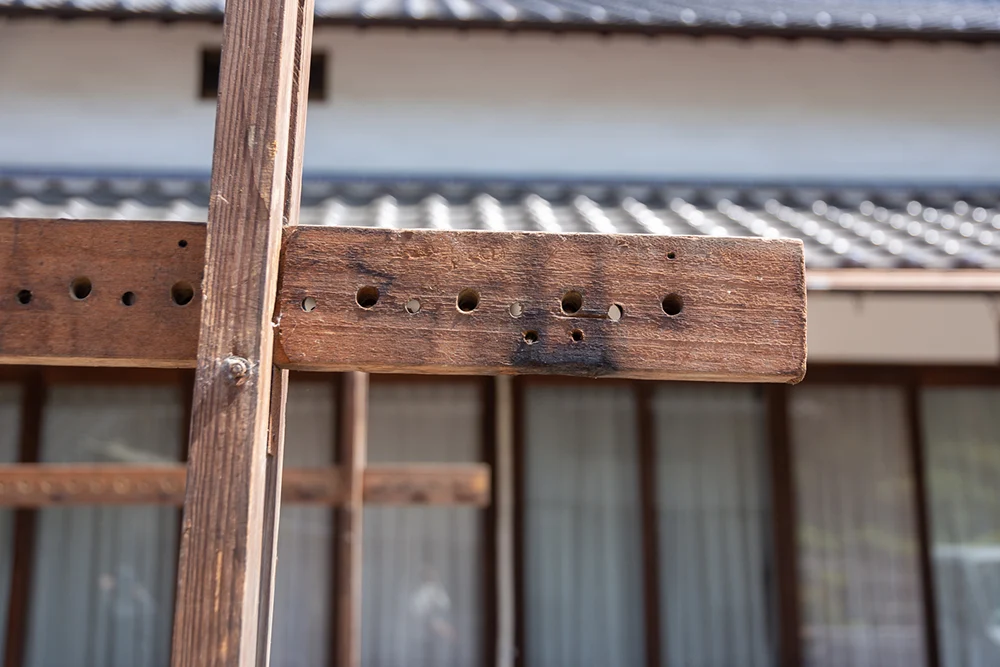
Instead of stretching all at once, they gradually stretch the noodles by changing the insertion hole.
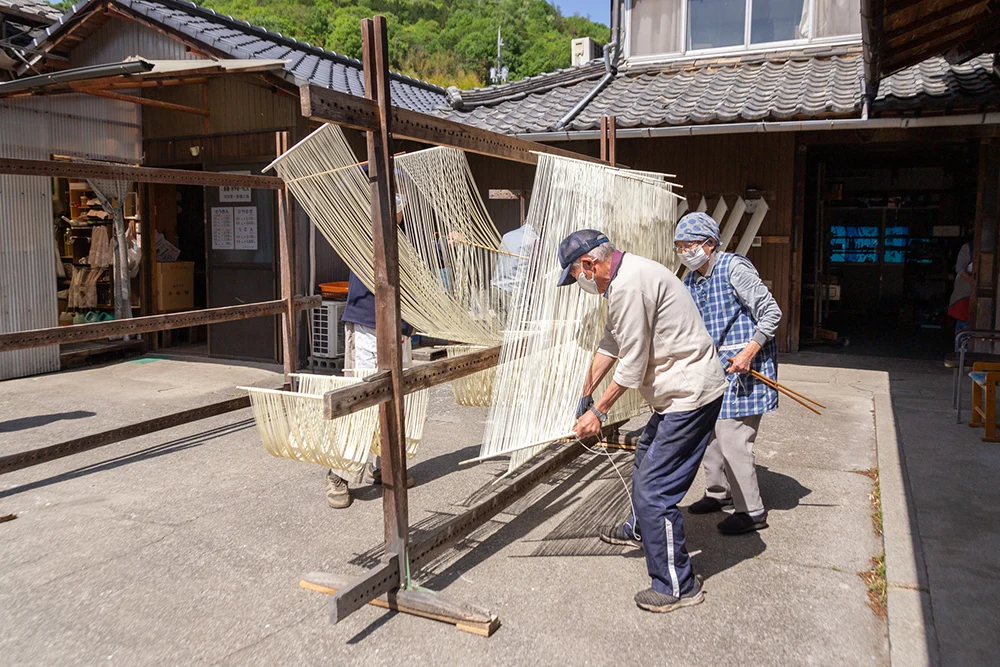
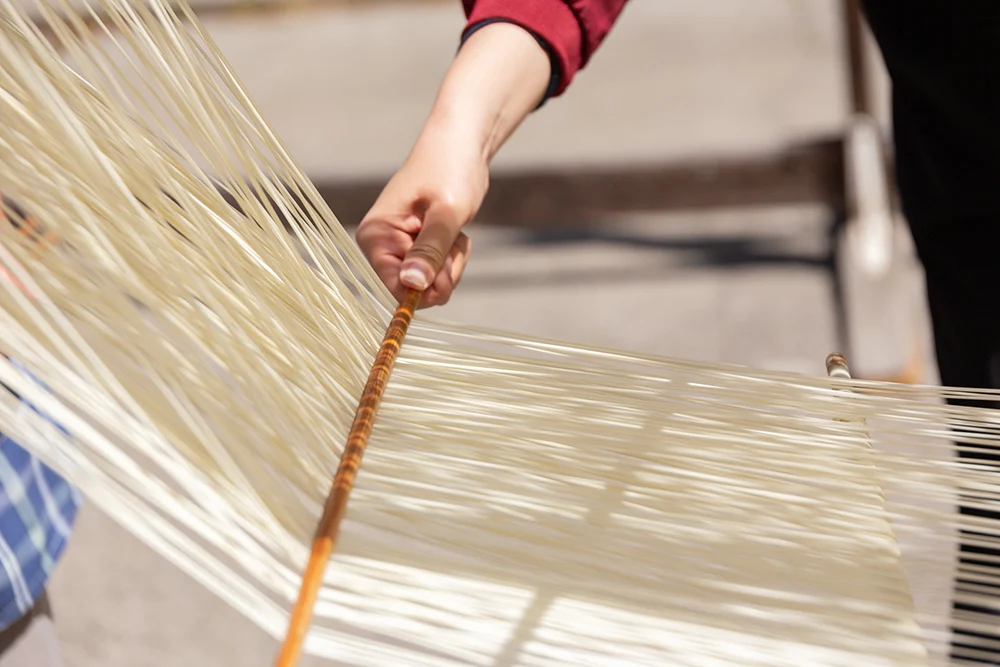
While stretching, they manipulate two bamboo chopsticks to separate the noodles that have stuck together.
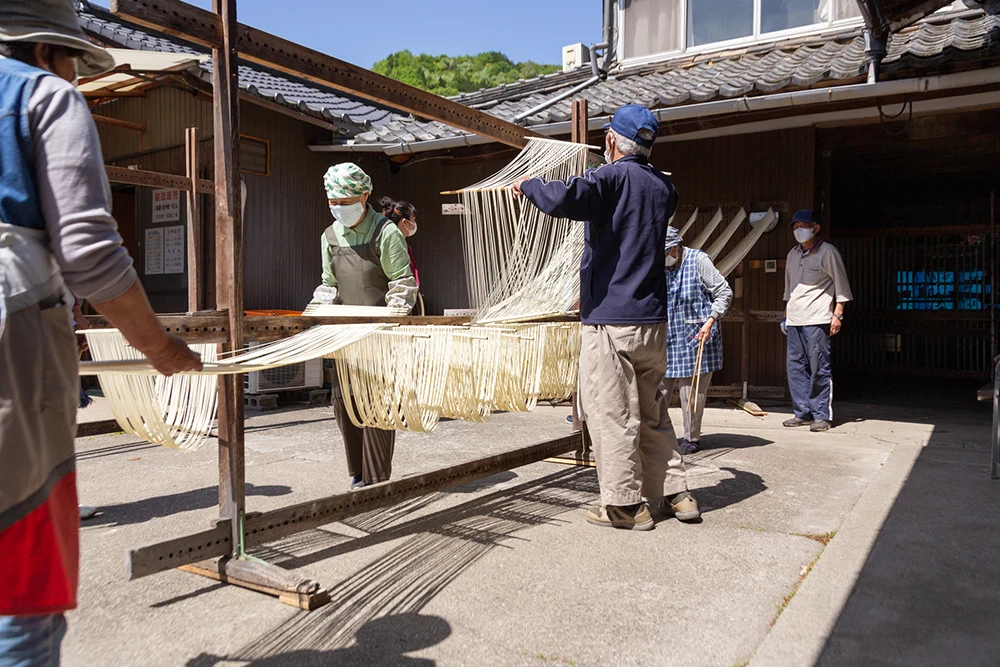
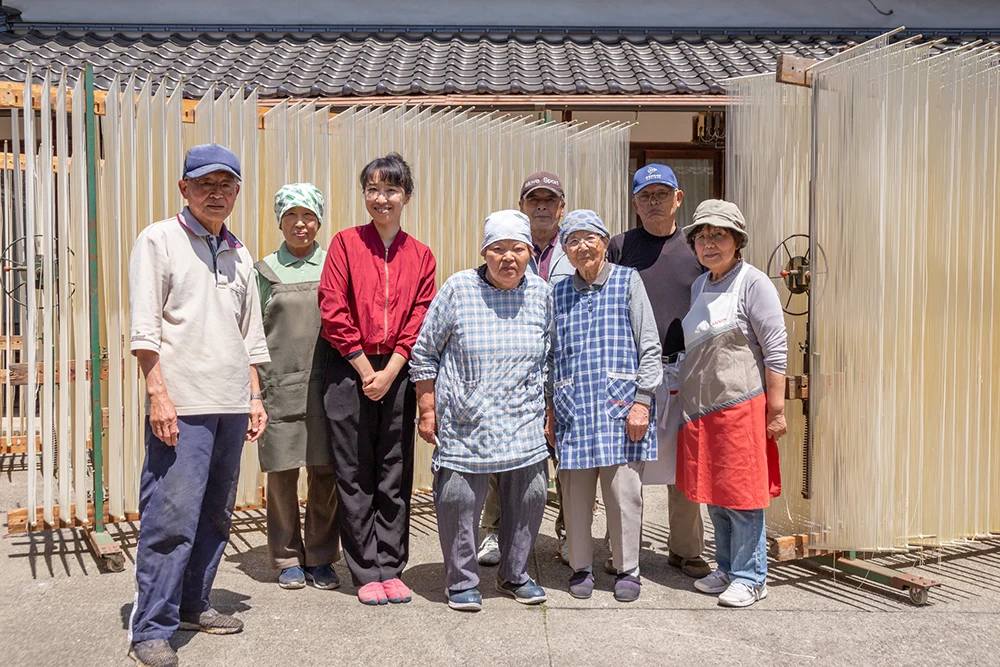
On this day, there were eight of us, including myself.
There were people responsible for inserting the stick wrapped with noodles into the machine, those manipulating the bamboo chopsticks, and others collecting the noodles that had been finished to about 1.5 meters, working together as a team.
If it takes too long, the noodles will dry out too much, so we need to be careful. We have to proceed efficiently.
The noodles, finished to about 1.5 meters, are hung like a noren (traditional shop curtain) to mature once, and then stretched to about 2 meters all at once, completing the shaping.
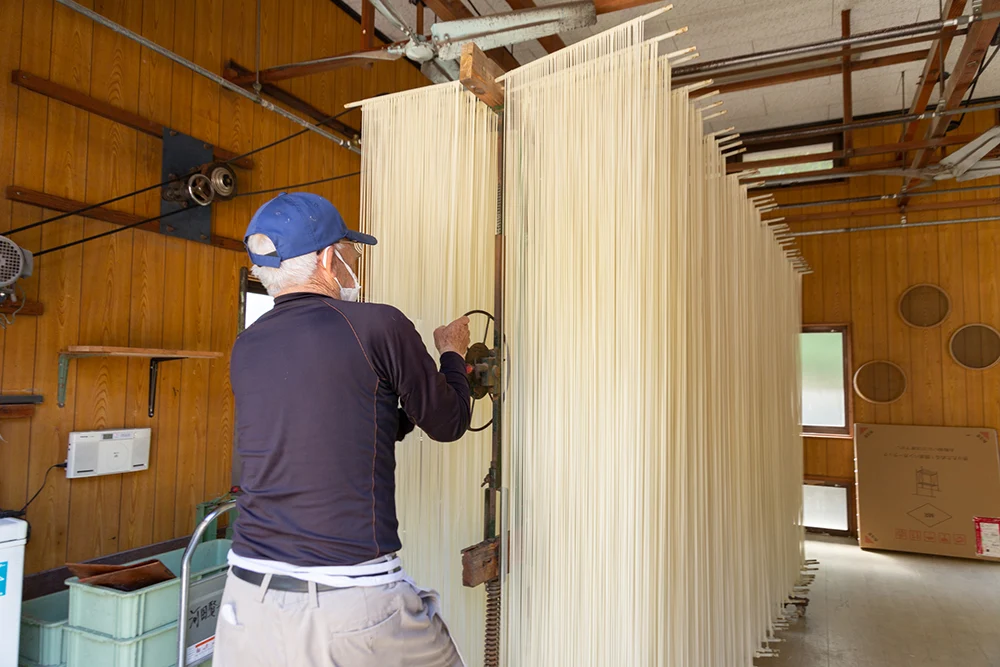
The background music was enka. Under the sun, the white, thread-like noodles spread gracefully. And a gentle aroma of wheat filled the air.
I was surprised that just mixing flour, salt, and water could create such elasticity and a pleasant aroma.
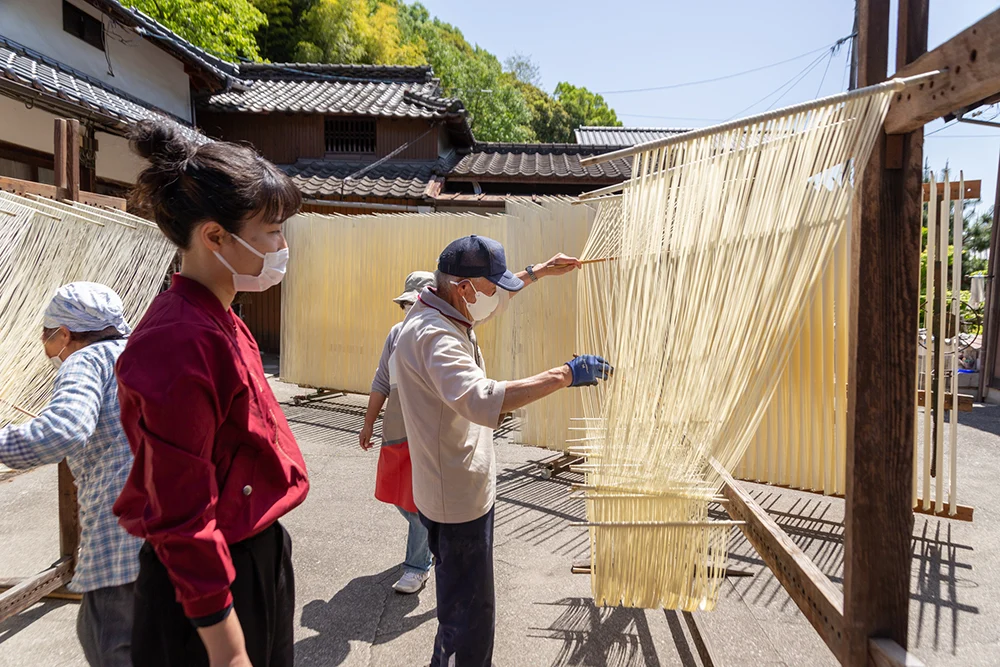
“When exposed to the sun, it turns white, and this aroma transfers directly to the noodles,” Mr. Kawada said.
Now, the Experience!
For the first 15 minutes, I observed and learned how to do it, and then I was responsible for separating the stuck noodles using bamboo chopsticks.
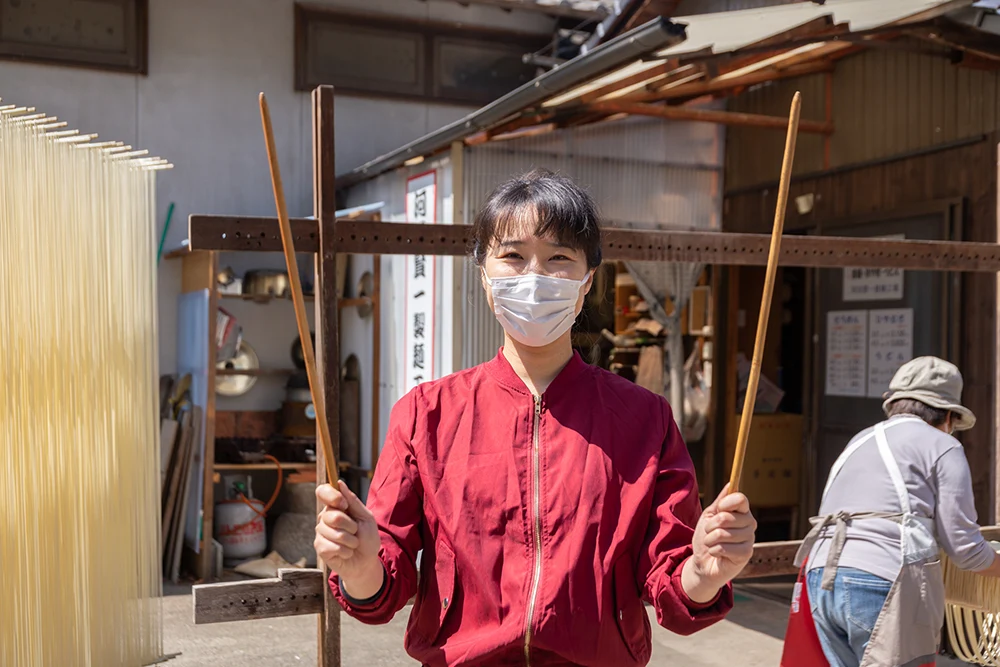
The staff members were doing it rhythmically and seemed to make it look easy, but when I tried it, it was difficult.
The hardest part was sliding the bamboo chopsticks between the noodles.
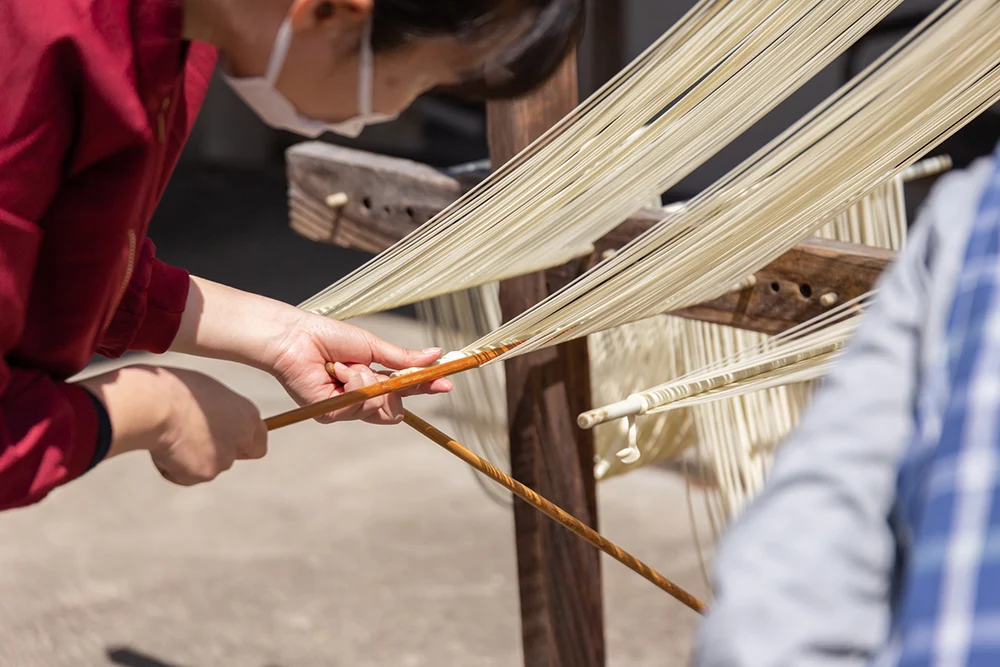
With some tips, I gradually got better as I practiced.
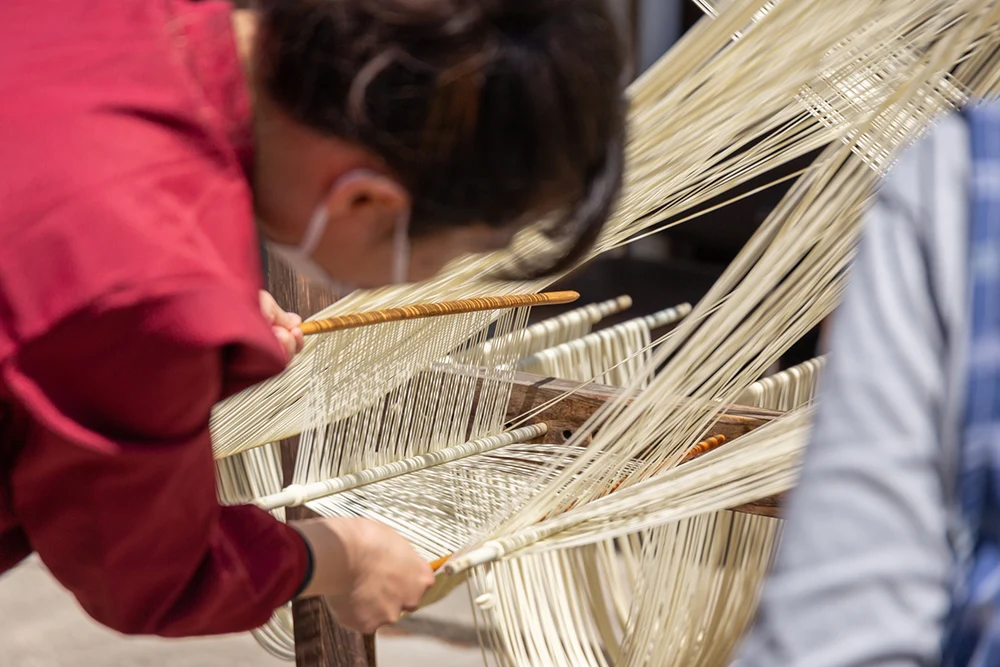
Also, to separate the noodles by spreading my hands apart, it required more strength than I expected. I felt a strong elasticity.
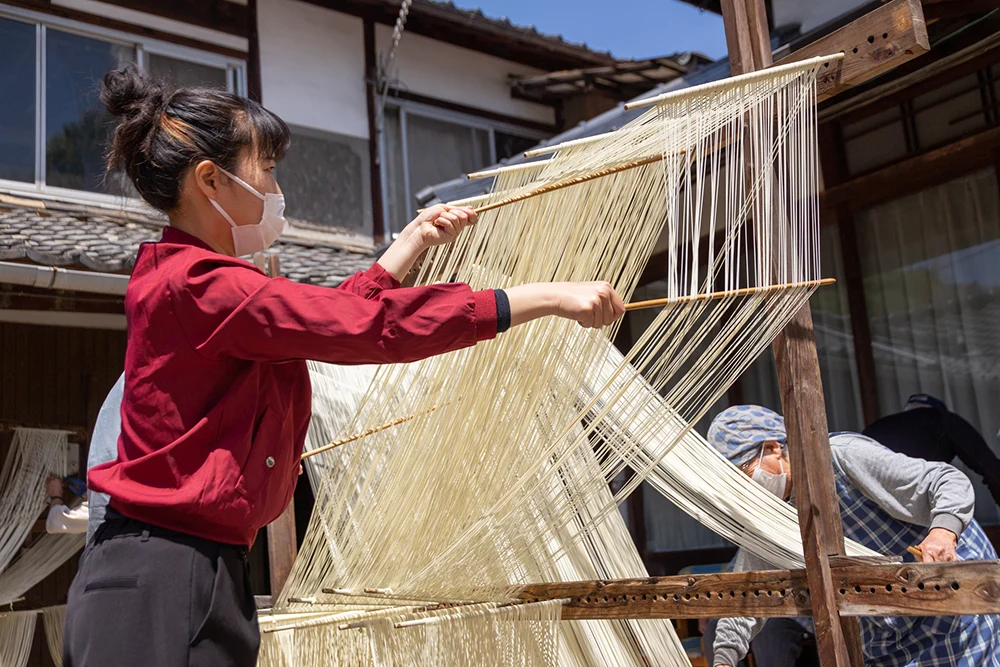
I was worried that the noodles would break, but they never did. They have that much elasticity.
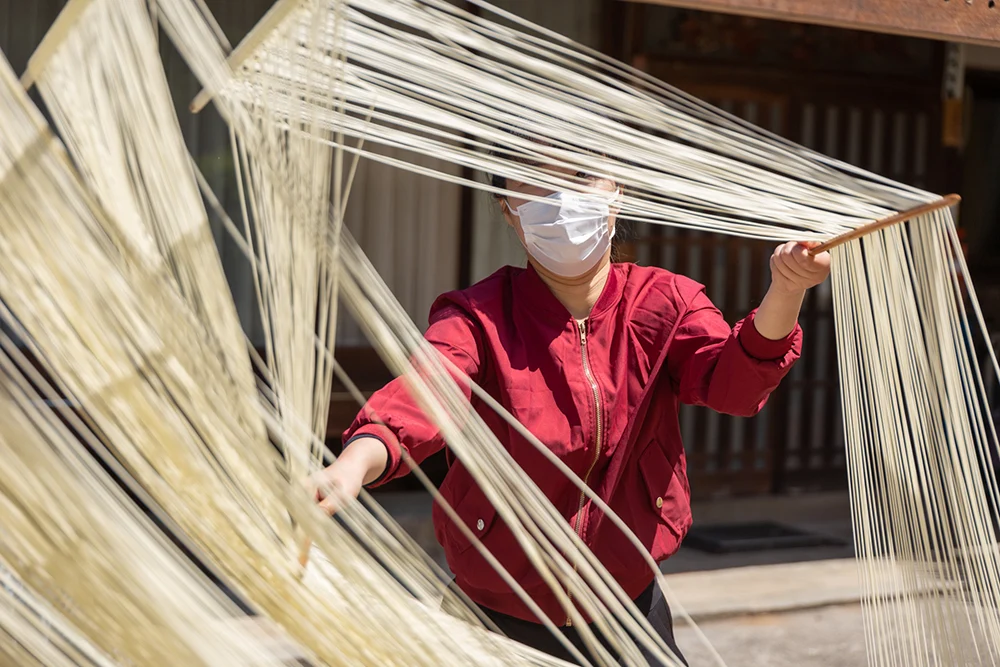
I realized that making hand-stretched noodles requires skilled techniques.
I enjoyed the teamwork of stretching the noodles in sync with the staff members.
In the end, I was praised with, “You’ve gotten better!”
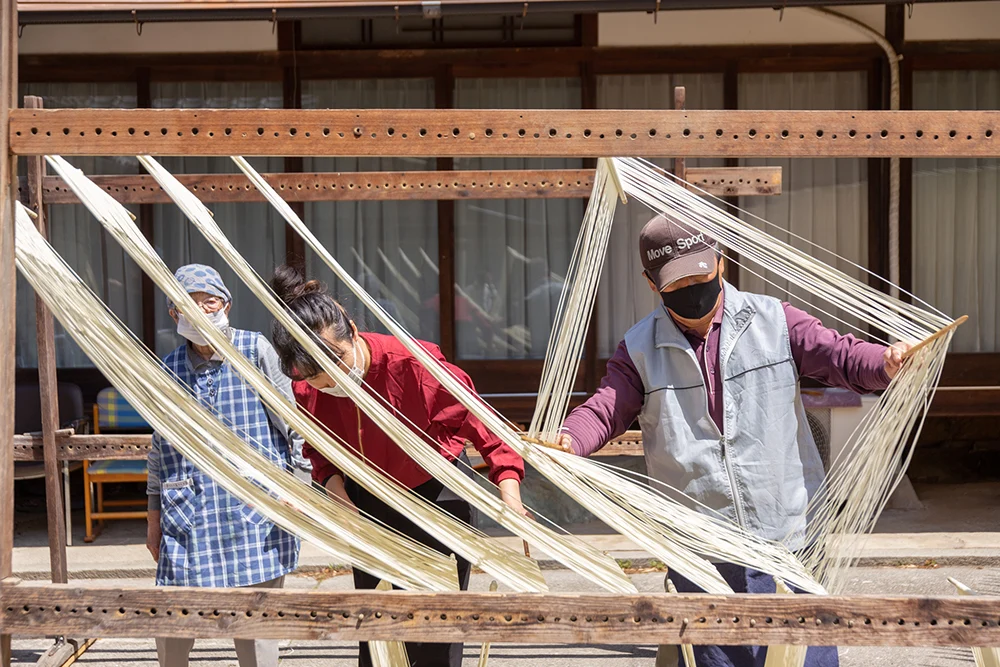
After stretching the noodles to 2 meters, I also experienced the final adjustment of inserting the chopsticks. I lightly passed the bamboo chopsticks through and separated any noodles that were stuck together.
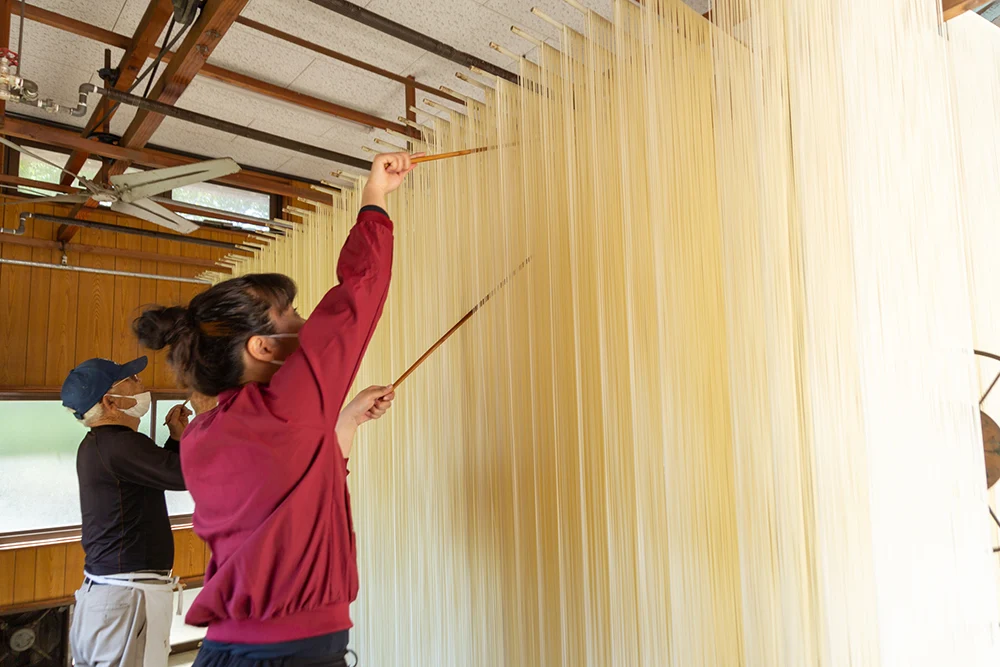
The stretched noodles are taken outside and adjusted in position to ensure they receive sunlight evenly, checking the shadows.
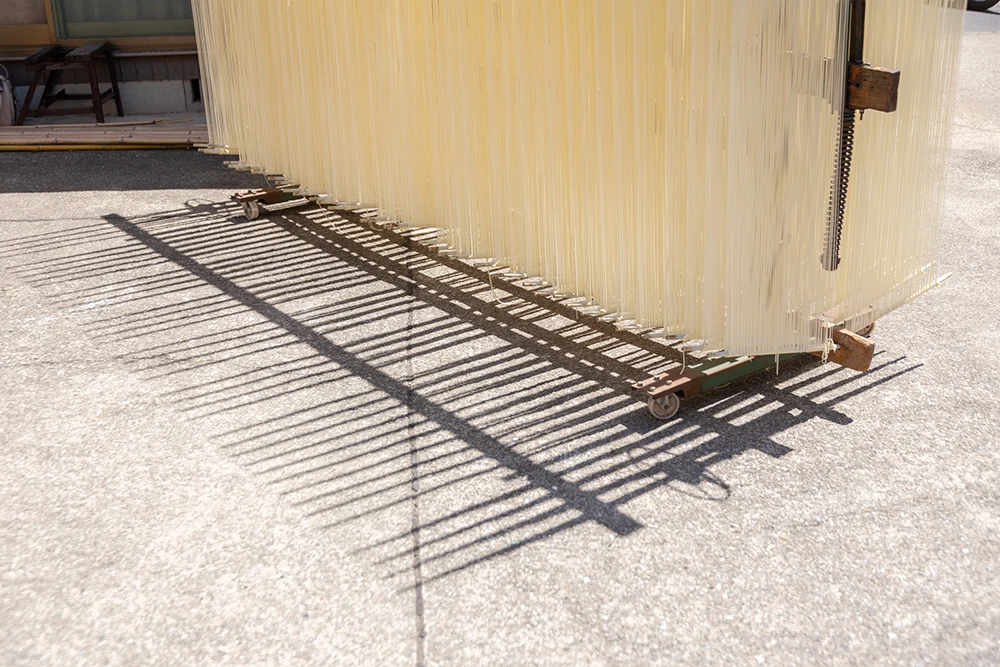
I was able to see various innovations up close.
Kadoboshi cannot be done outdoors on rainy days or when humidity is high. At Kawada Kenichi Noodle Factory, they perform the entire process indoors on rainy days.
Additionally, from April to May, the combination of temperature and humidity makes it easy for the noodles to dry out, which is challenging. Conversely, in July to August, the high humidity becomes a problem.
I heard the phrase, “Hand-stretched noodles are living things” several times.
Depending on the amount of water mixed, the stuck noodles can separate quickly or stretch too much, and because it is done by hand, you can truly feel the quality of the noodles.
Mr. Kawada, who decides the mixture, said, “When I hear everyone say today was difficult or easy, I think I should have adjusted the mixture more. It’s a daily cycle, and there’s no end to noodle making.”
In Conclusion
Making hand-stretched noodles outdoors, surrounded by the aroma of wheat.
The work itself was difficult and required skill, but seeing the lively noodles made me feel energized.
Also, learning about the process of transforming the dough into thin somen without using a knife was impressive, realizing how much time and effort goes into making somen, which can be casually enjoyed in summer.
I will never forget the words, “Hand-stretched noodles are living things,” shared among the cheerful staff working with enka as background music.
Would you like to experience the precious traditional hand-stretched noodle making?
- Photography: Sasaki Toshiyuki
Data of Kawada Kenichi Noodle Factory
| Name | Kawada Kenichi Noodle Factory |
|---|---|
| Location | 750 Kosaka Higashi, Kamogata-cho, Asakuchi City, Okayama Prefecture |
| Contact | 0865-44-4161 |
| Parking | Available 2 cars |
| Business Hours | Reservation acceptance (business hours) 8:00 AM - 6:00 PM Kado-boshi time 10:00 AM - 11:30 AM |
| Regular Holidays | Saturday, Sunday, irregular holidays Noodle-making experience available on Monday, Wednesday, and Friday. |
| Usage Fee (including tax) | 2,000 yen (including tax) Includes 1 kilogram of somen (20 bundles) |
| Payment Method |
|
| Reservation Availability | Yes Up to 3 people per day. Reservations must be made one week in advance. If "kado-boshi" cannot be done due to weather, notification will be given by the day before. |
| Toilet | Western-style toilet |