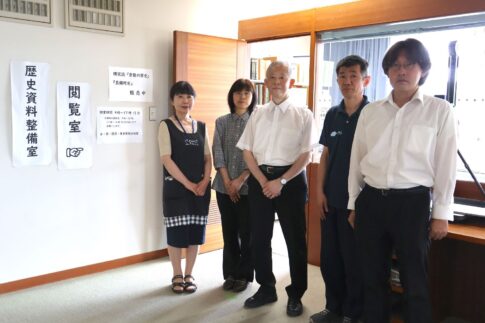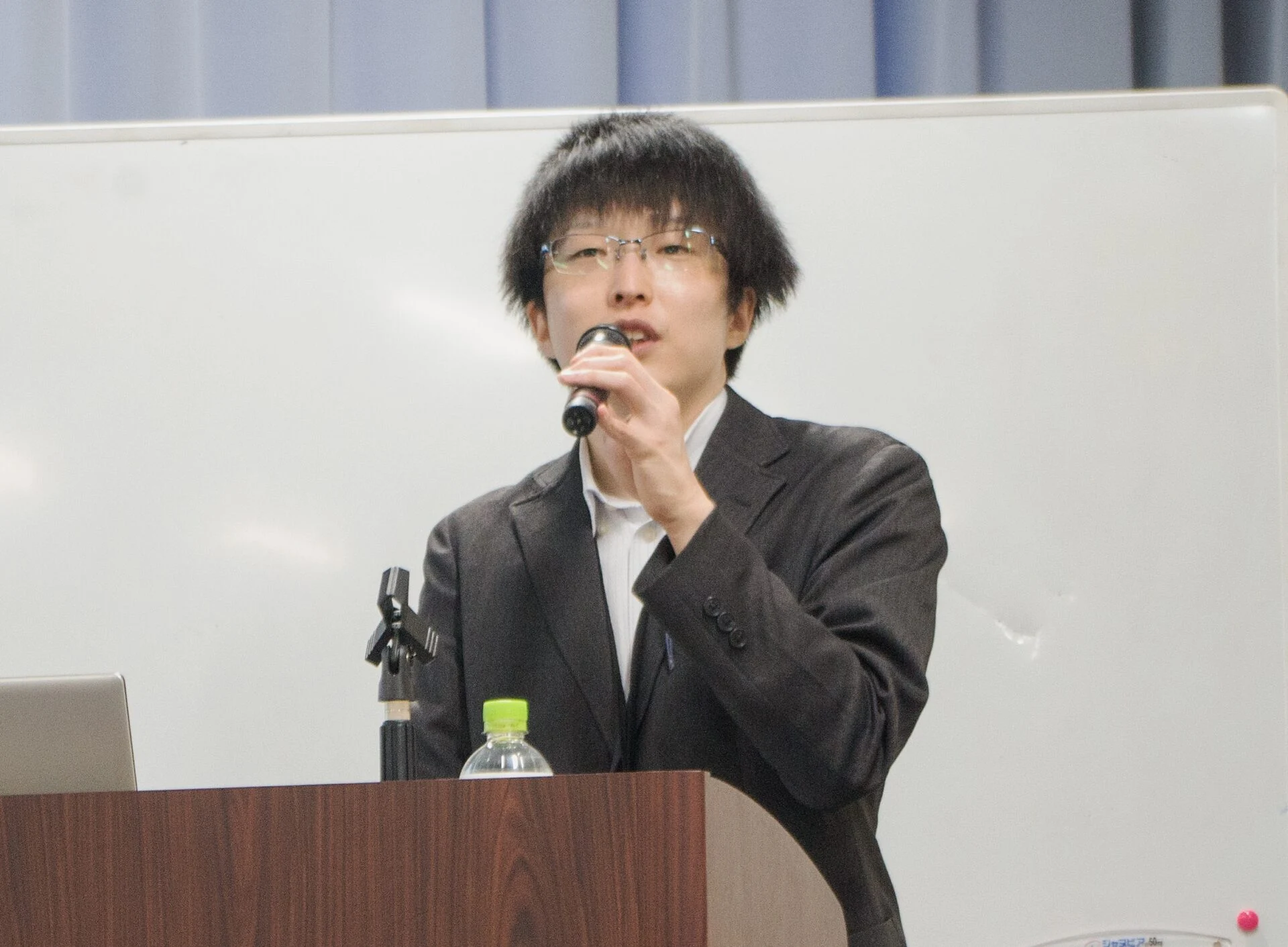
On June 7, 2025, at the Okada Branch of Mabi Community Center in Okada, Mabi, a historical lecture titled "Memories of the Okada Domain: Considering the Future of the Region from History" was held, hosted by the Okada District Community Development Promotion Council.
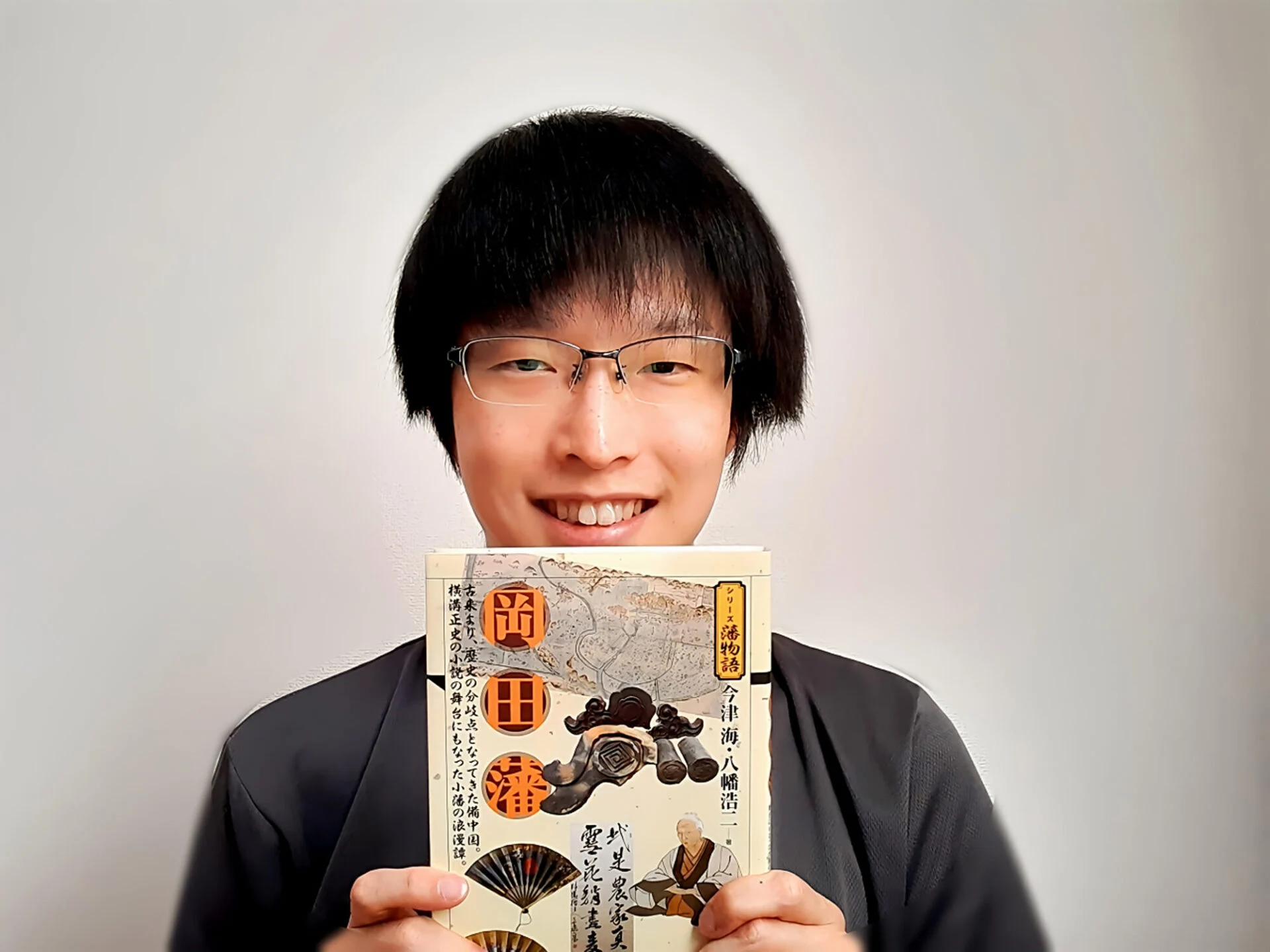
The lecturer, Imazu Kai, published "Series Domain Stories: Okada Domain" in April 2023 through Gendai Shokan. Throughout the writing process, he visited Mabi multiple times, building trust with the local community, which led to the organization of this lecture.
This article introduces the historical lecture that discussed the future of the region through the history of the Okada Domain and flood disasters.
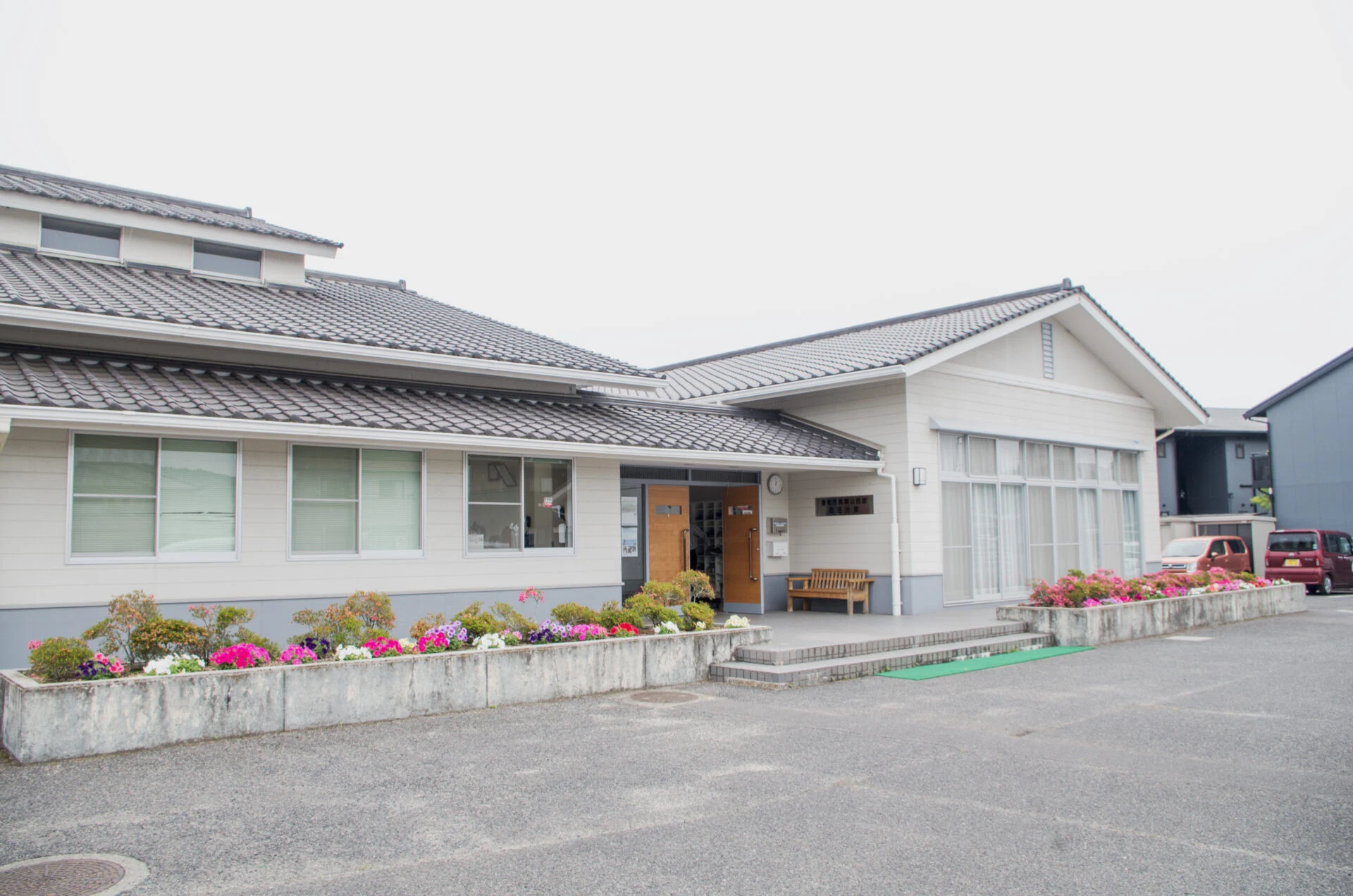
Historical Lecture "Memories of the Okada Domain: Considering the Future of the Region from History"
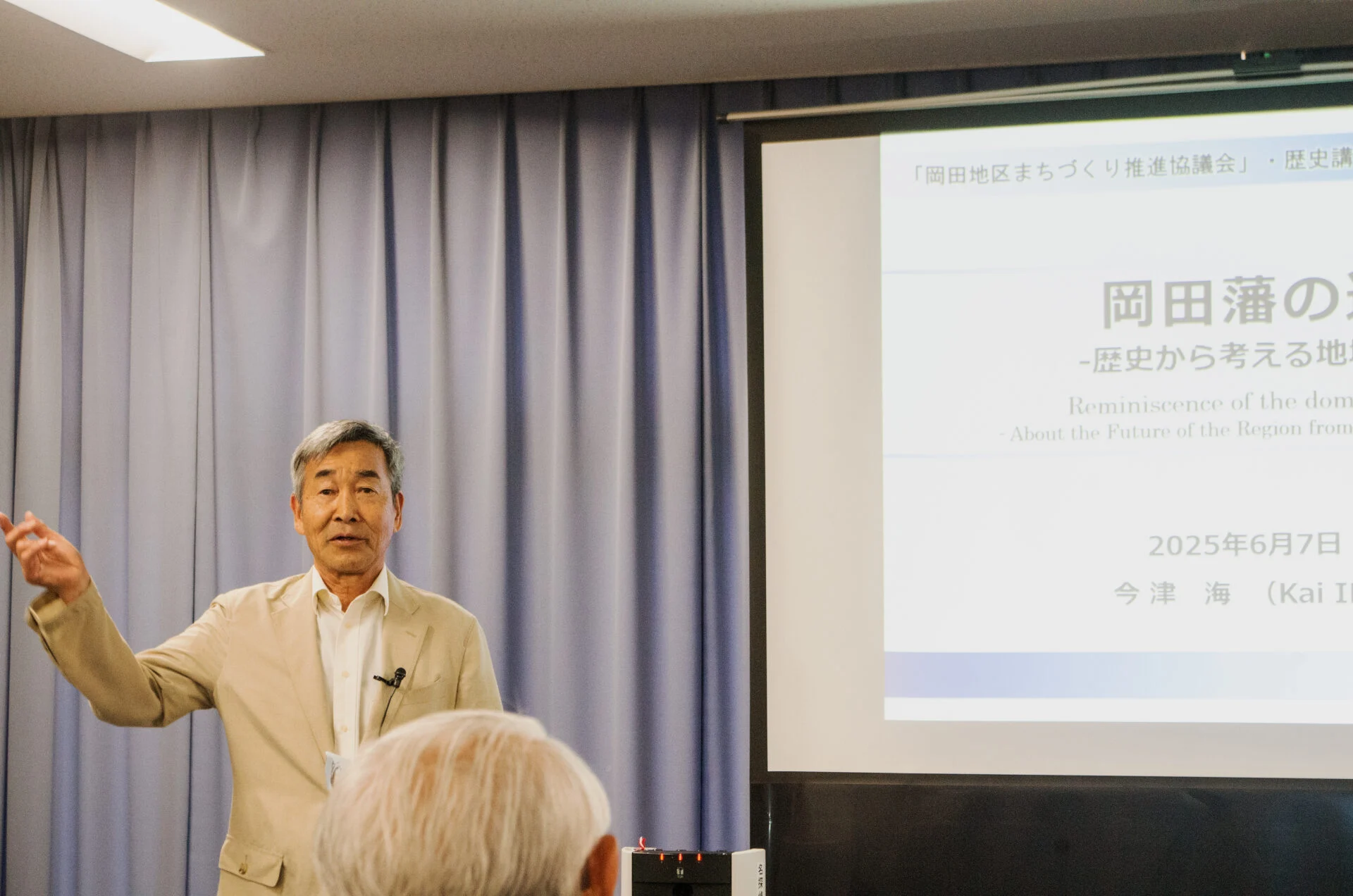
The lecture began with a greeting from the Chairman of the Okada District Community Development Promotion Council, Kurose Masanori.
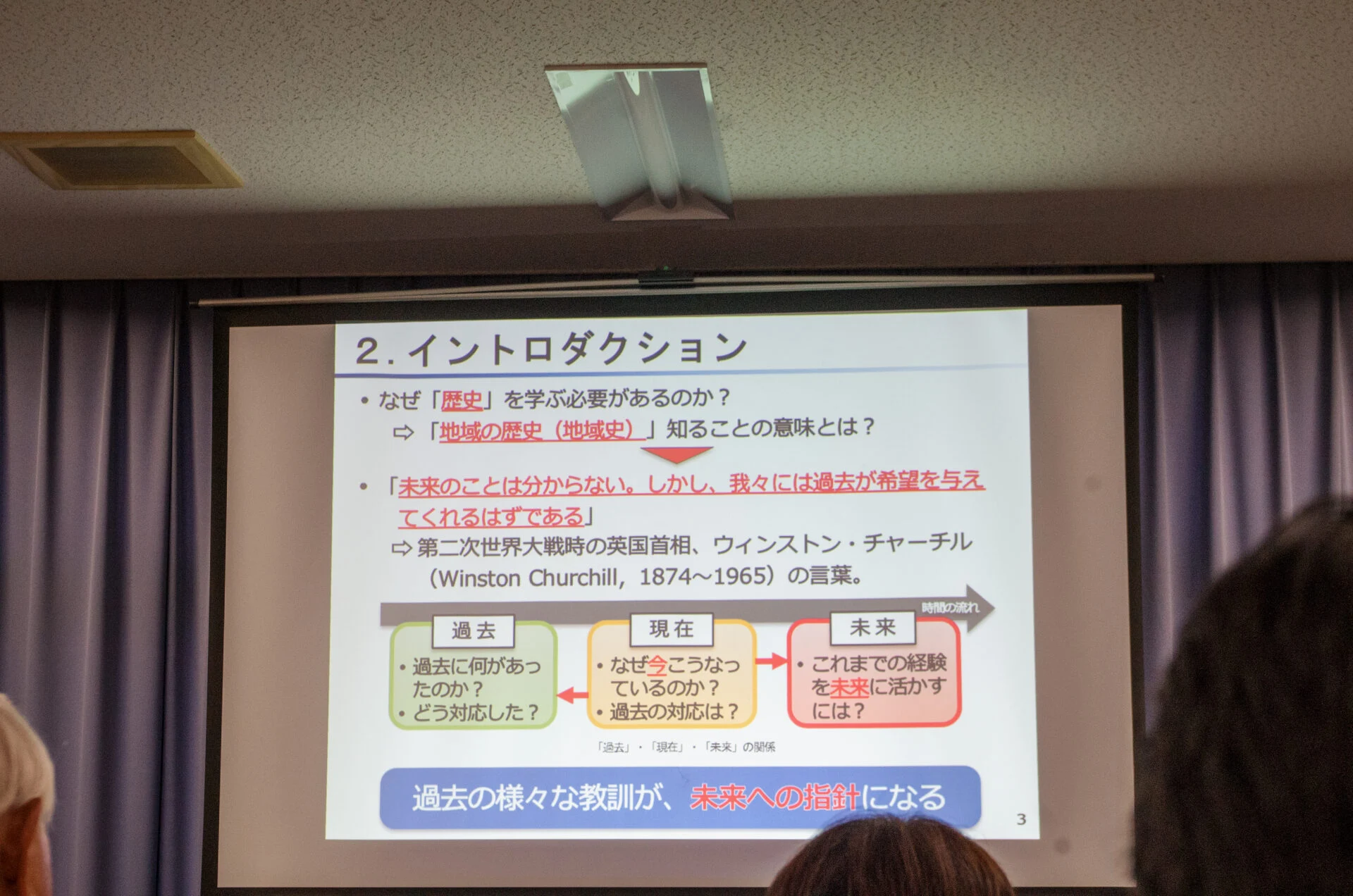
Why is it necessary to learn "history"?
Imazu's historical lecture started with the question, "Why is it necessary to learn history?" and cited a famous quote from Winston Churchill, the British Prime Minister during World War II: "We do not know what the future holds. However, the past should give us hope." as one answer.
As Mabi's Okada District was one of the areas affected by the heavy rains in July 2018, the statement that "various lessons from the past can serve as a guide for the future" resonates deeply.
The main themes of the lecture were the following two points. Excerpts from each theme are introduced below.
- Theme 1: The history of the Mabi area during the Edo period centered around the Okada Domain
- Theme 2: Flood disasters that struck the Mabi area during the Edo period
The history of the Mabi area during the Edo period centered around the Okada Domain
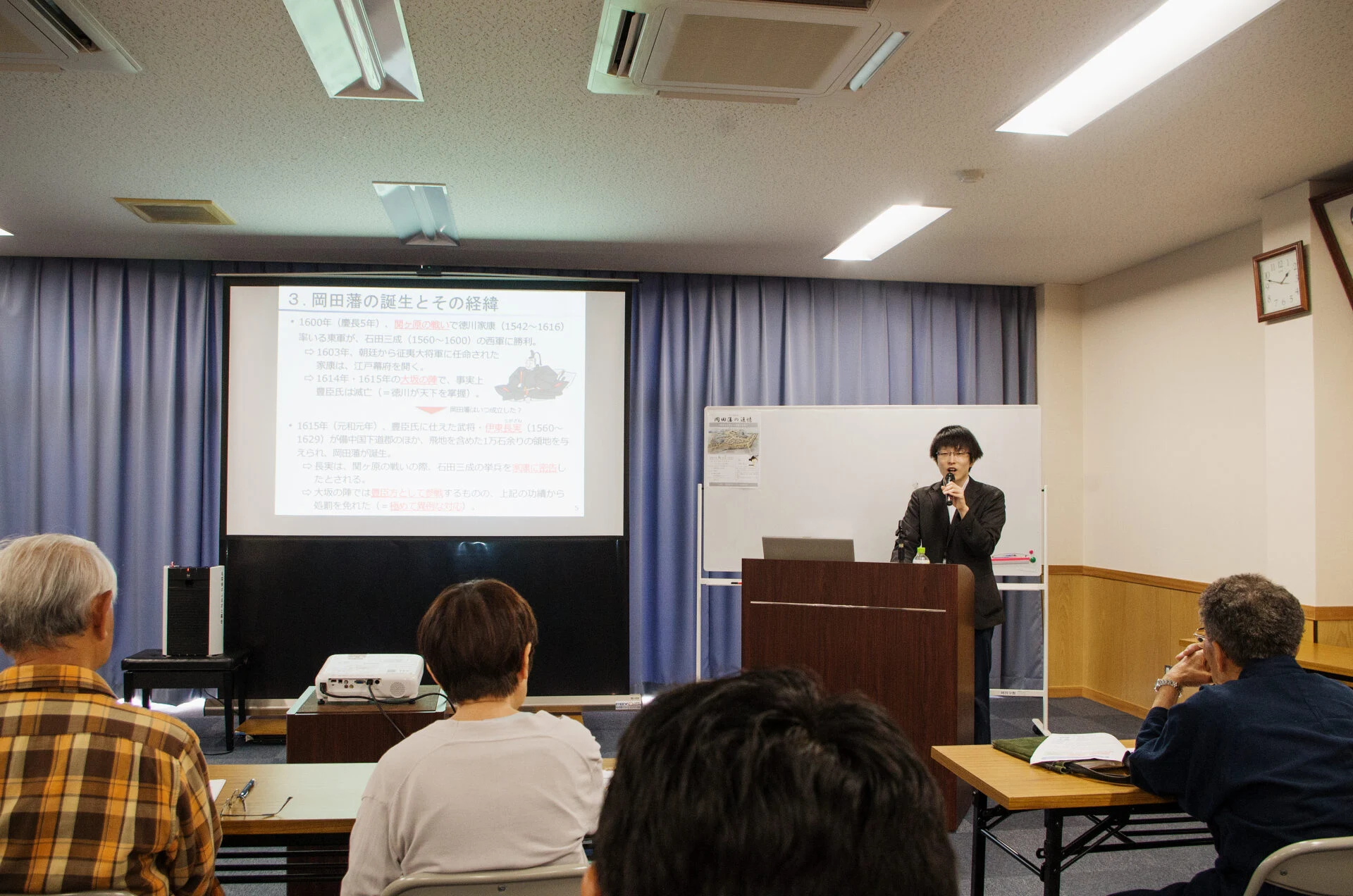
Here, three particularly interesting points are highlighted.
- The extremely unusual birth of the Okada Domain
- Who were the Ito clan?
- The ten generations of the Okada domain lords and their era
The extremely unusual birth of the Okada Domain
The Okada Domain was established in 1615 (Genna 1) when the warrior Ito Nagazane, who fought on the side of the Toyotomi during the Siege of Osaka, was granted over 10,000 koku of territory in the Kibi Province by the enemy commander Tokugawa Ieyasu. This response from the Tokugawa side was said to be unprecedented even on a national scale.
There are rumors that Nagazane was a spy for the Tokugawa side, as he had informed Tokugawa Ieyasu of Ishida Mitsunari's uprising during the Battle of Sekigahara.
Who were the Ito clan?
The Ito clan was a powerful family based in Ito-sho, Izu Province (present-day near Ito City, Shizuoka Prefecture) during the Kamakura period, and is a clan that descends from the Fujiwara clan (Fujiwara Nanke).
Ito Nagazane's father, Ito Nagahisa, served Oda Nobunaga and achieved many military exploits, receiving the character "Naga" from Nobunaga, as well as a family crest (Ito Inazuma Mon).
The ten generations of the Okada domain lords and their era
The Okada Domain, which was established after the Siege of Osaka, was passed down through ten generations until the Meiji Restoration.
| List of Okada Domain Lords | Main events of each era |
|---|---|
| 1st Lord: Ito Nagazane | Participated in the Siege of Osaka on the Toyotomi side but received a pardon. There are rumors that he was actually a "spy" for the Tokugawa side... In 1615, he became the first lord of the Okada Domain. |
| 2nd Lord: Ito Nagamasa | Born as the second son of the first lord, Nagazane. He became the successor of his father, Nagazane, after his elder brother, Ito Naganao, passed away young. |
| 3rd Lord: Ito Nagaharu | He is said to have been praised by Tokugawa Mitsukuni, known as the "Vice Shogun of the World,"... |
| 4th Lord: Ito Nagasada | Moved the domain's administrative office from the Doiya residence in Kawabe Village to the Nakamura residence in Okada Village. Also held important positions in the Edo Shogunate (such as guarding Sunpu Castle). |
| 5th Lord: Ito Nagahira | In 1701 (Genroku 14), he moved the administrative office to Okada. In 1717 (Kyoho 2), a peasant uprising called the Shinbon Gimin Incident occurred over the domain's shared forest. In 1721 (Kyoho 6), a major flood occurred in Bichu. |
| 6th Lord: Ito Nagooka | Struggled with financial reconstruction. In 1732 (Kyoho 17), the Great Kyoho Famine occurred. |
| 7th Lord: Ito Nagatoshi | Known as a wise lord, his death caused great sorrow among the domain's people. |
| 8th Lord: Ito Nagatomo | Worked on financial reforms and the establishment of the domain school (Keigakukan) with Uraike Kyuen and others. |
| 9th Lord: Ito Nagayasu | In 1850, a major flood occurred in Kaei 3. |
| 10th Lord: Ito Nagatoshi | The last lord of the Okada Domain. After the Meiji Restoration, he became a viscount. |
Flood disasters that struck the Mabi area during the Edo period
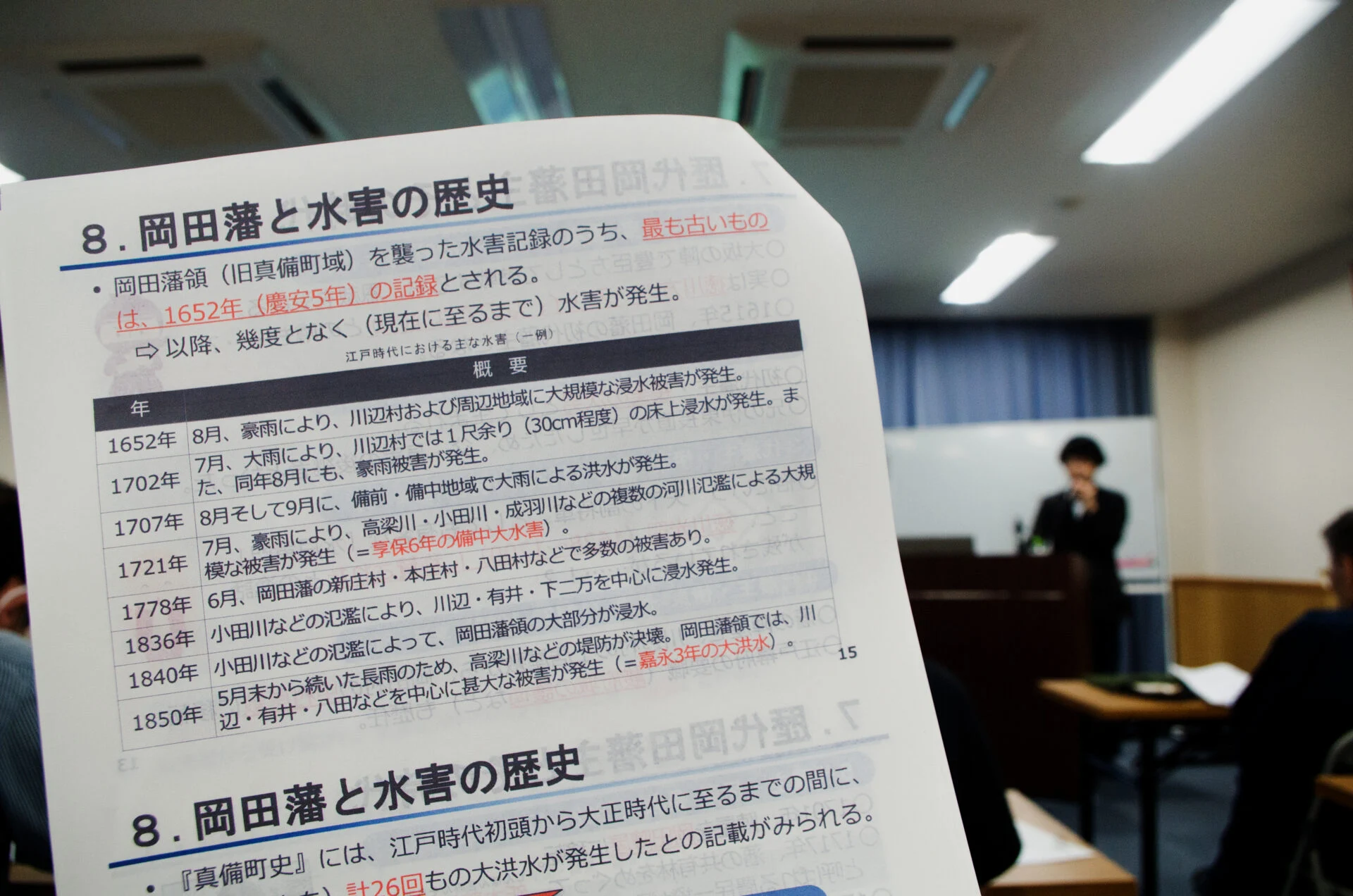
Next, we will learn about the history of the Okada Domain and flood disasters.
A region historically prone to flooding: At least 26 major floods recorded
The oldest record of a flood that struck the Okada Domain (the former Mabi area) is said to be from 1652 (Keian 5). Throughout the Edo period, the Okada Domain was repeatedly struck by large-scale floods.
| Year | Overview |
|---|---|
| 1652 | In August, heavy rains caused extensive flooding in Kawabe Village and surrounding areas. |
| 1702 (Genroku 15) | In July, heavy rains caused flooding over 1 shaku (about 30 cm) in Kawabe Village. Additionally, heavy rain damage occurred in August of the same year. |
| 1707 (Hoei 4) | In August and September, floods occurred in the Bizen and Bichu regions due to heavy rains. |
| 1721 (Kyoho 6) | The Great Bichu Flood of Kyoho 6 In July, heavy rains caused multiple rivers, including the Takahashi River, Oda River, and Narukawa River, to flood, resulting in extensive damage. |
| 1778 (An'ei 7) | In June, there were numerous damages in Shinjo Village, Honjo Village, and Hatta Village in the Okada Domain. |
| 1836 (Tenpo 7) | Flooding occurred centered around Kawabe, Arii, and Shimoniman due to the flooding of the Oda River and others. |
| 1840 (Tenpo 11) | Most of the Okada Domain was flooded due to the flooding of the Oda River and others. |
| 1850 (Kaei 3) | The Great Flood of Kaei 3 Due to continuous heavy rains from the end of May, levees on the Takahashi River and others broke, causing significant damage centered around Kawabe, Arii, and Hatta in the Okada Domain. |
Regarding the "Great Flood of Kaei 3" in 1850, the disaster situation was introduced using contemporary illustrations. Illustrations depicting the flooding that affected a large part of the area from the center of present-day Kurashiki City to the western part of Okayama City remain, conveying the tragic situation of that time to the present.
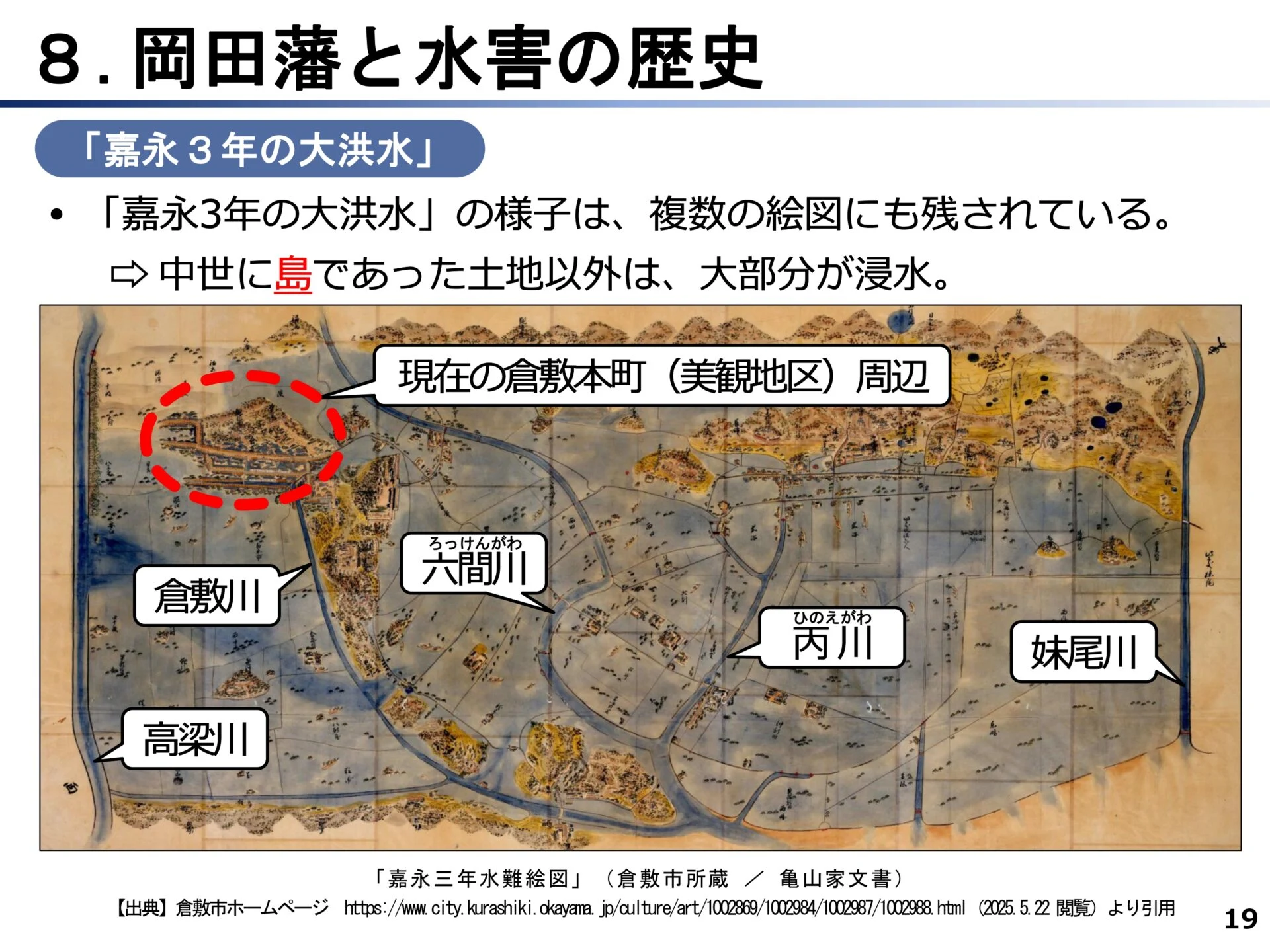
Why did floods occur frequently?
The background of the frequent floods in the Okada Domain and surrounding areas is complex, making it difficult to pinpoint a single cause. However, the following factors that contributed to the floods were introduced:
- The topographical factors of the Takahashi River and Oda River induced backwater phenomena.
- The operation of tatara iron manufacturing in the upper reaches of the Takahashi River led to the accumulation of large amounts of sediment in the lower reaches.
Struggles against Floods - Lessons from Our Ancestors
In response to the frequent floods, the Okada Domain implemented various measures, such as the construction of levees and the improvement of the Oda River.
Representative examples include the construction of "Kagura Dote" and "Okada Mizuyoke Tsutsumi", as well as the "Oda River Improvement" by Moriya Kanbei.
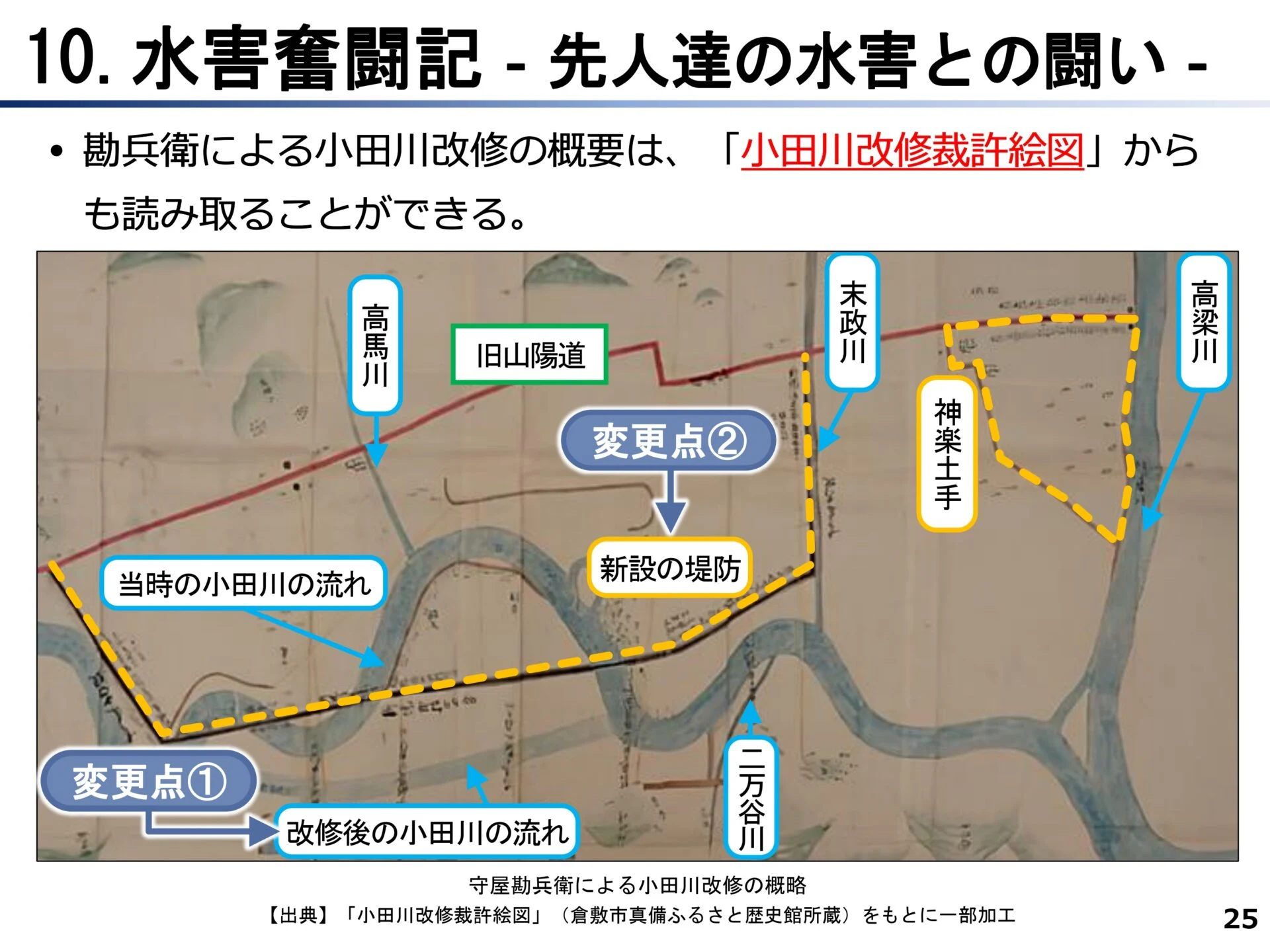
Among these, the Kagura Dote still has remnants in places such as the parking lot of the Kawabe Branch of Mabi Community Center.
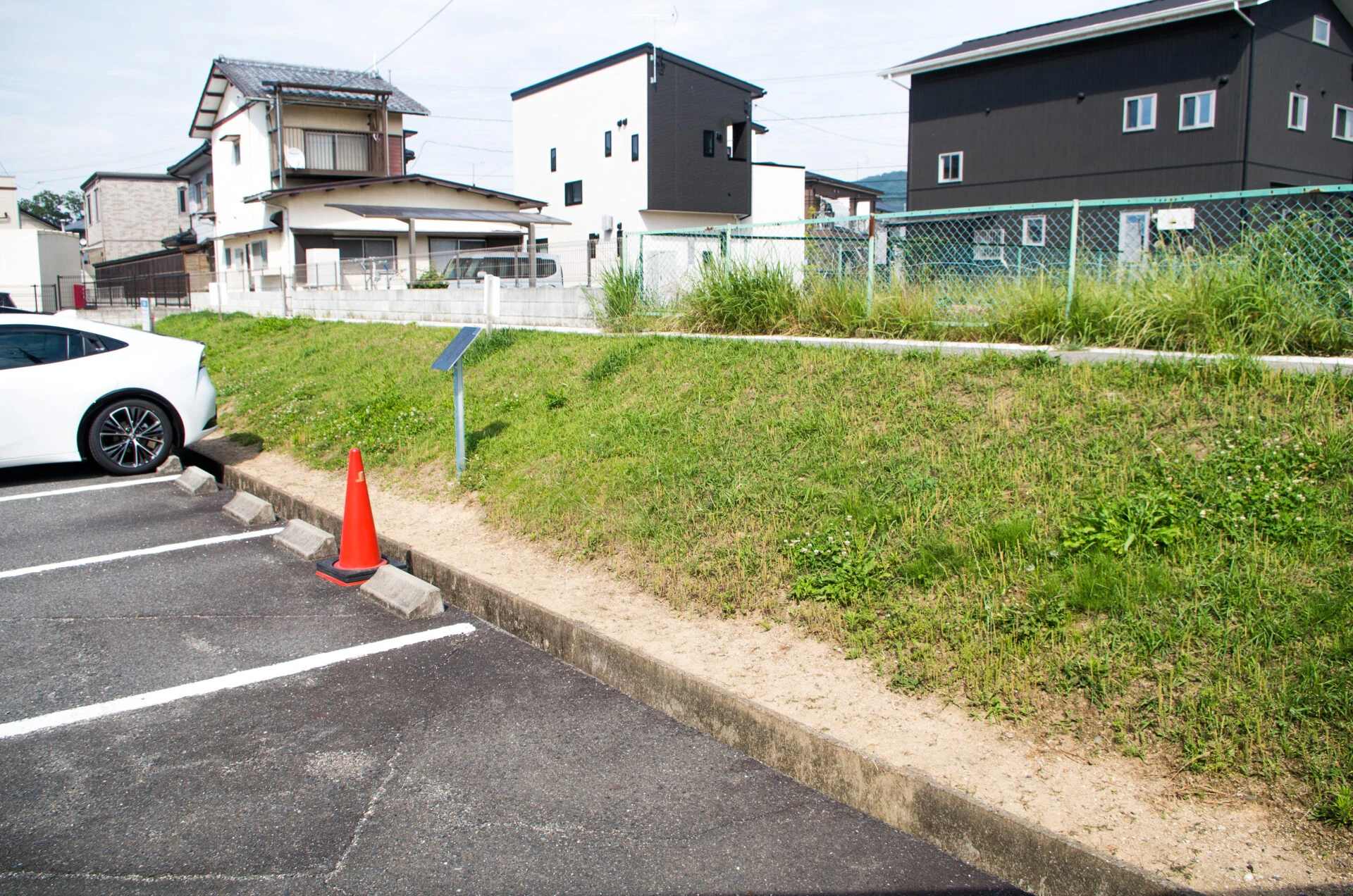
Kagura Dote is a structure built to protect the town of Kawabe from floods, surrounded by an earthen levee. Stone columns were placed inside and outside the base, and an earthen levee was built on top. The base is about 6 ken (approximately 11 m) wide and 2 ken (3.6 m) high. At the four corners of Kagura Dote, shrines such as Ekijin Shrine (Ushitor), Kojin Shrine (Tatsumi), Konpira Shrine (Hitsujisaru), and Abe Shrine (Inuin) were enshrined. It is unclear when Kagura Dote was built, but in the Oda River improvement plan drawn up in the first year of Hoei (1704) by Moriya Kanbei, a levee can be seen on the south side of the old Sanyo Road. The levee that protected the village from floods was breached during the great flood of Meiji 26 and was removed after the major reconstruction of the Takahashi River levee. Remnants can be seen along the road south of the Kawabe Branch, the stone walls in the precincts of Genpukuji Temple, and the fields to the north of Genpukuji Temple.
(Quoted from the guide map of Mabi Community Center, Kawabe Branch)
Summary: Struggles against Floods - Lessons from Our Ancestors
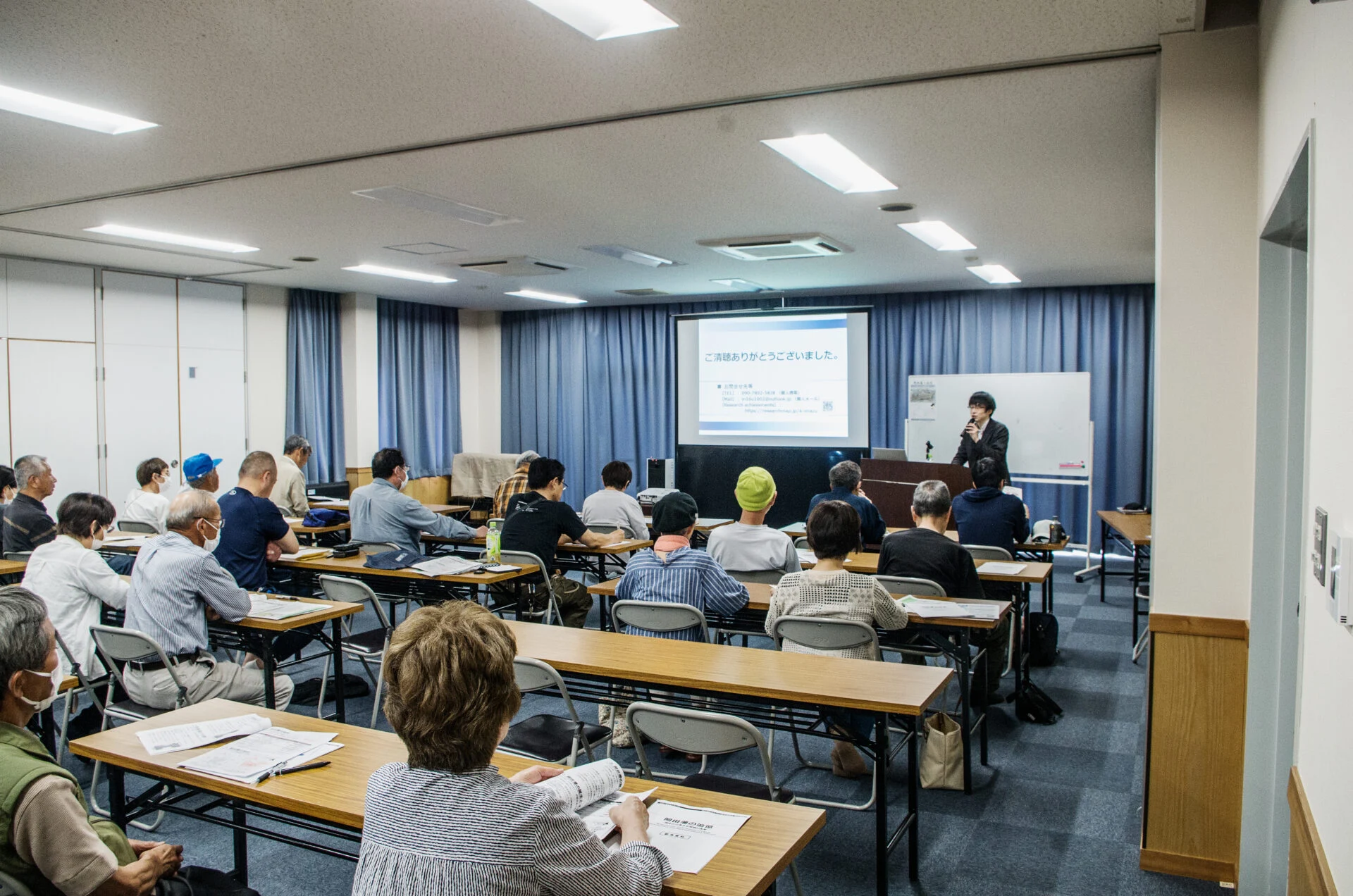
And as a lesson from the ancestors who have struggled against floods for many years, Imazu summarized the following:
In the past and even now, it is important not only to have physical measures (hard measures) but also to maintain disaster awareness on a daily basis as a soft measure, and in case of emergency, to "protect your own life and the lives of your loved ones."
Even as times change, the basic structure of "self-help, mutual aid, and public assistance" has continued since ancient times, and it is also necessary to pass on the history and experiences to the next generation.
"Various lessons from the past can serve as a guide for the future"
From the materials of the historical lecture
Conclusion
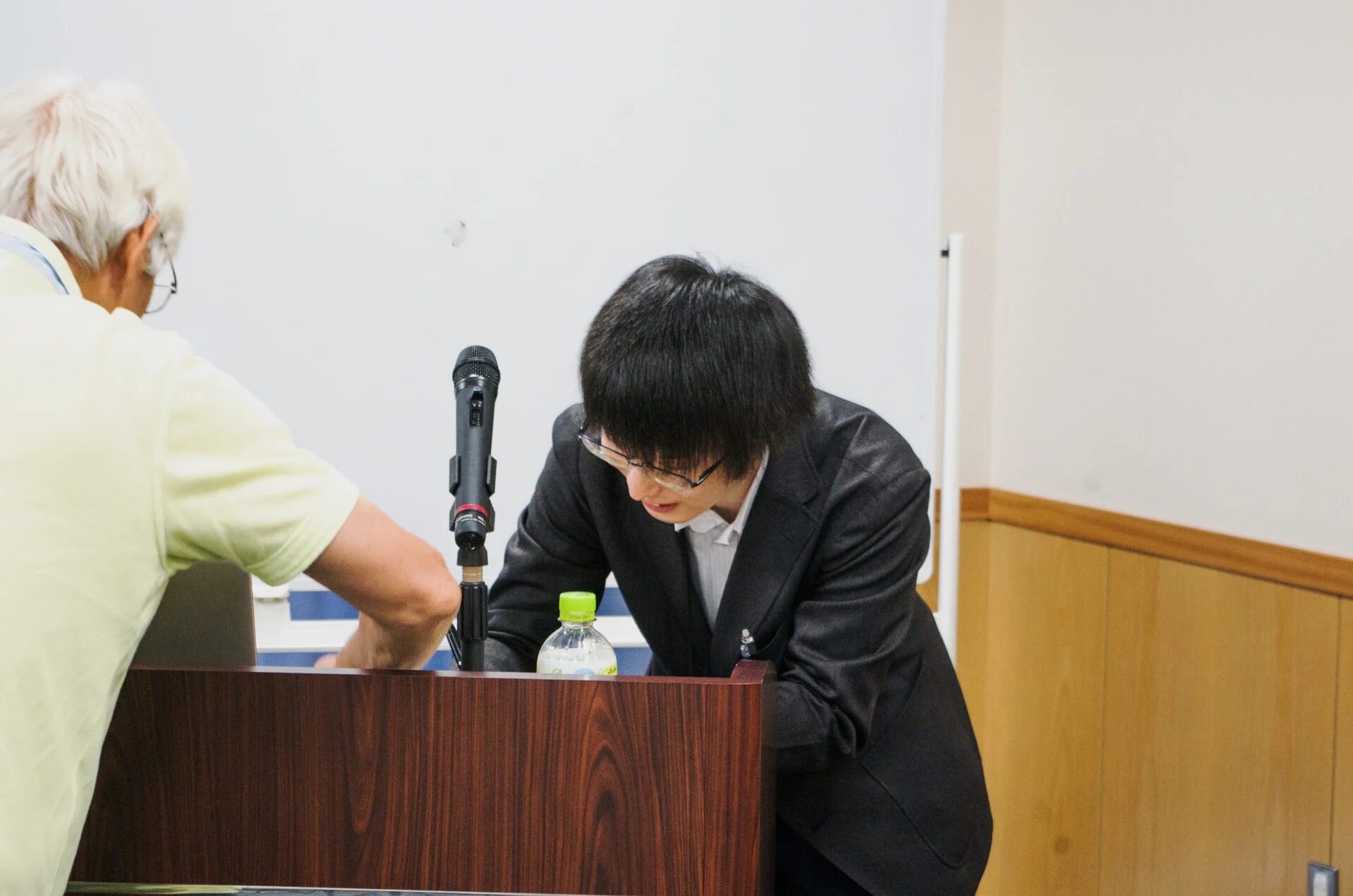
After the lecture, when I spoke with Mr. Imatsu, he mentioned that among the participants, there were those who provided many valuable materials and information for the writing of 'Series Han Monogatari: Okayama Han'.
And during the writing of the book, the heavy rain disaster in July 2018 occurred...
It seems that personal materials were washed away, but the content was compiled into a single book titled 'Series Han Monogatari: Okayama Han', resulting in its preservation.
Please be sure to pick up the book 'Series Han Monogatari: Okayama Han', which led to the holding of this lecture.
Data for the Historical Lecture: Memories of Okayama Han - Considering the Future of the Region from History
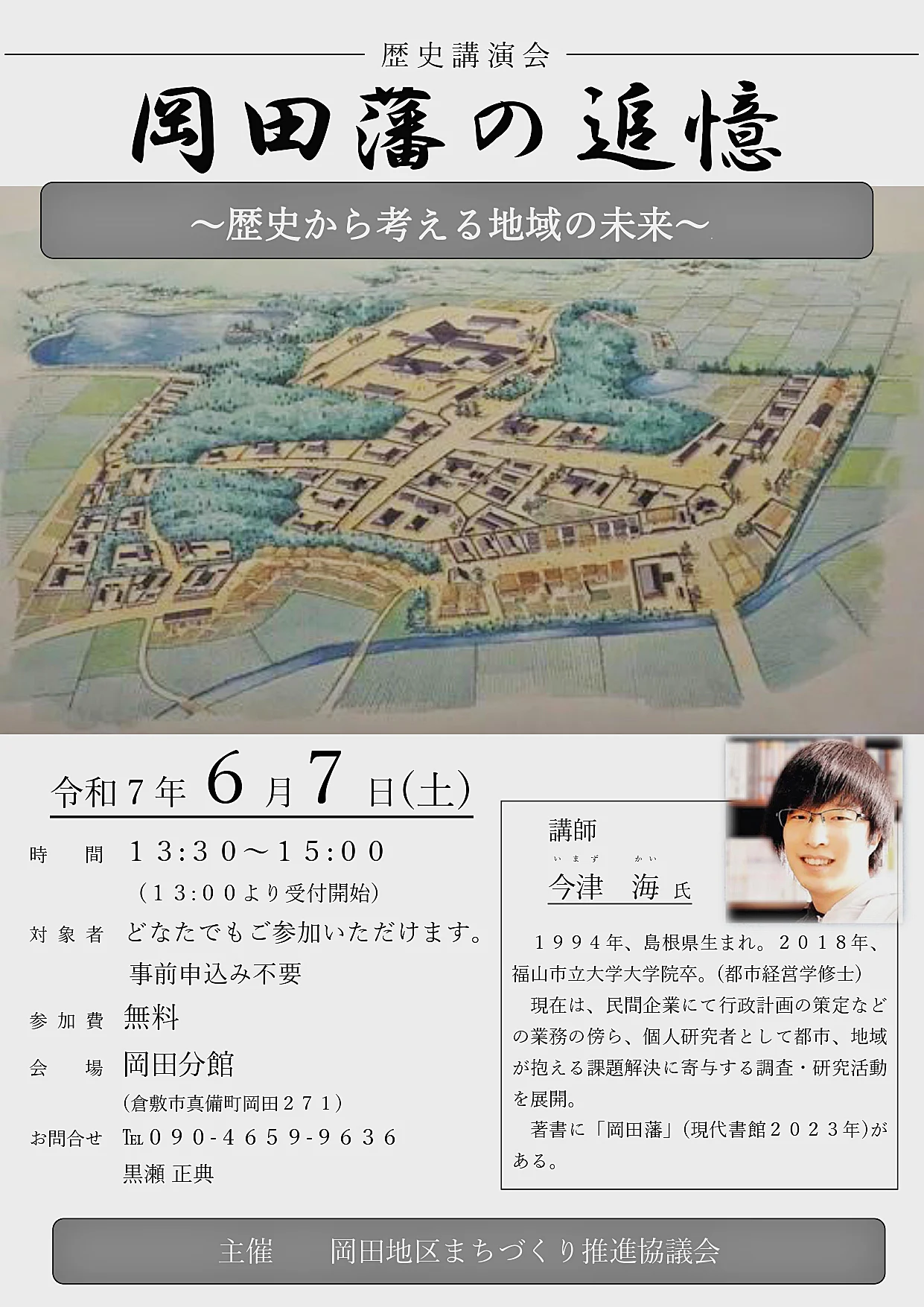
| Name | Historical Lecture: Memories of Okayama Han - Considering the Future of the Region from History |
|---|---|
| Date | June 7, 2025, 1:30 PM - 3:00 PM |
| Location | Okayama Branch of Mabi Community Center (271 Okayada, Mabi-cho, Kurashiki City) |