Interview with Nobuhiro Yoshida, Representative of Bakery Tongu
We spoke with Nobuhiro Yoshida, president and representative director of Tongu Co., Ltd., which operates Bakery Tongu.
This article presents the interview conducted during our initial visit in May 2019.
Deciding to take over to keep Tongu, rooted in the community, from disappearing

You are Tongu’s third-generation representative. How did you come to become its president and representative director?
Yoshida
I originally worked making Western-style sweets and bread at a hotel in Okayama.
When I decided to leave the hotel, Tongu’s previous owner, who had been a hotel customer, asked me if I would work at Tongu. That was how I joined Tongu as an employee.
Later, the previous owner decided to retire, but there was no successor, and Tongu was at risk of closing.
I’m from Okayama City, so I wasn’t familiar with Tongu.
However, after I started working at Tongu, I learned that it was far more firmly established among Soja City residents than I had imagined, and that they loved it.
For example, when I was delivering bread, a man on the roadside suddenly stopped me and asked, “I’d like some bread. Could you sell me some?”
I’d never experienced anything like that before, so I was surprised.
I don’t think there are many shops or products so deeply loved and established in their community.
That’s why I felt that a shop and its products, so cherished by local residents, absolutely must not disappear, and decided to become its successor.
Protecting products loved by local residents sometimes means making changes

What initiatives have you undertaken since becoming Tongu’s representative?
Yoshida
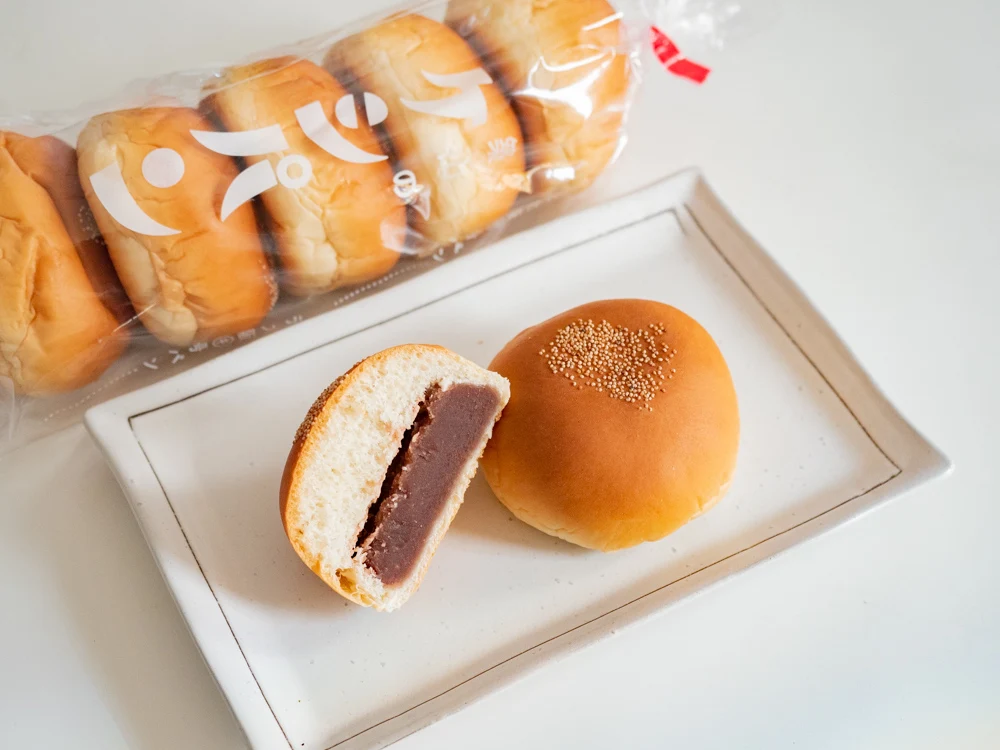
Tongu has many long-selling products that people have enjoyed for years, led by the “Anpan with Sweet Bean Paste” and “Butter Rolls.”
To keep offering them in the future, there were many things we had to change. Japan is currently facing a general labor shortage, and our company is in the same situation. So we scaled back our wholesale business.
We used to sell our products at local high schools, nursery schools, companies, and other places, but now, apart from our directly operated shop, we sell at only about two locations in the prefecture.
In turn, we decided to focus on sales at our own shop.
We’ve also started actively considering event stalls and new products. We need products that can become new mainstays, in addition to the products people have enjoyed until now.
In this context, the “Okayama Koppe” series became a new mainstay.
The “Okayama Koppe” series, making use of Tongu’s strength: school-lunch koppe-pan

How did the Okayama Koppe series come about?
Yoshida
Tongu has long supplied bread and rice for school lunches in the Soja area.
Among these, koppe-pan is our strength and specialty—we can hold our own against any bakery.
We created Okayama Koppe by drawing inspiration from the “make-your-own sandwich” served in school lunches, as a way to develop products that make use of Tongu’s unique strengths.
We tried selling it at an event, and it was a huge hit. Later, we adapted it for sale in our shop, and it became a popular product in less than a year.
Agepan also began when we sold it at “Retroad,” an event in Soja, as a nostalgic school-lunch menu item inspired by the keyword “retro.”
It was unexpectedly popular, and many people asked us to sell it regularly, not just at events, so we began offering it in the shop.
We sold exactly the same agepan that we serve in school lunches, and I think people enjoyed it because it brought back memories.
After graduating from school, it’s hard to find koppe-pan or agepan.
Both Okayama Koppe and agepan are products unique to our company, which has been involved in school lunches for many years.
Sales in the Kanto region begin to introduce Tongu’s products to a wider audience

Yoshida
We’ve also started selling at events in the Kanto region and at the joint Okayama and Tottori prefectural antenna shop.
To keep Tongu’s bread going in the future, I believe we need to introduce the products loved in Soja to more people.
At the antenna shop, we mainly sell packaged breads such as Anpan with Sweet Bean Paste, Butter Rolls, Matsukasa, Fruit Rolls, and Banana Rolls.
They’ve been well received not only by people in Tokyo who heard about us, but also by people originally from Soja who now live in Tokyo.
We’ve received many comments like, “When I go home for a long weekend, Tongu is sometimes closed and I can’t buy anything, so I’m really happy I can get it in Tokyo.”
The “Bread World Soja” project brings major economic benefits to Soja

Tongu is participating in a project called “Bread World Soja.”
Yoshida
“Bread World Soja” was originally a project launched by the Soja Chamber of Commerce and Industry.
Soja City has many small bakeries for a city of its size, and the presence of a Yamazaki Baking factory means its wheat flour consumption ranks among the top three nationwide. It also has the highest bread shipments in Okayama Prefecture.
This led to the idea at the Chamber of Commerce and Industry of “revitalizing the town through bread,” and our company, a long-established bakery in Soja, was asked to cooperate.
The idea behind “Bread World Soja” is to bring people to Soja from outside the city and encourage them to visit many of the city’s bakeries through activities such as a stamp rally.
As a result, “Bread World Soja” became the biggest hit project in the history of the Soja Chamber of Commerce and Industry, bringing major economic benefits to Soja.
Revitalizing a town through bread is unusual, and the project attracted attention nationwide.
The impact of the “July 2018 Heavy Rains”
Soja suffered extensive damage in the “July 2018 Heavy Rains.” Did Tongu also feel the impact?
Yoshida
One of our employees lived in a disaster-stricken area of the city and was affected by the disaster.
Of course, recovery work came first, so the affected employee took time off work. Unfortunately, one of the affected employees had no choice but to resign because of the disaster.
Mabi is in a neighboring area, and many Tongu customers live there, but the disaster in Mabi led to a decline in customers.
Some time later, when customers from disaster-stricken Mabi came to our shop, many told us that seeing the familiar Tongu bread they had eaten for years made them feel “reassured” and “relieved.” I was glad we had continued selling our long-standing products.
We also provided our bread to people volunteering in the recovery effort. There had been plenty of supplies for disaster victims, but supplies for volunteers were running low.
So we helped out as a way of expressing our gratitude to the volunteers working hard for the local community.
Creating a new mainstay and passing the baton to the next generation

Do you have any thoughts about what you’d like to do with Tongu going forward?
Yoshida
I’d like to keep selling packaged breads and other products that have been enjoyed for a long time, steadily and for years to come.
Long-selling products like packaged bread are things the previous owner worked hard to create.
Now, it’s our generation’s role to promote the products the previous owner worked so hard on to a wider audience. That’s why we started selling in the Kanto region.
Another goal is to create new mainstay products.
Okayama Koppe is one such attempt.
We need other mainstays too, so we’re working hard to create them.
Simply maintaining what has been passed down from the past doesn’t mean we’re growing.
I want to build new mainstays and then pass the baton to the next generation.
Tongu’s bread, loved by local residents for generations

I was born in Soja, and I’ve been eating Tongu’s bread since I was little. I often had it at elementary and junior high school lunches, at the high school shop, and as a snack during overtime at the factory.
You can’t get it outside Soja, so whenever I occasionally stop by Tongu after moving away, I end up buying a lot.
I also bought a large quantity of Tongu bread during this interview.
That’s how much Tongu’s bread is a taste of home for Soja residents.
For the interview, I was allowed to spend a long time inside the shop for the first time. Even in the morning, customers were constantly coming and going, and I was reminded just how popular Tongu is.
I was also struck by the wide range of customers in terms of age and gender.
I was surprised, too, that so many customers bought large quantities, mainly of packaged bread.
And as someone from the area, I was deeply moved by Tongu representative Yoshida’s strong determination to “protect products that have been loved for generations, keep taking on new challenges, create new mainstays, and pass the baton to the next generation.”
That determination also comes through in the idea for “Okayama Koppe,” which makes use of Tongu’s strength in koppe-pan, developed through its involvement in school lunches.
Be sure to try the many packaged breads that have long been loved in Soja, as well as agepan and Okayama Koppe, which bring back the nostalgic taste of school lunches and make use of Tongu’s strengths.
Bakery Tongu information

| Name | Bakery Tongu |
|---|---|
| Address | 1-2-3 Ekimae, Soja City, Okayama Prefecture |
| Contact | 0866-92-0236 |
| Parking | Available 10 spaces |
| Hours | 8:30 a.m.–6:00 p.m. |
| Closed | Monday, Sunday For other closures (long holidays, Obon, year-end and New Year holidays, etc.), see official Facebook page |
| Payment methods |
|
| Website | Bakery Tongu: A bakery with over 80 years of history near the station in Soja City, Okayama Prefecture |



What would you like to know about Kurashiki?
Enter a word to search articles on this site