When visiting a shrine in Kurashiki, which shrine do you visit?
Achi Shrine and Haguro Shrine are among the many historic shrines in Kurashiki City.
Among them, the most historically significant is the "Yuga Shrine Honmiya" located on Yugayama in the northern part of the Kojima area (also written as 瑜伽山).
With a history of over 2000 years, it is a shrine with a distinguished history where the imperial court and the lord of Okayama Castle, the Ikeda clan, prayed. Known as the headquarters for warding off evil, it flourished during the Edo period with the practice of "Ryomairi," where visitors would pray at both Yugayama and Kotohira Shrine in Kagawa Prefecture.
Today, Yuga Shrine Honmiya boasts one of the highest numbers of visitors in Okayama Prefecture.
We will explore in detail the history and highlights of Yuga Shrine Honmiya.
What is Yuga Shrine Honmiya
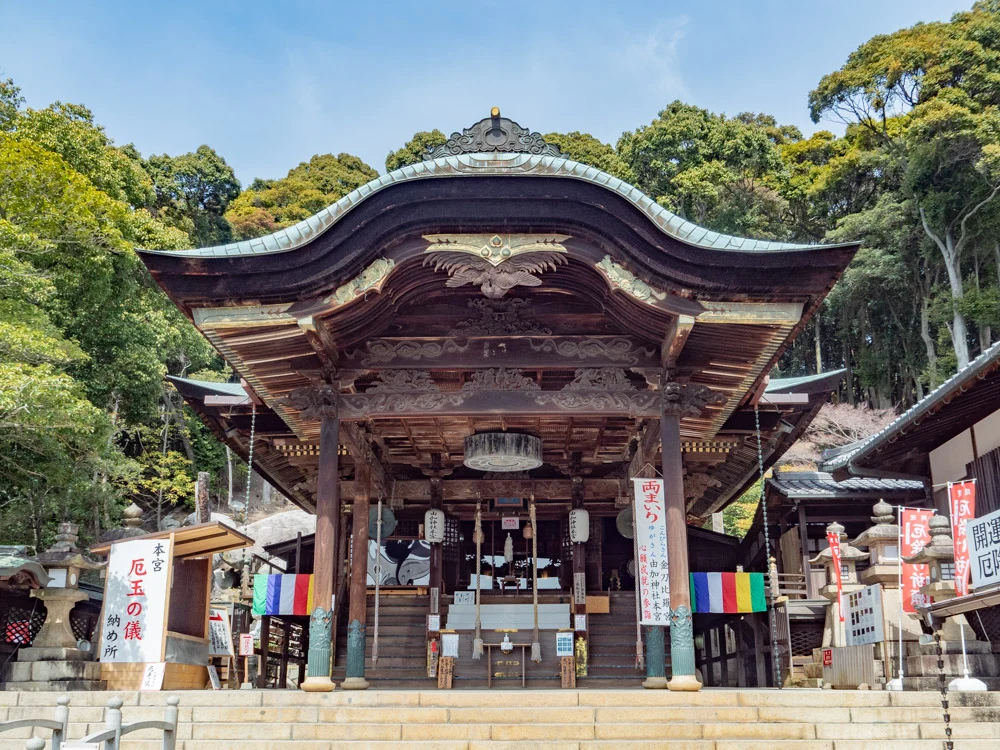
Yuga Shrine Honmiya is a shrine located on Yugayama, which has an elevation of 273.1m, in the northern part of the Kojima area of Kurashiki City.
There are 52 branch shrines nationwide, and literally, Yuga Shrine Honmiya serves as the head shrine.
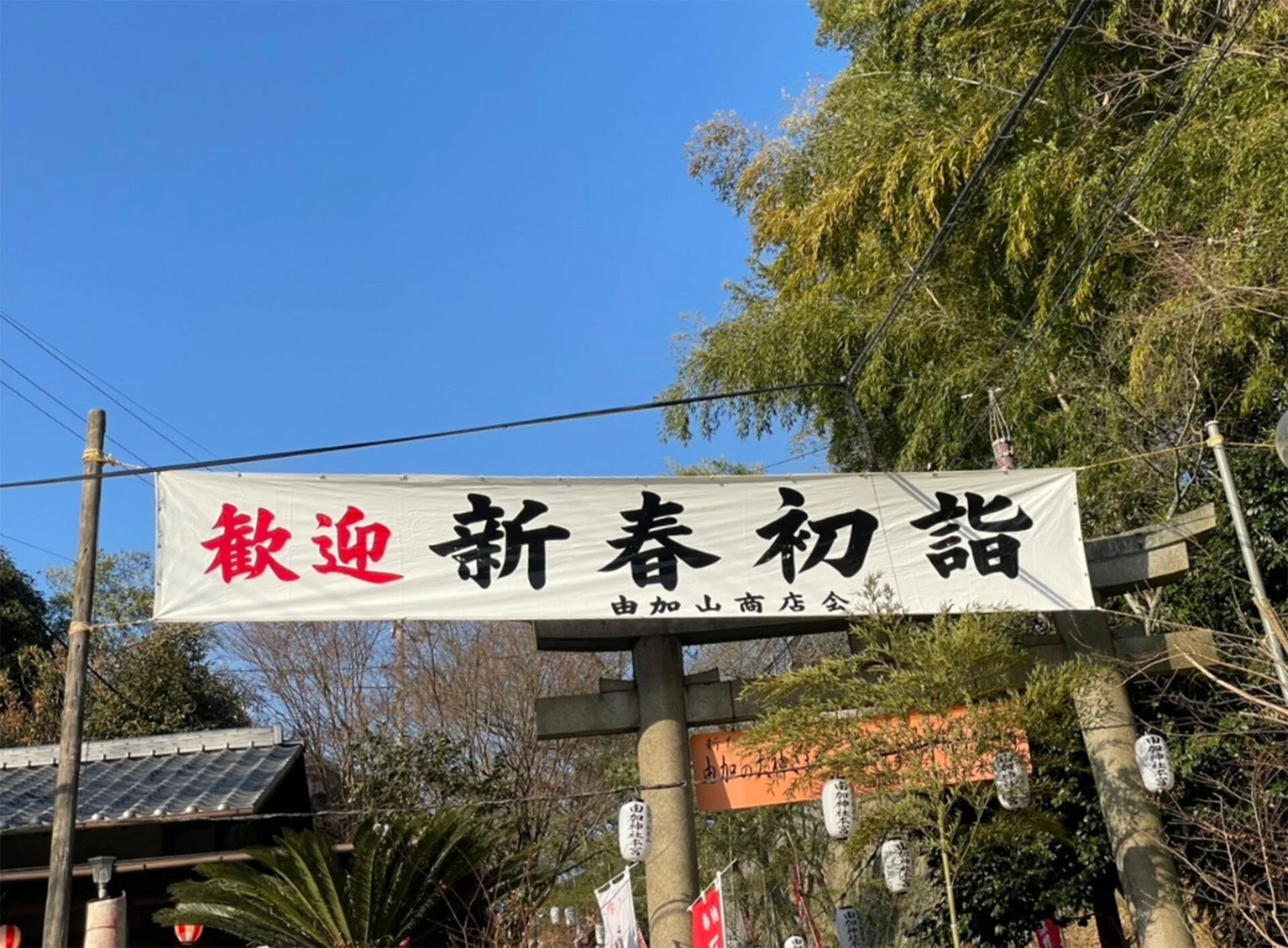
Approximately 1 million people visit each year, with over 350,000 visiting during the New Year, making it a representative New Year’s shrine in Kurashiki.
Originally, Yugayama refers to the name of the mountain, but it is also used to refer to the shrines and temples located on Yugayama, or as a collective place name for the area.
During the Edo period, Yugayama was depicted as "Bizen Yugayama" in Utagawa Hiroshige's "Yamami Mitate Sumo." Similarly, in Utagawa Hiroshige's "Sixty-Plus Prefectures Famous Places Illustrated," "Bizen Ta no Kuchi Beach Yugayama Torii" was illustrated as a famous place in Bizen.
In the Edo period, the entrance to Yugayama on the seaside was at the present-day Tanokuchi.
In 2017, Yuga Shrine Honmiya became one of the cultural properties of the Japan Heritage "A Kurashiki story beginning with a single cotton flower" ~ a town of textiles woven from harmony of Japanese and Western cultures.
History of Yugayama and Yuga Shrine Honmiya
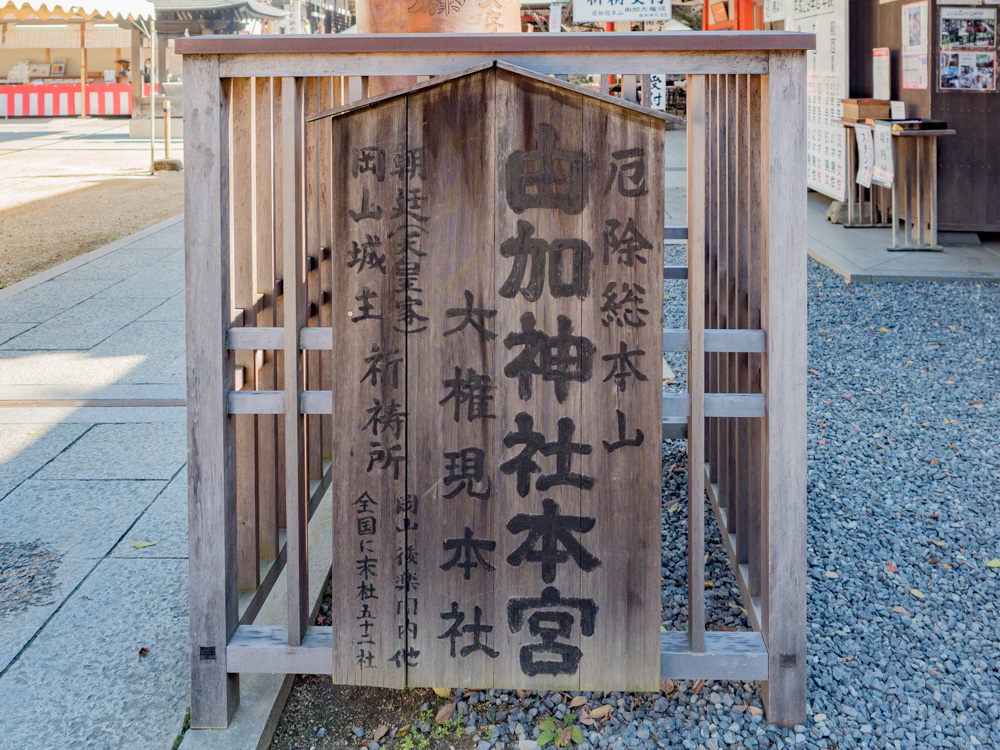
Yugayama has been worshipped as "Yuga Daigongen," a syncretism of Shinto and Buddhism, since ancient times.
Its history spans an astonishing 2000 years.
It is believed to have originated from the worship of a giant rock in the mountain as a sacred object.
During the Nara period, in the 5th year of Tenpyo (733), the monk Gyoki performed the "Sanmitsuyuga no Gyo" and enshrined Yuga Daigongen. The names Yugayama and Yuga Daigongen are derived from Gyoki's practice of Sanmitsuyuga.
Eventually, the deity worshipped at a nearby place now called Koyuga was combined, and it became revered as a sacred mountain of syncretism between Shinto and Buddhism.
During the reign of Emperor Kanmu, it became a place of prayer for the imperial court, and thereafter, Yugayama continued to prosper as a place of prayer for the imperial court. As a result, the current worship hall has received the chrysanthemum crest.
Furthermore, during the Nara period, Yugayama was also worshipped as one of the "New Kumano Three Mountains."
The New Kumano Three Mountains refer to the following three locations in the current Kojima area, which were likened to the Kumano Three Mountains (present-day southern Wakayama Prefecture).
- Kumano Hongu Taisha (Hongu-cho, Tanabe City) = Japan's First Kumano Shrine and Goryu Sonryuin (Hayashi, Kurashiki City)
- Kumano Hayatama Taisha (Shingu City) = Shokoji (Kimi, Kurashiki City, now only ruins)
- Kumano Nachi Taisha (Nachi-Katsuura Town) = Yuga Daigongen (Yugayama)
In the Edo period, Yugayama became a place of prayer for the Okayama domain lord, the Ikeda clan, and was deeply revered.
Among the common people, the practice of "Ryomairi" became popular, where people would visit Yugayama before crossing the Seto Inland Sea by boat to visit Kotohira Shrine in Sanuki Province (Kagawa Prefecture).
Even today, there are visitors who perform Ryomairi to both Yugayama and Kotohira Shrine.
In the Meiji period, due to the Separation of Shinto and Buddhism, Yuga Shrine Honmiya and Yugasan Rendai-ji Temple were separated.
Deities of Yuga Shrine Honmiya
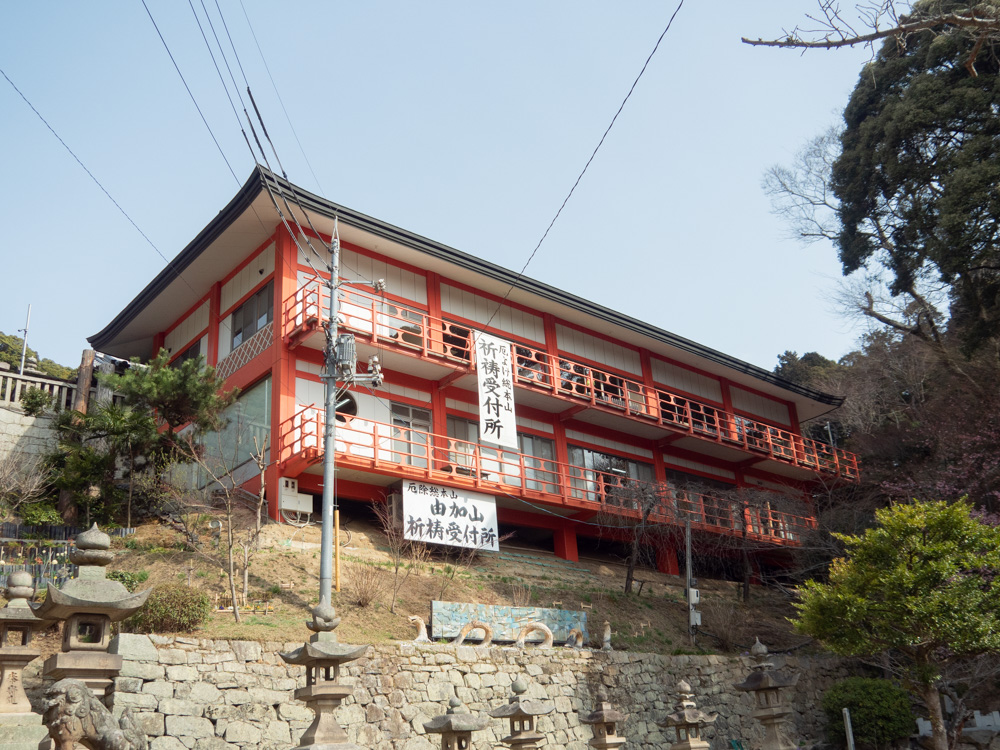
The deities of Yuga Shrine Honmiya are as follows:
- Teoki Hooin no Mikoto
- Hiko Sashiri no Mikoto
- Kamu Naohi no Mikoto
- O Naohi no Mikoto
Additionally, the following are enshrined as honjibutsu (Buddhas or bodhisattvas in the form of gods).
- Amida Nyorai
- Yakushi Nyorai
Teoki Hooin no Mikoto and Hiko Sashiri no Mikoto are the gods of architecture and skills.
These two deities are the main deities of Yuga Shrine Honmiya.
Kamu Naohi no Mikoto and O Naohi no Mikoto are gods of warding off disasters.
They were enshrined during the Edo period when the custom of Ryomairi was established to pray for safe travels.
Since then, many people have visited Yuga Shrine Honmiya for the purpose of warding off evil, and it has come to be known as the "headquarters for warding off evil."
Highlights of Yuga Shrine Honmiya
Yuga Shrine Honmiya has many highlights.
Let’s pick out some to introduce.
Warding Off Evil Stone Steps
From the first parking lot of Yugayama, the main approach continues.
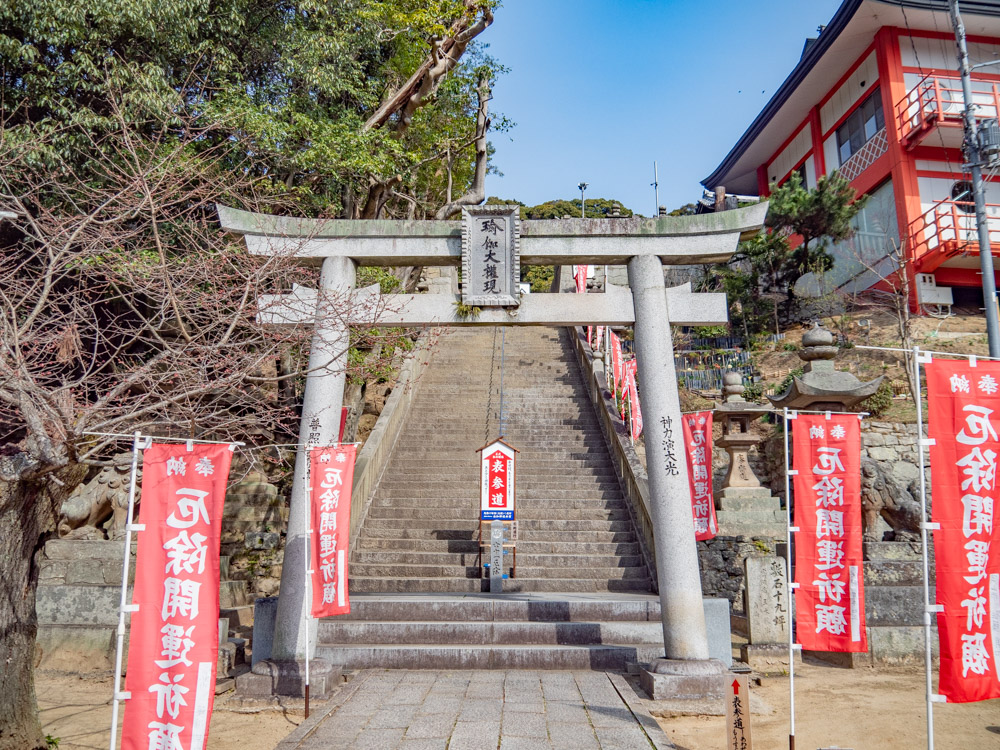
Along the approach, there are three sections known as the "Warding Off Evil Stone Steps." The first torii gate has the "Main Approach Warding Off Evil Stone Steps."
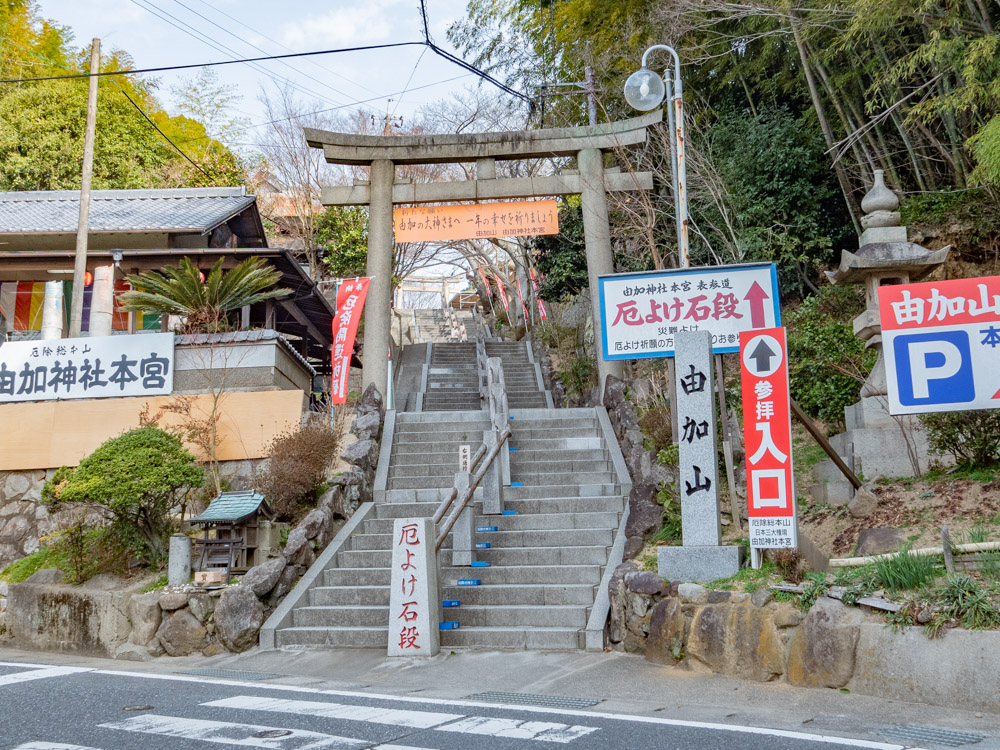
About 250m from the Warding Off Evil Stone Steps, before the Ryokami Torii, is the "Thirty-Three Warding Off Evil Stone Steps."
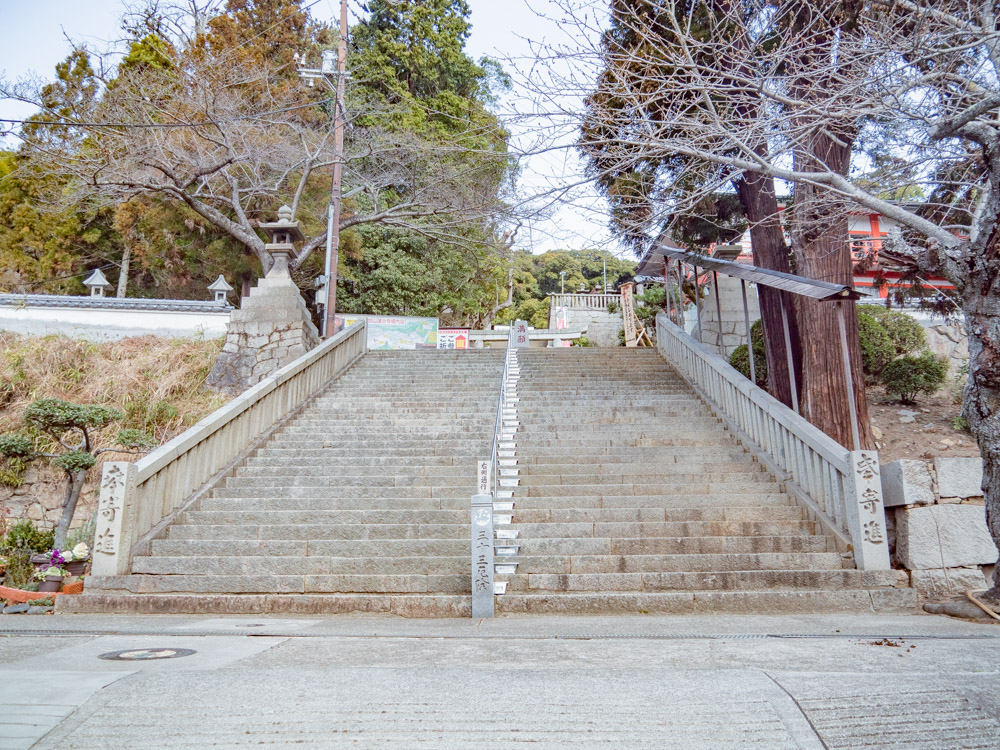
Next, behind the Ryokami Torii is the "Sixty-One Warding Off Evil Stone Steps."
Japan's Largest Bizen Ware Torii and Bizen Ware Lions
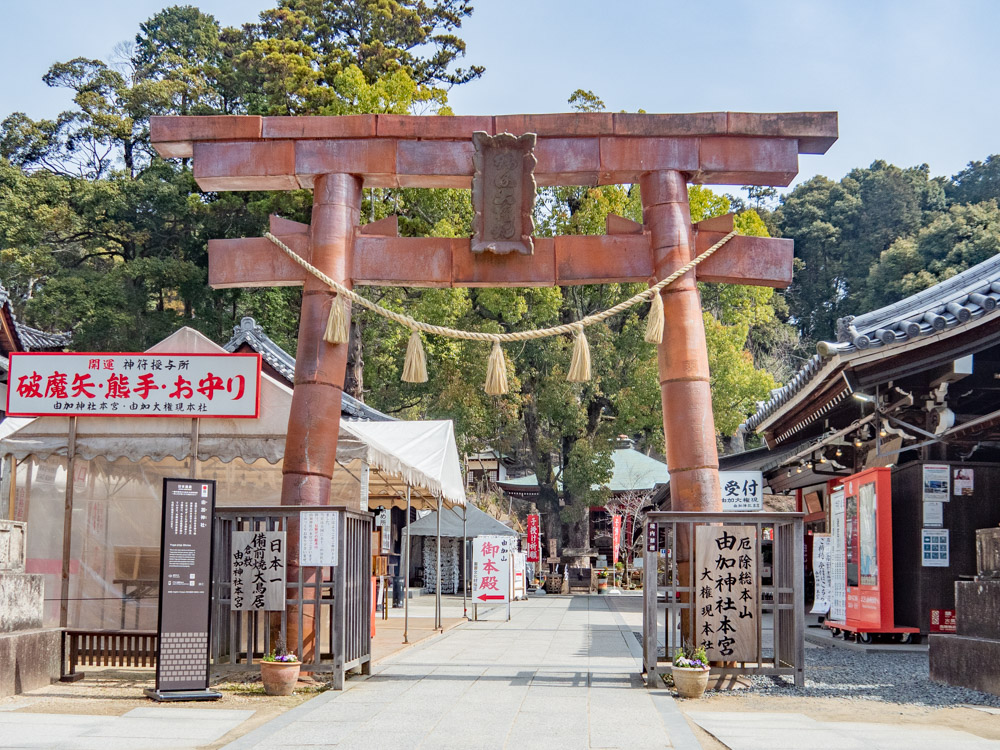
At the entrance of the Yuga Shrine Honmiya grounds, there is a large torii made of Bizen ware.
It was donated in 1894 (Meiji 27) and is the largest Bizen ware torii in Japan.
The Bizen ware torii was designated as a registered tangible cultural property of the country in March 2024.
Additionally, on both sides of the torii, there are lions made of Bizen ware.
They were donated by the Amagi Ikeda clan in 1829 (Bunsei 12) during the late Edo period.
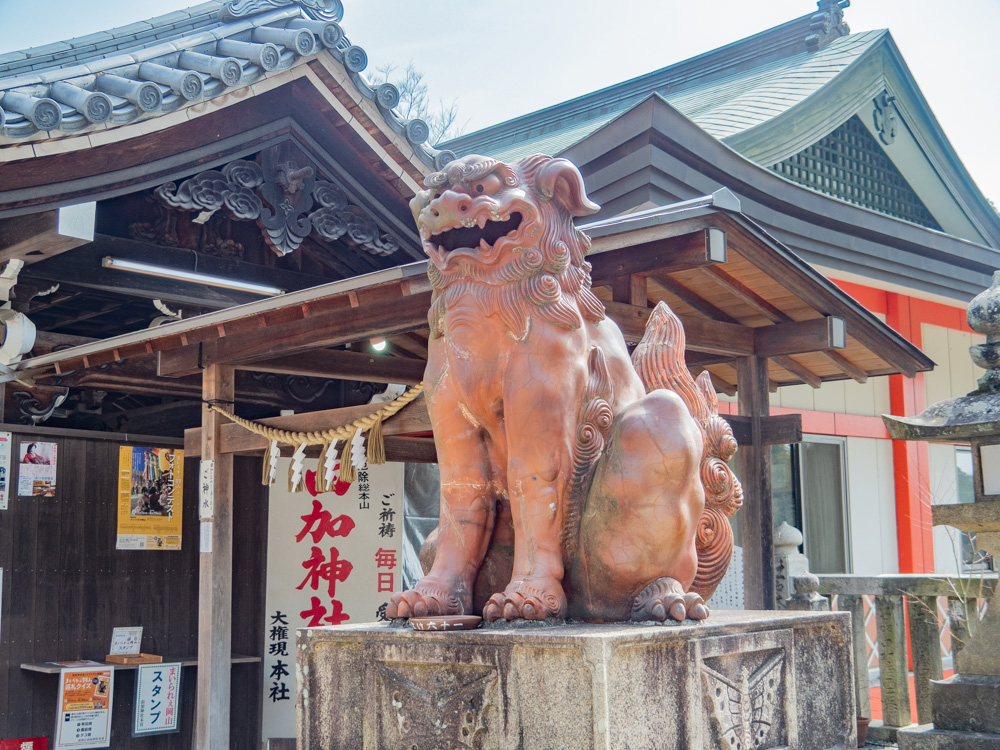
The base of the lion is engraved with the family crest of the Amagi Ikeda clan. The lion on the left side facing the front of the torii is in a position with its right front foot raised.
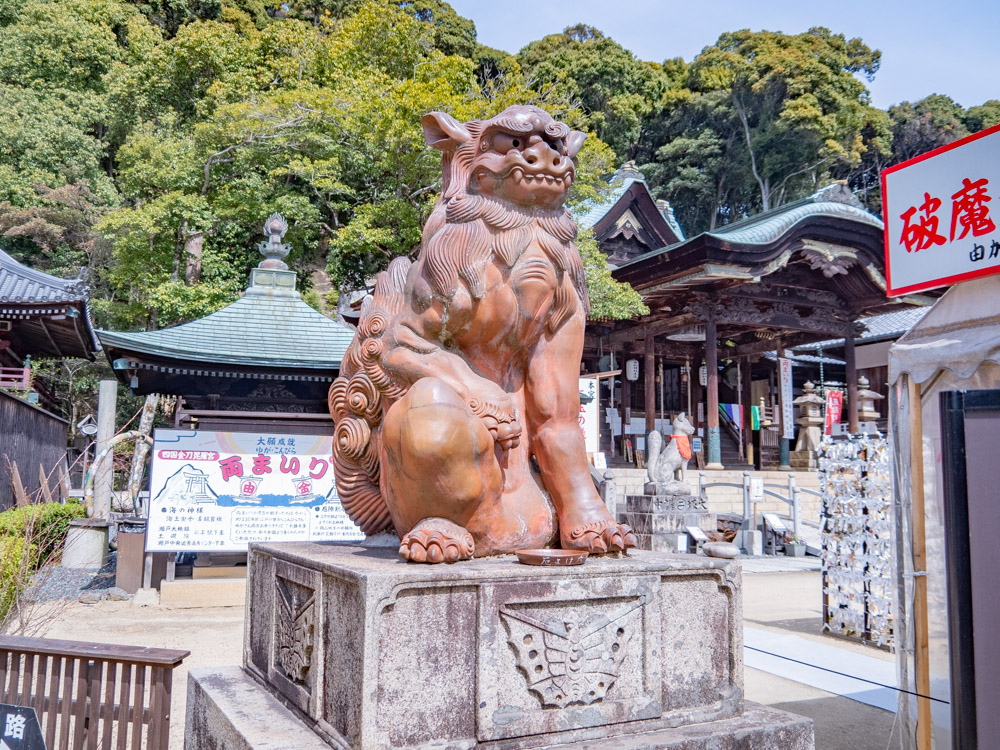
Originally, they were parent and child lions, with a cub beneath their feet.
However, during the Showa era, only the cub was stolen, resulting in the current state.
Main Hall, Offering Hall, Worship Hall
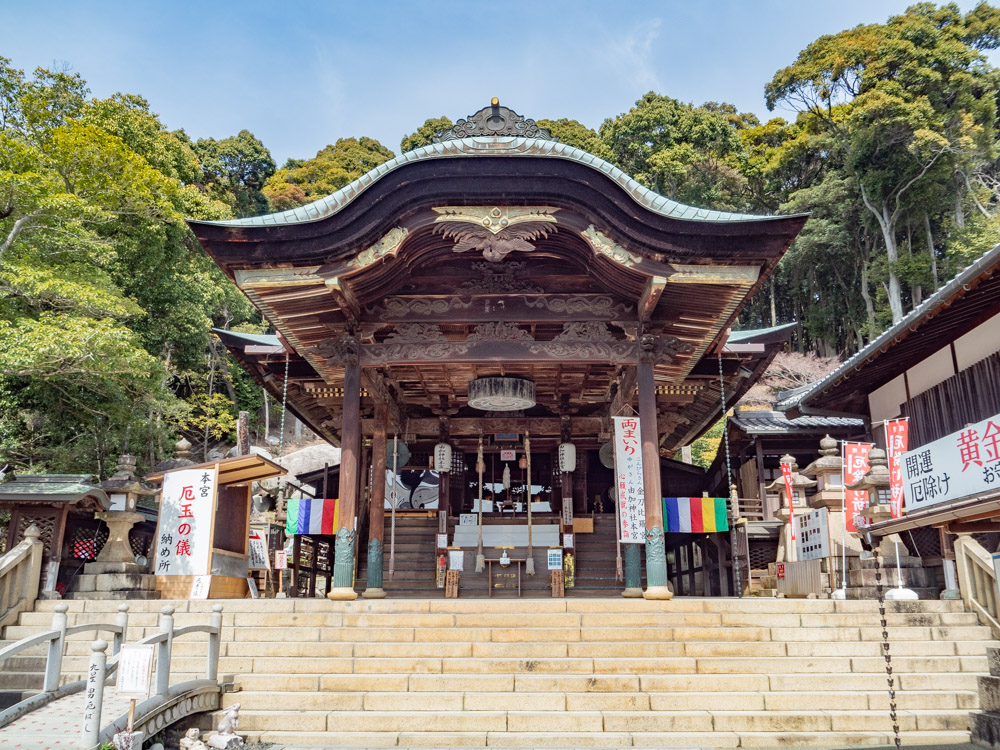
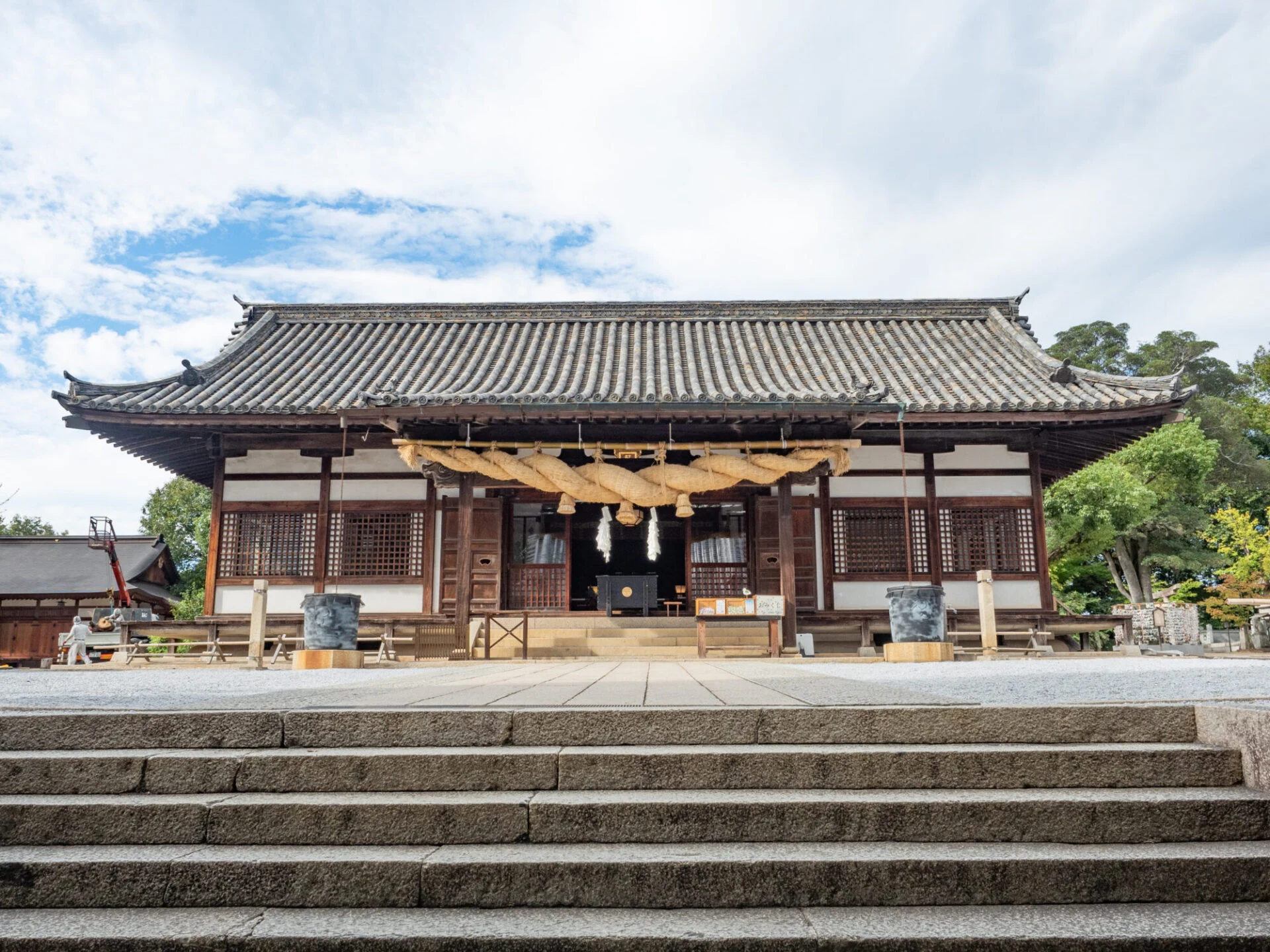
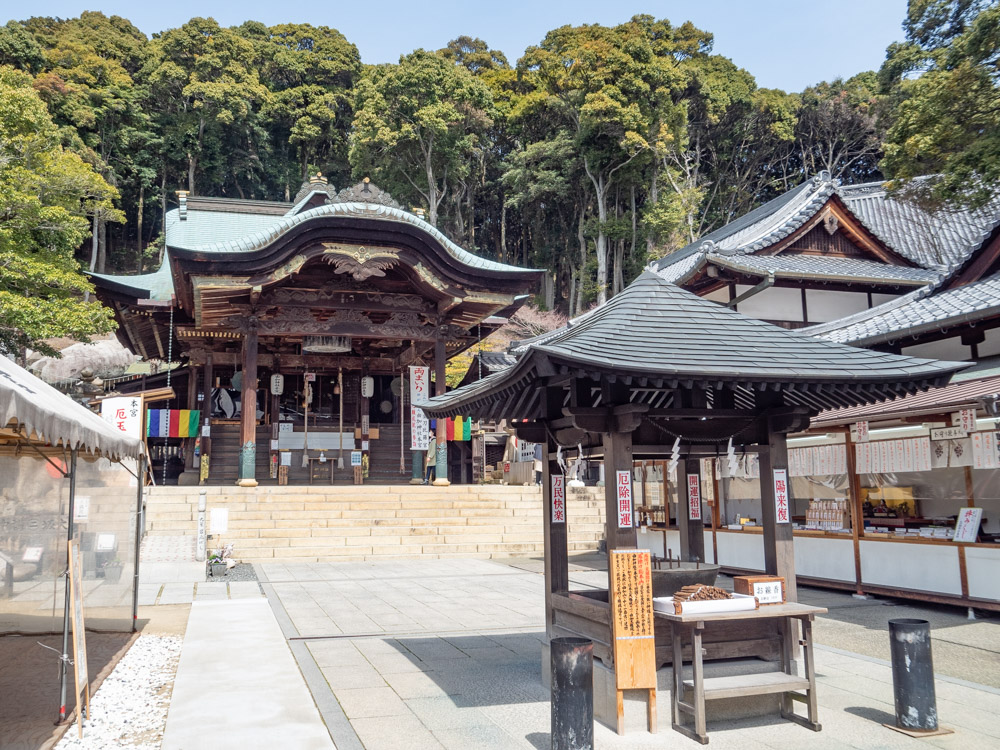
The architectural style of the worship hall of Yuga Shrine Honmiya is the representative Gongen-zukuri.
The main hall is the building where the deity is actually enshrined and is located behind the worship hall.
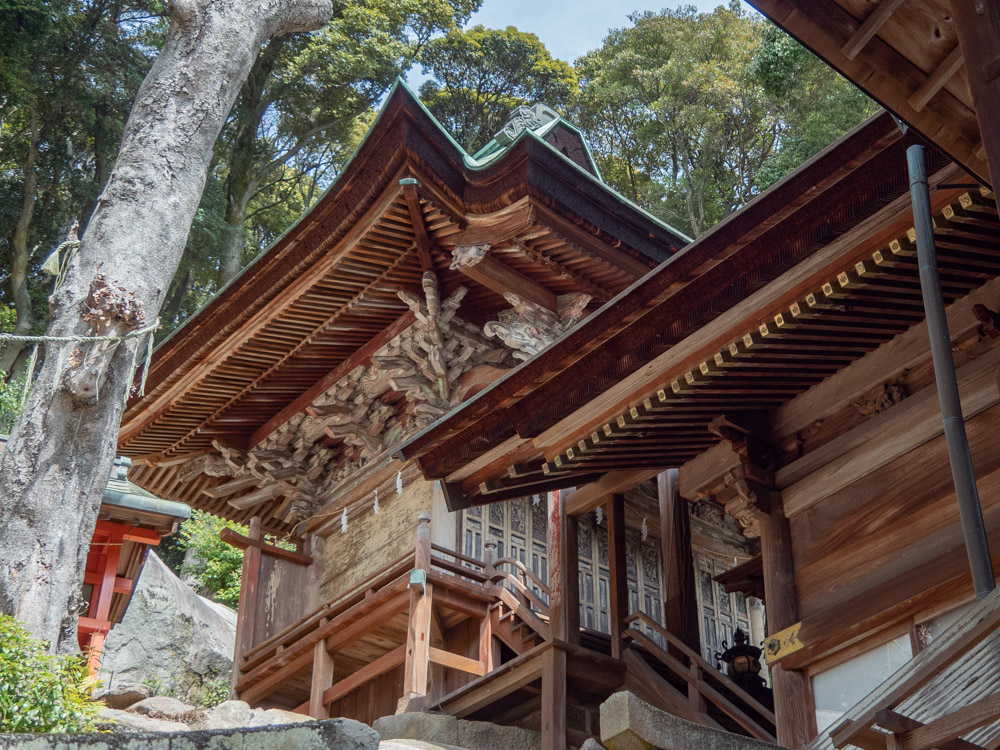
It is said to have been built in the early Edo period and is the oldest building on Mt. Yuga.
The main hall of Yuga Shrine Honmiya is designated as an Important Cultural Property of Okayama Prefecture.
The heiden is a place for offering offerings to the deities and conducting rituals, while the haiden is where worshippers join their hands and pray to the deities when they visit.
Looking around the pillars and ceiling of the haiden, you can see various wooden carvings, making it very luxurious.
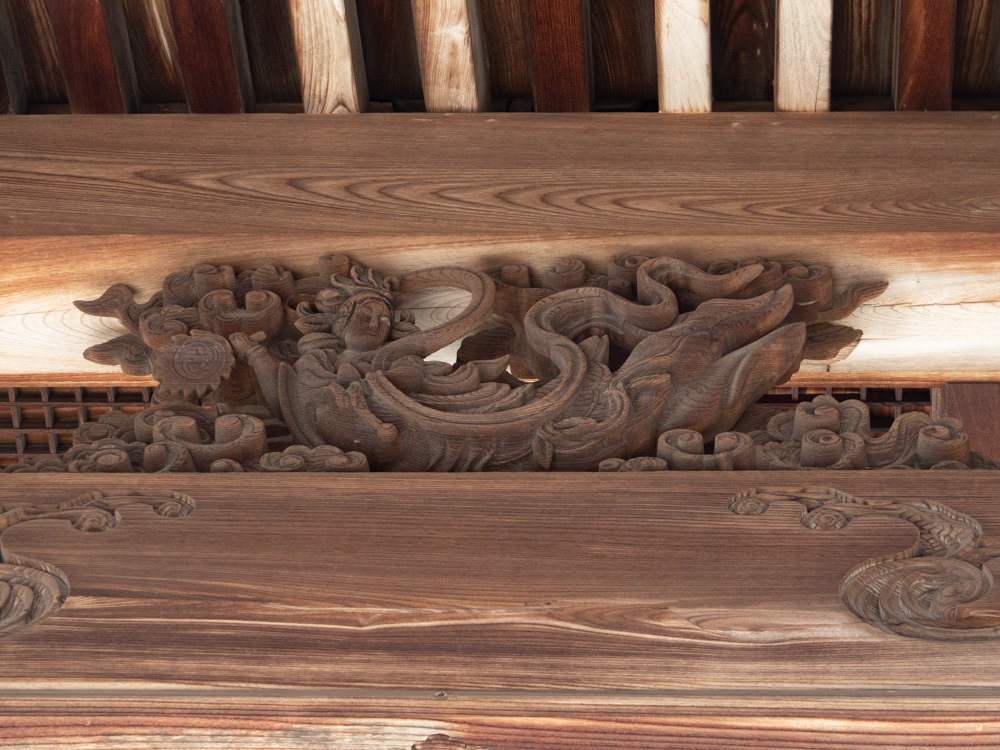
There is also an explanation about the decorations next to the haiden, so please refer to it while viewing the decorations.
In addition, the heiden and haiden, along with the Bizen ware large torii gate and Sanpo Kojin Shrine, will be designated as Registered Tangible Cultural Properties of Japan in March 2024.
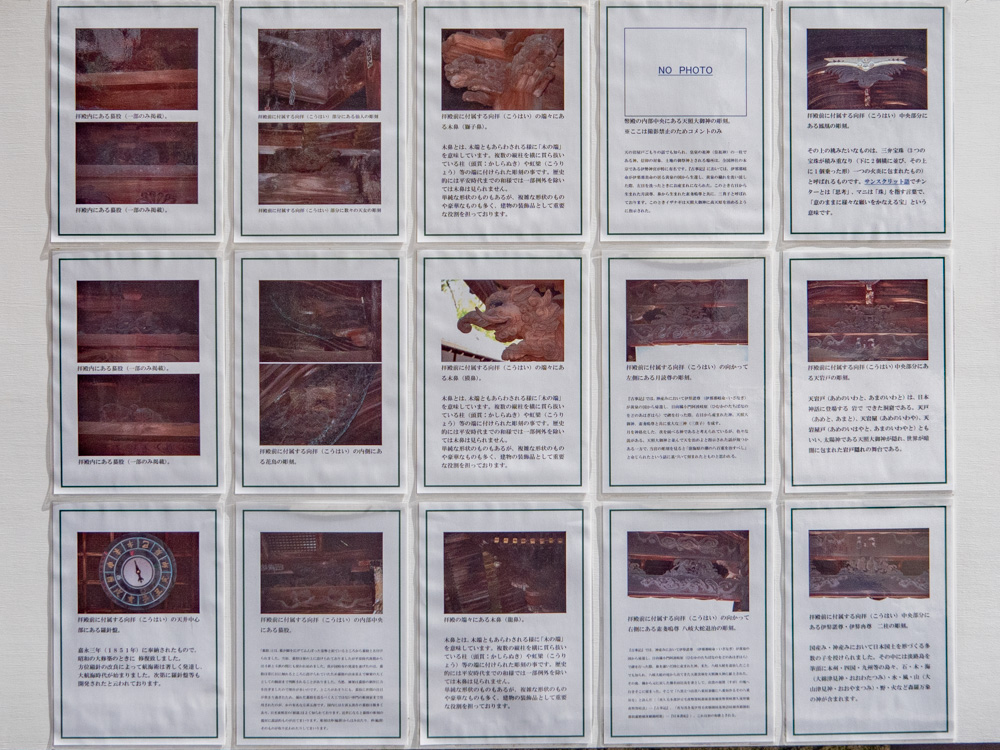
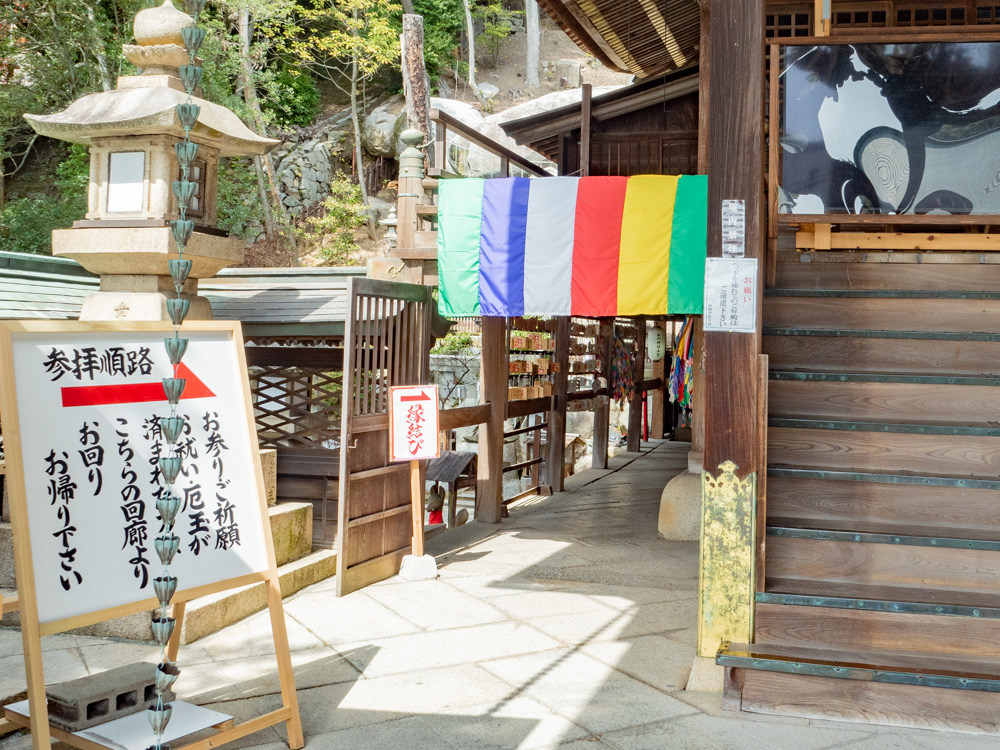
Additionally, you can enter from both sides of the haiden.
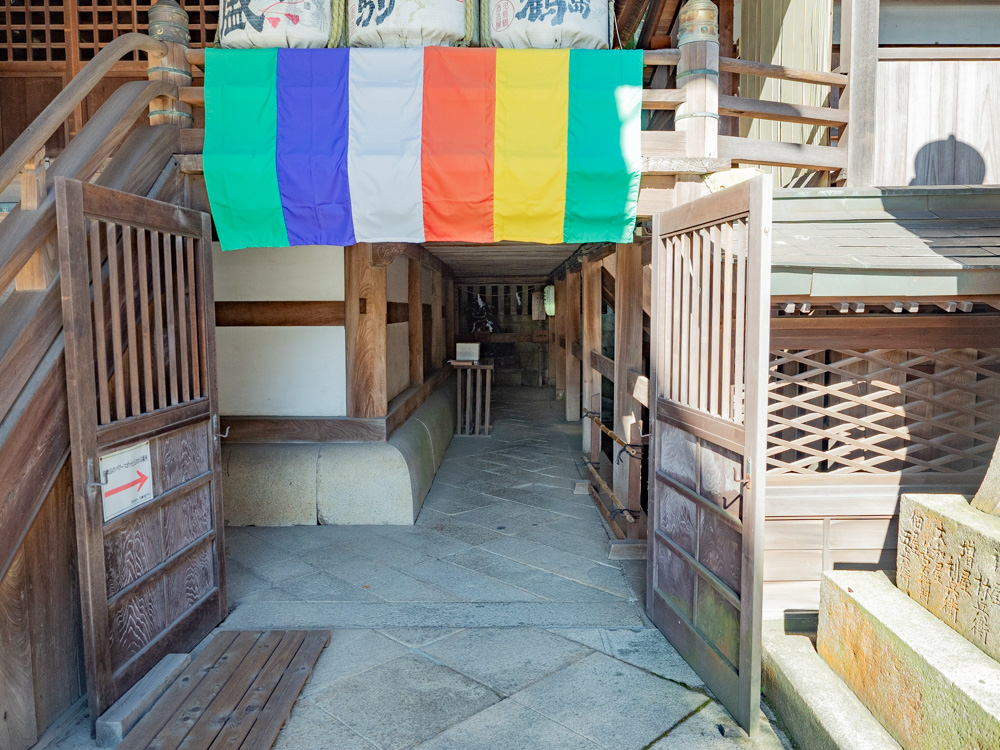
Inside, Susanoo no Mikoto, known for bringing couples together, is enshrined.
Men should enter from the left side and visit the female lion of the lion that brings couples together enshrined at the back.
Women should enter from the right side and visit the male lion of the lion that brings couples together.
Ritual of Yakudama
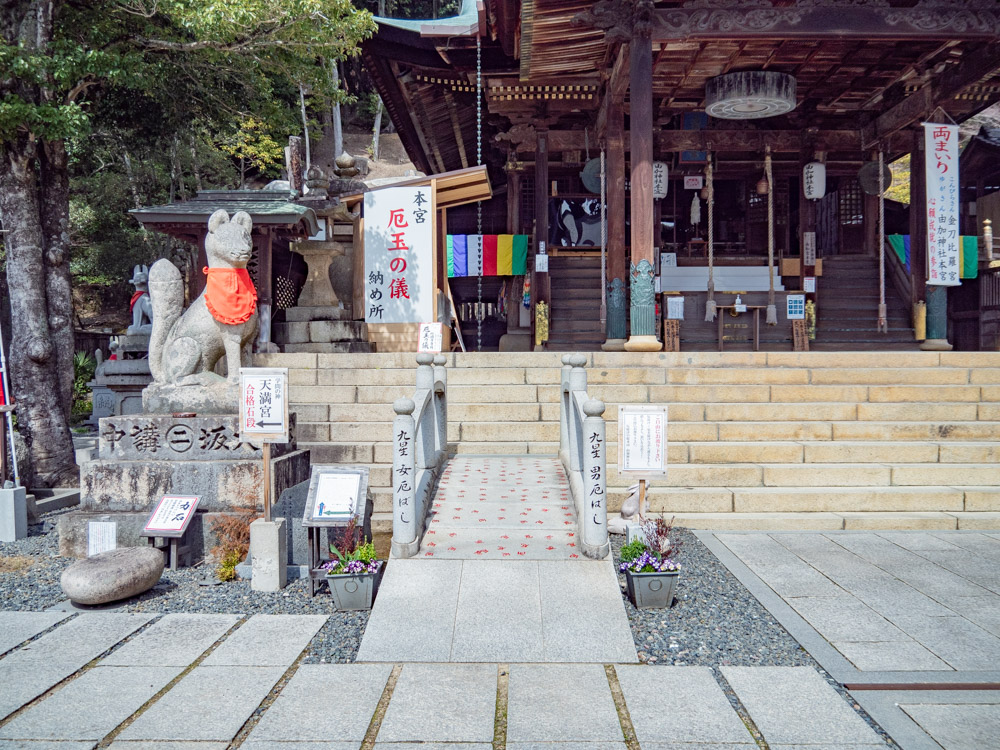
The Ritual of Yakudama is a unique ceremony specific to Yuga Shrine Honmiya.
After receiving a prayer, you will receive a "yakudama" from the shrine.
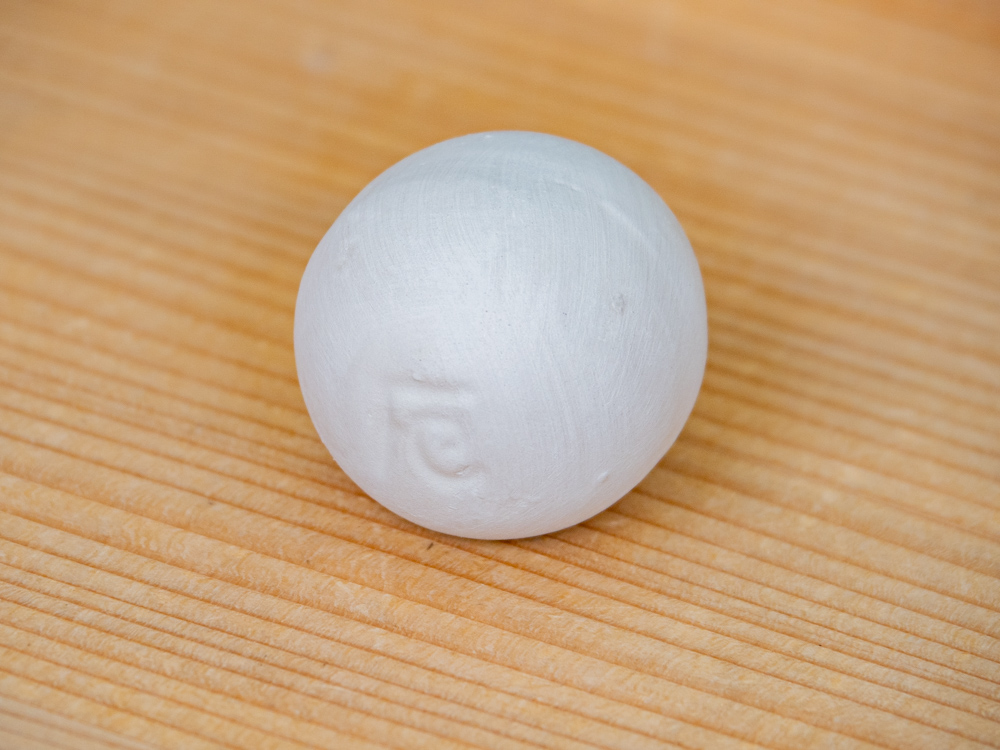
Then, head towards the "Yakudama Ritual Offering Place" located in front of the left side of the haiden.
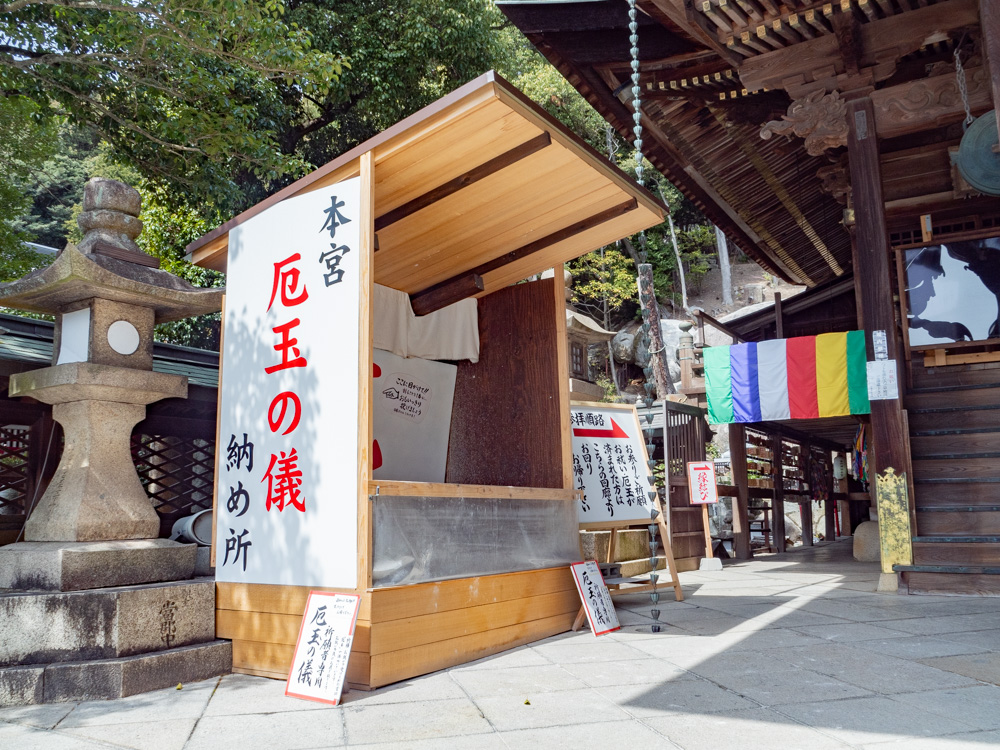
In front of the offering place, there is a small stone bridge called "Yakubashi", so cross it to reach the offering place.
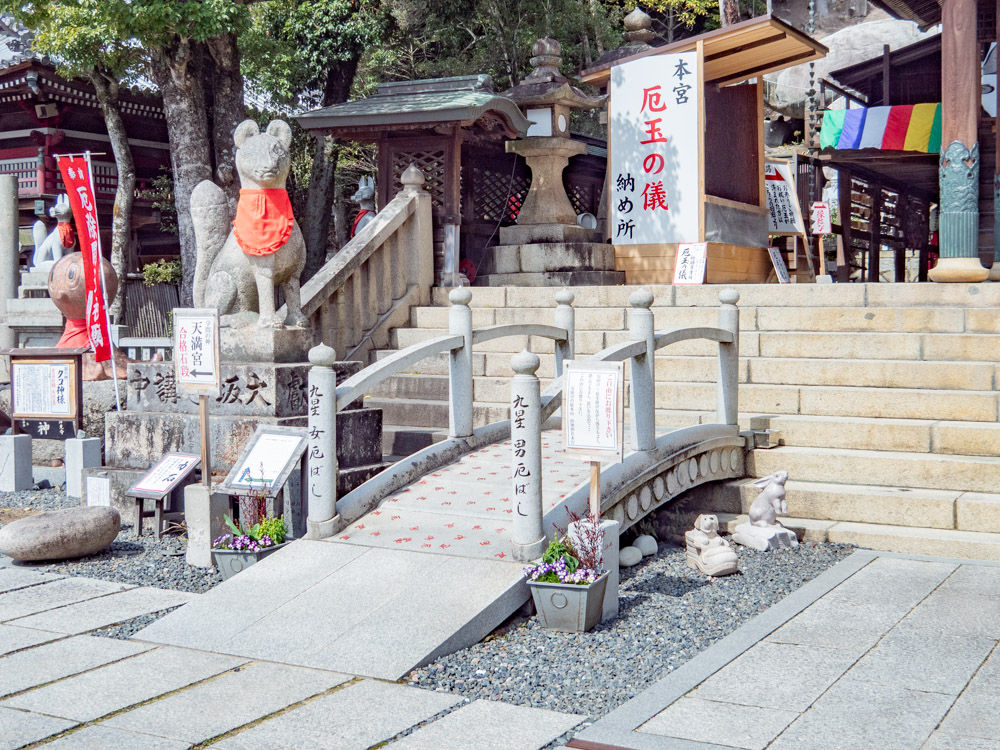
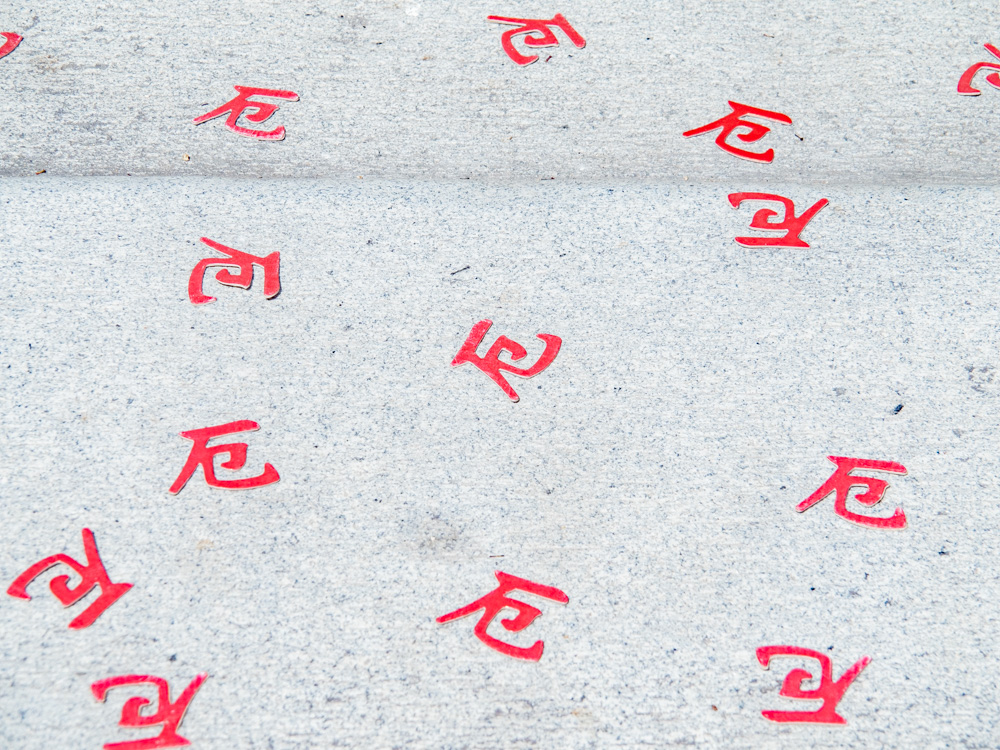
On the Yakubashi, there were countless characters for "evil."
The yakudama is a ceramic ball engraved with the character for "evil," with a hole in one place.
Breathe towards the hole of the yakudama.
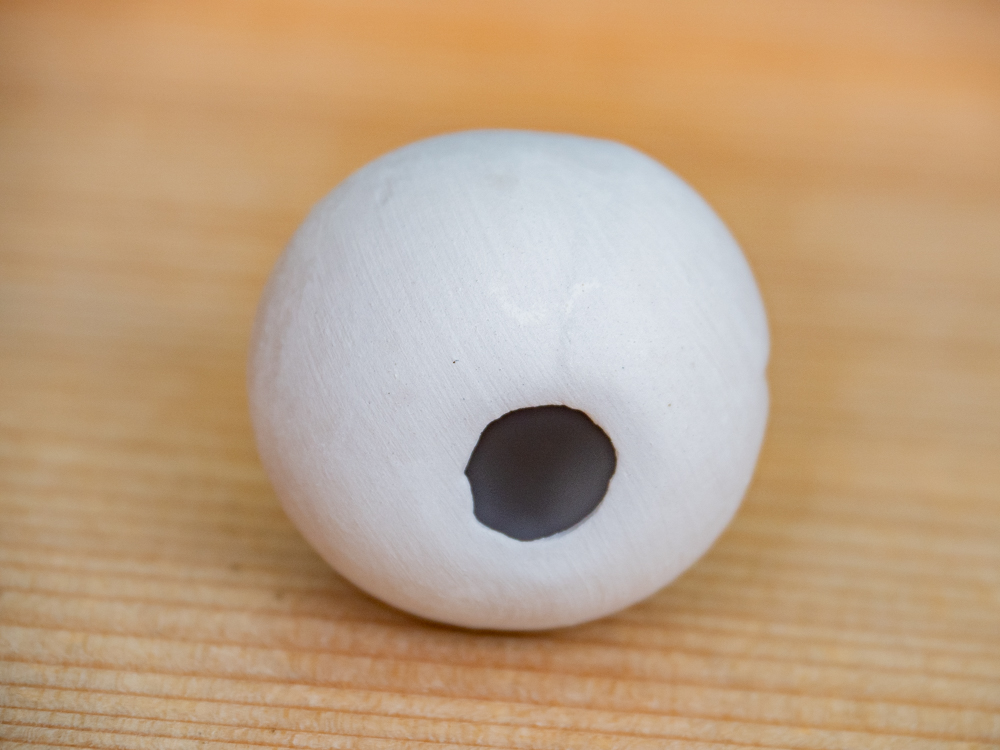
With your breath, the evil and misfortune are sealed inside the ball.
Then, throw the yakudama, which has sealed the evil and misfortune, with all your might towards the large character for "evil" written at the offering place.
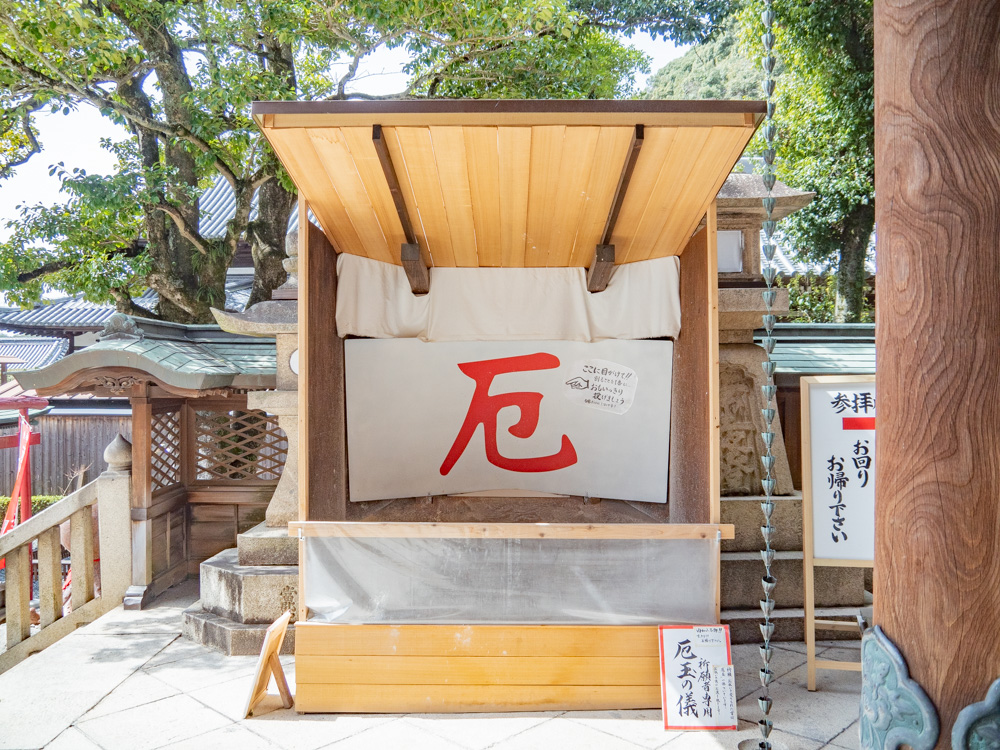
As the yakudama hits the character for "evil," it shatters with a cheerful sound.
By doing this, the purification from evil is performed.
I think the Ritual of Yakudama is a very interesting ceremony that simultaneously performs purification from evil and relieves stress.
Tako God (Sea God)
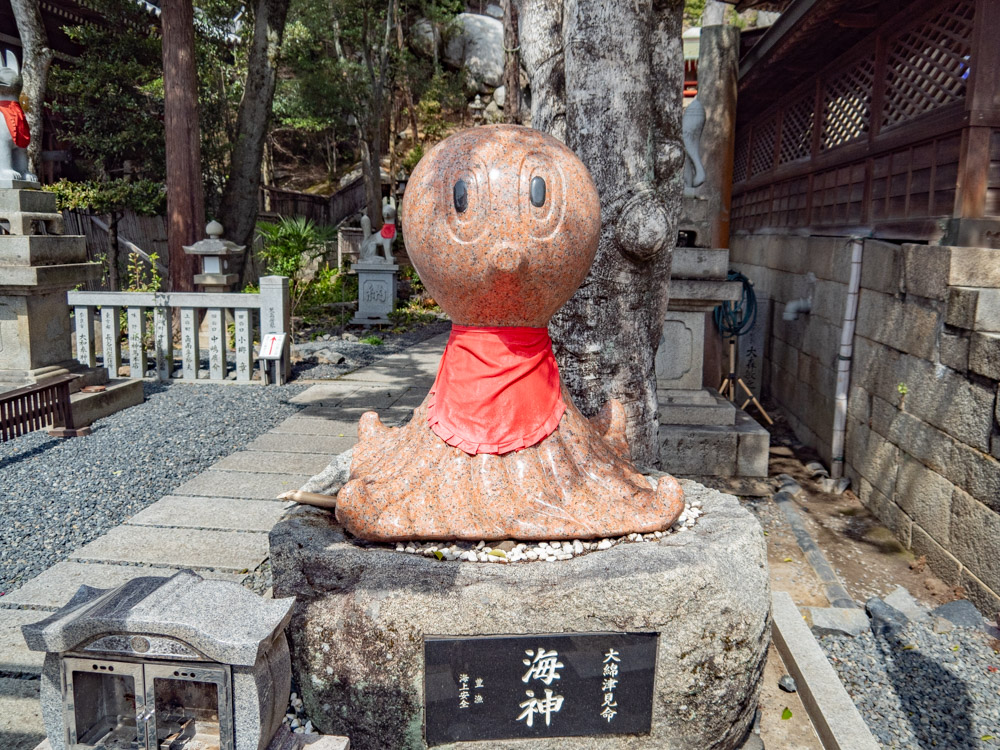
Local fishermen from the Kojima area built this shrine in the mid-Heisei period with the hope of praying for a good catch and offering gratitude for the seafood they caught.
They enshrined the sea god Owatatsumi no Kami. Since the Shimotsui area of Kojima is famous for octopus, the shrine is uniquely shaped like an octopus.
The Tako God is enshrined at the front left of the haiden.
Tenmangu, Inari Shrine, Iwakura
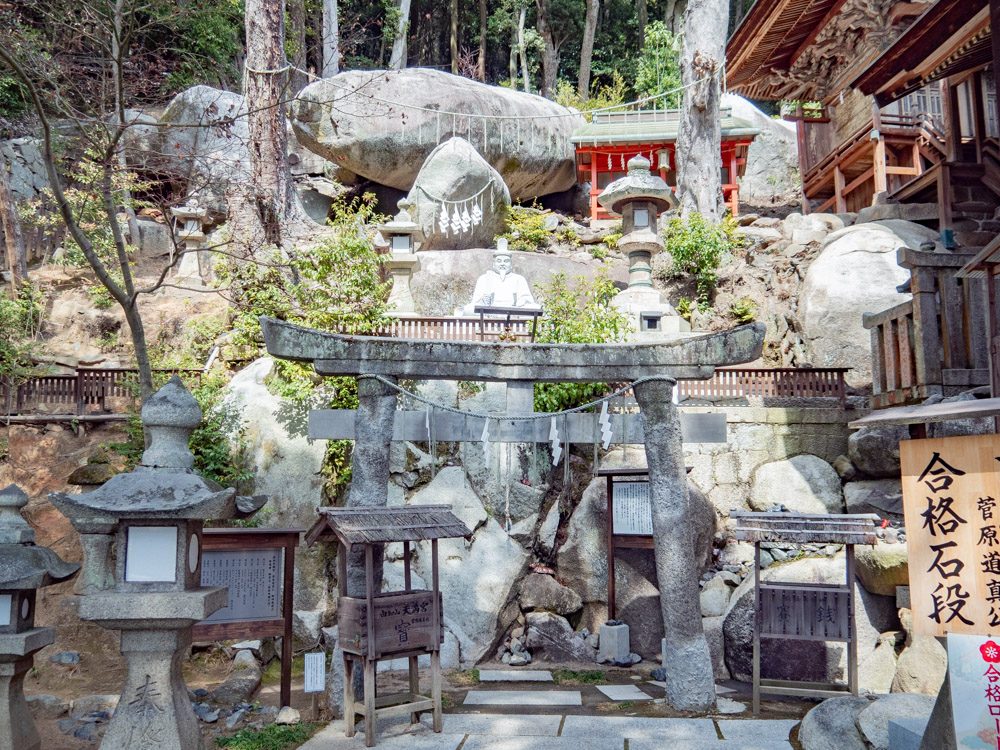
On the left side of the haiden, behind the Tako God, is the Tenmangu.
Tenmangu is a shrine dedicated to Sugawara no Michizane, the god of learning.
On the high ground to the left of the main hall, there is a white statue of Sugawara no Michizane.
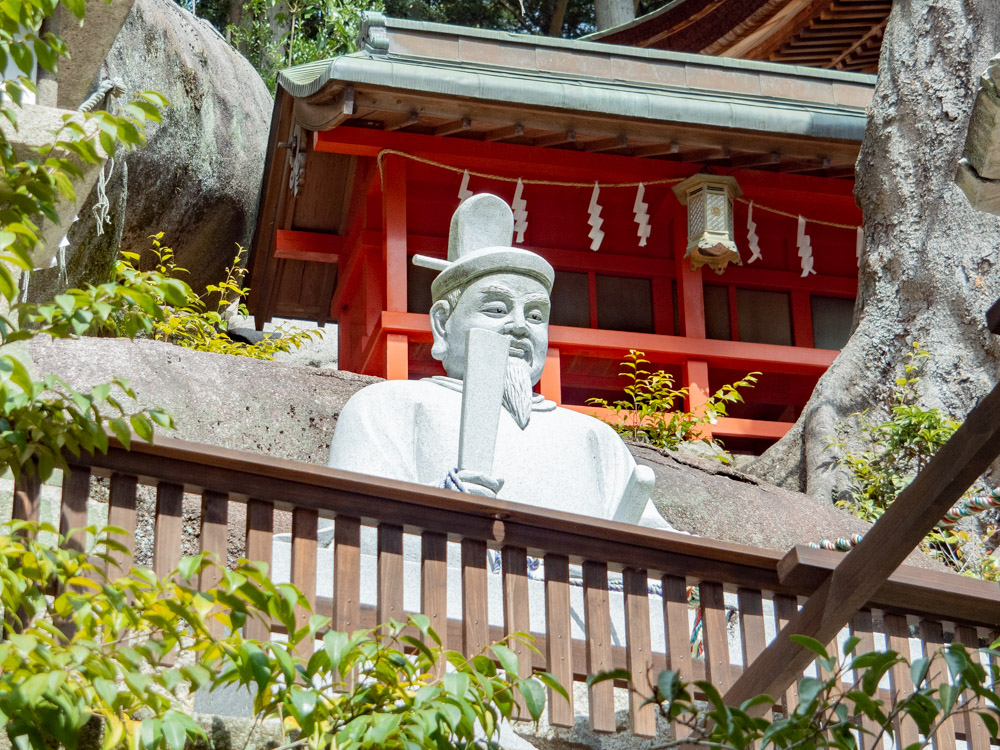
Behind it is a vermilion shrine, the Inari Shrine.
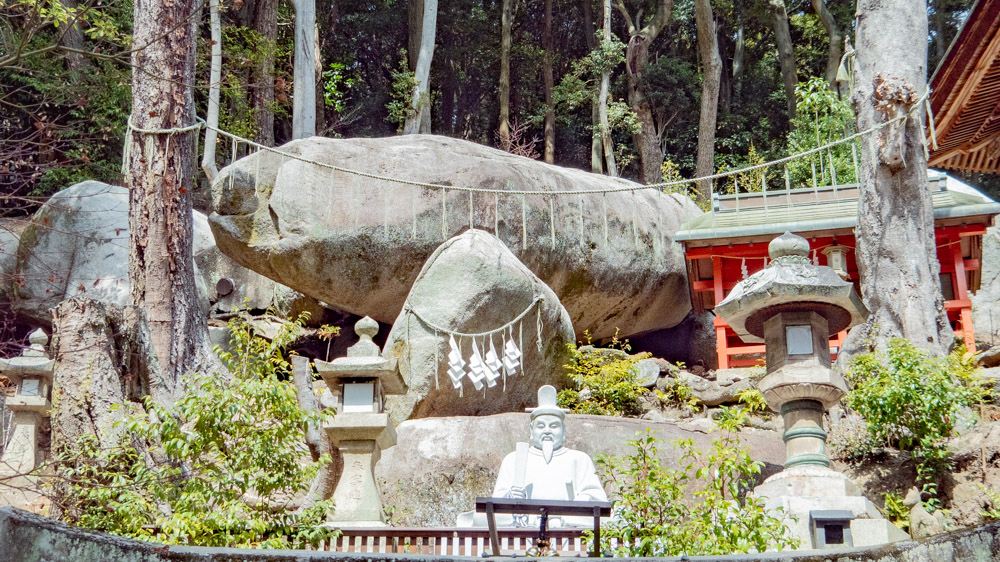
It enshrines Ukanomitama no Mikoto, the god of good harvests and prosperous business.
Behind the Inari Shrine is a huge iwakura, a rock where deities are said to gather.
It is said to originate from ancient nature worship.
Small Mallet for Pain Relief
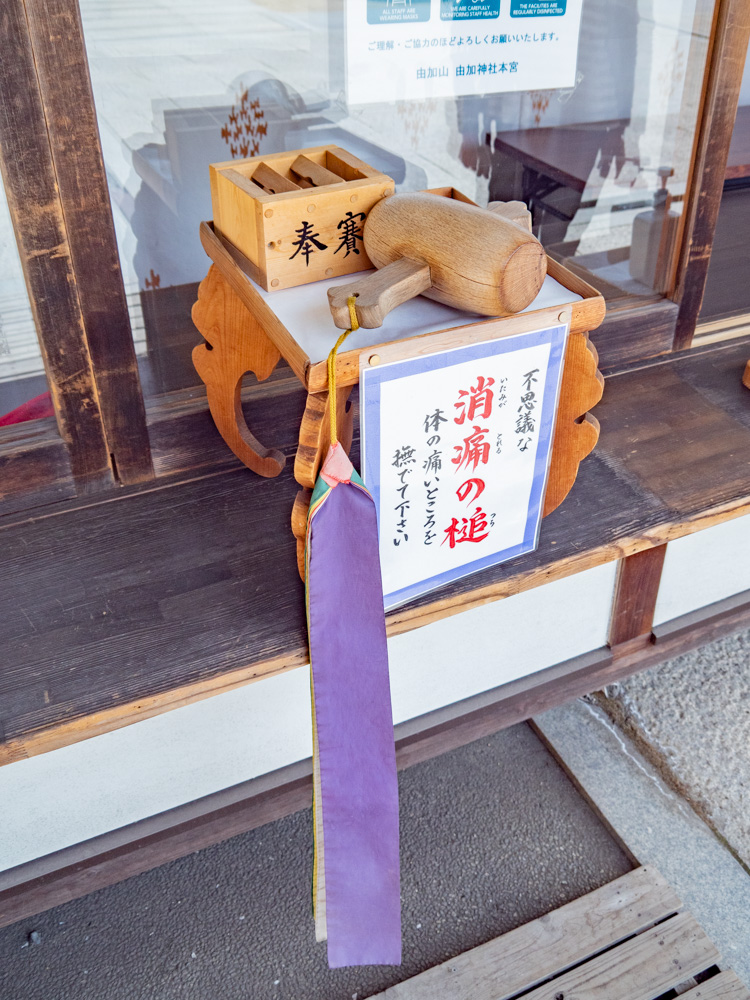
Pain-relieving hammer is said to have a mysterious power.
With the pain-relieving hammer, it is said that rubbing the painful or uncomfortable parts of the body will relieve the pain.
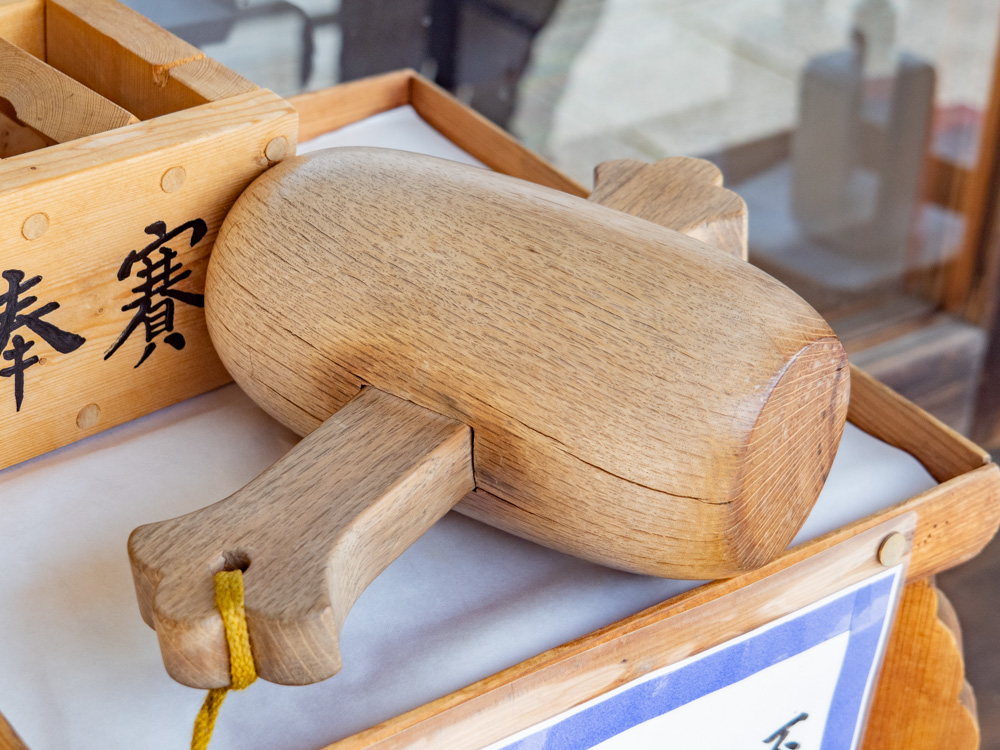
It is said that some people even visit from Shikoku to receive the blessings of the hammer.
Please do try the mysterious hammer.
Divine tree for childbearing
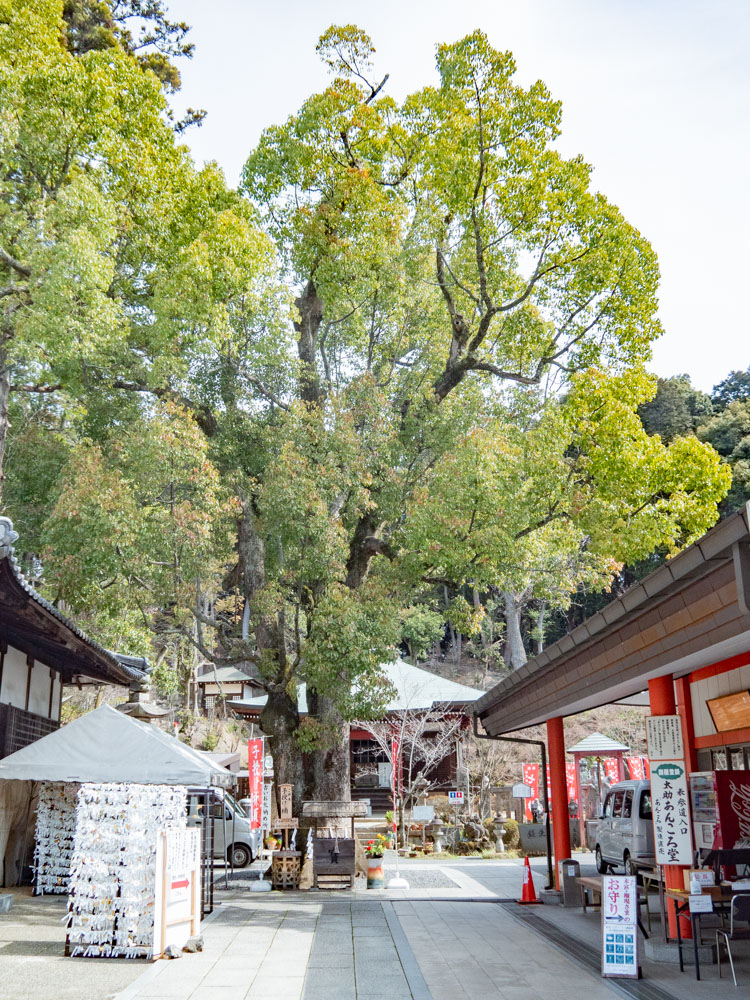
Divine tree for childbearing is a camphor tree that is said to have a mysterious legend of granting children.
It is said that if you walk around the divine tree three times in a clockwise direction (to the right) while facing it, you will be granted a boy. If you walk around it three times in a counterclockwise direction (to the left), you will be granted a girl.
Walking around the divine tree is said to bring blessings even to those who are not the ones actually becoming pregnant or giving birth. During the Edo period, the lord of Okayama Castle, the Ikeda clan, prayed to this camphor tree for a successor, and it is said that they were granted a child.
Since then, it has been enshrined as the divine tree for childbearing.
Zeniarai Benzaiten
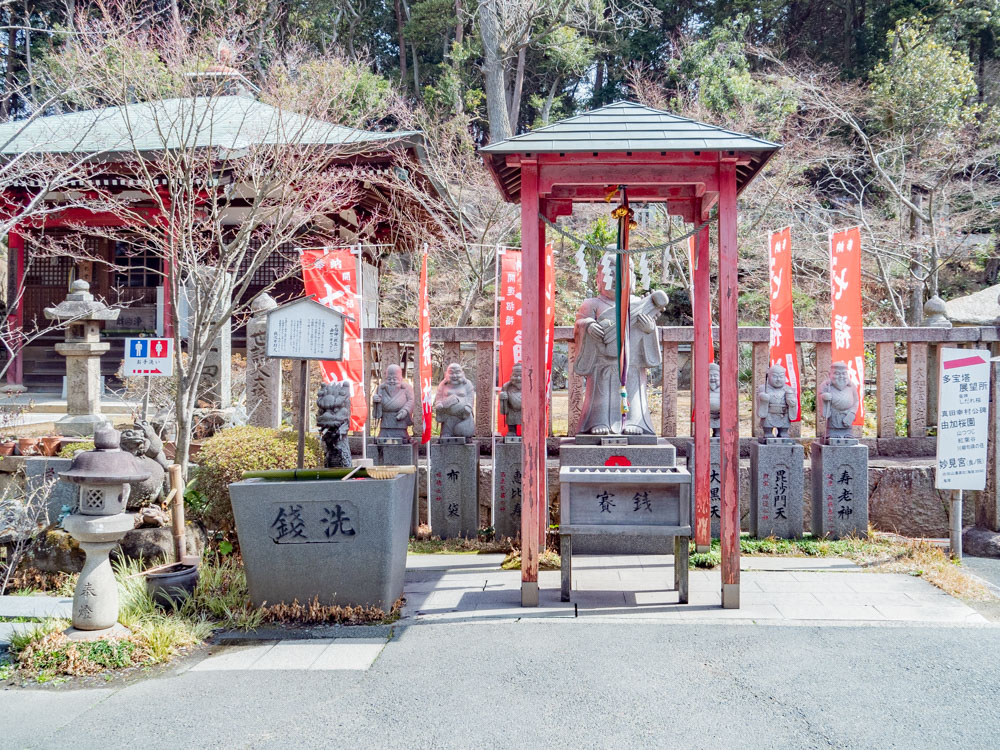
Zeniarai Benzaiten is said to have a mysterious power of increasing financial fortune.
The holy water located to the left of the Benzaiten statue is said to spring from 200 meters underground beneath the main shrine.
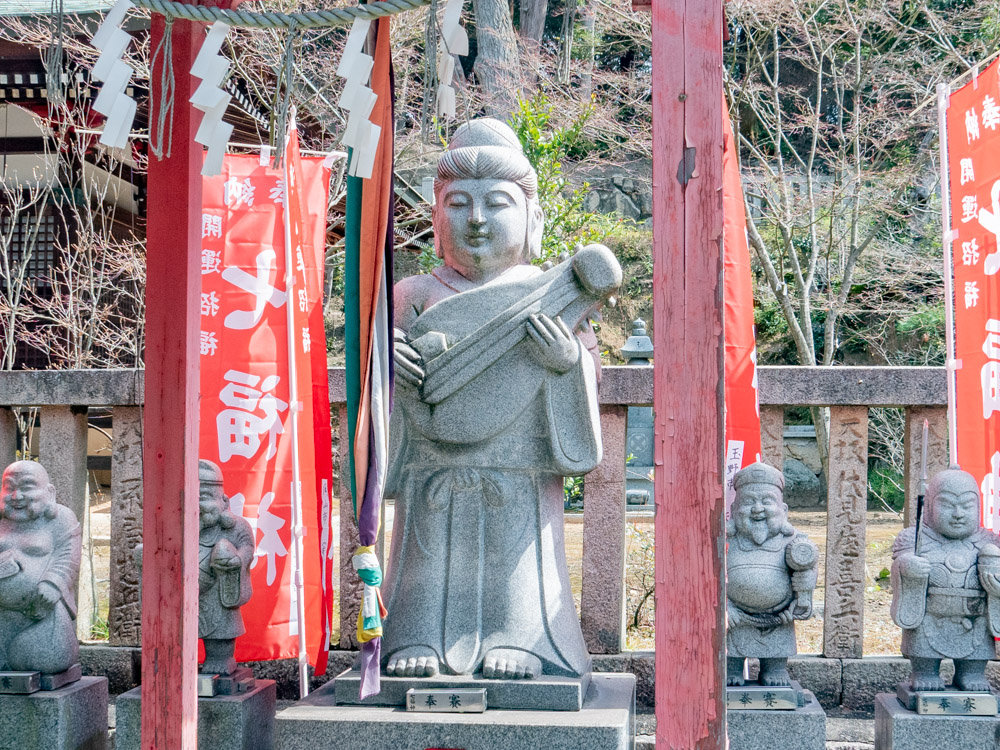
Washing coins (coins, bills) with the holy water is said to remove impurities and turn them into pure lucky money.
Furthermore, there is a legend that the money will return multiplied. Therefore, people pray for salary increases, business prosperity, and even for gambling.
After soaking coins or bills in the holy water, please wipe them with a cloth and let them dry.
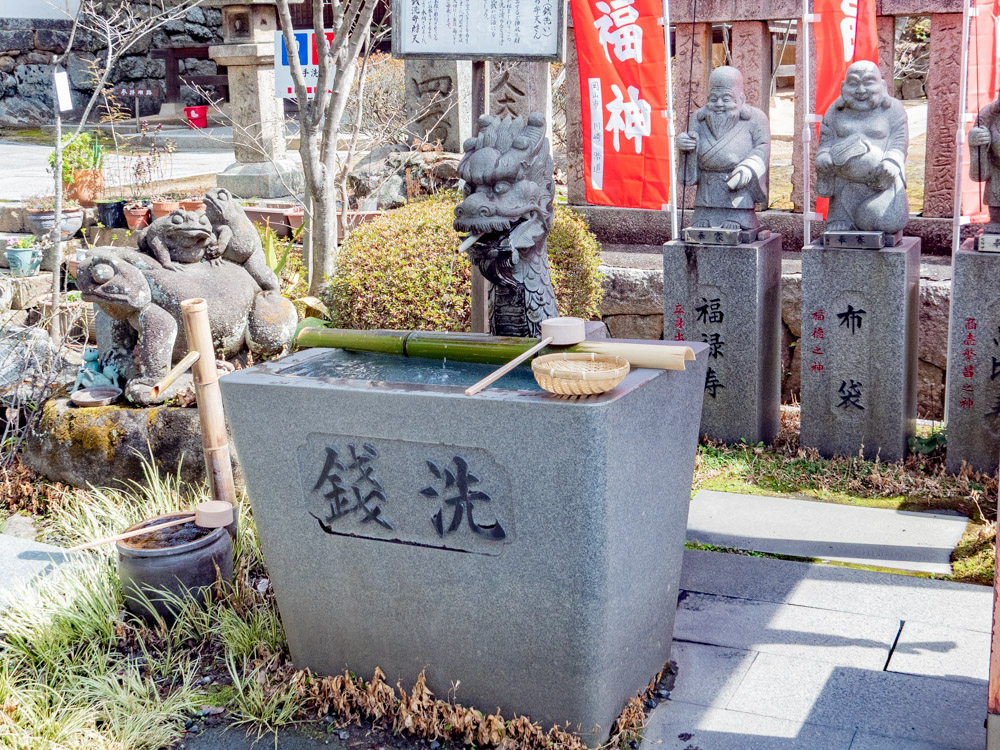
Therefore, it is recommended to prepare a towel or handkerchief to wipe with when visiting.
The dried money can be kept in your wallet as a talisman or used for payments.
This spot gained national attention when actor Ryuuta Mine washed money at Zeniarai Benzaiten on a variety show.
Mizuko no Haha
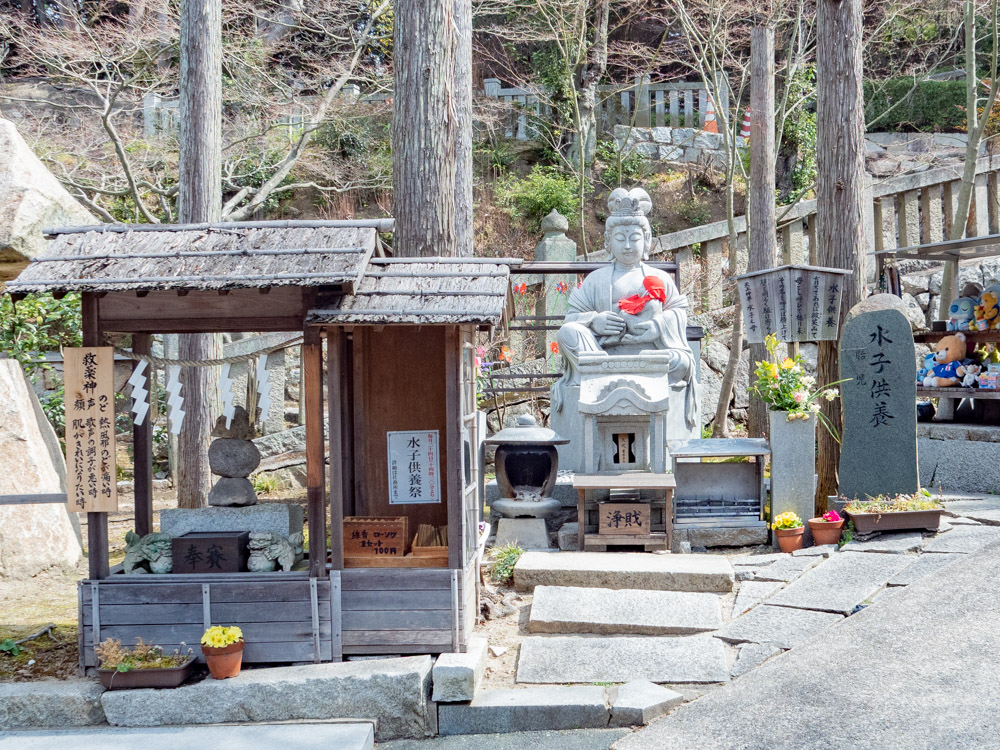
Mizuko no Haha is a place for Mizuko kuyo.
It is located on the east side of Yuga Mountain Hall.
Main events at Yuga Shrine Honmiya
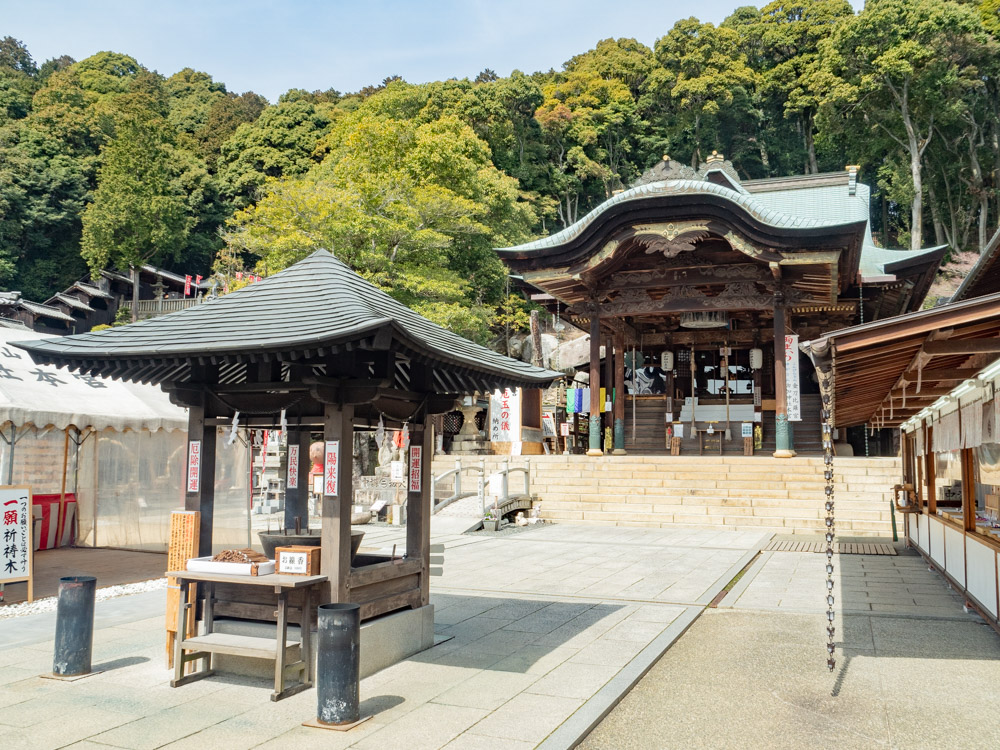
At Yuga Shrine Honmiya, various events are held throughout the year.
Among them, the following four events are particularly noteworthy.
| February 3 | Setsubun Bean-Throwing Ceremony |
|---|---|
| June 30 | Nagoshi no Oharai (Summer Purification Ceremony) and Waku-kuguri Festival |
| November 3 | Yuga Mountain Fire-Walking Festival (Annual Festival) |
| 24th of every month | Doll Memorial Festival |
[Setsubun Bean-Throwing Ceremony]
Every year on February 3rd, the "Setsubun Bean-Throwing Ceremony" is held with the concept of "blowing away evil spirits with laughter" by inviting comedians from Yoshimoto Kogyo.
[Nagoshi no Oharai Waku-kuguri Festival]
Held every year on June 30th, the "Nagoshi no Oharai Waku-kuguri Festival" involves passing through a chawa (bamboo ring) to pray for health and to ward off evil spirits as one prepares for summer, aiming to spend the remaining half of the year in good health.
[Yuga Mountain Fire-Walking Festival]
On November 3rd each year, the "Yuga Mountain Fire-Walking Festival," which is the annual festival of Yuga Shrine Honmiya, is held.
Participants write their wishes on "wish sticks," burn them, and walk barefoot over the fire.
This is a representative event of Yuga Shrine Honmiya, attracting many visitors who pray for the fulfillment of their wishes, good health, and safety from illness.
[Doll Memorial Festival]
On the 24th of every month, the "Doll Memorial Festival" is held.
Dolls and stuffed animals can be difficult to dispose of even when they are no longer needed due to the affection attached to them.
Additionally, hina dolls and boy's day dolls are often received from relatives or are expensive, making it hard to throw them away.
Such dolls and stuffed animals can be brought to Yuga Shrine Honmiya, where they will be purified and memorialized before being burned.
Note that the purification takes place on the day of the Doll Memorial Festival, but the burning occurs on a different day.
Yuga Shrine Honmiya's Goshuin, Goshuincho, talismans, and souvenirs
At the shrine, you can receive goshuin and talismans.
Here, we introduce the goshuin of Yuga Shrine Honmiya, notable goshuincho (goshuin book), talismans, and recommended souvenirs when visiting.
Goshuin
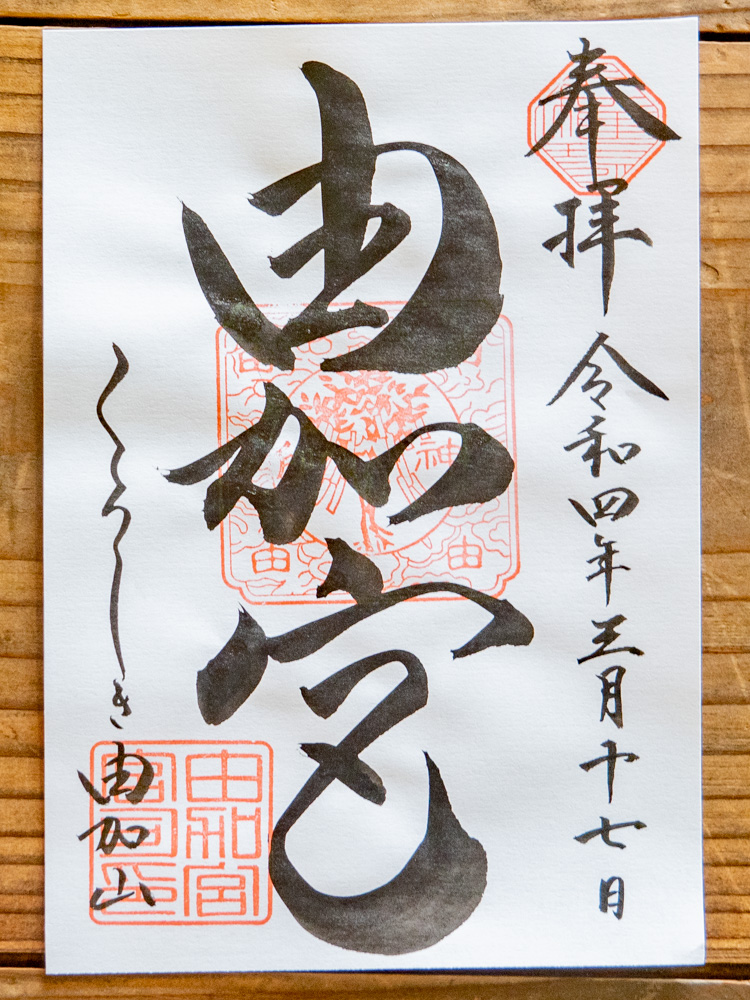
At Yuga Shrine Honmiya, you can receive goshuin.
Goshuin can be received at the shamusho (shrine office) for a donation of 300 yen.
Three types of original goshuincho at Yuga Shrine Honmiya
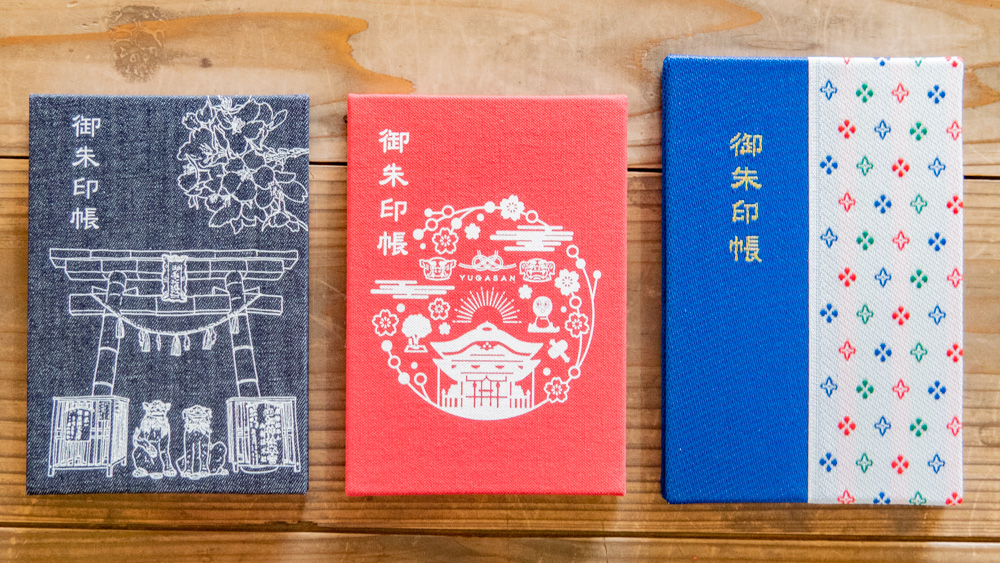
Yuga Shrine Honmiya has original goshuincho.
There are a total of three types as follows.
- Kurashiki Kojima denim fabric
- Kurashiki canvas fabric
- Kurashiki Kojima tatami edging fabric
Only the Kurashiki Kojima tatami edging fabric has a slightly larger size for the goshuincho.
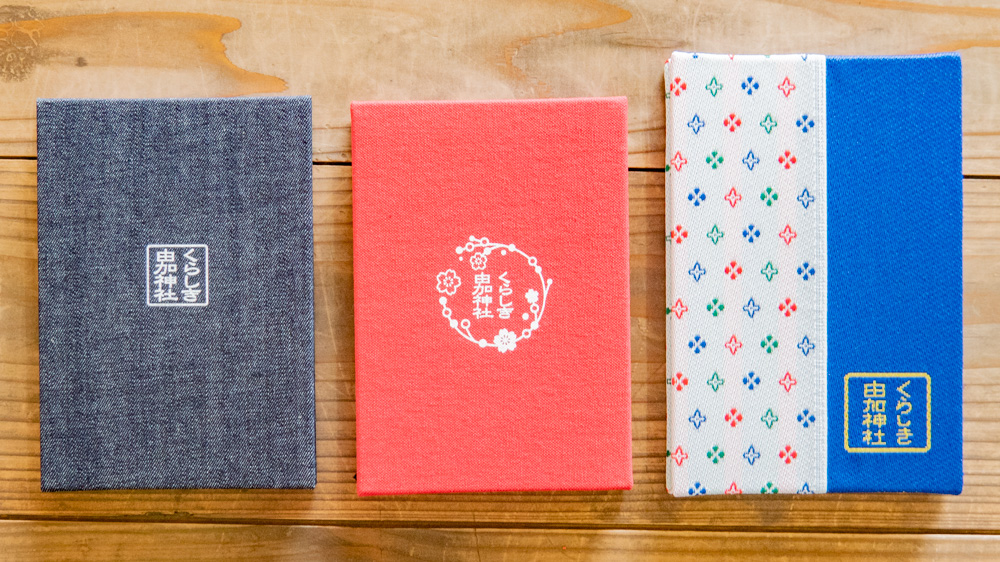
All of them evoke the charm of Kurashiki or Kojima.
The donation for all three types is 2,200 yen.
"Bizen-mamori" is a cute talisman made of Bizen ware
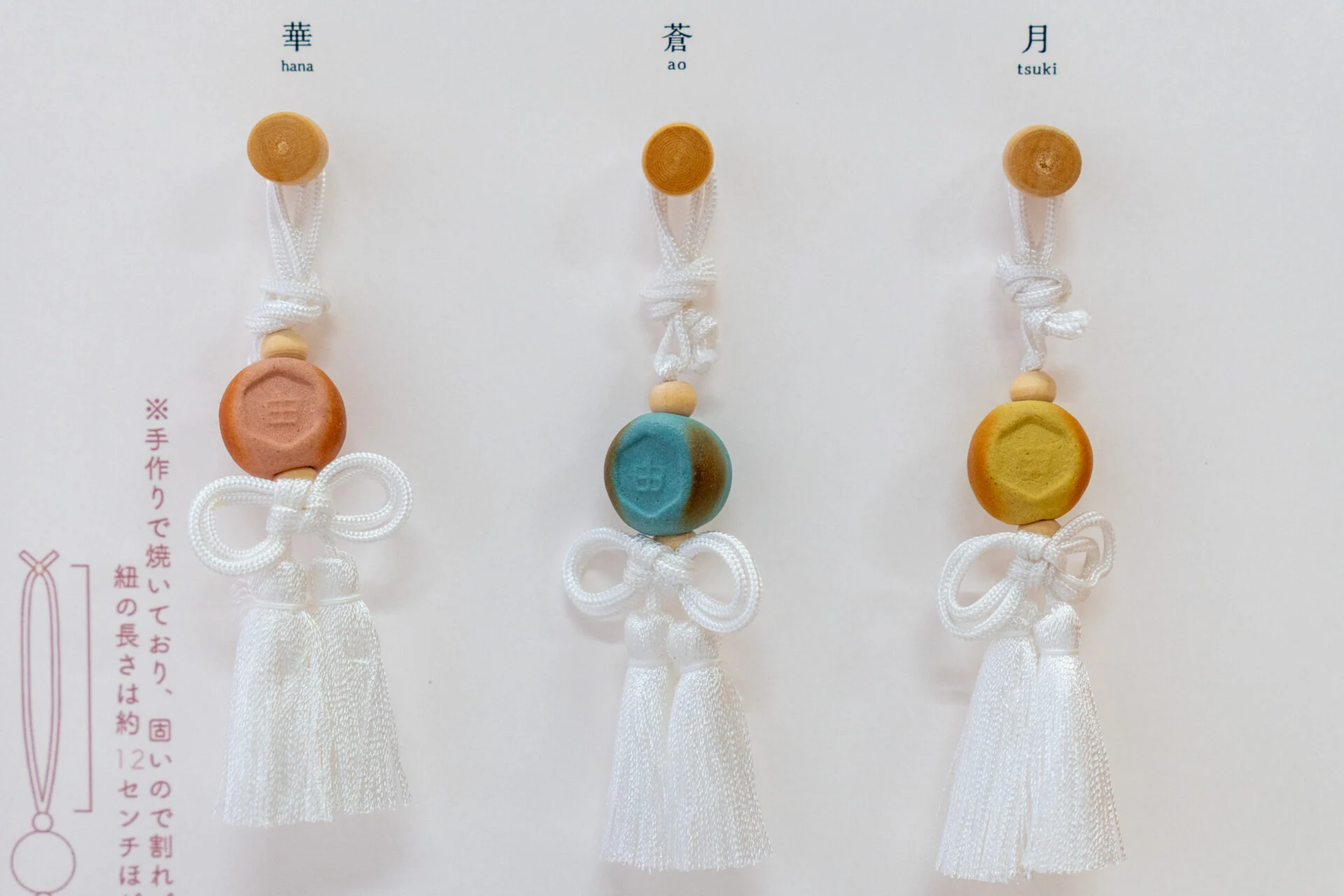
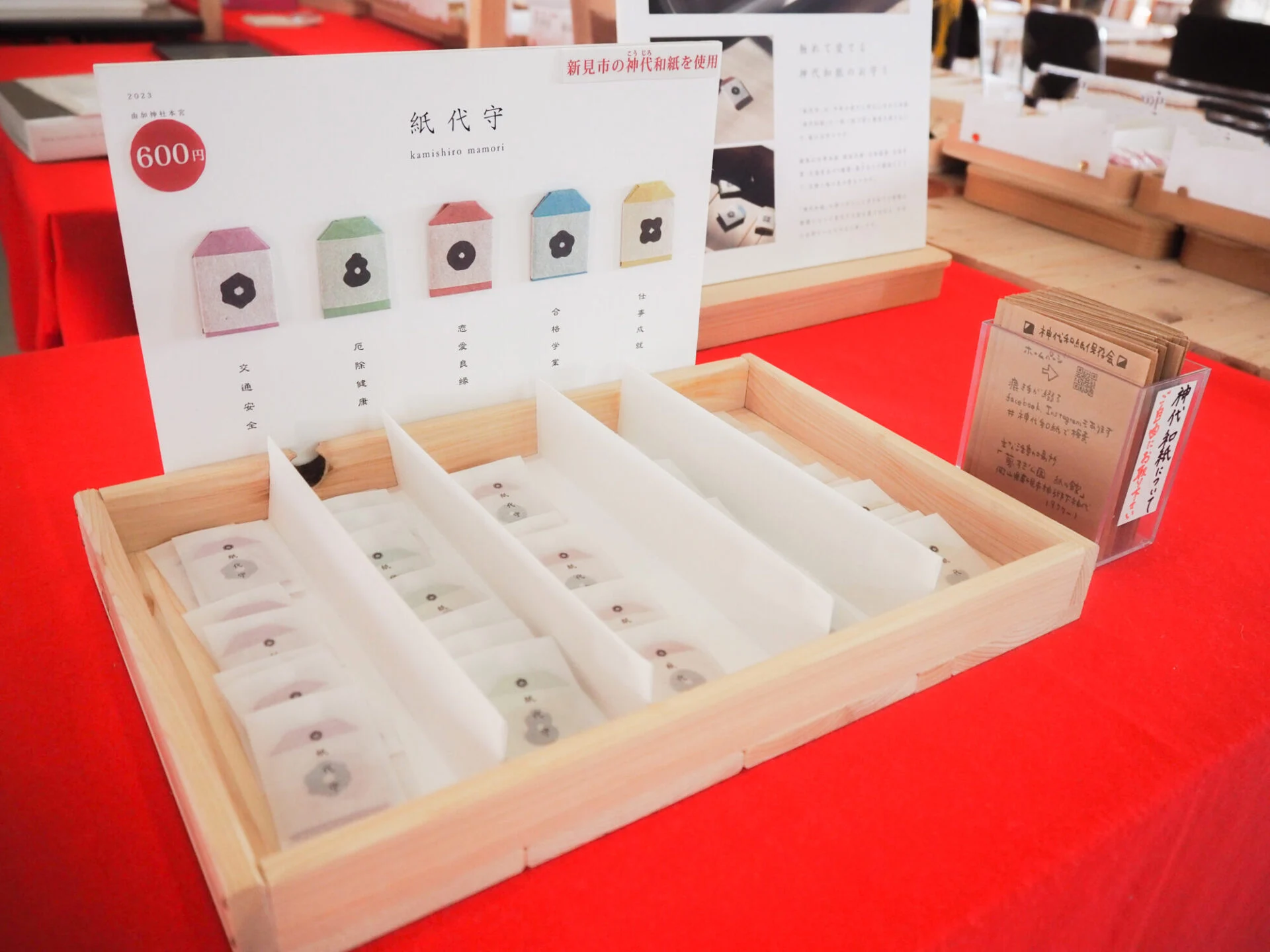
At Yuga Shrine Honmiya, various talismans are offered.
Among them, the notable one is the Bizen-mamori.
This talisman is made of Bizen ware and is a small spherical object with a diameter of about 1.5 cm.
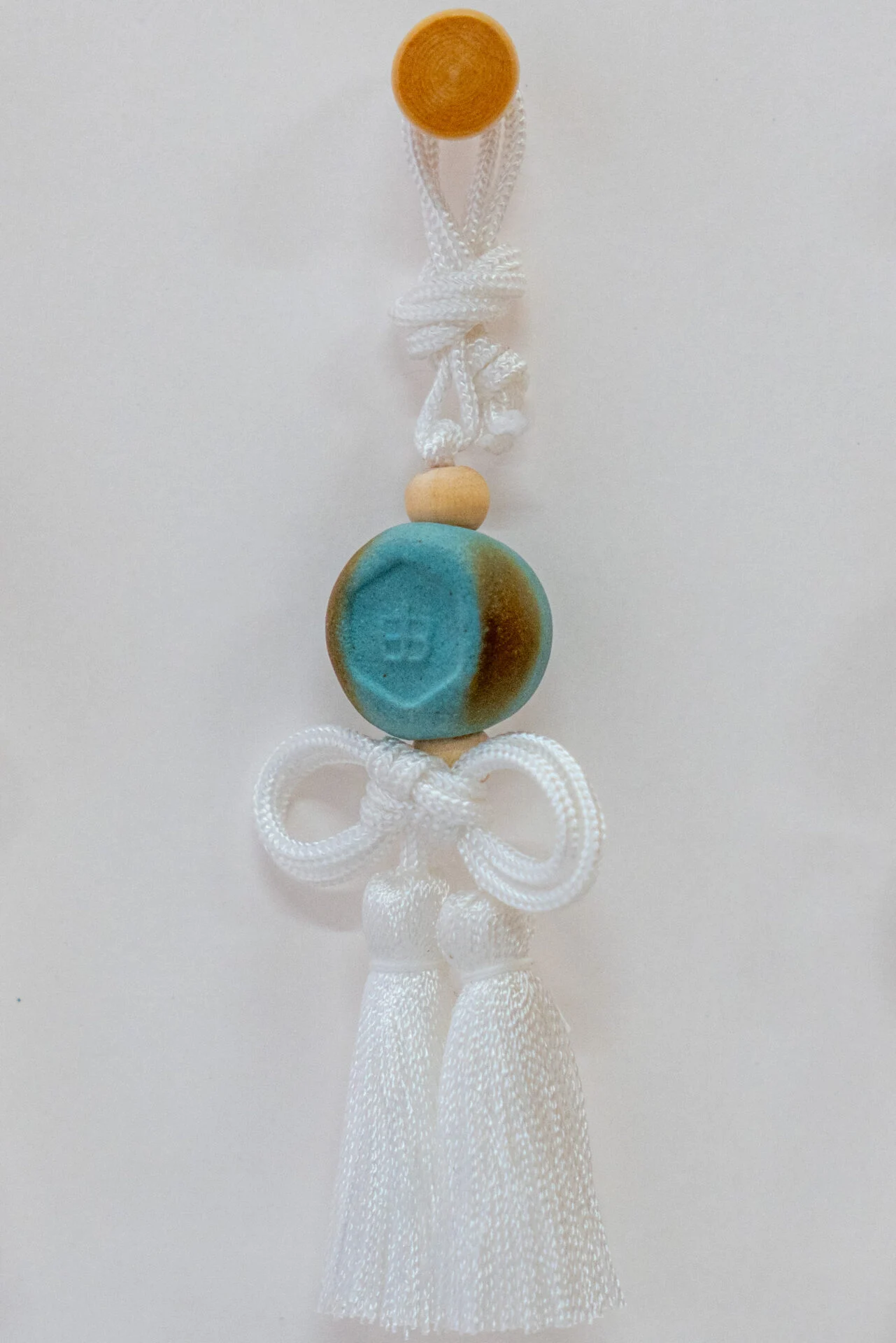
Additionally, there are about 0.5 cm wooden beads attached to the top and bottom of the sphere.
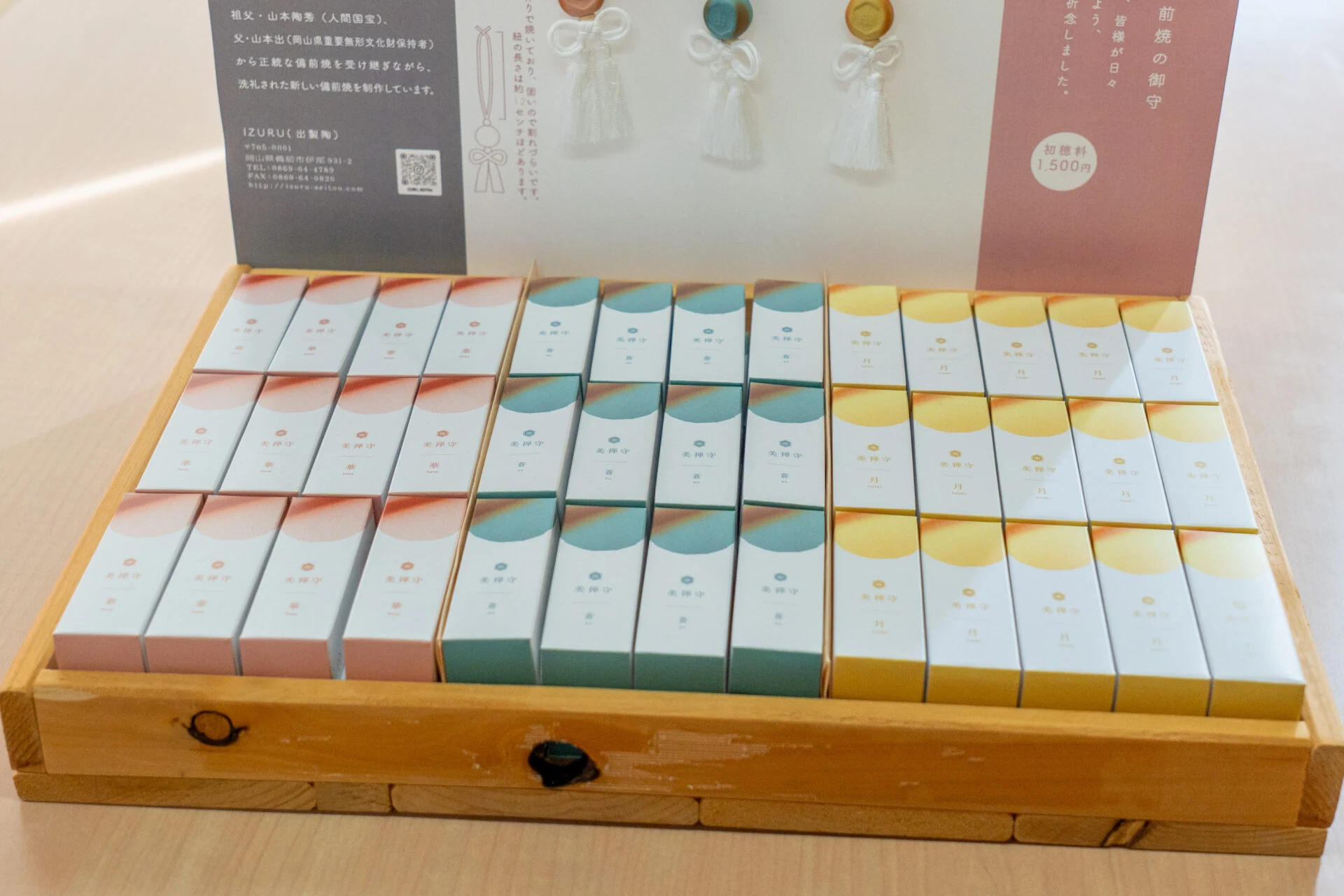
The Bizen-mamori comes in three colors: Ao (blue), Hana (red), and Tsuki (yellow), and it has the power to ward off evil and disasters.
The donation is 1,500 yen.
For more details about the Bizen-mamori, please see the interview page.
"Ankoro Mochi" is a specialty of Yuga Mountain since the Edo period
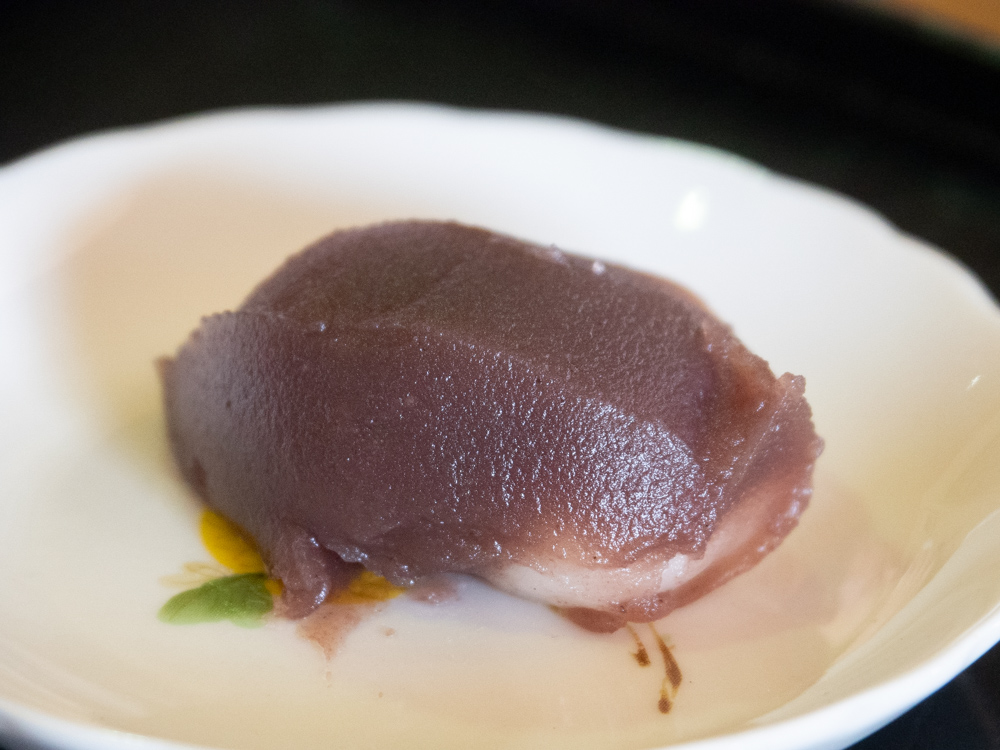
When visiting Mt. Yuga, a souvenir you definitely want to take home is Anko Mochi. It has been loved as a specialty of Mt. Yuga since the Edo period.
In the past, since worshippers visited on foot, it is said that sweet treats like Anko Mochi became popular to help with their tired bodies.
Once, there were many Anko Mochi shops in the town at the entrance of the approach to the shrine. Currently, there are only two Anko Mochi shops left in the town.
One of the Anko Mochi shops is located within the grounds of Yuga Shrine Honmiya. The Anko Mochi sold on the shrine grounds is priced at 700 yen per package.
Yuga Shrine Honmiya has a long history and attracts many worshippers.
We interviewed Shimozawa Takashi, the shrine's priest.
Data on Yuga Shrine Honmiya
| Name | Yuga Shrine Honmiya |
|---|---|
| Alternate Name | Yuga Daigongen |
| Location | 2852 Yuga-yama, Kojima, Kurashiki City, Okayama Prefecture |
| Contact | 086-477-3001 |
| Parking | Available There are first and second parking lots |
| Deities | Taokihooi no Mikoto Hikosashiri no Mikoto Kaminaohino Mikoto Oonahohino Mikoto Principal Buddha: Amida Nyorai, Yakushi Nyorai |
| Benefits | Protection from evil Disaster prevention Traffic safety Construction and civil engineering safety Family safety Improvement of skills Increase in financial fortune Prosperity in business Marriage and love fulfillment Childbirth and prosperity of descendants Examination success and more |
| Goshuin (offertory fee) | Available (300 yen) |
| Visiting Hours | Anytime |
| Reception Hours | 9:00 AM - 4:00 PM |
| Closed Days | None |
| Admission Fee | None |
| How to Pay Admission and Offertory Fees |
|
| Restroom | Western-style toilet |