When you think, “I’d like to see my friends again after a long time,” what do you do?
Have lunch at a cafe, plan a get-together… If you’re able-bodied, you might be able to decide on the spur of the moment and meet up.
However, for people with disabilities, “reuniting with friends” requires a range of conditions to be met.
If someone has a visual impairment, they need a place both people can get to on their own and know well; if they have a physical disability, a place that can accommodate several wheelchairs; if they need medical care, an attendant is also necessary…
Even so, like able-bodied people, people with disabilities wish to meet their friends and enjoy leisure time together.
“Himawari-go,” a sightseeing train where people with disabilities, medical and welfare professionals, and volunteers enjoy a day trip together on a chartered train, offers people with disabilities in Kurashiki City a day to reunite with friends and travel together.
In 2025, the train ran to Onomichi on Sunday, May 25.
The author, who has a hearing impairment, joined the trip as a person with a disability.
The information presented was current when this article was published in June 2025. Please note that it may differ from current information.
What is the “Kurashiki Himawari-go Onomichi Trip”?

Himawari-go is a chartered group train exclusively for people with disabilities that began in Tokyo in 1982.
At the time, trains and stations were not as widely accessible as they are today, and people with disabilities faced many difficulties when traveling by train.
Against this backdrop, people with disabilities, their families, volunteers, and labor unions took the lead in launching Himawari-go services, which then spread nationwide. In Kurashiki City, the first Himawari-go train ran between Kurashiki Station and Hiroshima Station in 1985.
Passengers on Kurashiki Himawari-go are mainly people with disabilities who live, work, or study in Kurashiki City and their families, as well as volunteers who support the purpose of the trip, regardless of where they live. Since the service began, the guiding principle has been that “everyone who takes part is a member of an inclusive society,” whether or not they have a disability. Both people with disabilities and volunteers pay the same participation fee to ride.
In 2024, Kurashiki Himawari-go headed to Himeji Station in Hyogo Prefecture. For its 38th trip this year, the destination is Onomichi City in Hiroshima Prefecture.


More than 150 dedicated volunteers!
The defining feature of Kurashiki Himawari-go is, above all, its dedicated volunteers.
In 2025, people joined not only from Kurashiki City but also from Kansai and Nagoya, and more than 100 people applied for the 80 available places.
Participants with disabilities were selected by lottery, while arrangements were reportedly made to allow all the volunteers to ride.
There were four types of volunteer roles recruited for 2025:
- Personal assistance volunteers
Spend the day enjoying the trip with wheelchair users or people with visual impairments - Setup volunteers
Set up temporary toilets, beds, diaper-changing stations, and other facilities on the train. Must participate from early morning until the end - Recreation volunteers
Create a fun, relaxed atmosphere through recreational activities they are good at, such as singing, ventriloquism, puppet shows, and kamishibai storytelling - Documentation volunteers
Photograph the day’s events and later compile them into a record book

A total of 163 volunteers supported the trip that day.
Volunteers of all ages and genders, from first-timers to annual participants
First-time volunteers are very welcome.
On Tuesday, May 6, a “volunteer training session” was also held, where participants could learn from experienced volunteers how to assist wheelchair users.

Children in fourth grade and above can also volunteer together with a parent or guardian.
On the day, a pair of junior high school siblings did a great job as setup volunteers.

Some participants became members of the organizing committee after volunteering with their parents, showing just how long-running this activity is.
The day of the trip
The breakdown of participants with physical disabilities was as follows:
- Wheelchair users bringing their own wheelchairs (including reclining models)
- Wheelchair users borrowing wheelchairs
- People who need diaper changes
- People with visual impairments
- People with hearing impairments
- People carrying portable oxygen
- People with pacemakers
In addition, people with rehabilitation certificates and mental health and welfare certificates also took part, bringing the total to more than 50 people with disabilities.
Compared with surrounding areas, Onomichi City has relatively good facilities, such as accessible toilets.
However, there were more than 20 wheelchair users alone, while only a handful of accessible toilets could accommodate adult diaper changes.
Diaper changes require assistance, and many participants are unable to propel their wheelchairs themselves.

I have a hearing impairment, so I find it difficult to make out people’s voices amid background noise.
Because I wouldn’t be able to hear instructions such as where to meet, I assumed I wouldn’t enjoy myself and tended to give up on joining group tours organized by travel agencies from the outset.
However, Kurashiki Himawari-go is accompanied by volunteers and medical staff.
There are people who push wheelchairs, people who help with diaper changes, and volunteers who check whether information is getting through to people with hearing impairments by communicating in writing or sign language. I’m sure I’m not the only participant who feels able to go and meet friends despite having a disability because of their support.

A trip where people with disabilities can spend time with friends and family
On Saturday, May 25, 2025, when I arrived at the north exit of Kurashiki Station, the area in front of the reception desk was buzzing with participants greeting one another with “Long time no see!”

People with disabilities, family members of people with disabilities, and members of groups who had traveled together in previous years each spotted familiar faces and watched the opening ceremony together.


Passengers are assigned to train cars at random, but sightseeing in Onomichi is free, so friends can explore together.
They spent their time on the trip as they pleased, alongside family and friends who had come with them.
Nearly 70 volunteers also welcome the group in Onomichi City
People with disabilities need assistance along the way, but they also need help such as wheelchair assistance at their destination. Onomichi in particular is an area with many slopes. It takes a lot of people to get to Senkoji Temple and the Senkoji Observatory.
To help with wheelchair assistance at Senkoji Park, 50 members of the rugby team at Onomichi High School, part of Onomichi Gakuen, volunteered.

With their strong, athletic builds and cheerful smiles, they helped push wheelchairs up steep slopes.


The original plan was to provide support only at Senkoji Park, but the participants were charmed by the volunteers, who also pushed wheelchairs through the shopping arcade and came all the way to the platform to see the Himawari-go off on its return journey.
It was a hot day, so the group bought and enjoyed juices and sweets recommended by volunteers who live in Onomichi, helping the participants and volunteers grow closer.
We had asked the Onomichi City Council of Social Welfare and the Onomichi City Volunteer Liaison Council to distribute the boxed lunches on the day.


On the day the organizing committee visited Senkoji Park in advance to check it out, they sampled the boxed lunches. Keeping in mind the faces of participants with disabilities who take part every year, they ordered a feast packed with side dishes.
A total of 76 volunteers helped welcome the group in Onomichi City.
Volunteers from both Kurashiki and Onomichi joined forces to support the trip.
A first-time experience in life! A trip full of ideas for future outings
Like me, a person with a hearing disability who hesitates to join group tours, some participants with other types of disabilities took on things they had never considered trying “because of their disability.”

If you saw a person with a disability carrying portable oxygen climbing a slope and getting out of breath, how would you speak to them?
Wouldn’t you be tempted to meddle—to stop them because it makes you nervous to watch, or to suggest they use a wheelchair?
However, the Kurashiki Himawari-go organizing committee and volunteers chose to “watch over” them.
That was because the participant said, “I want to walk by myself.”

As a result, the participant who made their way to both the Senkoji observation deck and Senkoji Temple under their own power had a look of pure accomplishment and murmured, “That was fun.”
A medical team was on standby nearby, and a wheelchair could be provided immediately if needed.
It was precisely because of this thorough advance preparation that the volunteers could focus on watching over participants in a way that respected their wishes and supported their trip.
We also met a participant who used a wheelchair lift when trying to board the ropeway from Senkoji toward the shopping arcade.

Have you ever seen a wheelchair lift in operation? You may occasionally spot one at train stations or public facilities.
These are expensive machines, and installing one costs a lot of money.
That is why it is important to let as many people as possible know that wheelchair users rely on wheelchair lifts, and to explain why installing them matters.
Because this was a group tour for people with disabilities, we made the fullest possible use of the accessibility equipment installed along the way.

The wheelchair user who used this lift was, amazingly, experiencing a ropeway ride for the first time in their life.

“Because I use a wheelchair, I’d never thought about riding one, but when I actually got on, the view was completely different, and it was a fresh experience! When you’re in a wheelchair, your eye level is lower than that of an able-bodied person. So being able to look down at the town from above, as you do on a ropeway, was moving.”
they said, their eyes shining.
For people with disabilities to make the most of their own abilities and the resources available in society, they also need to have successful experiences. This can help them apply what they learned to their lives from the next day onward—“I managed it on the Kurashiki Himawari-go, so I’ll try again”—and may also inspire those who held back that day to try again on an individual trip after seeing their peers take on the challenge.
A trip where you find friends you can say “Let’s meet again” to
The encounters made on a trip are not just about reunions.
Although many people take part in the Kurashiki Himawari-go more than once, there are also many first-time riders.
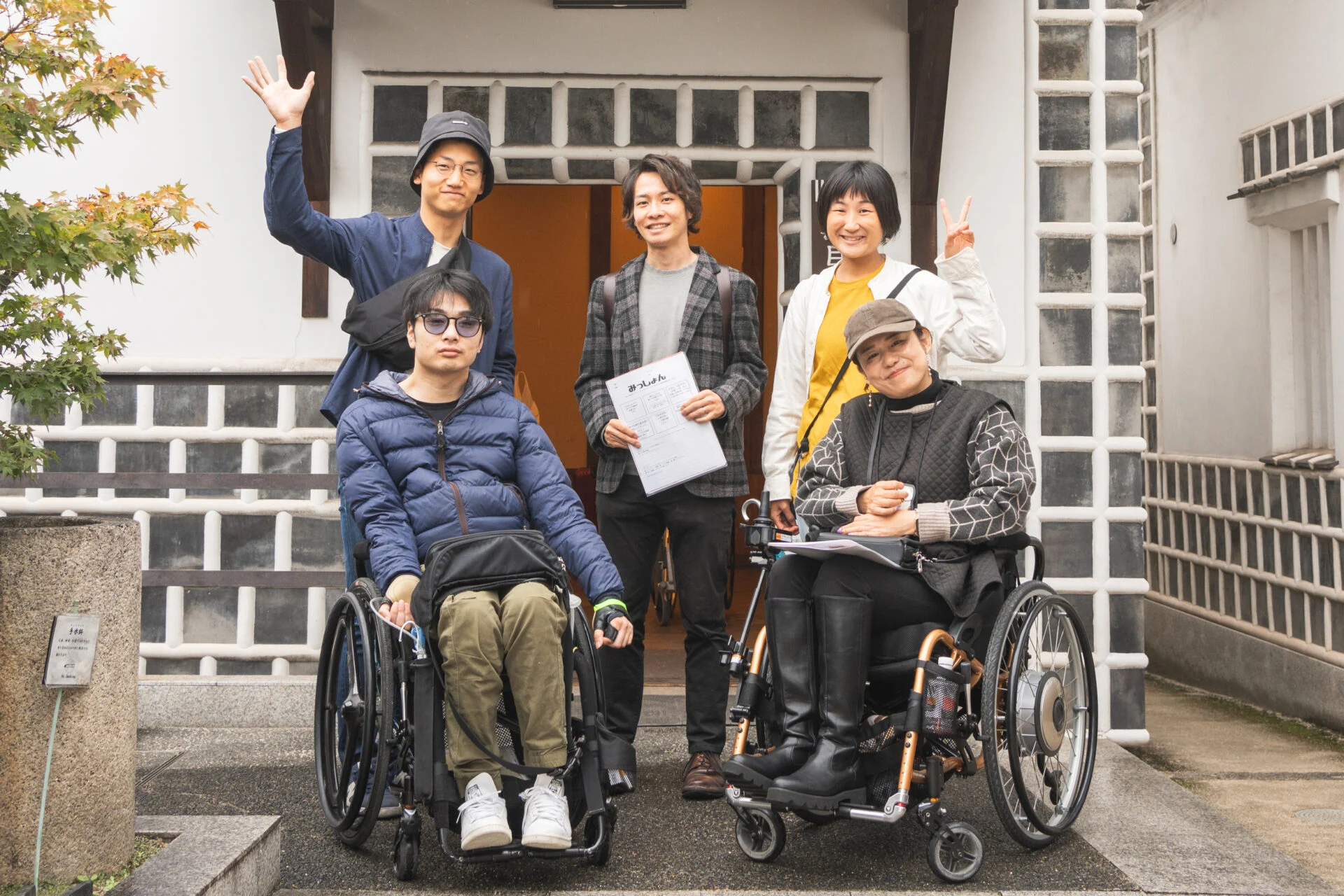
On the day, two or three volunteers are assigned to each person with a disability to form a group, so some groups included people meeting for the first time.

Some participants looked a little tense on the train to Onomichi, but as they ate their boxed lunches and explored the city, their expressions gradually relaxed.

The Onomichi shopping arcade had many places where you could enjoy food as you walked, so people with disabilities and volunteers talked things over and enjoyed juices and sweets together.
Some groups even went to eat Onomichi ramen, and everyone seemed to spend the time in their own way.

In some groups, students from Onomichi High School joined in, chatting happily together.
On the train back and in front of the ticket gates at JR Kurashiki Station, where the group dispersed, some people were reluctant to say goodbye. They seemed to head home having found friends they wanted to see again next year.

From the Writer
I was also responsible for taking photos that day, so I spent a lot of time on my own. But people checked in on me, asking things like, “Did you get to eat anything tasty?” and “Did you buy any souvenirs?” Others signed to me, “You came last year too, right?” As a fellow traveler, I was included in lots of conversations.
That alone made me very happy, but as I left the meeting place to head home, someone tapped me on the shoulder. When I turned around, they had come all the way over just to call out, “See you next year!”
It was a heartwarming, slightly embarrassing thing to hear, as if I had been welcomed among the friends they wanted to see again next year.
The day’s events will be broadcast in a special program on OHK Okayama Broadcasting on Saturday, June 21, 2025.
The Kurashiki Himawari-go, where people with disabilities can travel with friends with peace of mind, made this a special day for people with disabilities in Kurashiki City, who look forward to it while working hard every day in a society where able-bodied people make up the majority.
Kurashiki Himawari-go Onomichi Trip Information

| Name | Kurashiki Himawari-go Onomichi Trip |
|---|---|
| Date | Sunday, May 25, 2025 Around 8:00 a.m. to around 6:00 p.m. |
| Location | Between Kurashiki and Onomichi |
| Participation fee (tax included) | Adults: ¥3,000 Elementary, junior high, high school, and university students: ¥2,000 (Includes JR fares, facility admission fees, boxed lunch, and insurance) |
| Website | Kurashiki Himawari-go Organizing Committee |


What would you like to know about Kurashiki?
Enter a search term to find articles on this site