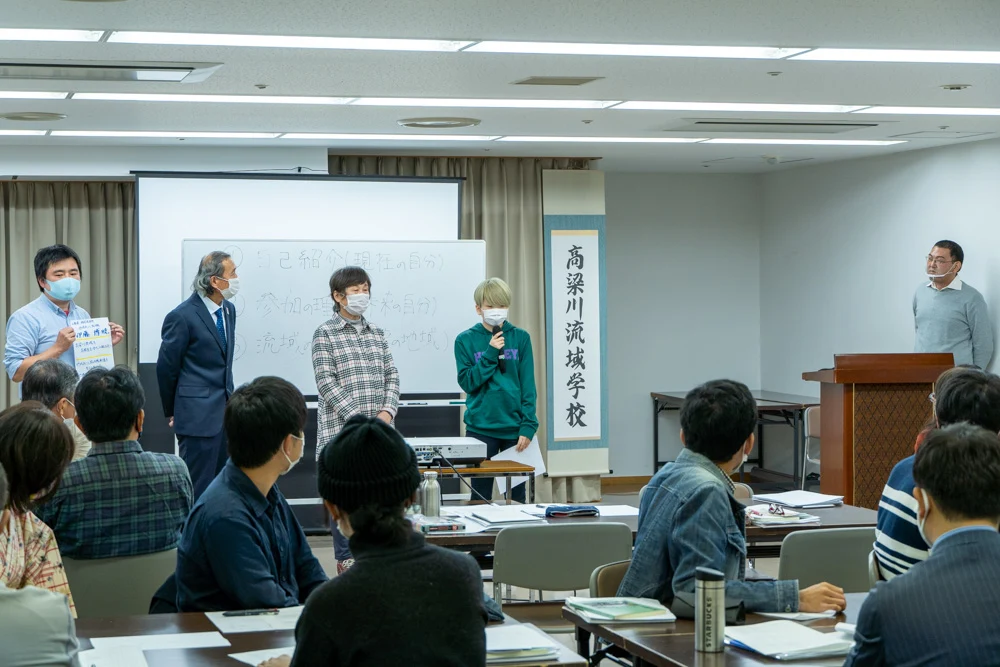
The "Takahashi River Study Group" is being held from November 2020 to February 2021.
A total of 41 courses classified into three categories: SDGs Vision, General Education, and Skills, are being attended by 23 students and auditors who participate as needed.
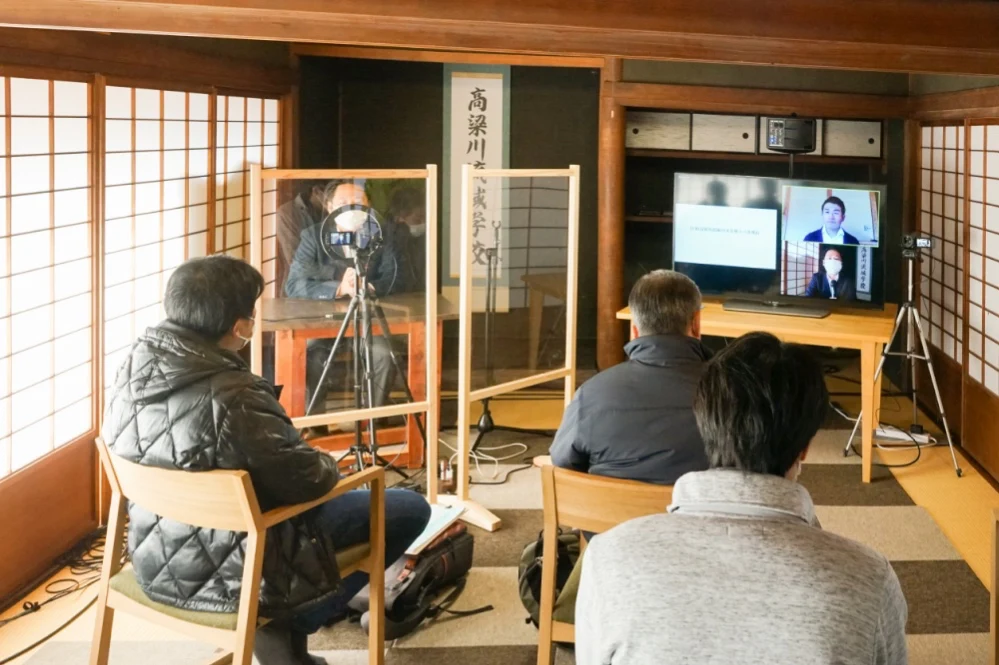
On December 5, 2020 (Saturday), as part of the SDGs Vision course, Ken Saku Okubo, the Chairman of Kurashiki Wood Industry Co., Ltd., took the stage.
- It is not a "magic bullet" that survival is guaranteed just by raising the SDGs flag.
- Consider not only general corporate stakeholders such as customers, employees, and shareholders, but also "local communities" and "nature" as stakeholders.
As a manager, he has always thought about how to survive as a sustainable local company and introduced the underlying thoughts behind it.
I will report on the content of the lecture.
Overview of the Takahashi River Study Group
The "Takahashi River Study Group" is a school operated by the General Incorporated Association Takahashi River Basin School as a commissioned project by Kurashiki City, aiming to foster human resources who will be responsible for community building and "sustainable" regions through history, culture, industry, and fieldwork in the Takahashi River basin.
There are two types of courses available:
- “SDGs Exploration Course” which includes practical training and presentations
- “Auditor Course” where participants can attend optional lectures
The opening ceremony was held on November 3, 2020 (Tuesday), and 41 lectures will be conducted until the completion ceremony on February 14, 2021 (Sunday).
The themes are as follows:
▼ SDGs Vision Course
A course that allows for a deep understanding of the 2030 vision for the Takahashi River basin and current efforts to solve issues through lectures by practitioners and experts, gaining insights for action.
▼ General Education Course
A course to learn about history, culture, and industry in the Takahashi River basin, acquiring knowledge that serves as a foundation for activities.
▼ Skills Course
A course to acquire skills and know-how for exploratory learning, such as presentations, nonprofit accounting, data analysis (using RESAS), utilizing IT tools, and using blogs and social media.
For more detailed information, please see the special page for the “Takahashi River Study Group.”
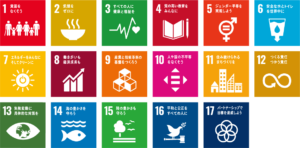
SDGs and Corporate Social Responsibility - Global Education Program Participated by Kuramoku
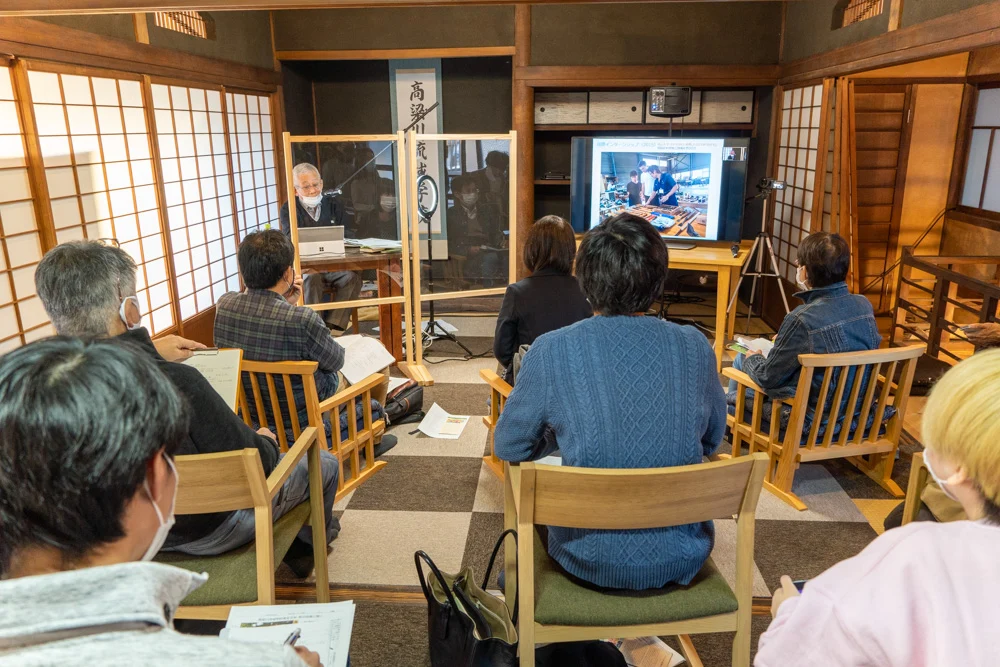
The lecturer, Ken Saku Okubo, is also the former representative director of the "General Incorporated Association Takahashi River Basin School," and is involved in numerous civic activities.
He mentioned, "The ratio of corporate people is about fifty-fifty," indicating that he has interacted with society through corporate activities.
- The family business of lumber dealing, "Kurashiki Wood Industry Co., Ltd."
- The community radio he founded, "FM Kurashiki Co., Ltd."
This lecture broadly introduced how companies (corporate people) should engage with local communities based on his experiences.
The content included the following:
- Introduction of Kurashiki Wood Industry Co., Ltd.
- Learning from international internships and global housing design philosophies
- Introduction of FM Kurashiki Co., Ltd.
- The role of community media
- Takahashi River, Takahashi River Basin, and Takahashi River Basin School
- The ideal image of a valued company
Having participated, I would like to introduce three topics that caught my attention.
Introduction of FM Kurashiki Co., Ltd. and the Role of Community Media
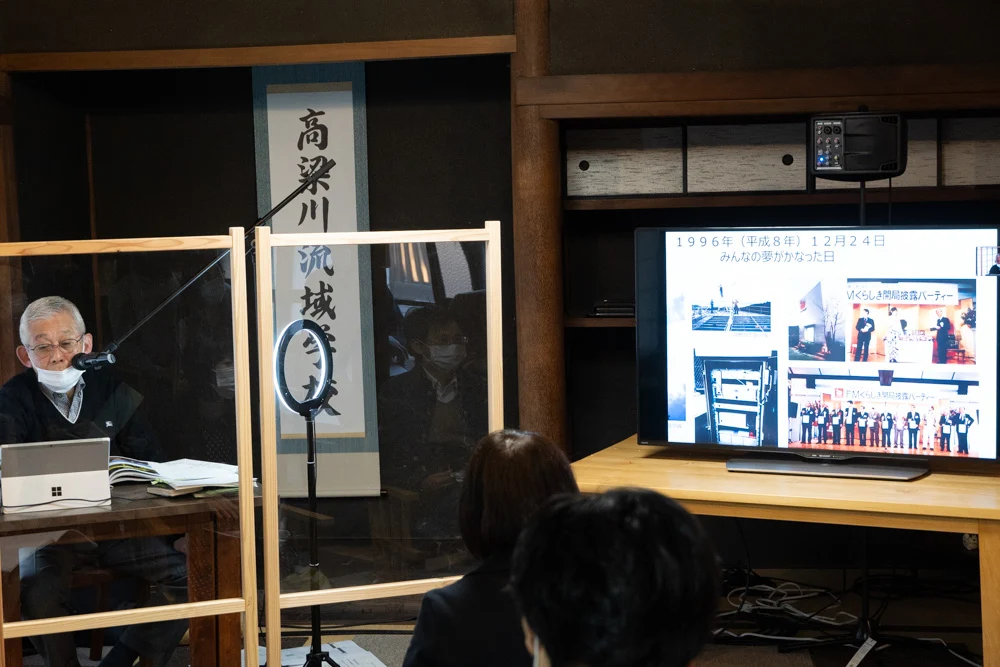
The community FM station in Kurashiki, "FM Kurashiki," was established in 1996.
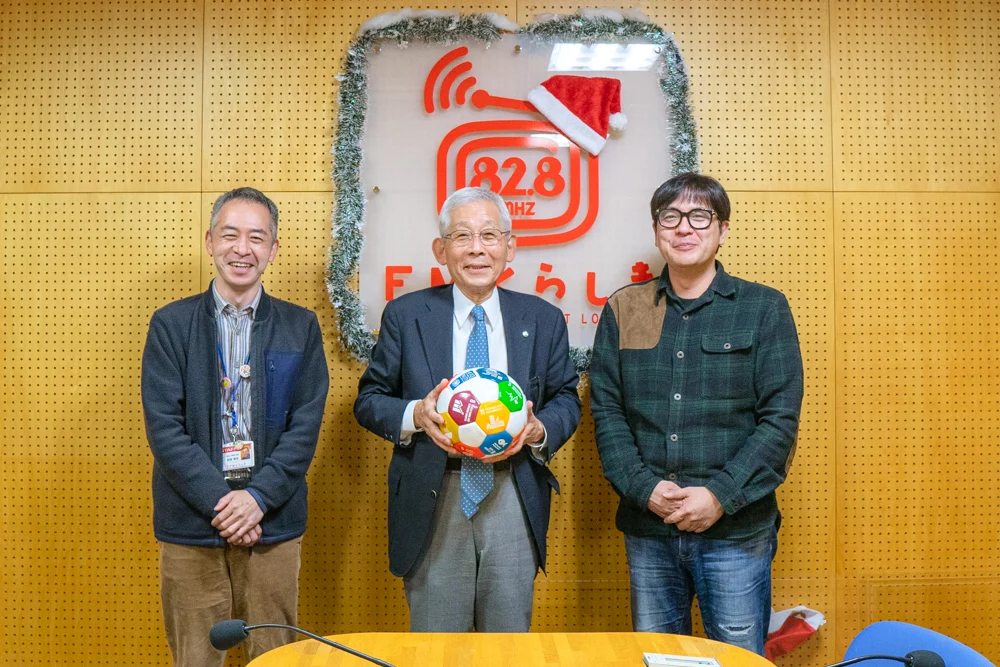
At the time of its establishment, I was a high school student who often listened to the radio, and I remember being very happy that a local FM station was created.
However, the situation of radio stations today is different from what it was in 1996 with the spread of the internet.
My own opportunities to listen to the radio have drastically decreased, and I no longer engage in conversations about radio programs.
So, is radio no longer needed?
Mr. Okubo stated that the role of community FM stations has two aspects:
- In normal times, "to assist residents in leading rich lives"
- In times of disaster, "to protect the safety and security of residents as 'local professionals'"
Even if the role in normal times has diminished due to the spread of the internet, the role in emergencies such as disasters remains unchanged.
In normal times, we create vibrancy in the town through broadcasting, and in times of disaster, we fulfill the public role of emergency announcements and disaster broadcasting.
This is the social responsibility of community broadcasting stations.
In fact, during the Great East Japan Earthquake and the July 2018 Heavy Rain, radio broadcasting played an important role.
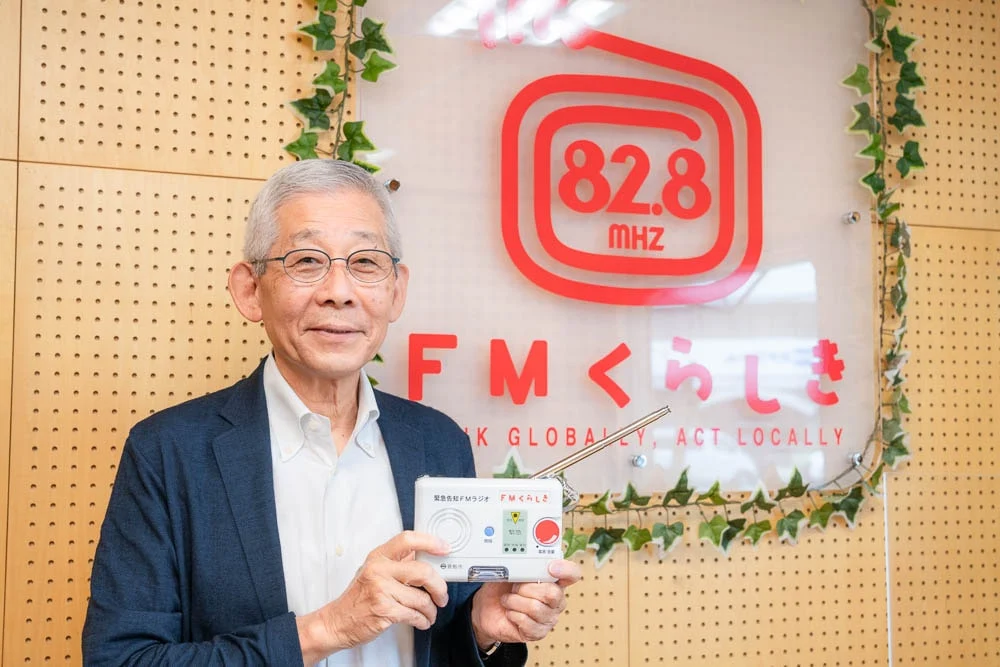
Additionally, products specialized for emergency announcements have also been developed.
This is the "Emergency Announcement FM Radio (Kokucchi)," which has a built-in battery, automatically turns on in emergencies, and receives broadcasts at high volume.
Takahashi River, Takahashi River Basin, and Takahashi River Basin School
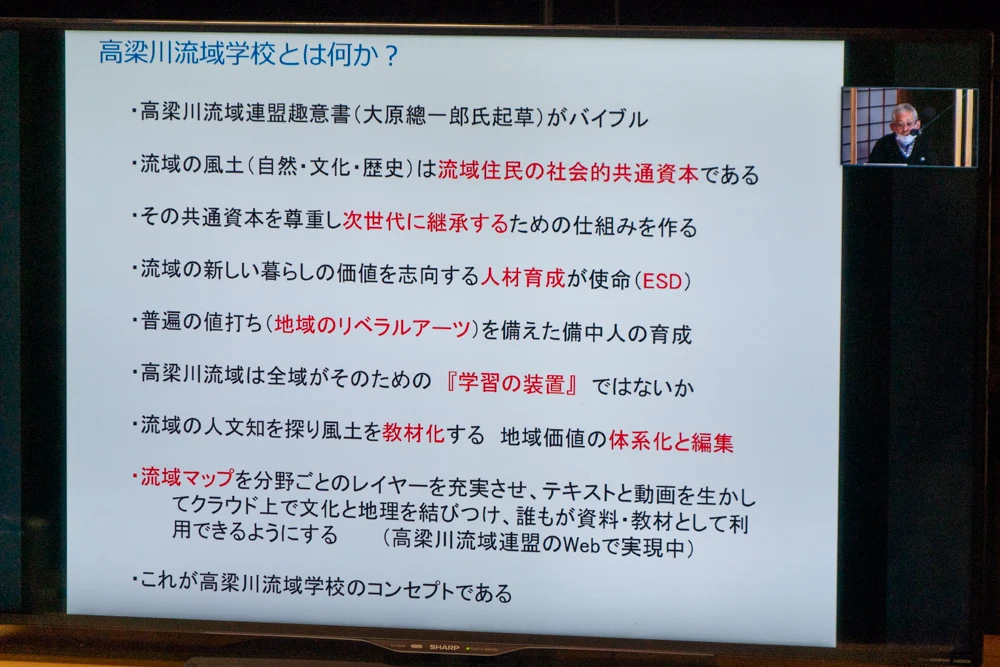
After ten years of activities such as "GREEN DAY," which started in 2003, the General Incorporated Association Takahashi River Basin School was established.
Based on the "Takahashi River Basin Federation Purpose Statement" drafted by Soichiro Ohara, the aim is to create a system that respects the local climate (nature, culture, history) and passes it on to the next generation.
Traditionally, such activities were conducted as civic movements, and corporate activities were often at the opposite end.
The original economic activity prioritized using resources to create products, investing, and earning profits.
However, Mr. Okubo believes that the time has come for companies to seriously address local issues.
Without the community, there is no survival for companies
This strong statement left an impression.
It may be a perspective gained precisely because he has been facing "local residents" through community media while basing his activities on corporate operations.
Looking over a medium-sized area like a river basin, Mr. Okubo stated that corporate actions aimed at solving local issues are required from the diversity of regional distribution.
The Ideal Image of a Valued Company
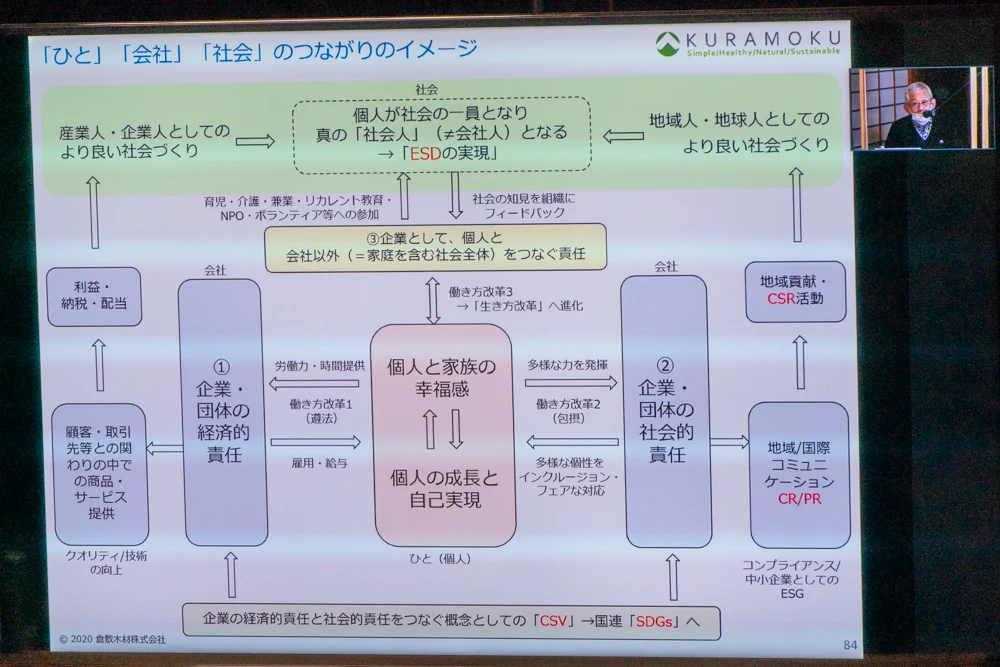
Until the 20th century, society was centered around "companies."
As a result, household chores, childcare, and community activities were postponed, becoming something only a few people participated in.
However, with the declining population, the relationship between people, companies, and society has changed.
To become a true "member of society," being just a "company person" is not enough.
- Services and profit provision associated with the economic responsibilities of companies
- Community contribution activities as corporate social responsibility (CSR)
In addition to these, companies are also required to have the responsibility to connect individuals and society beyond the company (including families).
By doing so,
individuals become members of society and become true "members of society"
This is what was established as a "code of conduct" at Kuramoku (Kurashiki Wood Industry Co., Ltd.).
Conclusion
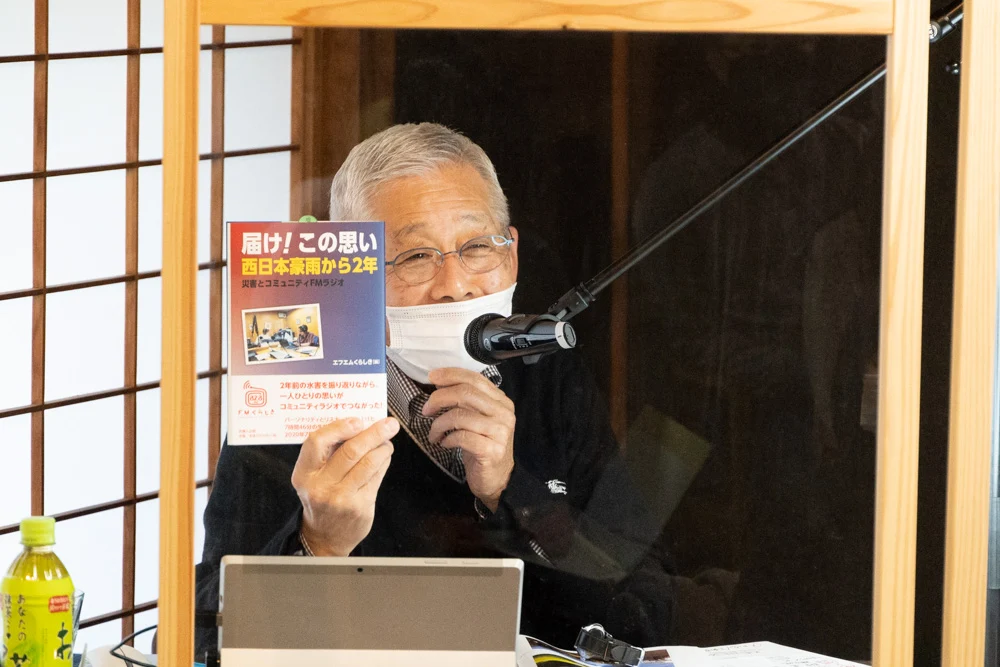
If you live in Kurashiki, you may have heard of Kuramoku and FM Kurashiki.
A lumber company and community media may seem unrelated at first glance.
However, after listening to Mr. Okubo's talk, I understood that there is a close relationship in terms of "engagement with society".
The perspective that it is important to think about the often perceived opposing axes of people, companies, and society with connections is something that cannot be gained from just one activity.
Listening to Mr. Okubo's lecture made me reconsider the role of this media, "Kurashiki Tocotoco."
Our goal for the "media business" is to build relationships with people and organizations active in the region, including businesses, and introduce them from our perspective during normal times, and to serve as a source of information through the internet during emergencies such as disasters.
This may be similar to the existence of "FM Kurashiki."
This lecture provided a glimpse of one of the goals regarding the many challenges of media management.