
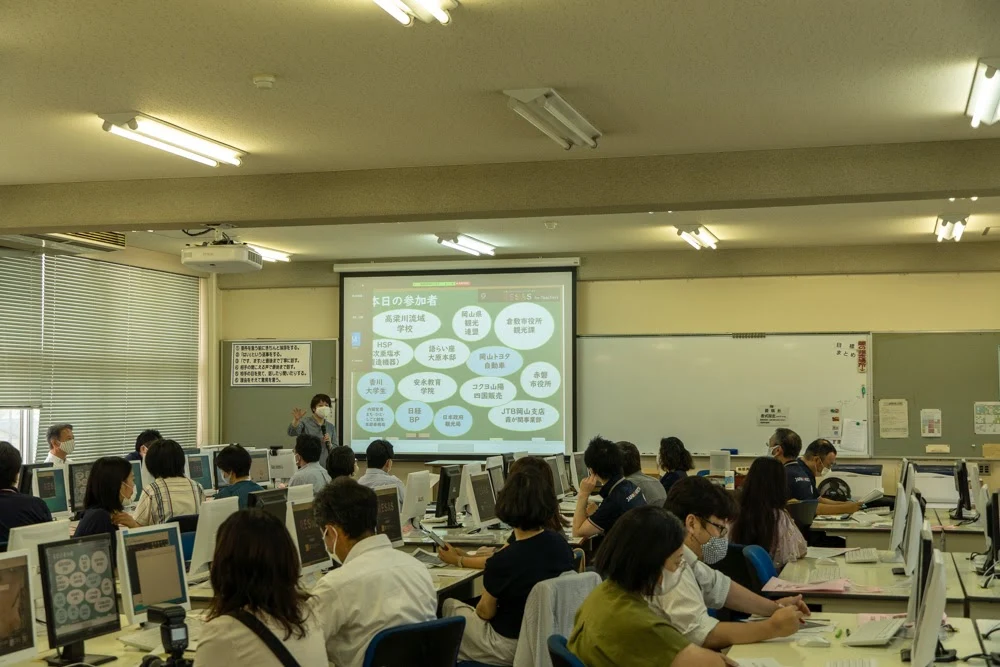
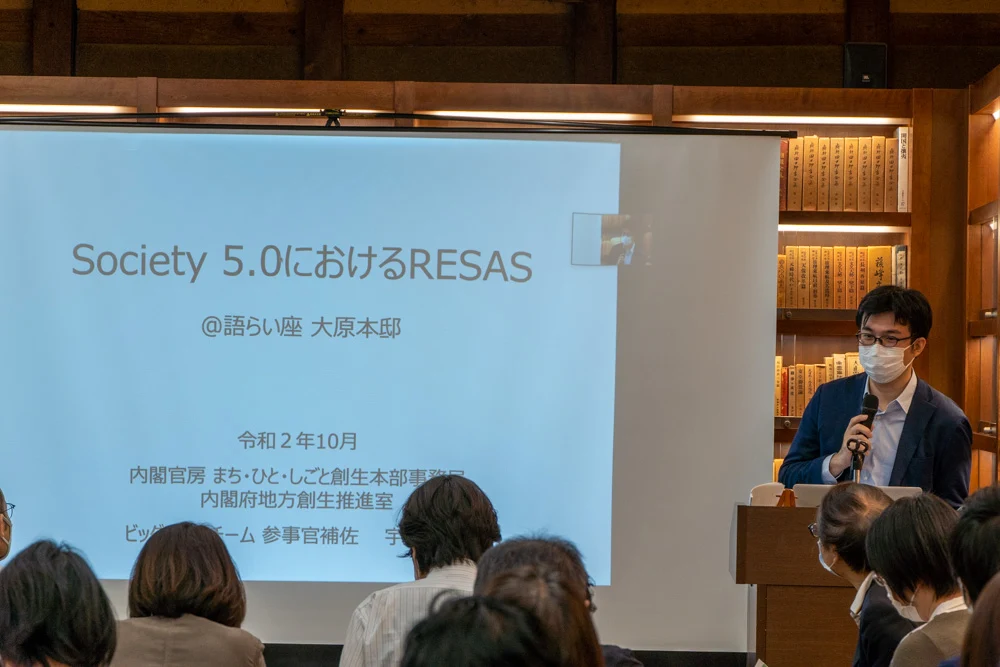
Regional Economy and Society Analyzing System (RESAS: Regional Economy and Society Analyzing System) is a big-data resource designed to support various regional revitalization initiatives with information.
It is provided by the Ministry of Economy, Trade and Industry and the Cabinet Secretariat (Secretariat of the Headquarters for Overcoming Population Decline and Vitalizing Local Economy), and is widely used by local government employees and people in various fields interested in regional revitalization to formulate, implement, and evaluate effective measures.
A “RESAS Workshop” was planned to use RESAS to explore what can be done through data analysis and to provide adults with inquiry-based learning about regional revitalization.
The “RESAS Workshop” is a five-part workshop series, attended mainly by school personnel as well as people from private companies and government who work with data in their jobs, that deepens participants’ perspectives and thinking about the region’s “present” and “future.”
This was held as the second of the five sessions.
The theme was tourism.
Speakers from various perspectives gave talks on the current state and future of tourism as understood through data such as RESAS, followed by an active exchange of opinions.
Here is a report on the “RESAS Workshop: Tourism” seminar held on Saturday, August 8, 2020.
The information presented was current when this article was published in September 2020. Please note that it may differ from current information.
Overview of the RESAS Workshop: Tourism

The program for the second “RESAS Workshop: Tourism” was as follows.
| Format | Content | Speakers |
|---|---|---|
| Talk | Using RESAS for education New subject: “Tourism Business, etc.” | Yoshimi Kawasaki |
| Talk (online) | Turning Japan’s appeal into Japan’s strength Inbound tourist trends survey Considering tourism amid the COVID-19 pandemic | Saki Komatsubara |
| Talk | Kurashiki, a city of tourism: the present and future | Tourism Division, Kurashiki City Office |
| Talk | Tourism trends and strategy in Okayama Prefecture | Visitor Attraction Group, Okayama Prefecture Tourism Federation |
| Hands-on session | Viewing tourism through RESAS ~RESAS Tourism Map Introducing content for tourism education | Scheduled for a follow-up session at a later date due to time constraints |
To help prevent the spread of COVID-19, participants were invited to attend either in person or online.
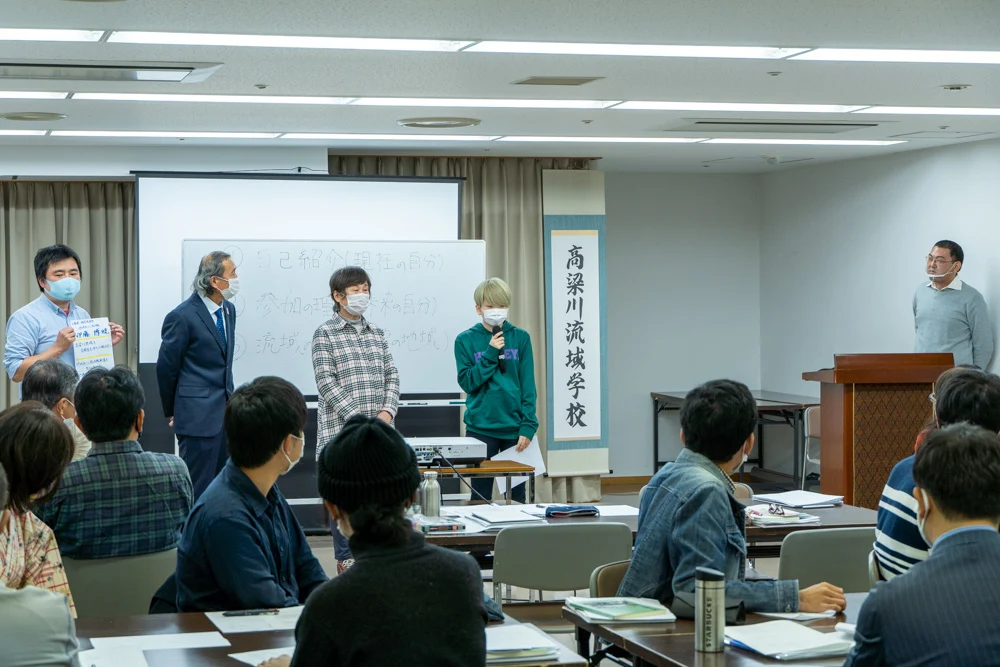
Participants included people involved in education and community development, as well as people working for companies.
The computer lab at Okayama Prefectural Kurashiki Commercial High School, the venue, had one computer at each seat. The RESAS website was open on the screens, allowing participants to try using RESAS on the spot.
As this was the second session, the workshop began in a relaxed atmosphere.
Talk by Yoshimi Kawasaki

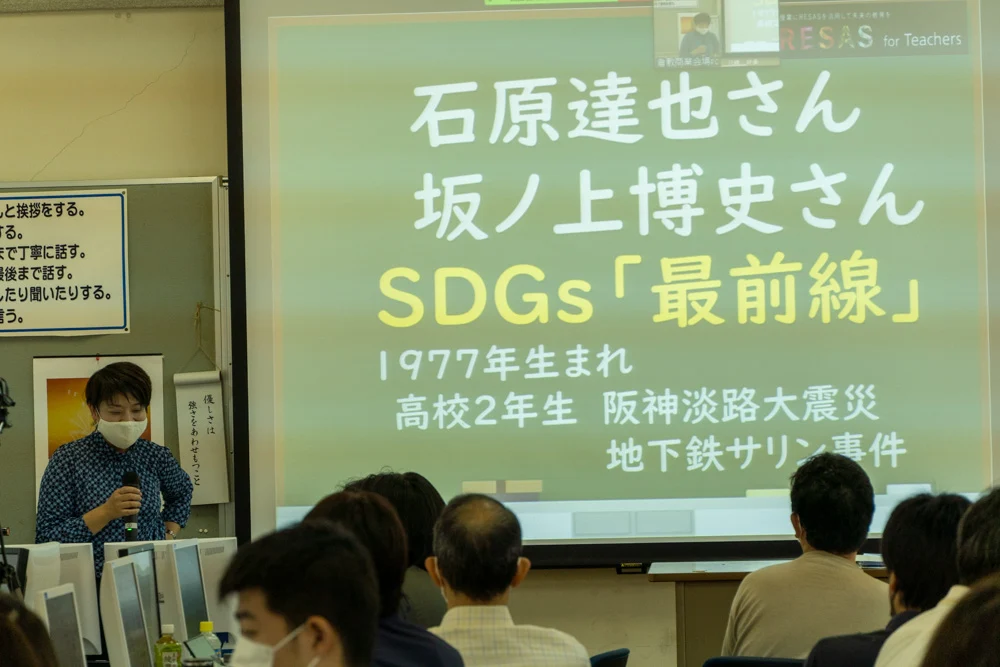
Yoshimi Kawasaki, a teacher in the Commercial Studies Department at Okayama Prefectural Kurashiki Commercial High School and a RESAS specialist committee member, spoke about lessons using RESAS in the department.
Starting in FY2022, the Commercial Studies Department will introduce a new subject called “Tourism Business”, providing class time for students to learn how to manage the appeal of their region.
The image below shows students using RESAS.

Students use RESAS to extract data on the region’s economic conditions in the form of figures and graphs, then compile reports or give presentations.

At Okayama Prefectural Kurashiki Commercial High School, when students reach their third year, they use RESAS to analyze regional issues and propose policy ideas to revitalize the region. They take part in the “Regional Revitalization Policy Idea Contest” as the culmination of their inquiry-based learning.

There is also a website called “V-RESAS” that presents data in an easy-to-view format on the impact of COVID-19 on regional economies and data that can be used to consider regional revitalization measures. Examples of its use in inquiry-based learning during the pandemic were also introduced.

Talk by Saki Komatsubara

JNTO (Japan National Tourism Organization)’s Saki Komatsubara is a member of its Planning and Strategy Department’s Research and Marketing Group.
She gave her talk online from Tokyo.
Ms. Komatsubara spoke about inbound tourist trends and tourism amid the COVID-19 pandemic.
“Inbound tourism” refers to travel by foreign visitors to Japan.
JNTO (Japan National Tourism Organization) is a government agency specializing in tourism to Japan and deals exclusively with attracting foreign visitors.
It works to attract foreign visitors to Japan by bringing in international conferences and other events, supporting local governments through market analysis, and supporting and developing tourist information centers in Japan.
The tourism industry has been growing worldwide in recent years, and Japan appears to show the same trend.
For example, tourism accounted for 7.0% (39.1 trillion yen) of Japan’s GDP (gross domestic product) in 2019, making it an important industry because of its significant economic impact.

A survey of inbound tourists showed that 80% of foreign visitors to Japan were from Asia, with China accounting for the largest share.

However, inbound tourism trends fluctuate depending on political issues and events taking place in a given year.
For example, it was noted that in 2019, when the Rugby World Cup was held, the number of visitors from Ireland—where rugby is popular—was more than five times that of the previous year.
Inbound tourism trends also differ by prefecture, and Okayama Prefecture has reportedly seen an increase of more than eightfold in recent years.

As for the impact of COVID-19 on tourism, before the pandemic around 2.5 million foreign tourists visited Japan each month, but the number plummeted, as shown in the next slide.

Travel across borders has been restricted, and the news has reported on the difficulties facing tourist destinations.
We could feel the impact, but seeing it in the data makes it even clearer.
The tourism industry has been facing difficulties due to COVID-19. The following perspectives were shared on what we need to consider going forward.
- What kinds of foreign visitors come to your region?
- What are the tourism attractions in your region? (How can they be enhanced?)
- What kinds of regions and tourism attractions are preferred in other parts of Japan and around the world?
Remarks from the Tourism Division of Kurashiki City Office

A representative from the Tourism Division of Kurashiki City Office spoke about the current state and future of tourism in Kurashiki.
Before the pandemic, around five million tourists visited Kurashiki City each year, and 65% of all tourists to Kurashiki visited the Bikan Historical Area.
The Bikan Historical Area is the most frequently visited tourist destination in Okayama Prefecture.
However, due to the COVID-19 pandemic, tourist numbers have plummeted at destinations throughout Kurashiki City, including the Bikan Historical Area.
Kurashiki City has introduced the following business support measures.
- Kurashiki City Business Continuity Support Grant
- Kurashiki City Grant for the “Hang in There” Business Support Program
- “Bokkee” Great-Value Kurashiki Future Trip
- Support Local Shops ☆ Save with Cashless Payments
Talk from the Okayama Prefecture Tourism Federation

A representative of the Okayama Prefecture Tourism Federation (Okayama Tourism WEB) spoke about tourism trends and tourism strategies in Okayama Prefecture.
For example, data can be presented in pie charts like the ones below, showing things such as “where travelers are from” and whether trips to Okayama are “from within a region where travelers stay overnight” or “from within a region where they can make a day trip.”

Spending during a trip differs between overnight stays and day trips, as do travelers’ schedules at their destinations.
Apparently, Okayama Prefecture often targets major metropolitan areas such as the Kinki region with its promotions.
However, the nature of a trip also varies depending on where visitors come from, so it may be better to run promotions suited to each region.
To conclude, they made the following points.
“The impact of COVID has led to more short-distance trips, such as micro-tourism.
Apparently, tourism is more appealing when people from the local area and nearby areas are highly satisfied, so now may be a good opportunity to prepare to attract visitors from outside the prefecture and overseas.
I think that the more we give local people enjoyable experiences and keep sharing the appeal of tourism, so they come to feel that their hometown is a great place, the more satisfied visitors from outside the prefecture will be.”
Because local people live nearby, there is plenty of potential for them to become repeat visitors.
And the shops and places recommended by local people are often truly appealing and wonderful.
Today, anyone can share and introduce places they have visited through social media, so I was reminded that I want to keep introducing the shops and places I love.
From the Writer

The RESAS Workshop: Tourism provided an opportunity to learn and think about tourism trends based on tourism data, and how to consider future efforts to attract travelers in light of those trends, from the perspectives of people in various positions.
Since spring 2020, the COVID-19 pandemic has restricted the movement of people not only in Japan but around the world.
The pandemic made me realize anew how precious it was to be able to travel before.
Meanwhile, people in various roles connected to tourism are taking a range of measures to get back on their feet.
I found it very encouraging that the speakers at this event each offered positive proposals and ideas in light of COVID.
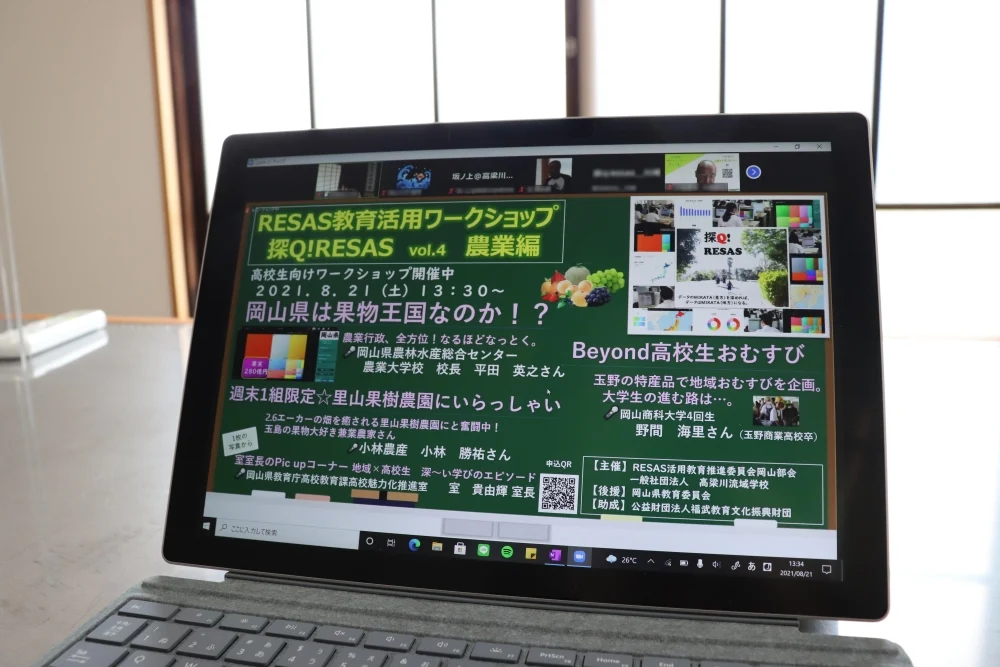
The FY2021 RESAS Workshop on Educational Use will be held starting July 10, 2021.
▼For details, please check the official page.
RESAS Workshop on Educational Use: Explore! RESAS Online Seminar
▼The application form is below.
Application Form
RESAS Workshop: Tourism Information

| Name | RESAS Workshop: Tourism |
|---|---|
| Date | Saturday, August 8, 2020, 9:30–11:30 a.m. |
| Location | 545 Hakuraku-cho, Kurashiki City, Okayama Prefecture — Okayama Prefectural Kurashiki Commercial High School |
| Participation fee (tax included) | Free |

What would you like to know about Kurashiki?
Enter a word to search articles on this site






































The FY2021 RESAS Workshop for Educational Use will be held starting July 10, 2021.
▼For details, please see the official page.
RESAS Workshop for Educational Use: Explore! RESAS Online Seminar
▼The application form is below.
Application Form