Interview with Yoshisuke Oda, owner of Cafe Kurashiki Geibunkan

We spoke with Yoshisuke Oda, owner of Cafe Kurashiki Geibunkan, about how the cafe came to open, the stories behind the creation of its recommended menu items, and what makes the cafe special.
His family business was a milk shop, but he was interested in the food-service industry, so he also tried running a cafe

First, could you tell us how the cafe came to open?
Oda
My family has run a milk shop in Kurashiki City since my grandfather's time.
However, I chose to move to Tokyo and work in the IT industry.
My family shop handled all kinds of food products in addition to milk, so I was interested in food myself.
So after moving to Tokyo, I went around trying different restaurants on my days off and after work.
Then the time came for me to take over the family milk shop, so I returned to Kurashiki.
And I began to want to try working in the food-service industry, which I had been interested in for a long time...
Eventually, together with a chef from Okayama Prefecture whom I had met while exploring restaurants in Tokyo, I started a catering business alongside the family business.

So you started out with catering. Why did you start running a cafe at Geibunkan Hall?
Oda
Cafe Kurashiki Geibunkan had been here for a long time, and it was run by another company.
At one point, someone I met through work told me that the company running Cafe Kurashiki Geibunkan was planning to close the cafe.
It is in a great location right next to the Bikan Historical Area, and I had always wanted to run a food-service business, so I decided to take over the cafe and give it a try.
Then, in April 2018, I opened the current cafe as part of the renovation of Cafe Kurashiki Geibunkan.
The chef who started the catering business with me also helps with menu development and cooking for private evening events, alongside the catering work.
The July 2018 torrential rains disaster struck soon after the cafe opened

Although Cafe Kurashiki Geibunkan was a renovation, this was your first time running a restaurant. Were there any difficulties after opening?
Oda
We opened in April 2018, and then the torrential rains struck in July—the July 2018 torrential rains disaster.
The areas around Kurashiki, including Mabi, suffered extensive damage. News coverage across the country led to a sharp drop in tourists visiting the Bikan Historical Area.
We had factored in some losses before the business got on track, but the impact was greater than we had initially anticipated...
Honestly, it was difficult to take such a big hit so soon after opening.
Tourist numbers temporarily rose a little around the New Year holidays, but it was around spring 2019 that I felt things were finally starting to recover.
During that time, at the request of the Kurashiki Junior Chamber, we also helped provide meals in the disaster-hit areas of Mabi.
We helped serve yakisoba, yaki udon, tonjiru, and other dishes.
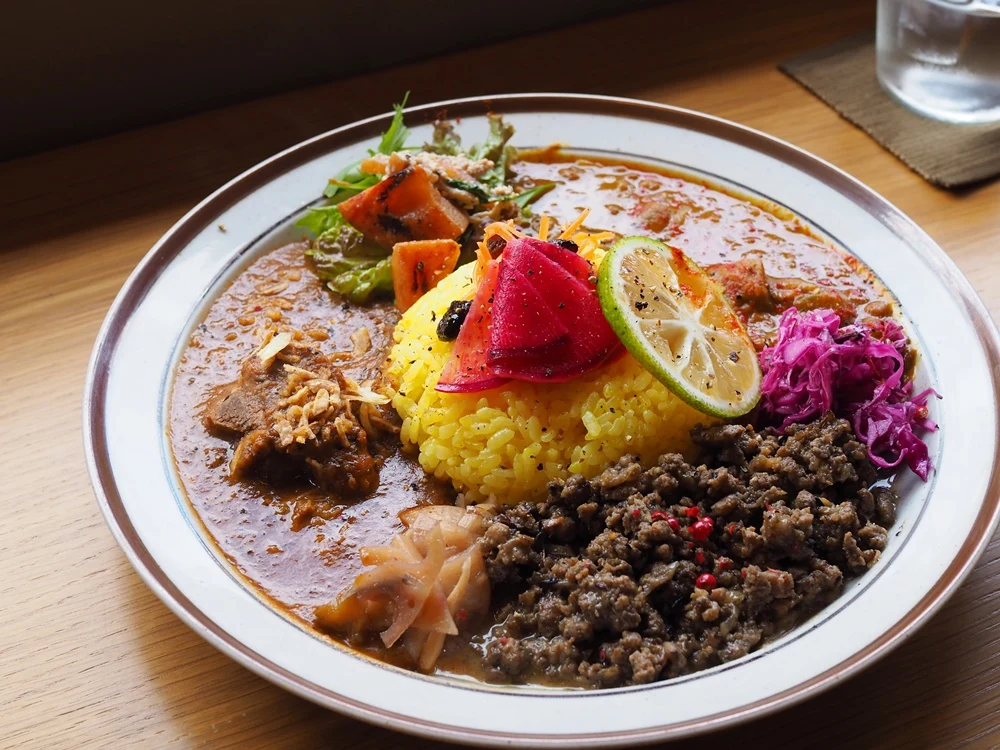
With so many curry-loving staff members, curry naturally became a focus

I hear keema curry is your signature dish. How did it come about?
Oda
Actually, I love curry.
When I was exploring restaurants in Tokyo, I went to lots of curry shops too.
The chef who started the catering business with me also loves curry.
And some of the staff who had worked at Cafe Kurashiki Geibunkan since it was run by the previous company are curry lovers too.
With so many staff members who love curry and are particular about it, curry naturally became the star of the menu (laughs).
However, there aren't many places in Kurashiki that feature keema curry as their signature dish.
But there are lots of people who love keema curry.
So I decided to make keema curry our signature dish.
Drawing on his experience as a milk-shop owner, he wants people to discover the quality of Shiro Bara Milk

You also promote menu items made with Shiro Bara Milk. Did that idea come from your experience running a milk shop?
Oda
That's right.
At the milk shop, we handle milk from various manufacturers.
Among them, our top recommendation is Daisen Dairy's “Shiro Bara Milk”.
Daisen Dairy is very particular about quality, including managing the cows' health with the help of its own veterinarian.
That's why Shiro Bara Milk has a rich, full-bodied milk flavor and high nutritional value.
Children drink milk at school lunch, so apparently they can easily tell the difference.
Children who try Shiro Bara Milk for the first time are delighted.
We also hear from many people who say they can drink Shiro Bara Milk even though they don't like milk.
I also really like Shiro Bara Milk.
Oda
Few restaurants serve it, so people who already like Shiro Bara Milk sometimes come into Cafe Kurashiki Geibunkan because of it.
On the other hand, some people don't know about Shiro Bara Milk, and others avoid it because it's a little expensive. That's the reality.
As a milk-shop owner, I want many people to discover the quality of Shiro Bara Milk.
That's why Cafe Kurashiki Geibunkan serves menu items made with Shiro Bara Milk.
We do our best to keep the prices as affordable as possible.
Focused on local production for local consumption, he uses ingredients from the Chugoku and Shikoku regions

Are there any other things you take particular care over?
Oda
We keep “local production for local consumption” in mind and use ingredients from our local Chugoku and Shikoku regions whenever possible.
Daisen Dairy's Shiro Bara Milk is one example (Daisen Dairy is based in Kotoura, Tottori Prefecture).
For rice dishes such as our curry, we use rice grown in Soja City.
Soja is well suited to rice cultivation, and rice grown there is highly regarded.
Tourists sometimes ask, “This rice is delicious. Where was it grown?”

We also have desserts made with oiri, a traditional confection from Kagawa Prefecture.
Oiri are round rice crackers about one centimeter in diameter.
They're known for their many bright colors.
Oiri are very popular now and hard to get.
We have a contract with a shop where a husband and wife make them by hand.
Oiri usually come in about five colors, but the ones from our supplier come in seven colors.
Plans to develop menu items that capture the character of Kurashiki

Could you tell us what makes the cafe special and what your plans are for the future?
Oda
One of Cafe Kurashiki Geibunkan's selling points is that pets are welcome.
Pets can join you not only on the terrace, but also inside the cafe if they are kept in a carrier.
There aren't many places in Kurashiki where you can bring pets, so we're popular with local dog owners too.
Of course, since we're near the Bikan Historical Area, tourists also look for places where they can bring their pets and make a special trip to visit us.
We want to keep doing our best to make those customers happy too.

Another common pattern is that local people come to an event at Geibunkan Hall, stop by for a break, find the cafe much better than expected, and become repeat customers.
Because we're inside a municipal facility, people sometimes think our staff are city employees or don't expect much from the food.
But after eating here, they're surprised, saying, “It was much better than I expected,” or “I didn't know this was a proper cafe and not just a cafe in a municipal facility.” Some then start visiting regularly.
We also want to take good care of our local customers.
And since we're so close to the Bikan Historical Area, we want to find ways to delight tourists too.
For example, we're currently thinking about menu items that capture the character of Kurashiki.
From the Writer

Cafe Kurashiki Geibunkan is just south of the Bikan Historical Area (along the Kurashiki River), making it an easy place to stop by while sightseeing.
It's also one of the few places in Kurashiki where you can bring your pet.
As a result, it's popular with pet lovers, from tourists to local residents.
And, of course, there's the “Shiro Bara Milk” from Daisen Dairy, made into sweets—a specialty you can enjoy thanks to the cafe's long-established milk-shop roots!
They have a rich, delicious taste that brings out the milk's full flavor.
Cafe Kurashiki Geibunkan's keema curry is also a treat, with its minced meat's savory flavor, and many of the staff are curry lovers.
Be sure to try Cafe Kurashiki Geibunkan's carefully prepared keema curry and Shiro Bara Milk sweets.
Cafe Kurashiki Geibunkan Hall Information

| Name | Cafe Kurashiki Geibunkan Hall |
|---|---|
| Address | 1-18-1 Chuo, Kurashiki City, Okayama Prefecture (within the grounds of Geibunkan Hall) |
| Contact | 050-5595-6763 |
| Parking | Available 7 spaces in total (3 beside the restaurant (east side), 4 behind it (south side)) |
| Hours | 11:00 a.m.–4:00 p.m. 7:00 p.m.–11:00 p.m. (private bookings only) |
| Closed | Wednesday Open if it falls on a public holiday; closed the following day |
| Payment methods |
|
| Reservations | Accepted Reservations can be made by phone or online through the website, Tabelog, and other services |
| Seating | 48 seats in total ・Counter: 4 seats ・Three 2-person tables ・Five 4-person tables ・One 6-person table ・Terrace: three 4-person tables (Pets are allowed on the terrace. Inside, pets are allowed only in a carrier.) |
| Smoking | Non-smoking (smoking permitted only in designated areas) |
| Restroom | Western-style toilet |
| Families with children | Strollers allowed Children's chairs available Children's plates and tableware available |
| Accessibility | Ramp Wheelchair accessible |
| Website | Cafe & Diner Kurashiki Geibunkan Hall |


What would you like to know about Kurashiki?
Enter a search term to find articles on this site