What comes to mind when you hear “calligraphy club”?
You might picture students quietly practicing calligraphy.
Unlike “shuji” (penmanship), calligraphy is an art form that uses a brush and ink to express kanji and kana artistically.
- Calligraphy performances
- “Kurasho Project,” a community service initiative through calligraphy
These are the activities that the calligraphy club at Okayama Prefectural Kurashiki Commercial High School (commonly known as Kurasho) focuses on.
The club is one of the top teams in the country. In the 28th International High School Students’ Selected Calligraphy Exhibition (Calligraphy Koshien), held in fiscal 2019, it won first place in the Chugoku region.
Because the school’s baseball team had qualified for the 92nd National High School Baseball Invitational Tournament, the club wrote the school’s own placard, making it only the third school in history to do so.
However, to prevent the spread of COVID-19, the invitational high school baseball tournament was canceled, and the calligraphy performance could not take place either...
This article introduces the activities of the calligraphy club at Okayama Prefectural Kurashiki Commercial High School, as well as the thoughts of its students who graduated on March 1, 2021, after giving their all over three years.
The information presented here is as of the article’s publication in March 2021. Please note that it may differ from current information.
About the calligraphy club at Okayama Prefectural Kurashiki Commercial High School

The calligraphy club at Okayama Prefectural Kurashiki Commercial High School (hereafter, Kurasho) aims to live by the motto “Calligraphy reflects the person.” Through club activities, it works to help each member grow and enjoy a fulfilling high school life.
As of March 2021, the club had 43 members (16 first-years, 16 second-years, and 11 third-years).
- International High School Students’ Selected Calligraphy Exhibition (Calligraphy Koshien)
- AEON MALL Cup High School Calligraphy Performance Grand Prix
- “Kurasho Project,” a community service initiative through calligraphy
The club engages in a variety of calligraphy-related activities.

A top team in the country with numerous awards

Some people may think of calligraphy as dull, but the Kurasho calligraphy club is involved in a wide range of activities and has achieved excellent results in all of them.
In fact, it is one of the top teams in the country.
Its results for fiscal 2020 are as follows.
| Competition | Award |
|---|---|
| 44th National High School Cultural Festival, Kochi: Calligraphy Division | Okayama Prefecture representative (ninth consecutive year) |
| 66th Okayama Prefecture Children’s Calligraphy Exhibition | Sanyo Shimbun President’s Award (top prize) Okayama Prefectural Governor’s Award Judging Committee Chair’s Award, and others |
| 29th International High School Students’ Selected Calligraphy Exhibition (Calligraphy Koshien) | Group award: Excellence Award, Chugoku region Individual: Honorable Mention and selected works |
| 15th National High School Students’ “Calligraphy” S-1 Grand Prix | Group: Runner-up Grand Prix Individual: Grand Prix, Runner-up Grand Prix, Mahoroba Award, and others |

| Activity | Notes |
|---|---|
| Large-scale work “Wish” displayed at the Kurashiki Station Underground Art Gallery | Featured in Sanyo Shimbun’s SANTA Times as the third work in a series about recovery from the July 2018 heavy rains |
| Call for reading cards for “Japan Heritage Karuta” by the Kurashiki City Japan Heritage Promotion Council | Seven people’s eight cards were selected from 45, including the Grand Prix winner |
| Visit to Kurashiki Police Station; work “Safety and Security” displayed | Received a letter of appreciation for contributing to community safety activities |
| Core Cities Summit 2020 in Kurashiki | Large-scale work “Wish” displayed at Kurashiki Ivy Square Created “oshina-gaki” using Bitchu washi paper for an early-morning tour Gave a speech about the calligraphy club’s activities |
If you are interested in the club’s results from fiscal 2016 through fiscal 2019, take a look below.
Fiscal 2016
| Competition | Award |
|---|---|
| 40th National High School Cultural Festival, Hiroshima: Calligraphy Division | Okayama Prefecture representative |
| 62nd Okayama Prefecture Children’s Calligraphy Exhibition | Sanyo Shimbun President’s Award Okayama Prefectural Governor’s Award, and others |
| 2nd AEON MALL Cup High School Calligraphy Performance Grand Prix Chugoku and Shikoku Tournament, Okayama Prefecture Qualifier | First place; advanced to the final |
| 25th International High School Students’ Selected Calligraphy Exhibition (Calligraphy Koshien) | Group award: First place, Chugoku region Individual: Runner-up Grand Prize, Excellence Award, and selected works |
Fiscal 2017
| Competition | Award |
|---|---|
| 41st National High School Cultural Festival, Miyagi: Calligraphy Division | Okayama Prefecture representative; received a Special Award |
| 63rd Okayama Prefecture Children’s Calligraphy Exhibition | Okayama Prefectural Board of Education Superintendent’s Award Okayama City Mayor’s Award Judging Committee Chair’s Award Okayama Prefecture High School Calligraphy Federation President’s Award, and others |
| 26th International High School Students’ Selected Calligraphy Exhibition (Calligraphy Koshien) | Group award: First place, Chugoku region (regional winner for the second consecutive year) Individual: Honorable Mention and selected works |
| Kurashiki City 50th Anniversary Ceremony | Calligraphy performance “Connecting” |
Fiscal 2018
| Competition | Award |
|---|---|
| 23rd All-Japan High School and University Student Calligraphy Exhibition | Exhibition Award and Excellence Award |
| 42nd National High School Cultural Festival, Nagano: Calligraphy Division | Okayama Prefecture representative; “Kanko Award” and “Special Award” |
| 64th Okayama Prefecture Children’s Calligraphy Exhibition | Sanyo Shimbun President’s Award Okayama Prefectural Governor’s Award Judging Committee Chair’s Award, and others |
| 27th International High School Students’ Selected Calligraphy Exhibition (Calligraphy Koshien) | Individual: Honorable Mention and selected works |
| Kurashiki City 50th Anniversary Ceremony | Calligraphy performance “Connecting” |
| Activity | Notes |
|---|---|
| Large-scale work “Live in the Present” displayed at the Kurashiki Station Underground Art Gallery | |
| “Live in the Present” displayed at three evacuation shelters in Mabi, Kurashiki City (Okada, Sono, and Niman Elementary Schools) | Visited Okada Elementary School; covered by numerous media outlets |
| “Mabi Yorozu Team Research Institute,” supporting recovery from the torrential rains in western Japan; Mabi Community Center, Yata Branch Wrote the activity theme and provided “Live in the Present” | |
| Featured on the cover of “Public Relations Kurashiki,” issue 620 (“Live in the Present”) | |
| “Live in the Present” displayed at the Kurashiki City Disaster Volunteer Center | |
| Featured on the cover of education newsletter “Kokoro no Wa,” vol. 128 (“Live in the Present”) | |
| “Live in the Present” displayed at Kurashiki City Library | |
| Performance work “Live in the Present” displayed in the public gallery at Kurashiki City Office | Calligraphy performance presented at the reception for the “Evening of Recovery” at the 26th Kitamaebune Port-of-Call Forum in Onomichi |
| Featured on the cover of issue 76 of “Takahashi River,” the Takahashi River Basin Federation’s journal (“Live in the Present”) | |
| Work “Live in the Present” displayed at Sophia University’s Summer 2018 Natural Disaster Photo Exhibition and Kurashiki Volunteer Report Exhibition |
Fiscal 2019 (Reiwa 1)
| Competition | Award |
|---|---|
| 24th All-Japan High School and University Student Calligraphy Exhibition | Exhibition Award and Excellence Award |
| 43rd National High School Cultural Festival, Saga: Calligraphy Division | Okayama Prefecture representative |
| 65th Okayama Prefecture Children’s Calligraphy Exhibition | Sanyo Shimbun President’s Award Okayama Prefectural Governor’s Award Judging Committee Chair’s Award, and others |
| 28th International High School Students’ Selected Calligraphy Exhibition (Calligraphy Koshien) | Group award: First place, Chugoku region ※ Wrote the placards for the invitational high school baseball tournament: “Kurashiki Commercial,” “Tottori Johoku,” and “Hirata” Writing a school’s own placard was only the third such instance in history, following Gifu Commercial and Sendai Ikuei Individual: Runner-up Grand Prize and selected works |
| 5th AEON MALL Cup High School Calligraphy Performance Grand Prix, Chugoku and Shikoku Tournament, Okayama Prefecture Qualifier | First place; advanced to the final |
| 5th AEON MALL Cup High School Calligraphy Performance Grand Prix, Chugoku and Shikoku Tournament Final | Runner-up |
| Activity | Notes |
|---|---|
| Daily calendar “Recovery: One Heart” | Visited Kurashiki Municipal Mabi Junior High School and presented the calendar Featured in the Sanyo Shimbun and broadcast on RSK, RNC, and KCT Due to strong public response, calendars were distributed to local residents |
| Large-scale work “Reborn” exhibited at the Setouchi Triennale | |
| Omobura 190 “Recovery: One Heart” | Appeared with students from Kurashiki Municipal Mabi Junior High School on a special stage at the north entrance of Omotecho, in front of Okayama Tenmaya’s main store Featured on the cover of an economic information magazine |
| Large-scale work “Toward Tomorrow” displayed at the Kurashiki Station Underground Art Gallery | |
| Masakazu Hase Piano Concert supporting recovery in Mabi Work “Live in the Present” displayed in the lobby of the Kurashiki City Art Museum | |
| Work “Weaving” displayed at the Japan Heritage Summit in Kochi |
Writing the school’s own placard for the 92nd National High School Baseball Invitational Tournament

In fiscal 2019, the club won first place in the Chugoku region at the 28th International High School Students’ Selected Calligraphy Exhibition (Calligraphy Koshien).
Kurashiki Commercial High School is also known for its baseball team. Because the team had qualified for the 92nd National High School Baseball Invitational Tournament, the club wrote the school’s own placard, making it only the third school in history to do so.
Writing calligraphy: using a brush to write characters or create pictures
However, the invitational high school baseball tournament, scheduled to be held on March 19, 2020, was canceled due to the spread of COVID-19, and the placard was never displayed at Koshien.
The story behind writing the school’s own placard is shared in the interview later in this article.
Main activities of the Kurasho calligraphy club

The Kurasho calligraphy club not only takes part in competitions, but also engages in a wide range of activities closely connected to the local community.
Its two main activities are:
- Calligraphy performances
- Kurasho Project
Here is a brief introduction to each.
Calligraphy performances

When I heard “calligraphy,” I used to picture something quiet.
Calligraphy performances completely changed that image. They have the following features:
- Several people work together to create one piece
- The work is created to music
- They also have a performative aspect, with dance and other elements for an audience to watch
One of the club’s signature works is “Prayer,” about the recovery of Mabi, which was devastated by the heavy rains of July 2018.
It won second place at the 5th AEON MALL Cup High School Calligraphy Performance Grand Prix, Chugoku and Shikoku Tournament Final, moving the audience.
However, in fiscal 2020, calligraphy performance competitions were canceled across the board to prevent the spread of COVID-19.
As a result, the Kurasho calligraphy club students have been unable to perform even in practice since January 2020.
Information as of February 2021
Kurasho Project
Following the heavy rains of July 2018, the club began its recovery efforts and message-sharing activities through calligraphy under the name “Kurasho Project.”
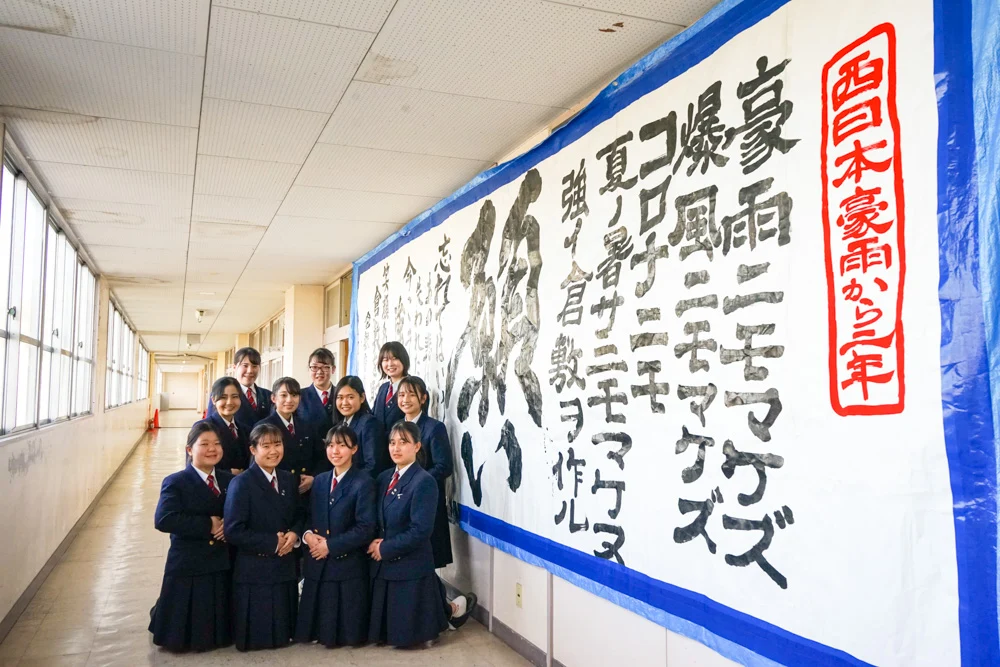
Its main works are the three-part series displayed for three consecutive years at the Kurashiki Station Underground Art Gallery: “Live in the Present,” “Toward Tomorrow,” and “Wish.”
▼ Live in the Present (2018)

▼ Toward Tomorrow (2019)

▼ Wish (2020)

Alongside its impressive competitive record, Kurasho Calligraphy Club is committed to community service as a commercial high school rooted in the local area.
However, in the 2020 school year, measures to prevent the spread of COVID-19 imposed many restrictions—not only on external activities such as calligraphy performances, but also on club activities in general.
On February 27, 2021, just before graduation, we spoke with the club’s 11 third-year students and their advisor, Junko Kajitani, about their three years of activities and what they think now.
Interview with Kurasho Calligraphy Club’s 11 Third-Year Students and Advisor Junko Kajitani

To begin the interview, we asked why they had joined Kurasho Calligraphy Club.
Not a single student said, “I came to Kurasho hoping to join the calligraphy club.”
Most said they happened to find a calligraphy club after enrolling at Kurasho, or joined with a friend.
Some had studied calligraphy before high school, while others started in high school. Together, the 11 of them made it through all three years.
Activities During the COVID-19 Pandemic

Kurasho Calligraphy Club is one of the top teams in the country. Were the 11 graduating students the members who remained in the club?
Kajitani
Actually, no one quit. The same 11 of us stayed together for all three years.
We might have become a stronger team if we had held auditions within the club and brought in more skilled students. But we were committed to doing it with these 11 members.
Was there a reason you were committed to having 11 members?
Kajitani
Maybe because I believe it’s important to create something together, regardless of whether someone is good or bad at it.
If we had kept changing the team, some people might have dropped out.
From their first year, I kept giving them the challenge: “Create something with these 11 people.”

I imagine it was frustrating to have so many activities differ from previous years, including the cancellation of the High School Calligraphy Performance Grand Prix due to the pandemic.
Could you tell us about the episode that left the strongest impression on you?
Third-year calligraphy club student
We were preparing for a performance competition, but it was canceled, and we were disappointed that we couldn’t take part.
In the end, we didn’t get to perform even once after becoming third-year students. Our last performance was in January 2020.
We often learned about performances from our seniors, but the competition itself was canceled, and people from outside the school weren’t allowed in, so we couldn’t do anything at all…
So we hardly had any contact with the younger students, especially the first-years.
We had a chance to teach them how to move during a performance in December 2020, and that was the first time we really talked with them.
Instead, we each tried to win awards for our individual works and worked hard in other areas.
You couldn’t practice performances, but did you do more individual activities?
Third-year calligraphy club student
No, not really. If anything, we did less…
It depended on the time, but our club activities were limited to set periods, like “two hours.”
Activities of the “Kurasho Project”

When you were first-year students, the July 2018 Heavy Rains struck, and you saw your seniors create “Living in the Present.” What did you think of that?
Afterward, you often worked with “recovery support” as a guiding theme over your three years. Are there any episodes that stand out to you?
Third-year calligraphy club student
When I thought of disaster relief, I imagined going to the disaster-stricken area and doing something there.
But I saw our seniors doing indirect volunteer work, like writing and displaying calligraphy, and learned that it had encouraged people. I realized, “There are ways to help like this, too.”
Another thing was that we received a letter from someone who had seen our “Prayer” performance. We learned that “by taking action, we can convey our feelings, and the people who see it can feel encouraged.”
“You’ve been through something painful, but don’t dwell on it—let’s move forward.”
I realized that words have the power to convey a message, so from then on, we began working with the aim of sharing “the power of words.”

What was difficult?
Third-year calligraphy club student
The “Prayer” performance was really challenging.
How do you decide on the sequence of a performance?
Third-year calligraphy club student
- Choose a theme
- Choose the characters
- Choose the music
- Choose the performers
- Decide on the movements
That’s more or less how it goes. We all discuss and decide together, including our advisor.
The Okayama Prefecture preliminaries are usually held around October, so we decide on the content and practice over summer vacation. If we make it to the finals, we keep refining it until around January the following year.
Kajitani
I’m not a performance professional, so I offer my opinions, but I think we decide together.
Writing the School’s Name on Its Own Selection High School Baseball Tournament Placard

Could you tell us about writing your school’s name on its own tournament placard, making it only the third school ever to do so?
Third-year calligraphy club student
I’m not comfortable standing out, so I don’t think I’m the type to volunteer.
But the baseball team achieved amazing results, and we achieved results too. Because everyone worked so hard, we got this rare opportunity to write our own school’s name on its placard.
I got to write the names for three schools, but I thought, “I’ll write Kurasho’s myself,” and took it on.
I worked hard, taking confidence from the thought, “I wrote powerful characters,” and hoping people would be happy to see them on TV.
Where is that placard now?
Third-year calligraphy club student
I don’t know. Maybe at The Mainichi Newspapers?
Apparently, it wasn’t meant to be returned; you just see it on TV, and that’s it.
What We Gained from Three Years in the Calligraphy Club

There was a disaster when you were first-year students, and COVID-19 when you were third-years.
It must have been a very eventful three years. Is there anything you gained or learned through the calligraphy club?
As several students answered, their responses are listed below.
- I became mentally stronger. When I was a first-year student, I don’t think I could even have answered an interview like this (laughs).
- I feel like I’ve become better at speaking and explaining things in front of people.
- When I went for an entrance interview, I felt that the “etiquette” I’d learned—like where to put my hands and how to bow—came in handy. The teachers at Kurasho praised me when they helped me practice for the interview!
- I have a younger sister. I’ve always liked taking care of her, but I also felt like I didn’t want to rely on other people and that it was embarrassing.
After joining the calligraphy club, there were so many things I didn’t understand or couldn’t do, so I learned to ask people around me for help and rely on them. - On my own, I might have wanted to give up, but performances are something we do together. Being able to get through them by thinking, “I can keep going because everyone’s here,” gave me confidence.
Will you continue calligraphy after going on to further education or starting work? How would you like to stay involved with calligraphy in the future?
Third-year calligraphy club student
I won’t! (laughs)
We don’t know what will happen with the pandemic, but our seniors came to school and taught us, so we hope we can teach our juniors about the performances we’ve done.
In particular, we struggled a lot with “how hard it is to bring everyone together” and “how to give instructions.”
The younger students probably haven’t done those things before, so I’m sure they’ll struggle too. I hope we can pass on what we’ve learned.
That’s something I wish we could have handed down…

Is there anything you’d like to tell people who are interested in the calligraphy club?
Third-year calligraphy club student
I think people often imagine that the calligraphy club’s activities are all about improving your handwriting.
Of course, your handwriting improves. But after being in the club for three years, I realized it’s a club where you can grow as a person even more than that, so I hope you’ll give it a try!
From the Writer

I first learned about Kurasho Calligraphy Club while volunteering at the Kurashiki City Disaster Volunteer Center after the July 2018 Heavy Rains.
At the time, from July to October 2018, the Disaster Volunteer Center was located in the gymnasium of the Chugoku Polytechnic College. One day in September 2018, I visited and saw a huge piece of work displayed on the stage.
I clearly remember feeling happy and encouraged when I realized, “High school students are working hard for their local community, too.”
Everyone who saw “Living in the Present” was smiling. I, too, believe that “words have power.”
With the graduation of the students who had seen all three works—“Living in the Present,” “Toward Tomorrow,” and “A Wish”—the “Kurasho Project” may have reached a turning point as a recovery-support initiative.
But the “power of words” to convey a message, which they gained through this project, will surely be passed on not only by the graduates but also by the younger students.
We look forward to seeing what Kurasho Calligraphy Club does next.
What Matters in Kurasho Calligraphy Club: Messages for the Younger Students

This interview was conducted on February 27, 2021, just before the graduation ceremony.
We asked the 11 graduating third-year students what matters in Kurasho Calligraphy Club and what messages they wanted to share with the younger students. Here are all their responses.
All 11 students responded, so their answers are listed below.
- Before joining the calligraphy club, I also thought of calligraphy as something you do alone. But that means you don’t see what’s going on around you, and you don’t develop the ability to work with others. So in the club, I made it a priority to keep a broad perspective.
- Winning awards and competitions is important, so I hope you’ll keep working hard. But I also hope you’ll continue activities like the “Kurasho Project,” where you use calligraphy to communicate something to others, rather than focusing only on your own achievements.
- I think it’s important to know that you have teammates. We were able to create good work by discussing both performances and individual pieces, so this club taught us how important it is to have teammates.
- When I became a performance leader, I tried to do everything myself. But one day, I listened to the people around me, and they gave me good advice. I realized how important communication is, so I hope you’ll keep that in mind as you take part in club activities.
- Individual ability is important, but I think the most important thing is for club members to work together to create performances and other works.
- When I said I was in “Kurasho’s calligraphy club,” I met people from outside the prefecture who knew about it. I think it’s a club where people can see how hard we’ve worked.
- We’re the ones who write the characters, but we’re able to do what we do because teachers teach us, students who know a lot about performances teach us, and our seniors and juniors help us. We can’t do it on our own, so I hope you’ll value your connections with other people.
- We came up with our performances from scratch and created them by sharing our opinions with one another, so I think teamwork is important.
- It’s important to “make up for what our seniors couldn’t achieve,” but it’s also important to support one another as a team. Above all, I think it’s important to enjoy what we do.
- You absolutely can’t do a performance alone, but having everyone there made me think, “Let’s do our best.” I learned that even when things are hard, it’s important to see things through together.
- I think it’s important to be grateful. Many people helped us create each performance: teachers who gave us all kinds of advice, including on the writing; seniors who taught us and came to support us on the day; juniors who filmed and supported us; and, most of all, the 10 teammates who worked hard alongside me. It can be easy to take these things for granted, but I’m grateful.
- Photography: Goto Hiroto



What would you like to know about Kurashiki?
Enter a word to search articles on this site