
When you think of an udon shop, don’t you picture one serving “handmade udon”?
That’s what I think, too.
But there are surprisingly few shops that make authentic handmade udon using traditional methods.
Among them is an udon shop in Tamashima, western Kurashiki City, that has continued making udon by traditional hand-making methods for many years.
It is “Teuchi Udon Kura (Kura, hereafter Kura).”
Kura was originally a noodle-making factory specializing in udon.
It later became an udon shop in the late Showa period and has continued operating in Tamashima ever since.
In 2019, the first year of Reiwa, the shop was completely renovated.
Many customers visit Kura every day in search of delicious handmade udon.
Kura continues to make traditional handmade udon.
Of course, you can also enjoy its broth, made with carefully prepared dashi.
Let’s take a closer look at what makes Teuchi Udon Kura special.
The information presented here was current when this article was published in April 2023. Please note that it may differ from current information.
Kura, a handmade udon specialty shop founded in 1974 and originating as a noodle factory

Kura is located in Otoshima, in the southeastern part of Kurashiki City’s Tamashima area.
It is along Sangyo-dori, a main road connecting Shin-Kurashiki Station and Mizushima Industrial Zone E.
Kura was founded in 1974 as a noodle-making factory specializing in udon.
In 1987, it became a handmade udon shop.
The shop has been operating from a new location since September 2019.
The new shop is just south of the former one.
Kura has a spacious interior.


▼There are two tables with seating for four.

▼There are four booth tables with seating for four, popular with families with children.

▼There were also two tatami-room tables with seating for four.

▼There are eight tables for shared seating in total.

The shop is divided into nonsmoking and smoking areas.
The area near the entrance is nonsmoking, while the area toward the back allows smoking.
▼Tempura bits are self-serve.

Tempura bits are placed on each table.
Kura’s menu
Information as of April 2023. Prices include tax.
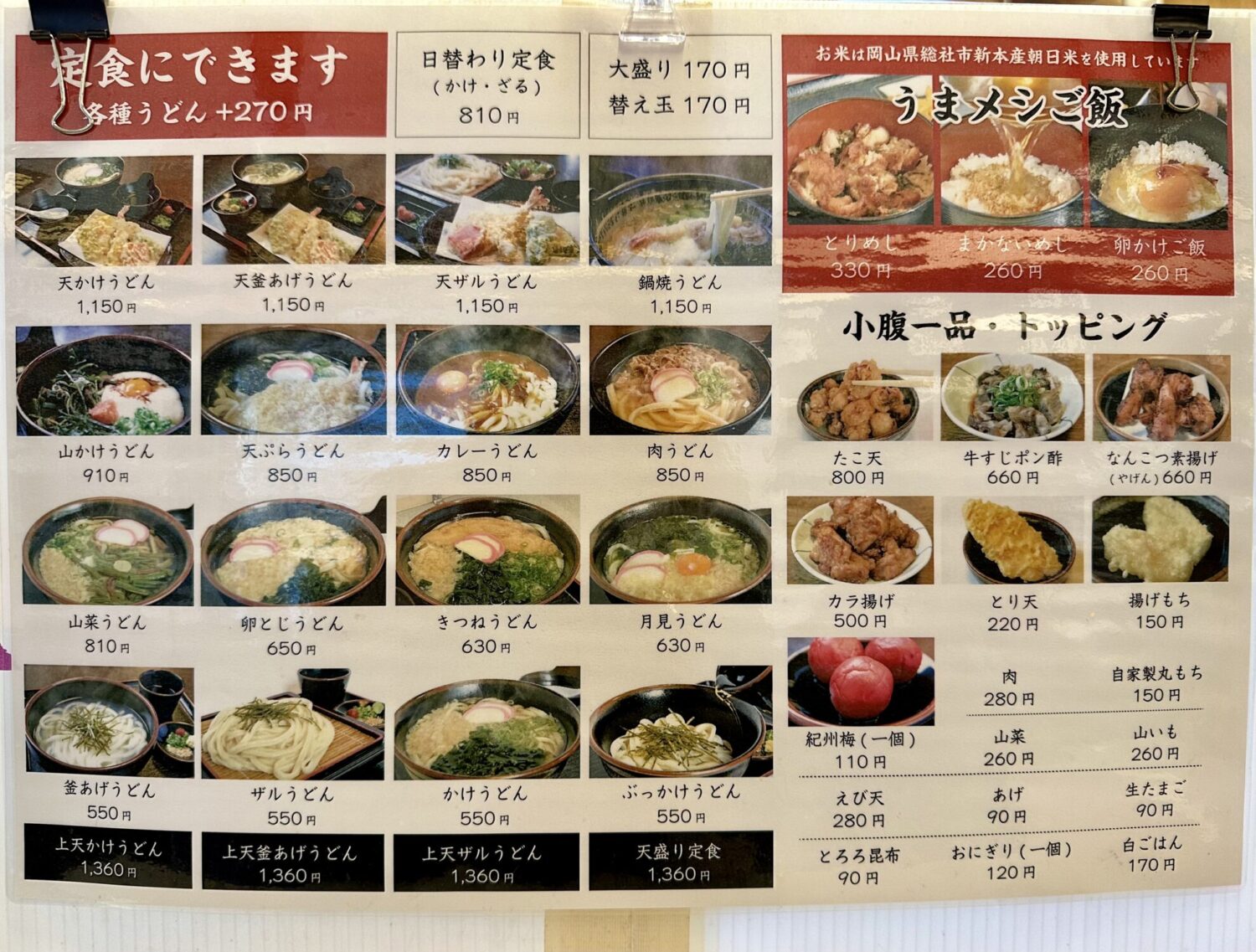
As an udon shop, Kura offers a wide variety of udon dishes.
The selection ranges from classics such as kake udon, meat udon, zaru udon, and Bukkake udon to Kura’s original udon dishes.
We were told that many of the main menu items have been offered ever since the shop opened as an udon restaurant.
There is also a great selection of side dishes.
Options include rice dishes, a la carte dishes, and oden.
The “daily set meal” (810 yen), which comes with udon, rice, a side dish, pickles, and more, is also popular.
▼The daily set meal when we visited included a minced-meat cutlet and stir-fried komatsuna greens.

The udon in the set meal is either kake udon or zaru udon.
You can also make a set meal with any other udon dish by adding 270 yen to its price.
You can also order an extra serving of noodles at Kura for 170 yen.
I think it’s very unusual for an udon shop to offer extra servings this way.
Kura also offers a 50% discount (half price) on meals for people affected by the July 2018 heavy rains, saying, “We hope we can help, even in a small way.”
To receive the disaster-affected resident discount, show a staff member a disaster damage certificate or another document showing your address, such as a driver’s license.
Please note that the disaster-affected resident discount cannot be combined with other discounts or special offers.
Kura’s handmade udon is incredibly long—about one meter!

As the shop name “Teuchi Udon” suggests, Kura makes its udon by hand.
These days, more shops are making their own noodles with machines, and fewer udon shops continue to make them by hand.

Kura continues to use the hand-making method passed down since its founding, as the method that customers find most delicious.
▼And Kura’s udon noodles are very long!

They are apparently about one meter long!
They’re so long that even eating them one strand at a time makes for a satisfying meal.
They were also quite thick.
With zaru udon or kamaage udon, be careful not to pick up too many noodles with your chopsticks, or they may not fit into the dipping sauce.
Of course, Kura takes care with more than just its udon noodles—it also pays close attention to its dashi broth.
The broth is made fresh at the shop every day.
Kura’s rice is Asahi rice from Shinpon, Soja City
All the rice used in Kura’s set meals and rice-based side dishes is Asahi rice from Shinpon, in western Soja City.
Kura uses Asahi rice grown by a farming family called Ono Factory.
Grown in a lush, green area with clean water, the Asahi rice is highly praised for its delicious taste.

I personally love Asahi rice, with its large grains and satisfying texture.
As someone from Soja, Shinpon is a very familiar area to me.
I was delighted to hear that Kura uses rice from Shinpon.
Introducing Kura’s standout menu items!
Let’s take a look at some of the standout items among Kura’s many menu options.
“Tempura zaru udon” lets you enjoy the udon noodles along with crispy tempura

If it’s your first visit, we recommend zaru udon or kake udon!
After hearing this from the owner, Mr. Nakagawa, I decided to try the zaru udon.
Customers say udon served with tempura is popular, so I ordered the Tempura Zaru Udon (¥1,150).

It comes with a generous assortment of tempura, so it looks like it’ll be filling.
▼The green onions, sesame seeds, wasabi, and pickled plum are condiments for the udon dipping sauce.

▼The grated daikon with chili pepper is a condiment for the tempura dipping sauce.

But in fact, the dipping sauce for the udon and the tempura is the same.
So if you switch which sauce you use partway through, you can enjoy a different flavor with both the udon and the tempura.
▼The glossy udon noodles look beautiful and delicious.

As mentioned earlier, each noodle at Kura is long.
So I dipped and ate them one at a time.

Slurping up the long noodles, I found them chewy and springy, with a wonderfully supple texture.
The sweet flavor of the sauce and the aroma of the dashi mingle with the noodles and spread through your mouth.
▼The tempura comes in a generous assortment.

There are seven kinds of tempura in all:
shrimp, carrot, pumpkin, lotus root, sweet potato, eggplant, and green pepper.
Of course, it’s freshly fried and crisp.
The combination of crisp-battered tempura and light zaru udon is superb.
Kura’s “Beef Udon” stands out for how the beef is simmered
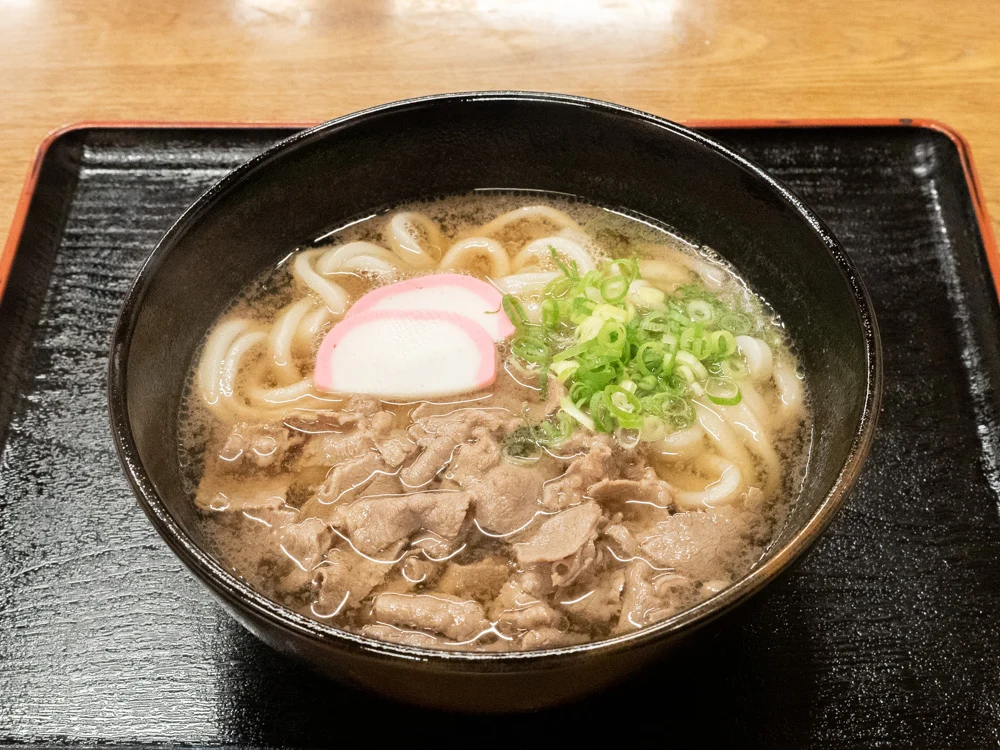
The owner, Nakagawa, also recommends the Beef Udon (¥850).
It’s a popular choice with customers, too.
Simple, yet it looks delicious.

It’s a delightfully generous serving of beef, enough to cover about half the bowl.

When you think of the beef in beef udon, don’t you picture it simmered until sweet and strongly flavored?
At Kura, though, they cook the beef differently.
That’s why the beef in their beef udon tastes light and refreshing.

You can enjoy the beef’s flavor and savoriness directly.

The beef’s savory flavor also infuses the dashi broth, making it so delicious you can drink every last drop.

An interview with Nakagawa reveals how the beef for Kura’s beef udon is prepared.
Be sure to watch the interview.
Of course, the noodles in the beef udon are long, too.

They have a slightly softer texture than the zaru udon.
The dashi clings to them nicely, so you can savor the noodles along with its flavor.
“Yamakake Udon” is a generously topped bowl distinguished by the sticky texture of grated yam

Yamakake udon is a generously topped, great-value dish.
It has been a popular menu item since the previous owner’s time, and apparently has many repeat customers.
The toppings include plenty of grated yam, a raw egg, mountain vegetables such as bracken, grated daikon with chili pepper, chopped green onions, shredded nori, and grated wasabi.

The sauce is rich and quite sweet.

As with the other udon dishes, the noodles in the yamakake udon are about a meter long.

Mix the noodles and toppings thoroughly with the small amount of sauce before eating.
The chewy noodles, the yam’s smooth, sticky texture, the sweet sauce, the crisp bite of the bracken, and the flavor of the grated daikon with chili pepper all mingle in a complex way, creating a delicious marriage of flavors.
Adding wasabi brings a sharp kick and fragrant flavor that adds a lively accent.
This is an udon dish you’ll crave again.
Noteworthy Side Dishes
“Torimeshi” is a local favorite of fried chicken served over rice

From the rice dishes listed under “Tasty Rice,” I ordered the torimeshi (¥330).
There are many different dishes called torimeshi throughout Japan.
Kura’s torimeshi is rice topped with shredded nori and sauce, then chopped pieces of fried chicken.
It’s the same kind of torimeshi familiar from bento shop menus around Okayama Prefecture.
The sauce has a sweet-and-savory flavor, but isn’t too strong, and goes well with the rice.

It’s delicious to tuck into the rice alongside crispy, fragrant fried chicken.

As mentioned earlier, the rice is Asahi rice grown in the Shinpon district of Soja City.
“Staff meal rice” is rice topped with udon broth

We also tried the “staff meal rice” (260 yen) from the “Uma Meshi Gohan” menu.
It is rice topped with udon broth and bonito flakes.

The broth is delicious, so although it’s simple, I thought it was very tasty.
The “oden” includes “castella,” a Tamashima specialty

Oden is also popular at Kura.
Oden is self-service.
Every item costs 120 yen.
▼The oden ingredients are as follows:
- Goboten (burdock root tempura)
- Hiraten (flat fish cake)
- Tofu
- Egg
- Atsuage (thick fried tofu)
- Daikon radish
- Konnyaku
- Castella
- Beef tendon
The three most popular items are daikon, konnyaku, and beef tendon.
Another item worth noting is “castella.”
Kura’s oden is thoroughly simmered in udon broth.
▼The broth had soaked all the way into the daikon.


▼The konnyaku has a very chewy, springy texture.

▼The beef tendon is also irresistibly chewy.

▼And now, the castella that caught our attention.

It looks just like castella cake, but it is actually something entirely different.

Castella is a food that has been enjoyed around Tamashima for a long time.
For more information about castella, see the Tamashima Oden page on the Kurashiki Regional Resources Museum website.
Kura is an udon shop that continues to make traditional hand-cut udon and broth-rich dipping sauce.
We interviewed Keisuke Nakagawa, representative of Keishin Co., Ltd., which operates Teuchi Udon Kura.
Teuchi Udon Kura Information
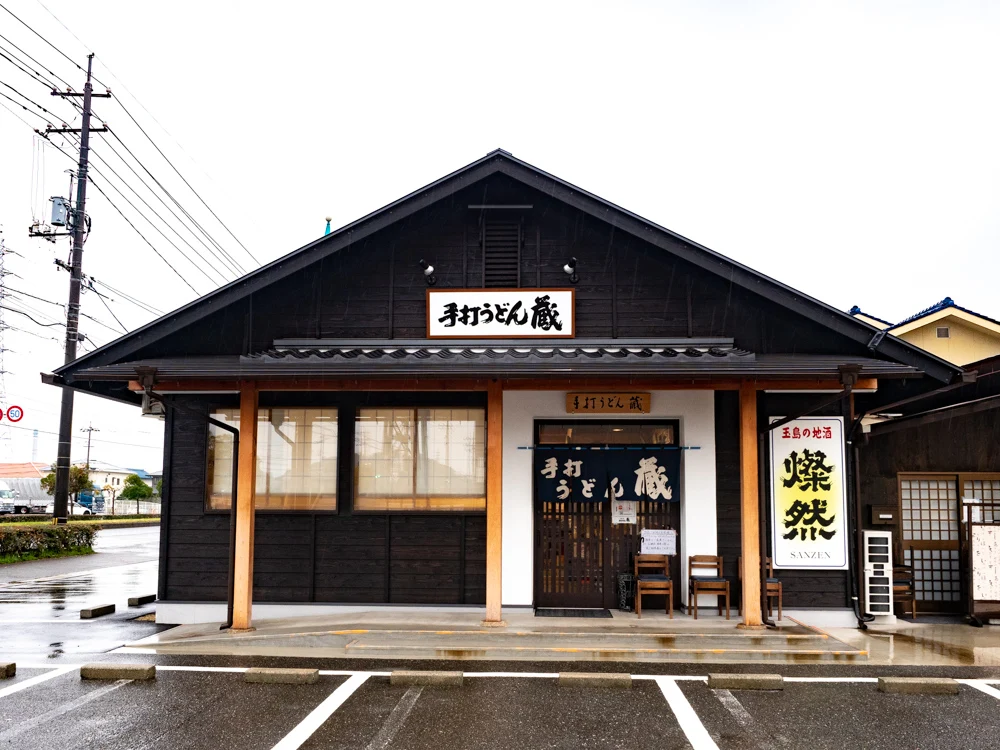
| Name | Teuchi Udon Kura |
|---|---|
| Address | 7283-1 Otoshima, Tamashima, Kurashiki City, Okayama Prefecture |
| Contact | 086-522-7178 |
| Parking | Available ・Parking Lot 1: 12 spaces ・Parking Lot 2: about 6 spaces |
| Hours | 11:00 a.m.–2:00 p.m., 5:00 p.m.–8:00 p.m. ※Closes when sold out |
| Closed | Tuesday |
| Payment methods |
|
| Reservations | Accepted |
| Seating | 40 seats ・Two four-person tables for shared seating ・Two four-person tables ・Four four-person booth tables ・Two four-person tatami rooms |
| Smoking | Non-smoking (smoking permitted only in designated areas) |
| Restroom | Western-style toilet |
| Families with children | ・Strollers allowed inside ・Children’s chairs available ・Children’s tableware available |
| Accessibility | Ramp Wheelchair access available |
| Website | Teuchi Udon Kura |

What would you like to know about Kurashiki?
Enter a word to search articles on this site



































Because our udon noodles are so long, we recommend eating them one strand at a time!