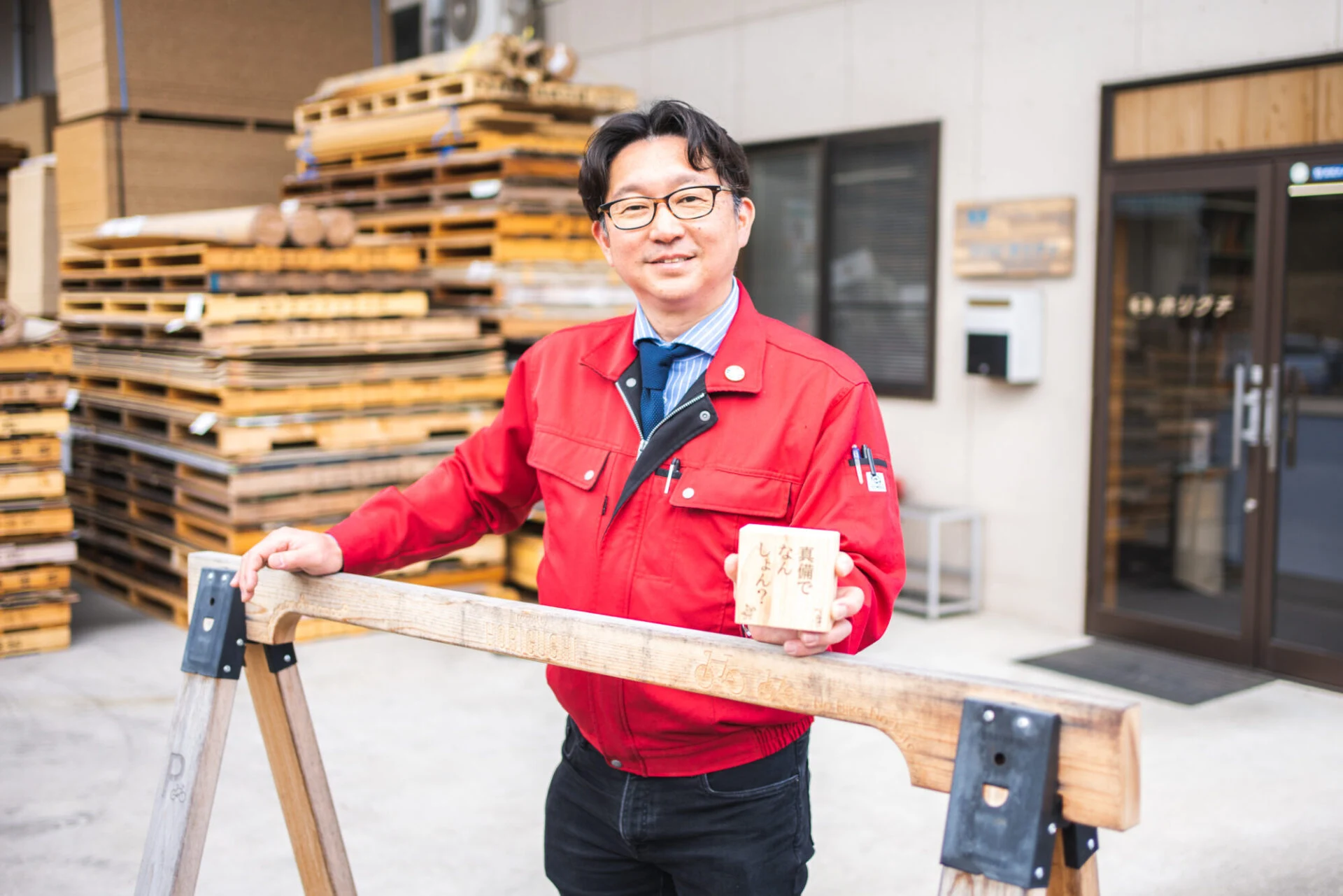
Interview with Yasuhiko Hamada, Director of the Takahashi River and Oda River Emergency Flood Control Office
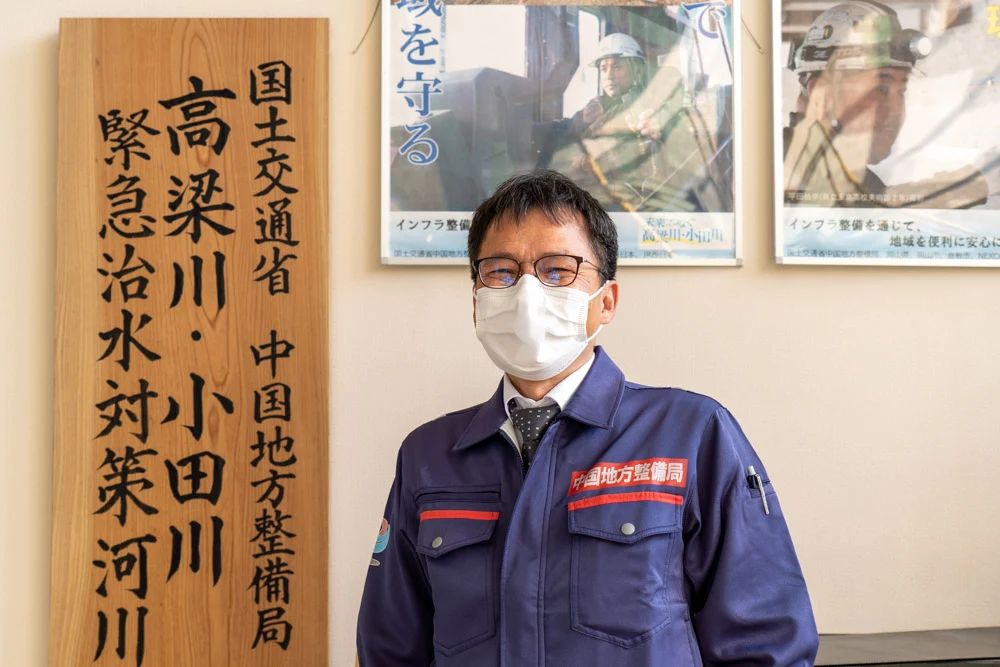
I spoke with Yasuhiko Hamada, the Director of the Takahashi River and Oda River Emergency Flood Control Office of the Chugoku Regional Development Bureau, about the status of the construction and other matters.
About the Takahashi River and Oda River Emergency Flood Control Office
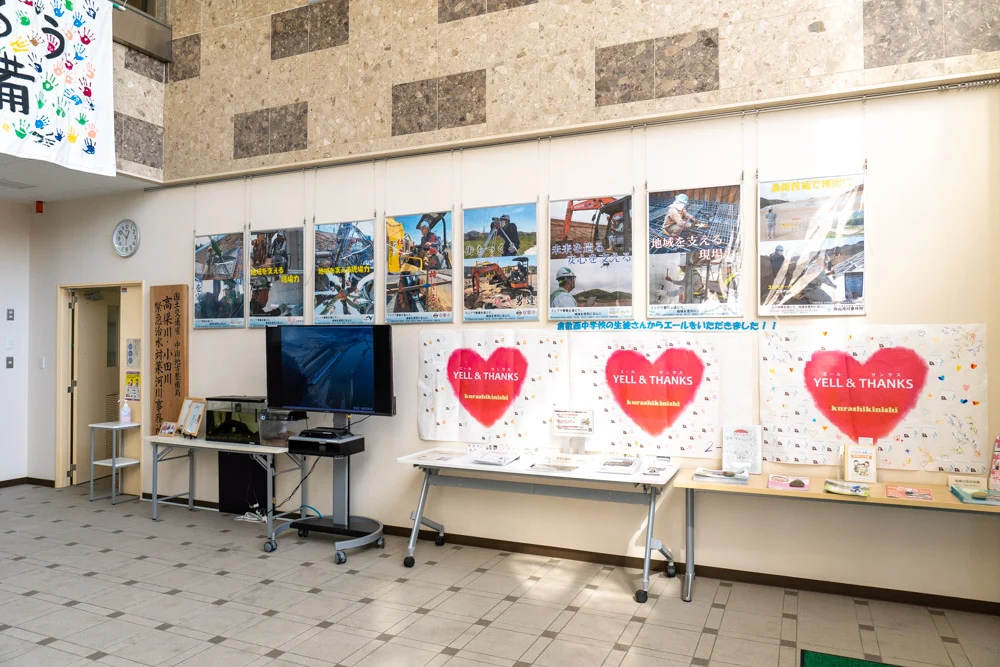
Please tell us about the Takahashi River and Oda River Emergency Flood Control Office.
Hamada (honorifics omitted)
Our office did not originally exist.
After the heavy rain disaster in July 2018, we initially established a "Disaster Recovery Office" at the Takahashi River Branch of the Okayama River Office to manage the disaster recovery sites.
The first response involved drainage work, removal of sediment, and logging, and as an emergency measure, we first filled the breached levee and created a temporary levee.
Subsequently, to implement the full restoration of the levee and the "Special Emergency Measures Project," we established an office in Mabi Branch of Kurashiki City in April 2019 and began operations as a new organization.
The term "Special Emergency Measures Project" is not very familiar, and it gives the impression of being "impressive" from the sound of it. What kind of project is it?
Hamada
There are many national projects, and one of them is called the "Special Emergency Measures Project," which is implemented when the damage is severe and emergency disaster prevention measures are carried out based on a certain plan, and it is expected to be completed in about five years.
In the July 2018 heavy rain disaster, about 4,600 buildings were damaged in Mabi, and due to the extensive damage, it had to be implemented urgently, so it was adopted and implemented as a "Special Emergency Measures Project" by the national and prefectural governments.
Did the construction mainly start with the restoration of the breached levee?
Hamada
Yes, that's correct.
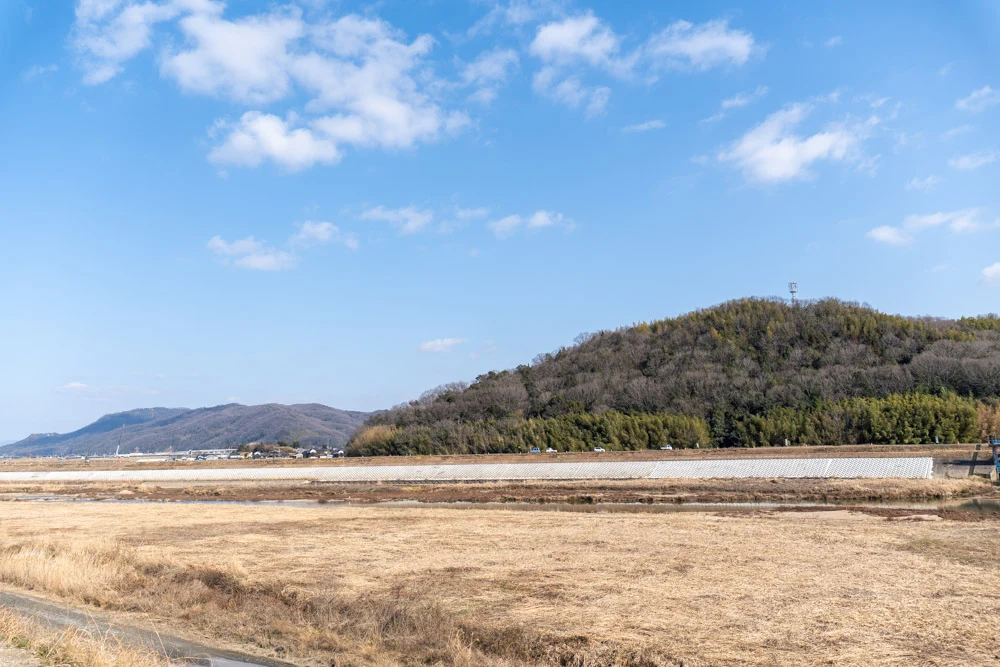
Two levees were breached, and after investigating the cause, we built up soil around the clock and completed the temporary levee on July 21, 2018.
Since it might rain again, we also logged trees in the river to improve the flow and reduce the burden on the temporary levee.
After the flood season ended, we removed and rebuilt the temporary levee.
It was only temporary, and the soil had not been compacted properly.
In addition, in September after the disaster, we established a plan to carry out hard measures such as the Oda River confluence point relocation project and soft measures over approximately five years, and we are currently in progress.
The hard measures are understandable as a project of the Ministry of Land, Infrastructure, Transport and Tourism, but I was a bit surprised to hear that you are also focusing on "soft measures," which I believe includes the response to this interview.
Hamada
Currently, we are working on hard measures (such as levees), but we cannot definitively say "it is safe" because of that.
That is a frustrating point for us, as the heavy rain in July 2018 was not the maximum.
We are working to ensure that we can safely handle rain similar to that of July 2018, but if it rains more than that, it may overflow again.
In that sense, we need to engage in activities to raise awareness of "evacuating," so we are also focusing on promoting "My Timeline," which is one of the soft measures.
The residents of Mabi are looking forward and thinking about how to recover and rebuild, and within that context, everyone in the area says, "We have to evacuate."
- So, how do we evacuate?
- When do we evacuate?
We are providing support for these questions, and as a Ministry of Land, Infrastructure, Transport and Tourism office, we may be conducting more in-depth activities.
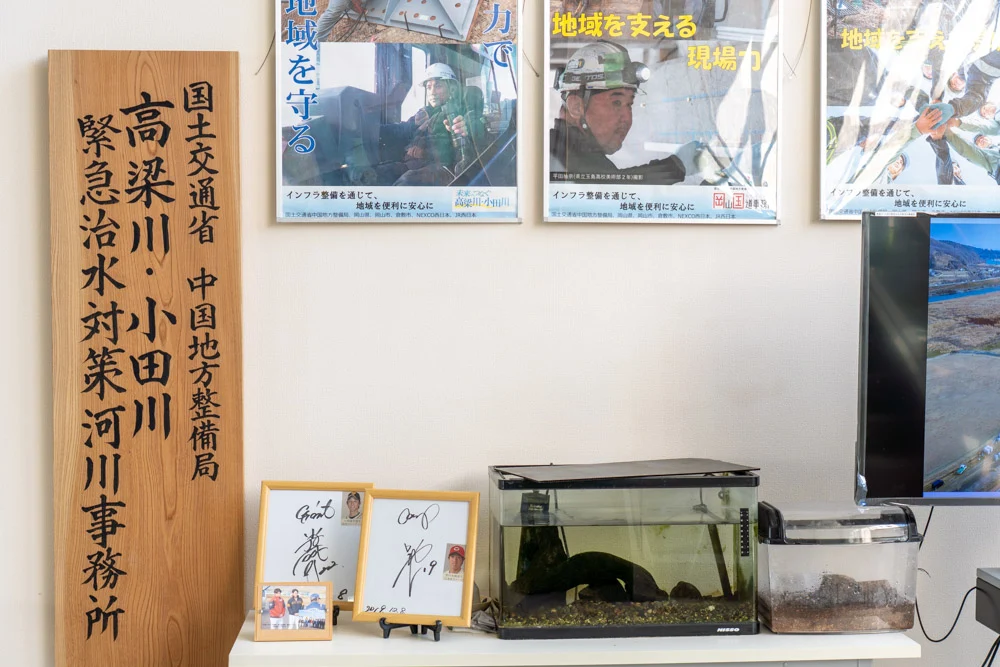
Please tell us about the office.
Hamada
As of February 2022, there are 24 staff members in the office.
The work we are doing primarily involves hard measures.
We issue construction orders, supervise the sites, and our technical staff is involved in design. We also coordinate based on requests from local residents.
The rest are administrative staff.
The main work is general affairs, but what is different from other offices is that we have a tool called "My Timeline" for creating evacuation plans, and we also conduct outreach lectures for "Nige Kid" (Evacuation Kid).
This is not limited to Mabi, and we provide lectures upon request from within Kurashiki City, which is something that staff in other offices may not have the opportunity to experience.
So, if you let us know, we will be happy to visit.
About the "Oda River Confluence Point Relocation"
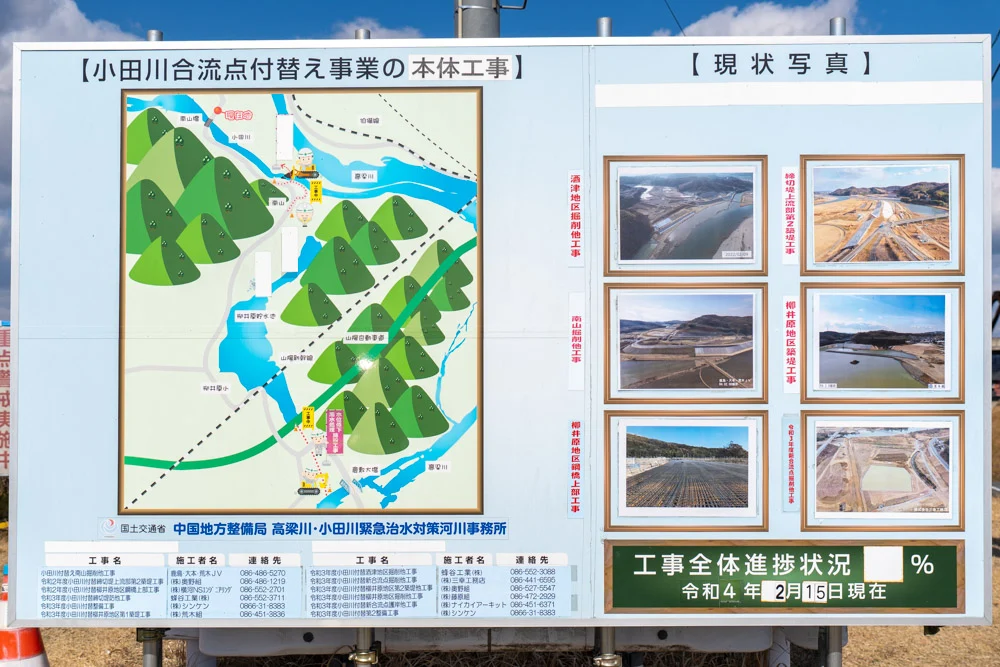
The main hard measure seems to be the "Oda River Confluence Point Relocation." Can you tell us about its features?
Hamada
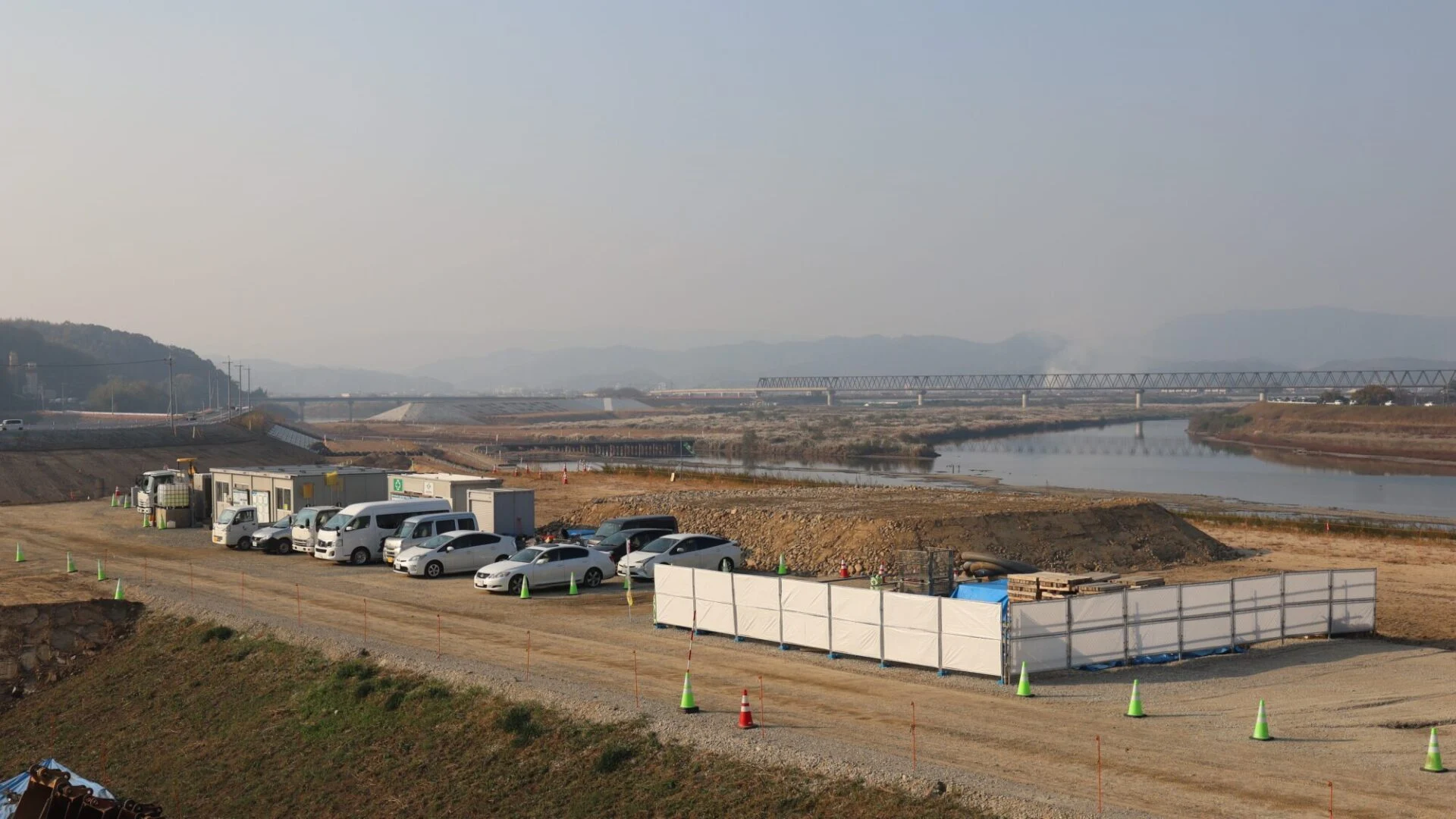
We are relocating the confluence point to about 4.6 kilometers downstream, and the biggest advantage is that it will reduce the occurrence of the so-called "backwater phenomenon."
Since the Oda River flows east-west, it has a gentler slope compared to the north-south flowing Takahashi River. Therefore, it is more susceptible to the influence of the Takahashi River, making the "backwater phenomenon" more likely to occur.
By relocating the confluence point, we can steepen the slope, which will make backwater less likely to occur.
It is a grand project, but I have heard that it was not planned in response to the July 2018 heavy rain disaster.
Hamada
That's correct.
In fact, it was planned as a "large-scale general improvement project," and it was commercialized in 2014, with local surveys, environmental impact assessments, and investigations of buried cultural properties conducted, and we were about to start temporary construction in the fiscal year 2018.
At that time, the heavy rain disaster in July 2018 occurred.
Since we had already started in 2014, the current construction could begin immediately, but without that, we might have only just started in 2022.
The construction, which was originally planned to take ten years, is being shortened to five years, but the fact that the design was already completed (meaning what needed to be done was decided) played a significant role in making this possible.
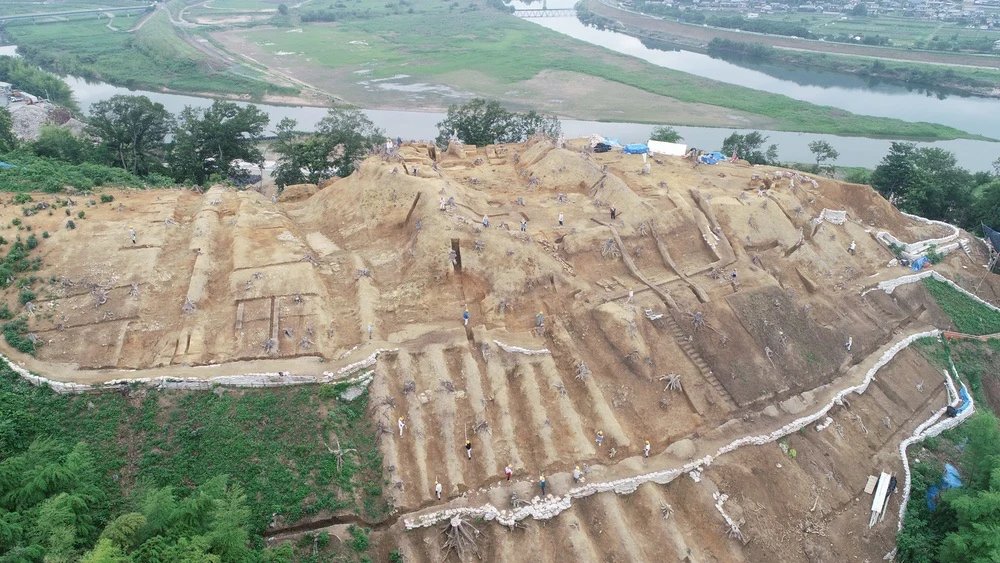
Photo provided by the Takahashi River and Oda River Emergency Flood Control Office
The investigation of buried cultural properties in Minamiyama seems to have become a topic of discussion after the construction began. Was this already being conducted?
Hamada
We had already been conducting it since 2017.
Excavation surveys take time, but they need to be completed before the project starts, so we were already working on it.
In Kurashiki, about 100 years ago, the East Takahashi River was abandoned and consolidated, leading to the creation of the Takahashi River East-West Water Supply Distribution Facility. I have heard that it was a major project at the time, but are such constructions rare?
Hamada
There are shortcuts, but I think "relocating the confluence point" is rare even on a national scale.
Struggling with the exchange of "soil" during construction
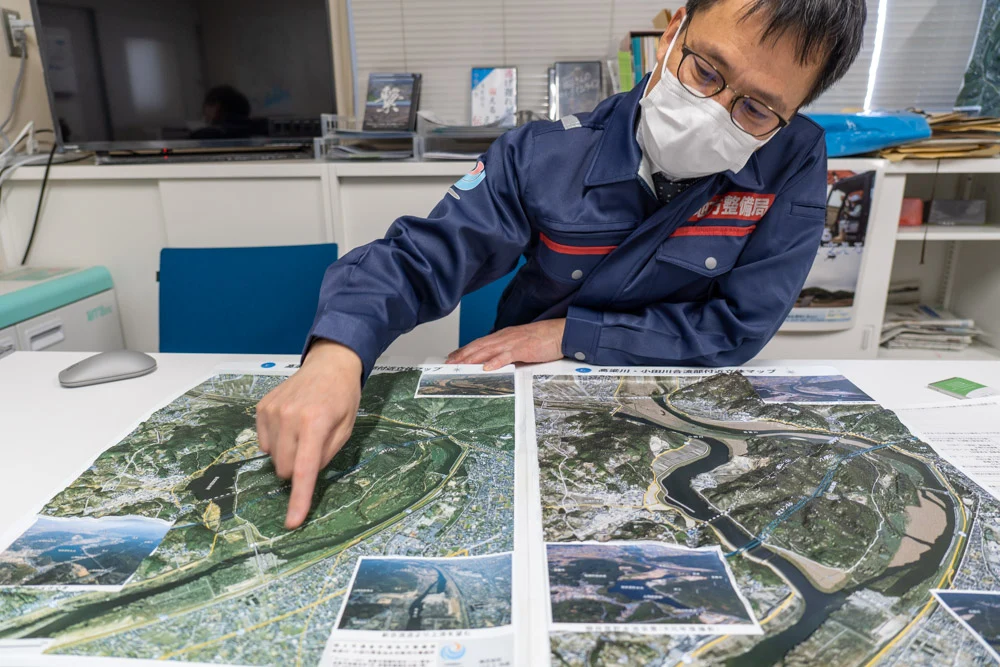
Are there any difficulties due to the fact that a large-scale construction that was originally planned to take ten years is now being done in five years?
Hamada
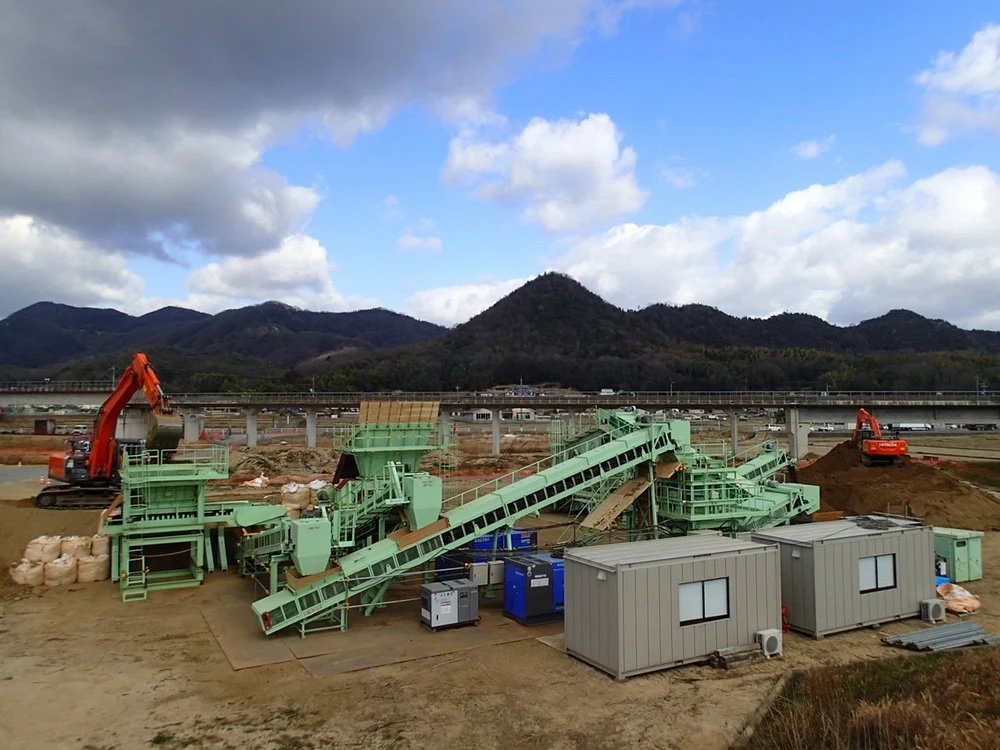
There are various challenges, but when it comes to construction, we are struggling with the exchange of "soil."
We are clearing Minamiyama and excavating the river, which generates an enormous amount of "soil," and we have to figure out what to do with it.
It would be easy if we could use the excavated soil directly for the levee, but the soil from the Oda River is "clayey" and difficult to use as is, so we are mixing it with the "sandy" soil from the Takahashi River.
This means we need to coordinate with the Takahashi River side for the construction.
To mix it, we need to gather it somewhere. If we have time, we can consider it slowly, but we are required to efficiently proceed with "excavating, mixing, and piling" at the same time, which is challenging.
Moreover, initially, there is plenty of space for storage, but as the construction progresses and the area is developed, the storage space decreases.
It might be possible to take it far away, but that would incur costs in terms of both time and money.
The site is required to work as efficiently as possible nearby, so it is quite challenging.
Please tell us about the current progress of the construction as of February 2022.
Hamada
In terms of progress rate, it is "52%," and we are on schedule.
There are two years left until the planned completion of the construction. The completed appearance is gradually becoming visible.
The reinforcement of the Takahashi River levee is being implemented as part of the "three-year emergency measures for disaster prevention and mitigation, and national resilience"

The construction of the Oda River is going smoothly.
By the way, I believe that levee reinforcement work is also being carried out on the Takahashi River. Is it being progressed in parallel?
Hamada
As I mentioned earlier, since we are using "soil," it is true that there is a connection, but from a project perspective, they are separate.
The construction of the Takahashi River is being carried out by the Okayama River Office as part of the "three-year emergency measures for disaster prevention and mitigation, and national resilience." While they are separate projects, they are not completely unrelated, as this is also necessary work for flood control.
As seen in the July 2018 heavy rain disaster and Typhoon Hagibis in 2019, disasters are increasing nationwide.
There is a consensus that "we need to properly engage in flood control," and budgets have been secured for implementation.
Since absolute safety cannot be guaranteed, I want you to remember to "evacuate first"
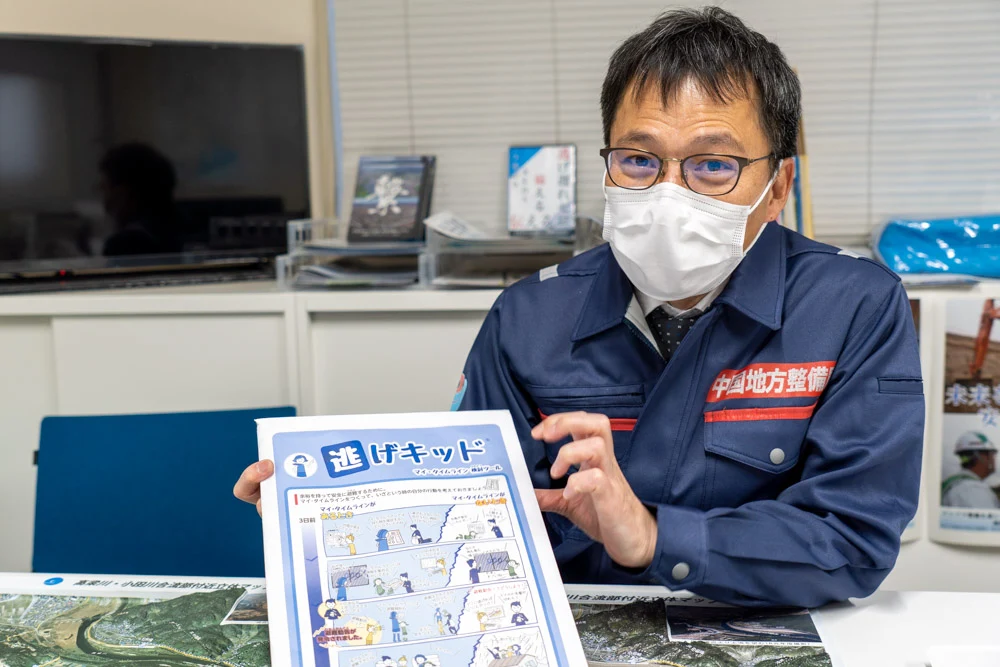
Finally, please give a message to the residents of Mabi and Kurashiki City.
Hamada
The national, prefectural, and city governments have been continuously improving flood control, so the safety level of flood control is gradually increasing.
This is my personal opinion, but I want to reach a state where "the river flows normally" is taken for granted.
I used to think it would be nice if "it rained a lot" became natural instead of "it was scary when it rained," but now that feeling has become less sweet.
Therefore, I want you to recognize that "evacuating first" is important.
I often hear from local people, "Since so much construction is being done, it must be safe now."
However, as I have mentioned, we cannot say "it is absolutely safe," so we say, "it will be safer than in July 2018."
Even after this project is completed, the risk will not be zero. Please do not forget to protect yourself.
Also, for those currently living in Kurashiki, you may not know where you will go in the future due to further education, employment, or transfers.
If you create and study something like "My Timeline," it will help you be more aware of safety wherever you go.
Moreover, even if you are healthy now, you never know what will happen next year. It may be necessary for everyone to review their plans.
I would be happy if more people had that awareness.
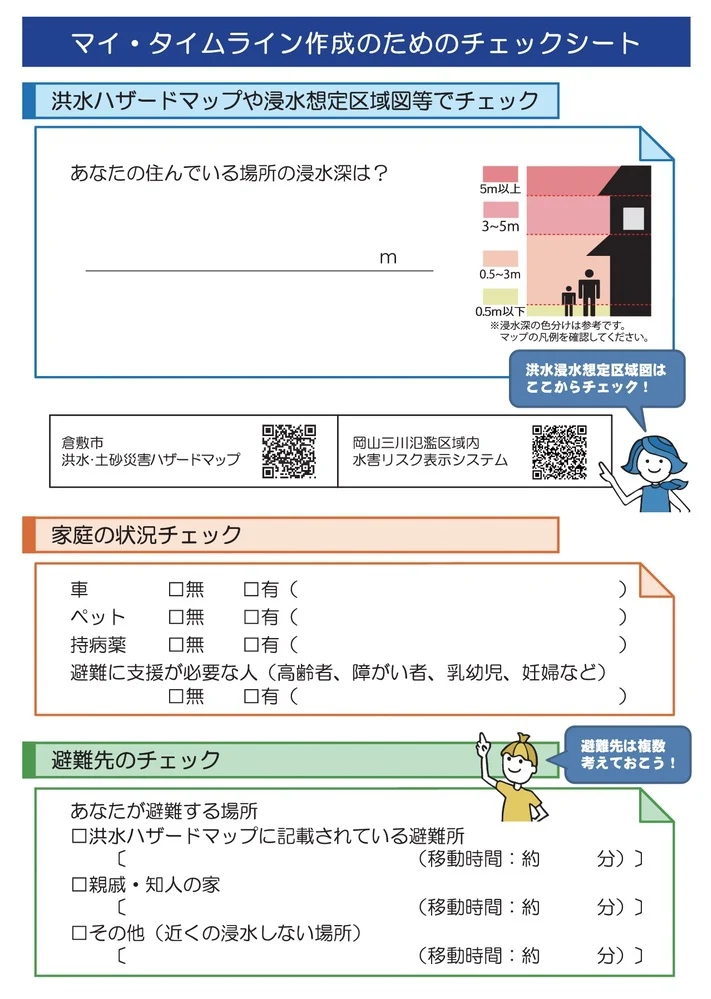
- Download "My Timeline Creation Support Tool - Escape Kid"
- Escape Kid User Guide (YouTube)
Conclusion
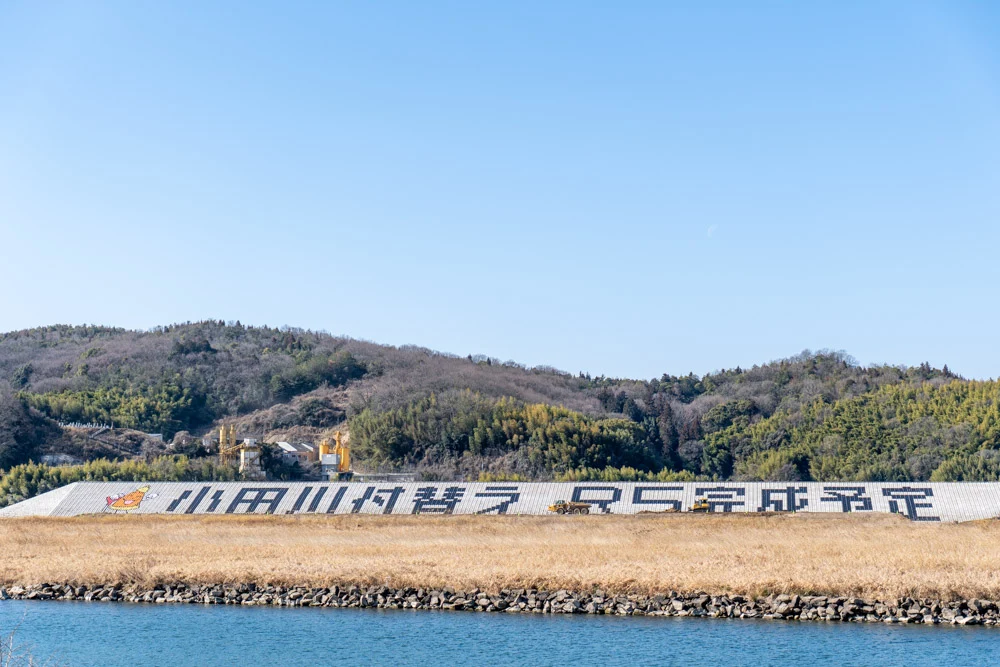
I have lived in Kurashiki for about 30 years out of my 42 years of life, but until the heavy rain disaster in July 2018, I thought disasters were something far away.
Since then, I have prepared for disaster awareness and the ability to escape by checking hazard maps, confirming evacuation centers, and preparing emergency supplies, but I cannot deny that my awareness has faded over time.
One reason for this is that I thought, "Since such large-scale construction is being carried out, I will feel safe once it is completed."
However, what left an impression on me was the repeated statement during the interviews that "I cannot say it is absolutely safe. I want you to escape when it is dangerous, and I want you to always prepare for that."
Construction is currently ongoing with the aim of completion by March 2024 (the end of the 5th year of Reiwa), and it will be safer than before once completed.
However, I realized that it is necessary to always be aware of the risks of living there.