Takahashi River Shijuku aims to achieve the SDGs in the Takahashi River basin and is a school designed to create human resources capable of playing a central role in community activities.
From June 2021 to September 2021, Takahashi River Shijuku 2nd Term was held, with about 30 lectures planned by instructors active in the Takahashi River basin.
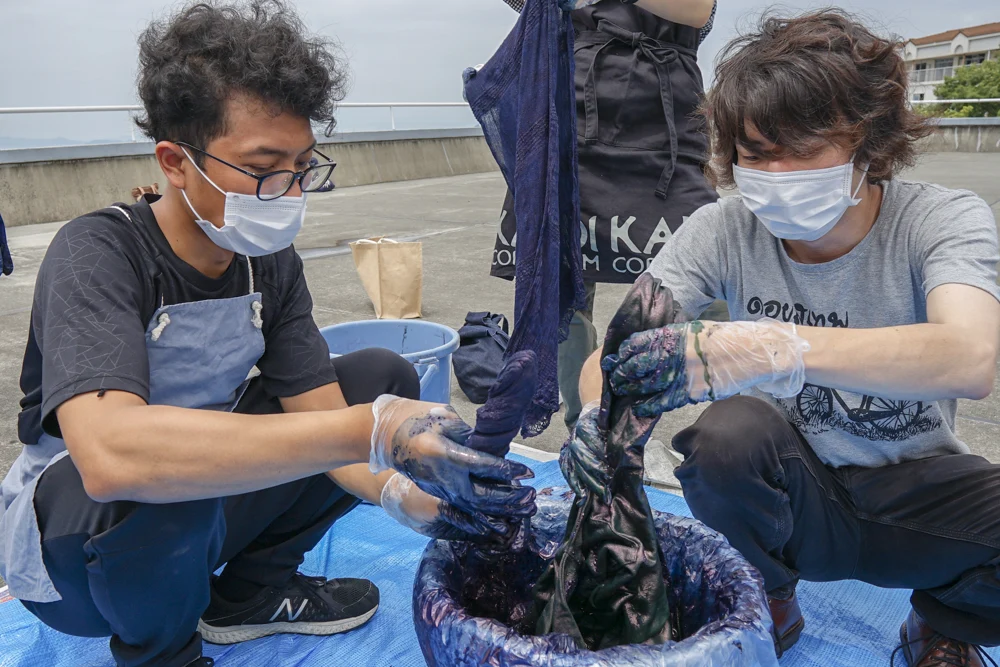
On July 3, 2021 (Saturday), a course was held to deepen understanding of jeans, a specialty of Kojima in Kurashiki City, featuring Ikegami Yoshiyuki, a former regional revitalization cooperation team member from Kurashiki City, who conducted a indigo dyeing and slen dyeing experience.
Having participated in the dyeing experience and learned about dyeing with the students, I will introduce the content of the course.
Overview of Takahashi River Shijuku
Takahashi River Shijuku is operated by the general incorporated association Takahashi River Basin School as a commissioned project by Kurashiki City, aiming to foster human resources that will support community development and sustainable regions through history, culture, industry, and fieldwork in the Takahashi River basin.
There are two types of courses available:
- "SDGs Exploration Course" which includes practical training and presentations
- "Auditor Course" where participants can attend optional lectures
The first term of Takahashi River Shijuku was held from November 2020 to February 2021, and the second term began in June 2021.
The opening ceremony was held on June 27, 2021 (Sunday), and about 30 lectures are scheduled until the completion ceremony on September 26, 2021 (Sunday).
The content of the lectures includes the following five categories.
| Category | Content |
|---|---|
| SDGs Vision Edition | A course where participants can hear about the 2030 vision and current initiatives in the Takahashi River basin from instructors actively engaged in activities |
| Cultural Edition | Courses to gain knowledge about history, culture, and industry in the Takahashi River basin |
| Skills Edition | Courses to acquire necessary skills and know-how for carrying out activities in the community, such as presentations, utilization of IT tools, and use of blogs and social media |
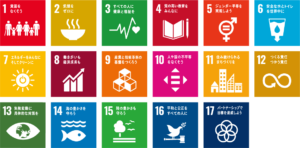
| Local SDGs Mission Edition | A workshop to redefine the 17 goals of the SDGs as objectives for the Takahashi River basin |
| Fieldwork | Experiential learning for community revitalization in the Takahashi River basin |
In the first term, there were three types: SDGs Vision Edition, Cultural Edition, and Skills Edition, but from the second term, Local SDGs Mission Edition and Fieldwork have been newly added.
For those who want to know more details, please check the special page for "Takahashi River Shijuku".
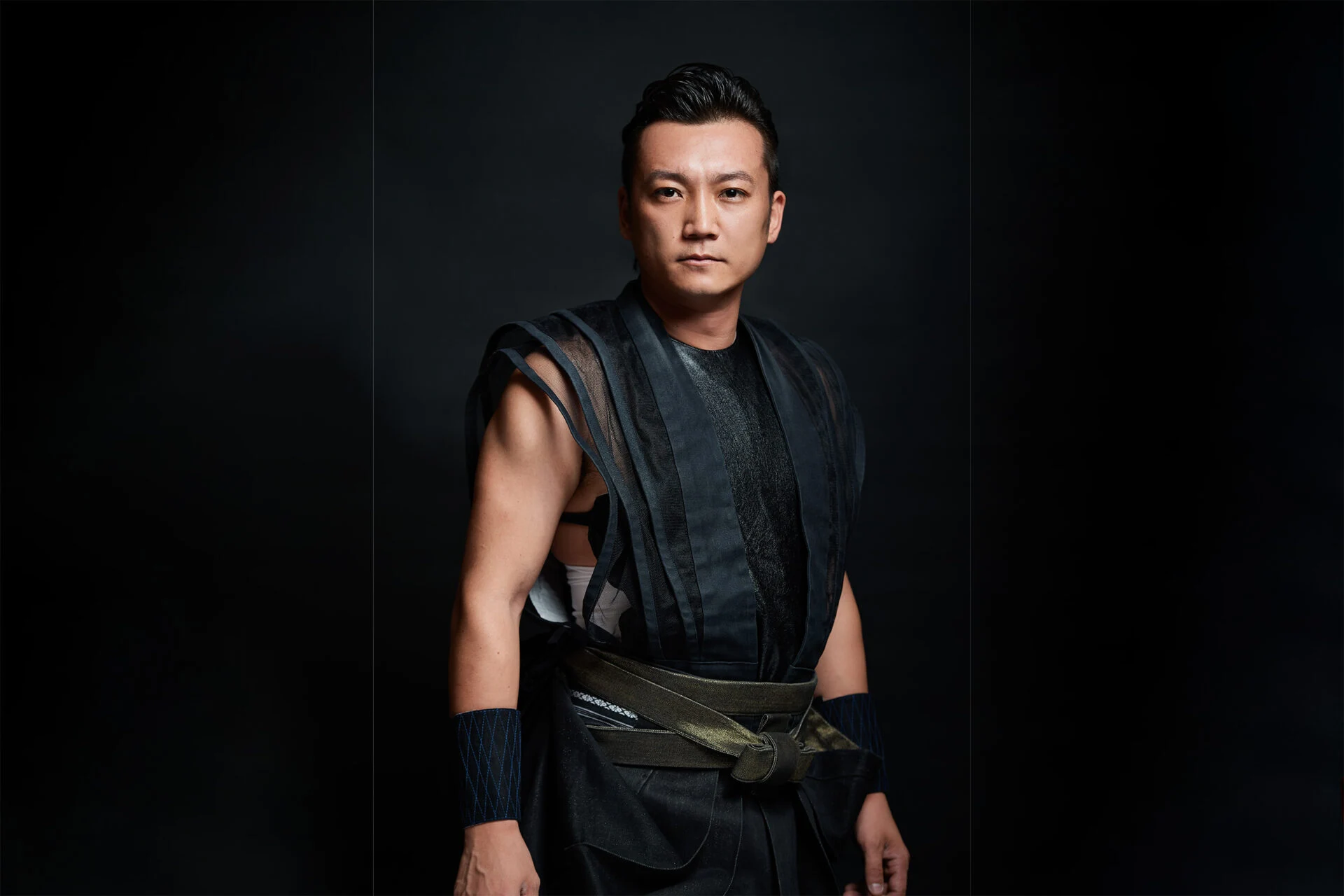
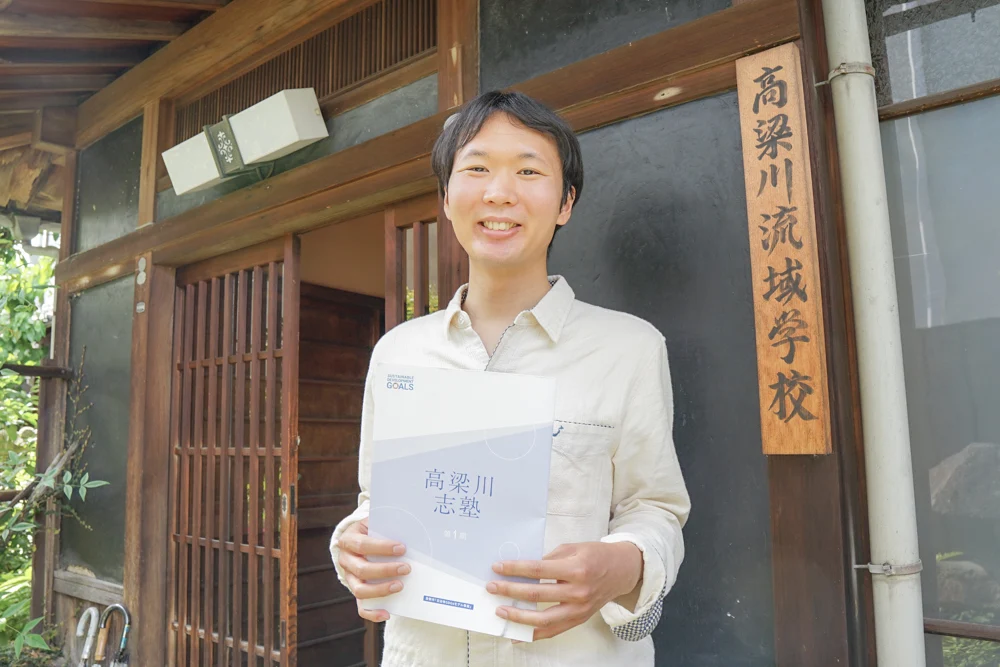
Introduction of Ikegami Yoshiyuki, representative of land down under
Biography of instructor Ikegami Yoshiyuki
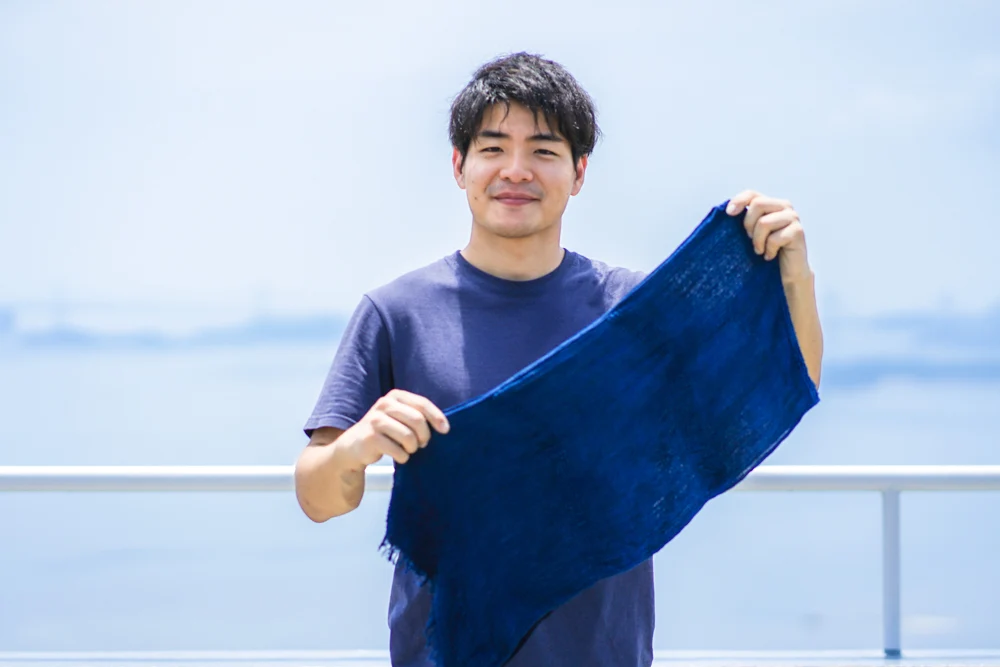
Instructor Ikegami aims to create jeans that do not produce waste by circulating resources and established the apparel brand land down under in January 2021.
Ikegami, who has been interested in clothing production since his student days, moved to Kojima in Kurashiki City, the birthplace of domestic jeans, as a regional revitalization cooperation team member.
While working as a regional revitalization cooperation team member, he became aware of the structure of the textile industry, where products are mass-produced and discarded, through interactions with local producers and clothing production.
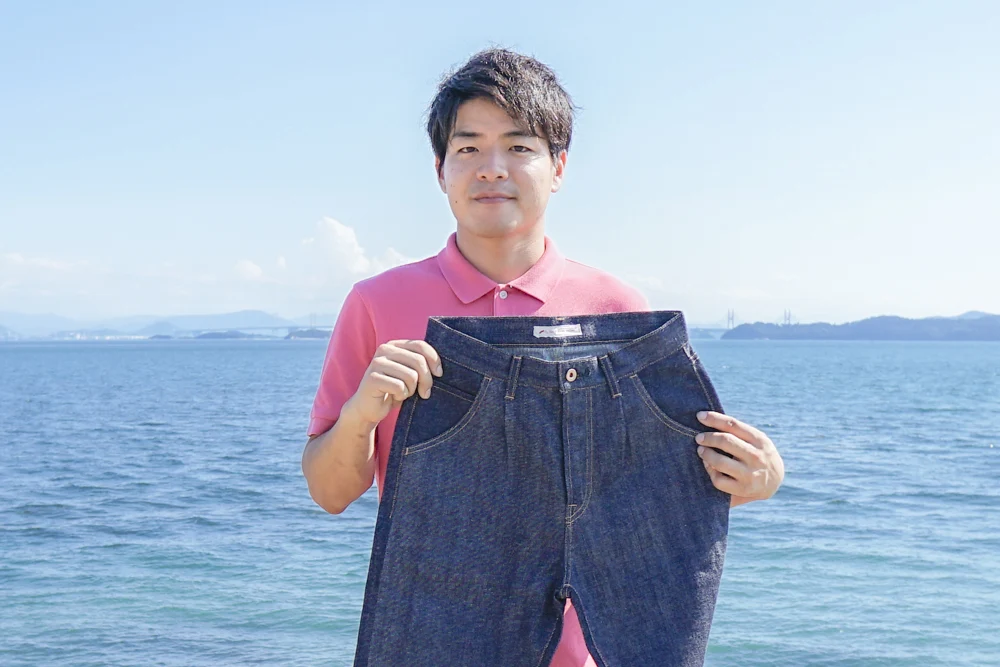
Based on the concept of circular economy, he proposed "circular jeans" that do not produce waste by reusing materials.
After completing his term as a regional revitalization cooperation team member in March 2021, he continues to convey the mechanisms and ideas of circulating materials through the business of land down under.
Lecture venue "Ojigadake Resthouse"
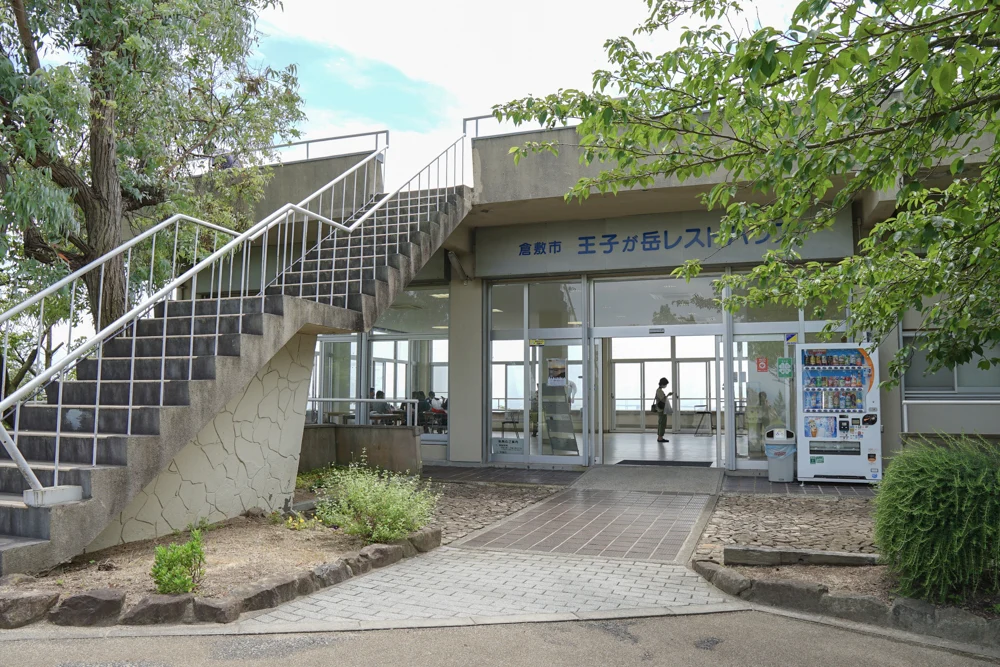
The lecture venue was held at the Ojigadake Resthouse located in Kojima Karakoto-cho, Kurashiki City.
It is a rest facility of Kurashiki City located near the summit of Ojigadake, facing the Seto Inland Sea.
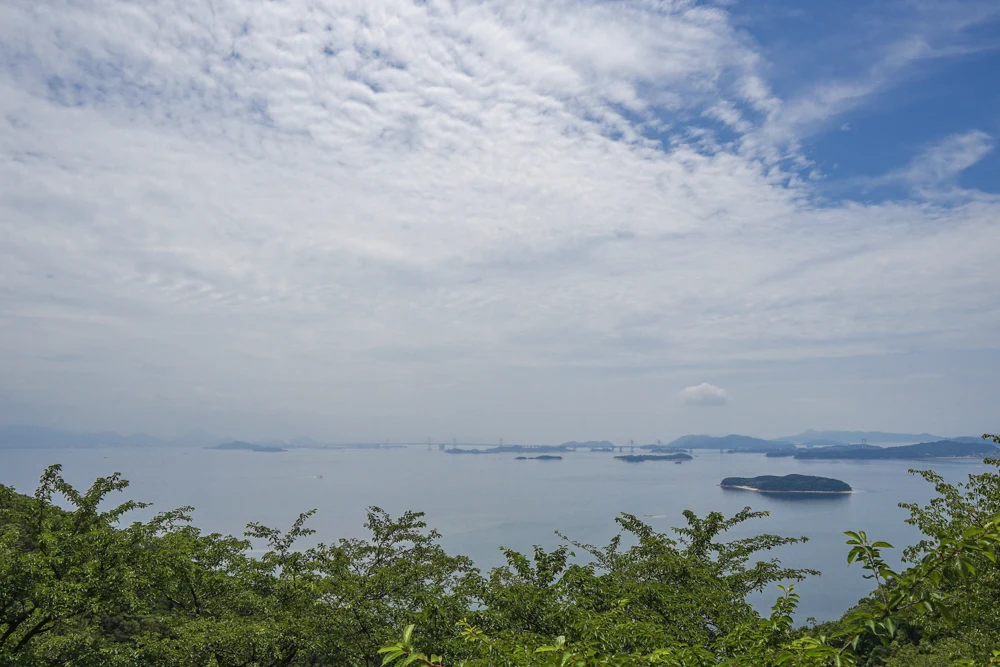
From the Ojigadake Resthouse, one can enjoy a wonderful view of the beautiful islands of the Seto Inland Sea.
In the first half of the lecture, classroom instruction was conducted on the first floor of the facility, followed by a dyeing experience on the rooftop in the second half.

What is fieldwork?
Ikegami conducted fieldwork in Kojima as a regional revitalization cooperation team member and realized the necessity of creating jeans based on the circular economy.
Starting his life in Kojima without a specific purpose, Ikegami has been visiting various places to gather information in order to discover new business opportunities.
In the lecture, he shared how he has approached fieldwork from various perspectives.
- Do not go looking for problems
- Consider problems from multiple angles
- Fieldwork has no end
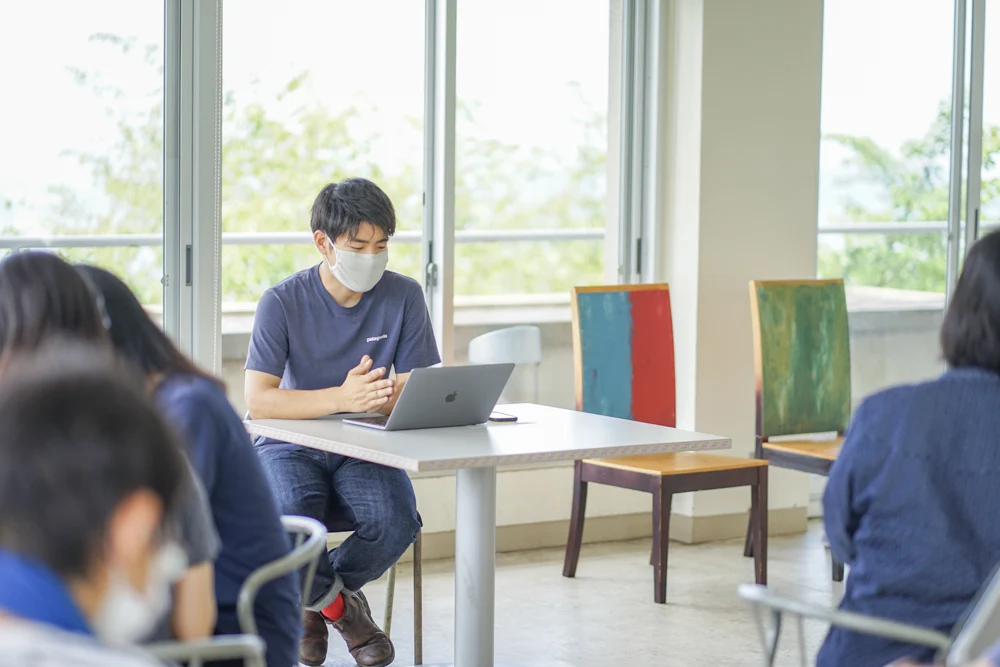
Do not go looking for problems
If you set a problem, you will tend to view things from a biased perspective, making it difficult to think from an objective standpoint.
If you approach local stakeholders with a biased opinion, it can lead to difficulties in relationships.
It is important to gather information from a neutral position without preconceiving problems.
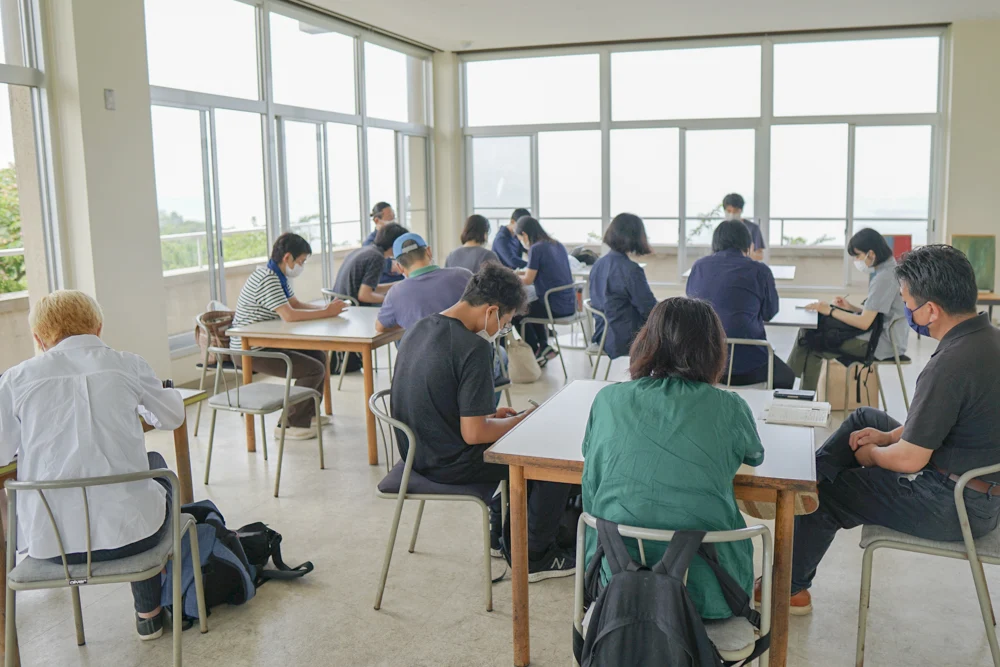
Consider problems from multiple angles
What may be beneficial for one person can be a problem for another.
For example, the business owner of a shop in a tourist area and the local residents.
While many tourists coming to the town can lead to prosperous business, the hustle and bustle of a crowded town can also disrupt the peaceful lives of residents.
Considering the perspectives of many people is crucial for identifying the essence of the problem.
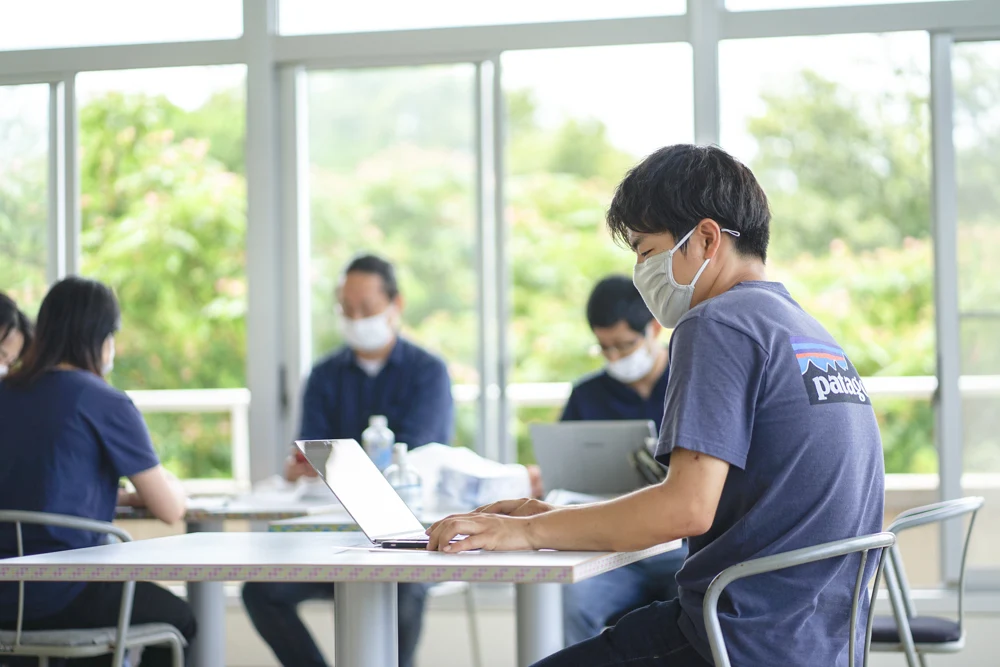
Fieldwork has no end
What is needed changes with the times.
It is important to continue observing and questioning, as understanding something or knowing something is not possible.
The phrase "Yesterday's common sense is today's nonsense. Yesterday's nonsense is today's common sense" was particularly striking.
Basic knowledge for indigo dyeing and slen dyeing experience
Why fibers are dyed
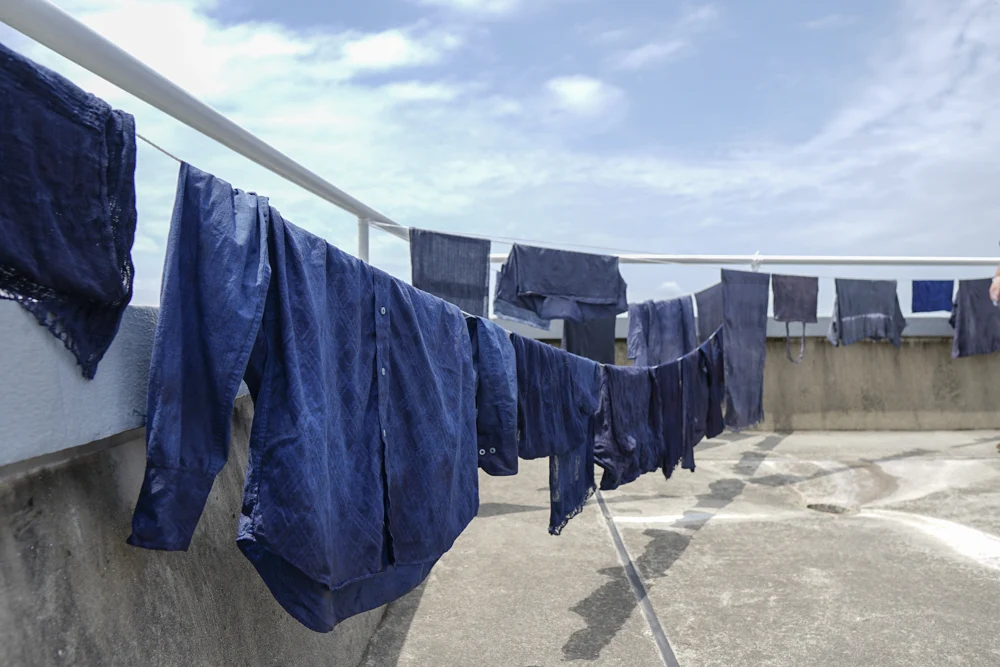
The experience includes indigo dyeing and slen dyeing.
Both indigo dyeing and slen dyeing are classified as a dyeing method called building dyeing.
Building means to make it alkaline and in a reduced state.
After soaking the fabric in the dye, exposing it to air causes oxidation, changing the dye particles into an insoluble form that adheres to the fibers.
Indigo dyeing
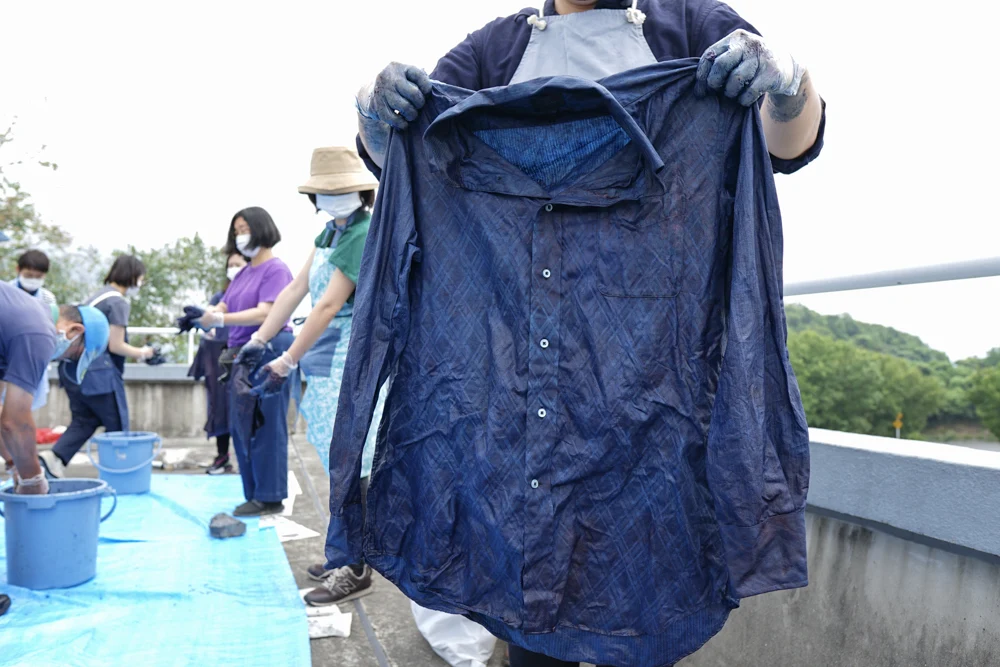
The characteristic of indigo dyeing is that it has large dye particles.
Because the particles are large, they tend to fade easily, creating the unique aging effect of jeans.
A dyeing method that is as familiar as indigo dyeing is ai (indigo) dyeing.
In fact, the dye used in indigo dyeing is made from petroleum-derived substances that are artificially produced.
On the other hand, the dye used in ai dyeing is a naturally derived substance obtained from the plant indigo.
It is said that both have the same molecular structure, but indigo dyeing can be mass-produced, significantly reducing costs, which is why it is used in jeans that are commonly sold.
Ai dyeing is labor-intensive, and there are ai-dyed jeans that can cost several hundred thousand yen.
Suren dyeing
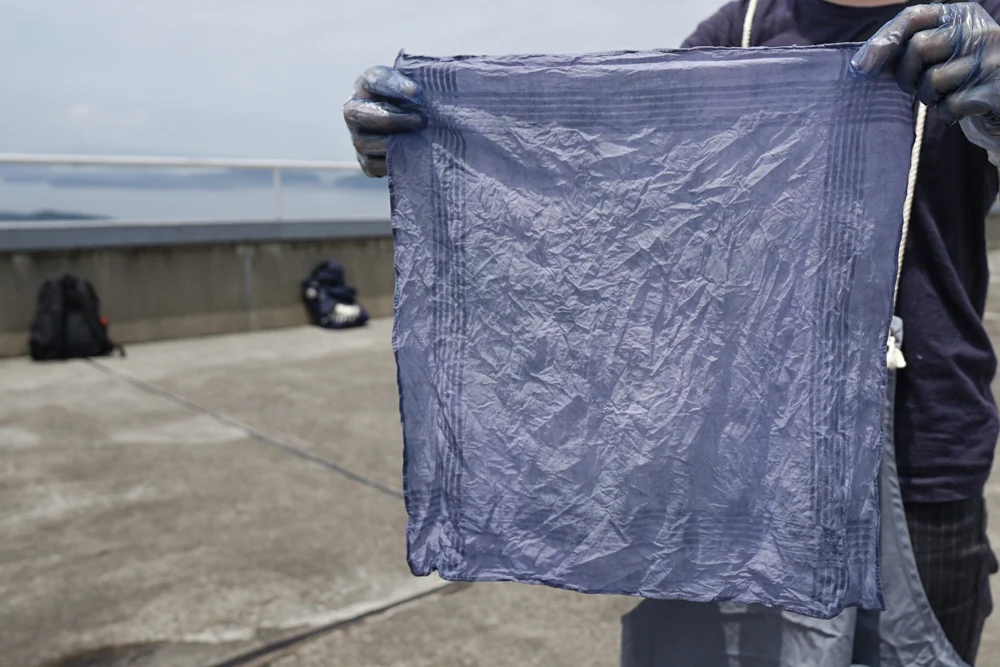
Suren dyeing, in contrast to indigo dyeing, uses small dye particles.
Once attached to the fibers, they are difficult to come off, making it less prone to fading compared to indigo dyeing.
Because it is less prone to fading even when wet or rubbed, it is a dyeing method often used for work clothes.
It was explained that this dyeing method is a specialty in the Setouchi region, particularly around Kojima.
Dyeing experience
Preparing the dye
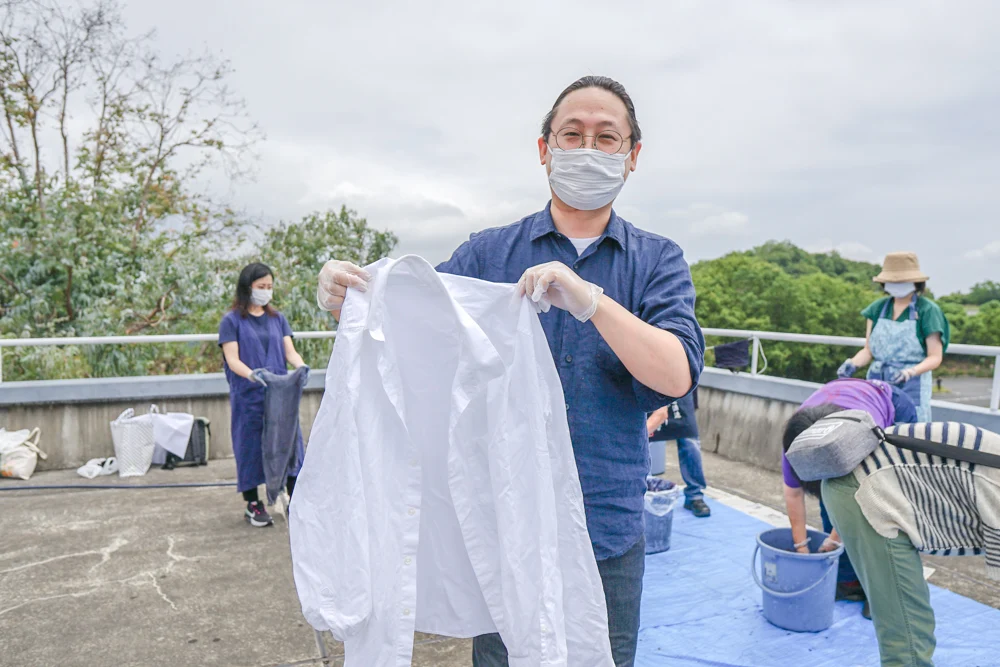
After the lecture, we went up to the rooftop of Ojigadake Rest House for the dyeing experience.
The participants each prepared white towels or shirts.
▼This is the dye for indigo dyeing.
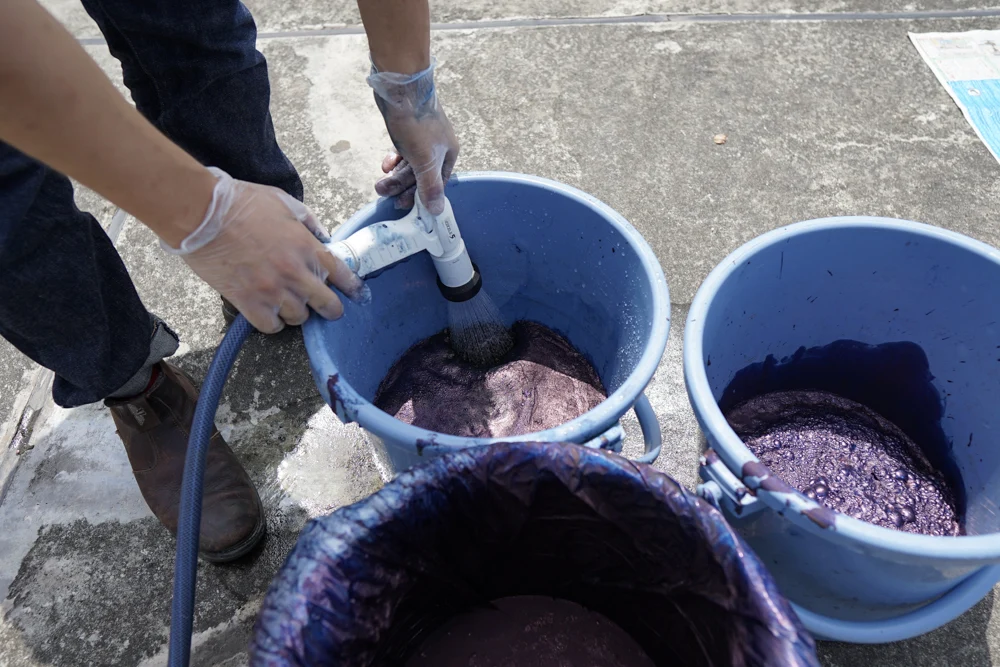
The dye is stored in powder form, so it is used by dissolving it in water.
When I brought my face close to the bucket containing the dye, I sensed a distinctive smell.
It has a scent reminiscent of the weak rotten egg smell of hydrogen sulfide that drifts in hot spring areas.
▼This is the state of the dye before soaking the fabric.
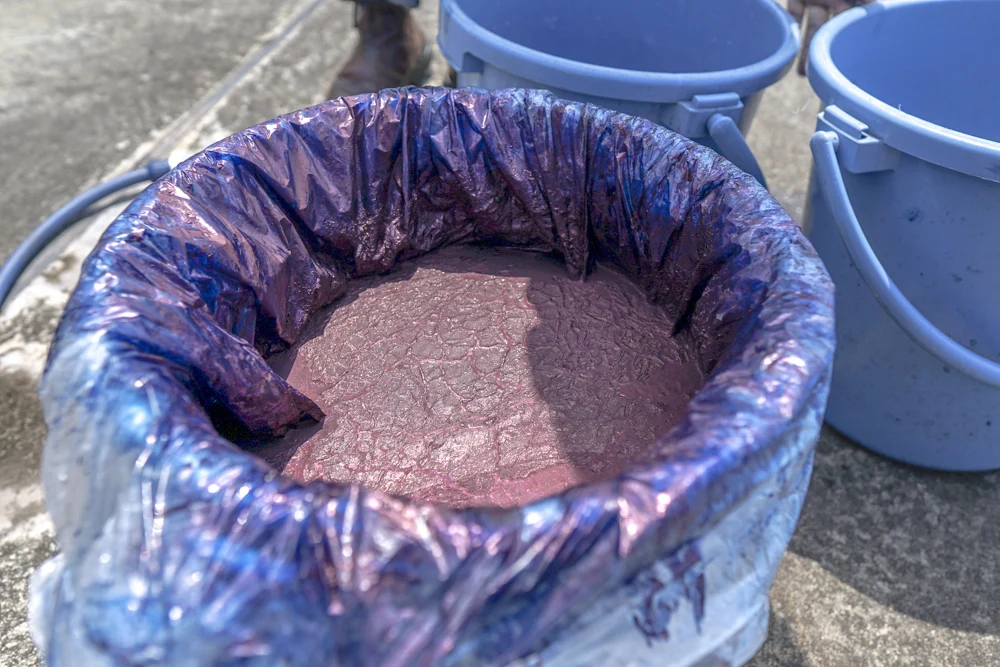
On the surface of the dye solution that is exposed to air, a purple film has formed.
It seems that oxidized dye floats on the surface of the dye solution.
There are no solids under the film, only the dye dissolved in the aqueous solution.
▼This is the dye for suren dyeing.
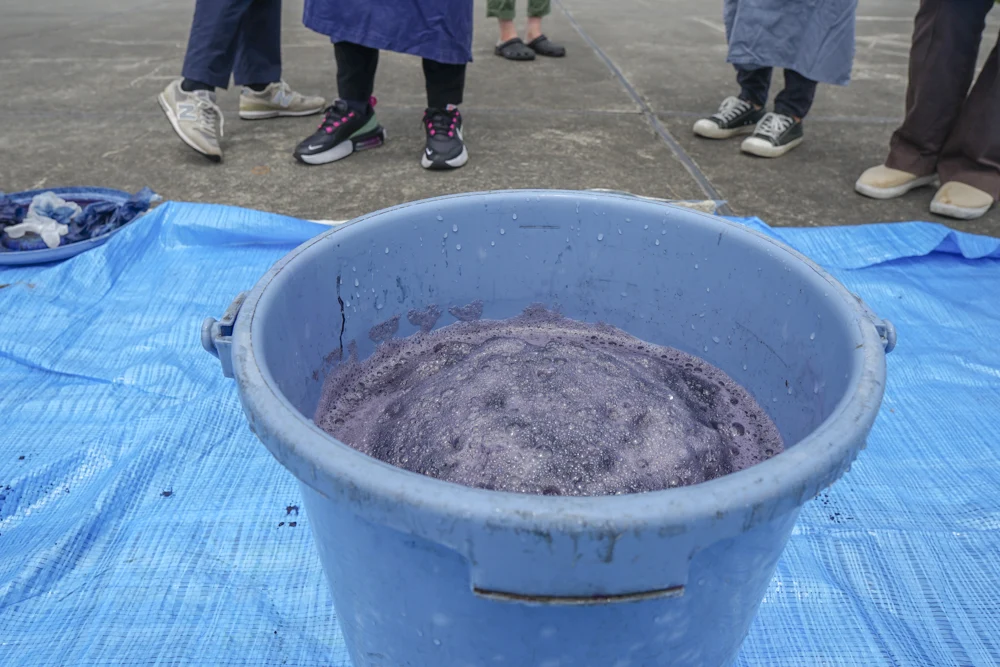
Integrating the dye into the fabric
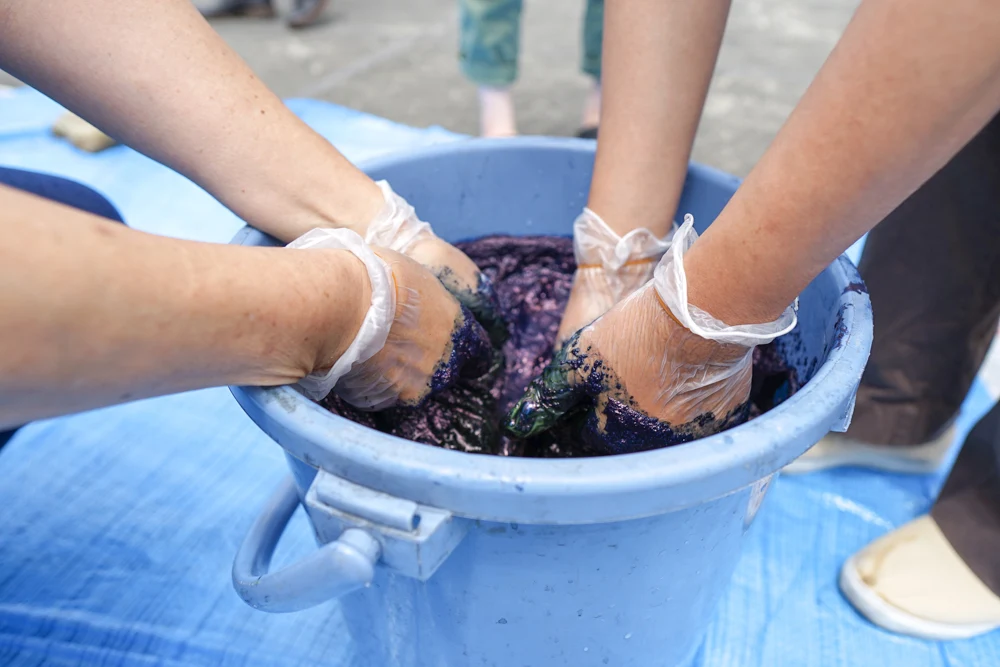
By kneading the fabric in the liquid, the dye is absorbed.
Performing the dyeing work with bare hands is dangerous.
The dyes used in indigo dyeing and suren dyeing are alkaline and have the property of dissolving proteins, so we wear vinyl gloves to protect our hands while working.
In fact, I felt a slight stinging pain in the areas where the dye splashed and adhered to my arm.
▼If you look closely at the vinyl gloves, you can see green and blue areas.
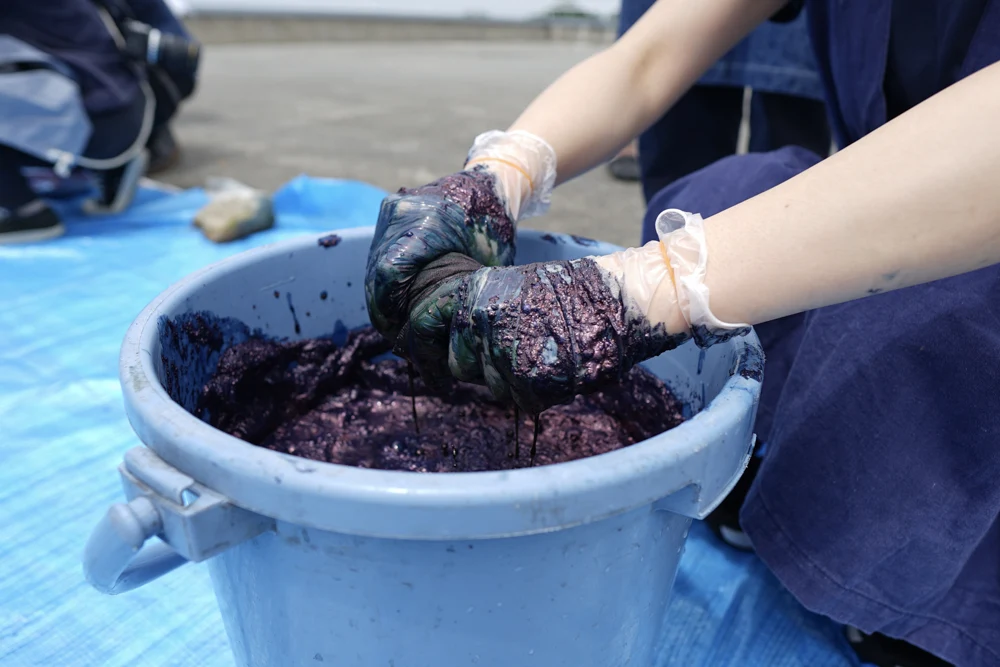
The green areas indicate the color of the dye that has not yet oxidized, while the blue areas indicate the color of the oxidized dye.
▼This is the state of the fabric after absorbing the dye.
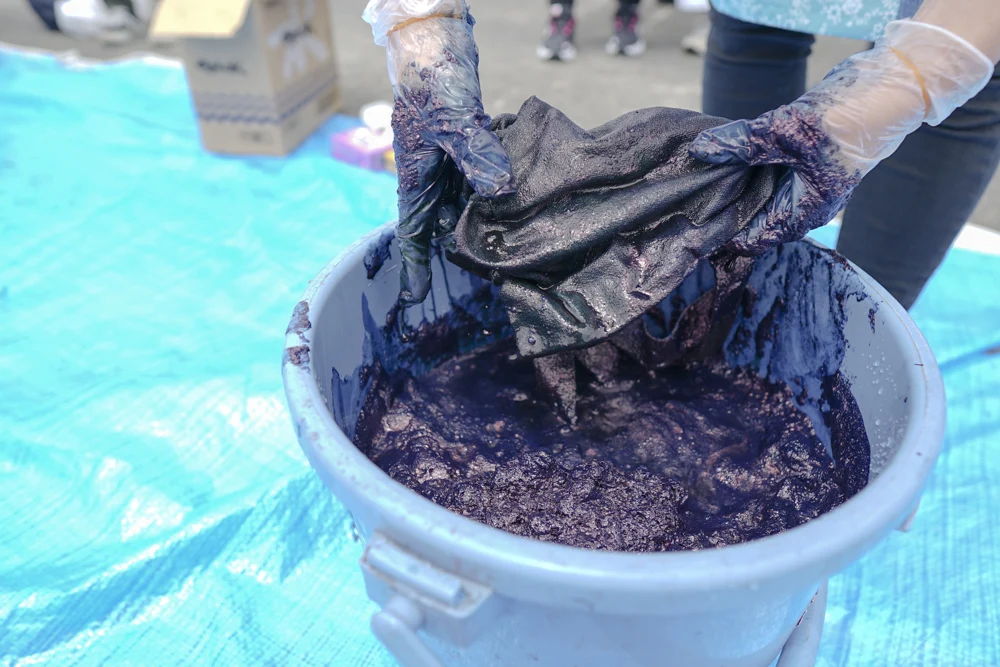
It appeared to have a slightly greenish color.
The subtle differences in color are information that can only be gained through experience.
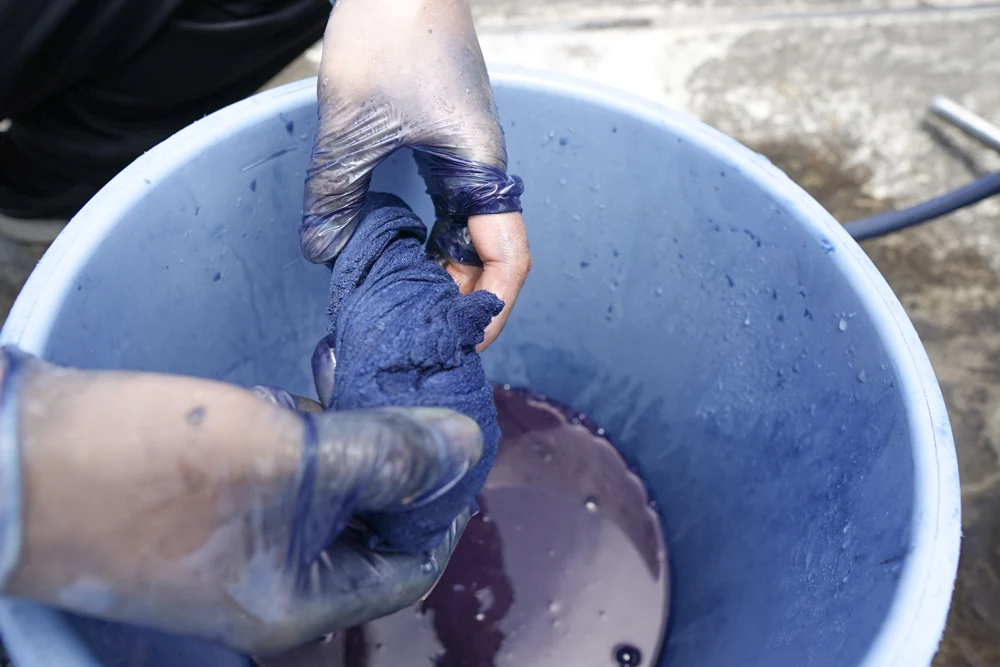
▼Next is the process of wringing out the fabric to remove excess dye.
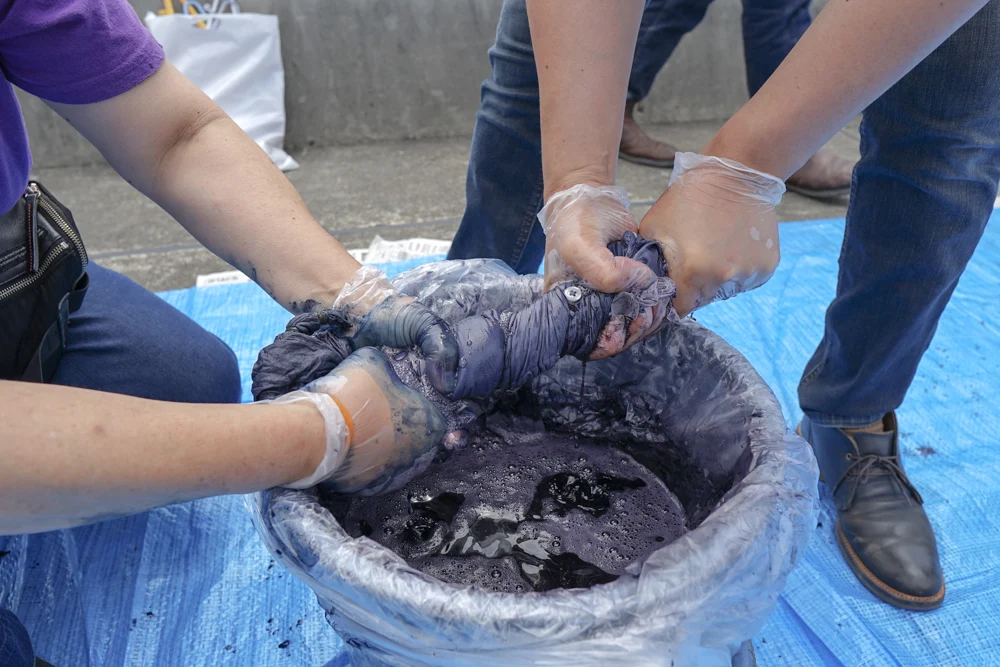
Thin fabric is easy to wring out, but due to wearing vinyl gloves, I found it quite difficult to wring out the thick fabric.
This can lead to uneven coloring, so it is important to thoroughly remove excess dye.
Drying
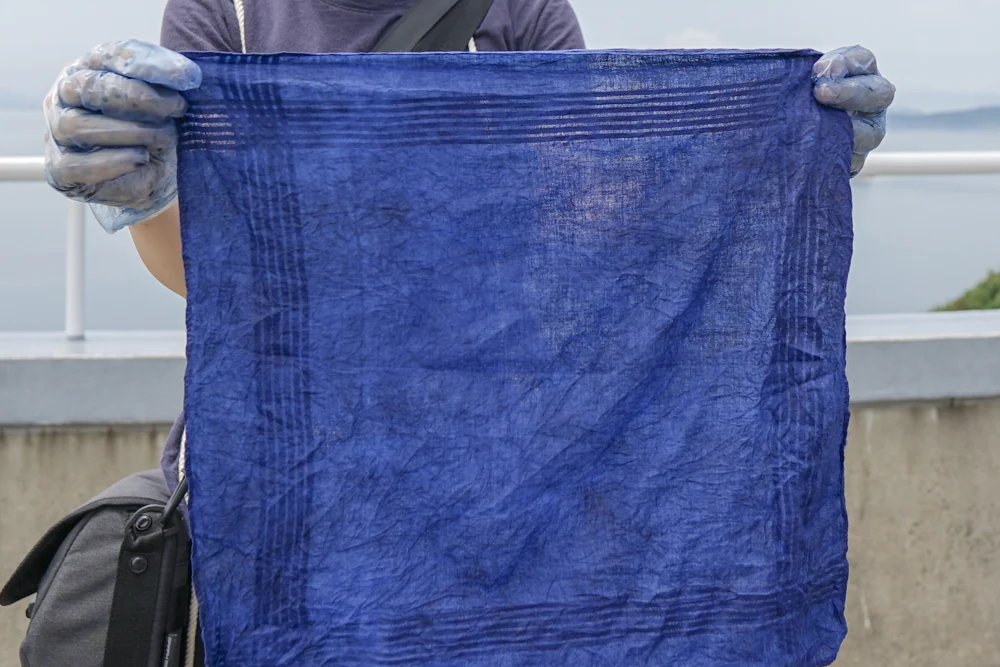
This is the state of the fabric after wringing it out.
When it was soaked in the bucket, it was a deep green or blue, but after wringing out the dye and spreading the fabric, it turned into a light, refreshing color.
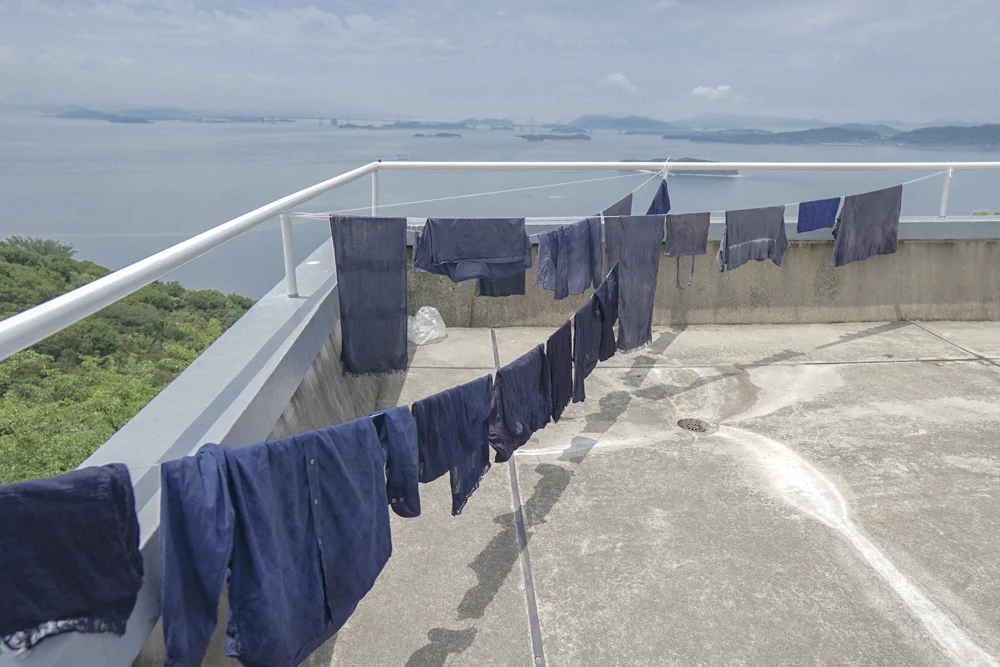
Next, the fabric is dried to oxidize the dye and attach it to the fibers.
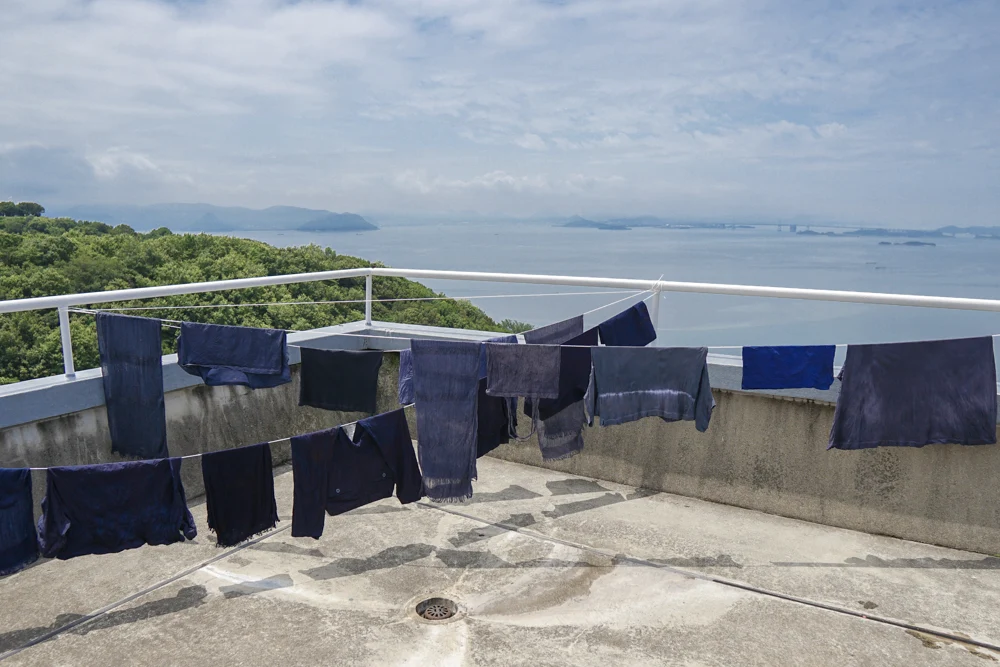
Against the backdrop of the beautiful islands of Setouchi, the sight of indigo-dyed and suren-dyed fabrics drying is a scene that symbolizes the textile town of Kojima.
Rinsing
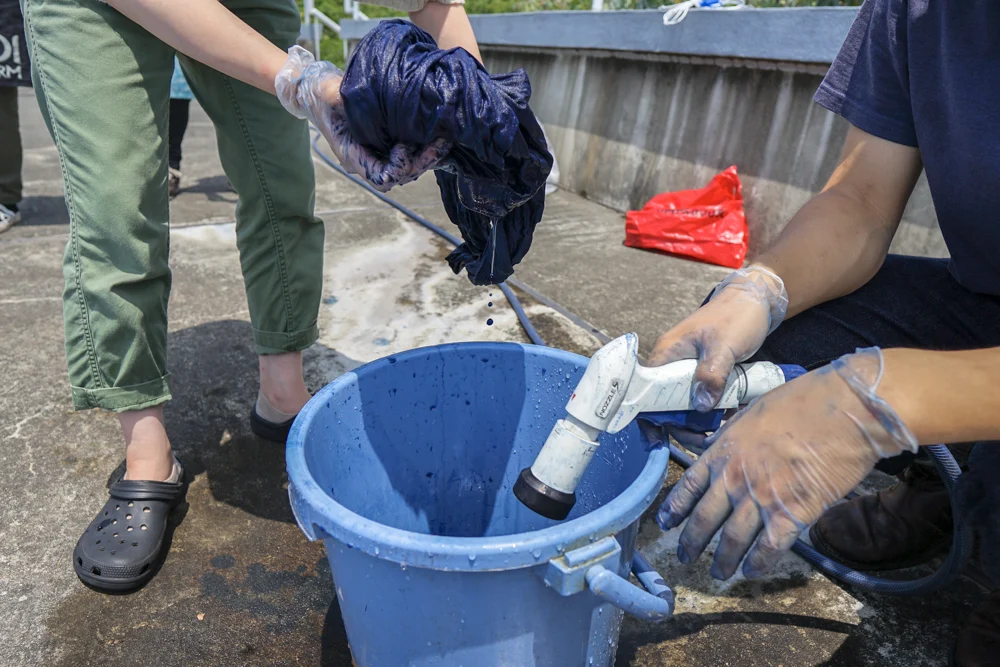
After about 10 minutes of exposure to the wind, we rinse it with water.
After rinsing, the fabric is dried again.
If you want to dye it darker, you can soak it in the dye solution again and repeat the above process.
The state of the fabric one week later
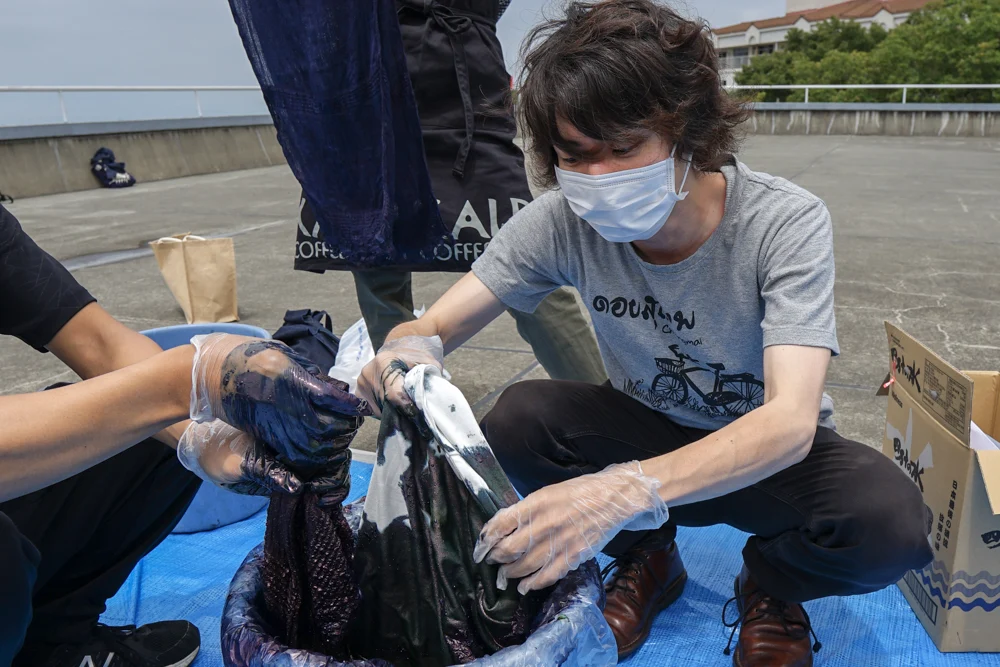
In fact, I also had the experience of dyeing a T-shirt with indigo.
▼This is my T-shirt after rinsing.
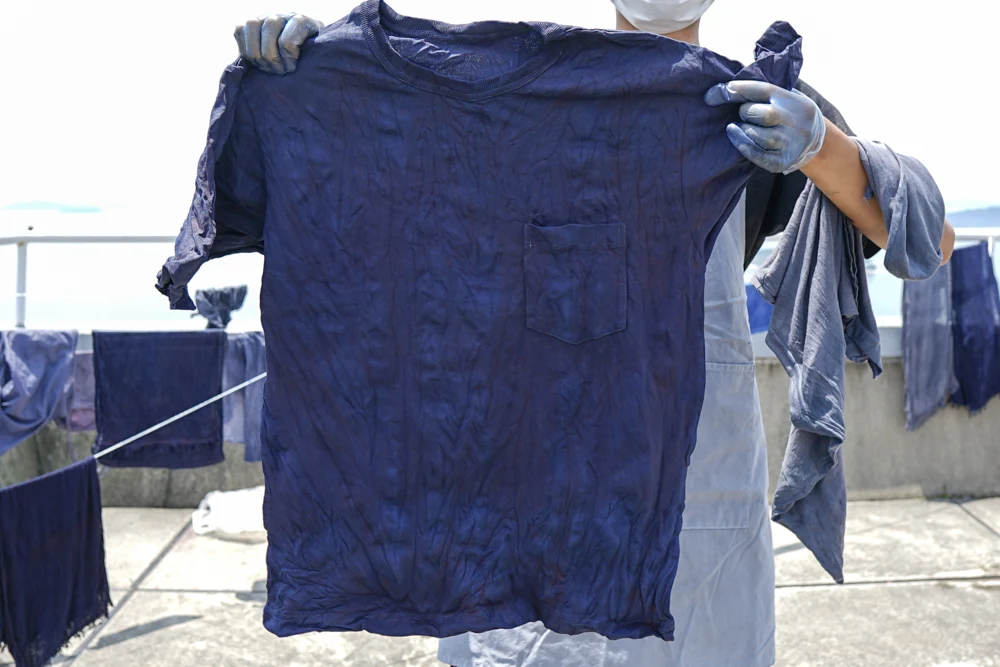
It is dyed a deep blue, but it appears to have some unevenness.
Because it was a thick fabric, it was difficult to wring it out, and I could not achieve uniform dye penetration.
It's frustrating, but knowing the actual difficulty of the work is also a learning experience unique to the workshop.
I took the T-shirt home, rinsed it again, and then dried it.
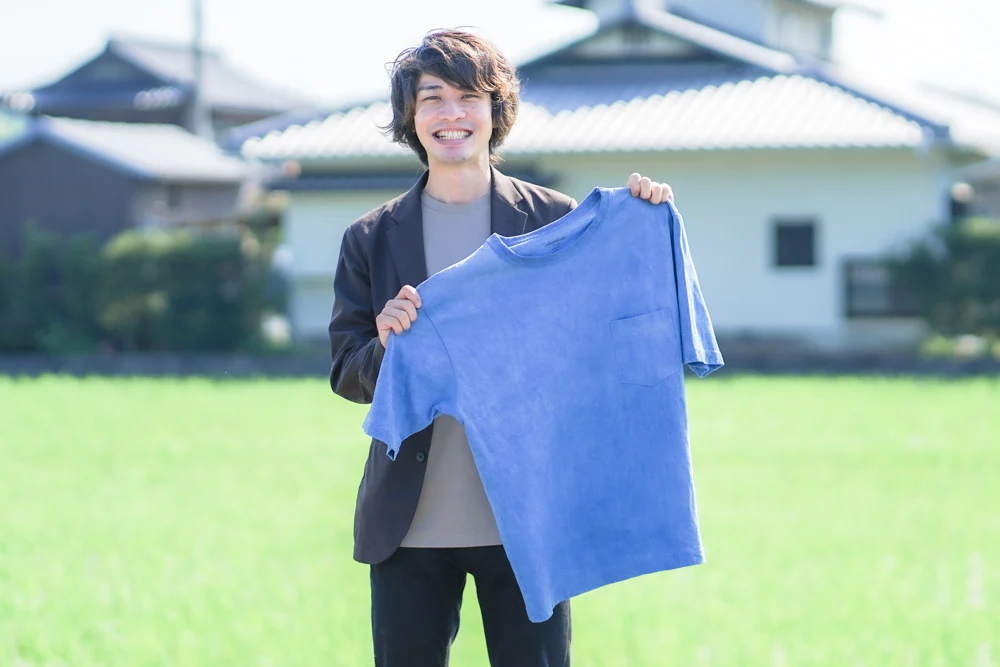
I was surprised to see that the deep blue color had changed to a light blue.
When I actually experienced it, there were many things regarding the smell, texture, and color that I could not understand just by listening to the lectures, and it was very educational.
After the dyeing experience
Since I became interested in jeans from Kojima, I have started to see the term indigo dyeing.
I only had the knowledge that it was the process of dyeing fabric blue, but when I actually experienced it, it stimulated my five senses and left a deep impression.
The unique smell that lingers in my nose, the stinging pain from the dye that adhered to my skin, and the changing color of the dye over the course of the process and time.
The information gained through the five senses is far more stimulating than the information obtained from books or the internet.
This lecture reaffirmed that learning through experience provides much more information than learning through text.
Additionally, while touching on the local culture, I was able to interact with instructors and students active in the Takahashi River basin, and I felt it was a very fulfilling time.
It became a fieldwork that satisfied both my senses and my heart.
Data for the Takahashi River Shijuku 2nd Term
| Name | Takahashi River Shijuku 2nd Term |
|---|---|
| Dates | Duration of Takahashi River Shijuku 2nd Term: June 27, 2021 – September 26, 2021 |
| Location | Ojigadake Hill Rest House |
| Participation Fee (including tax) | For details, please check the Takahashi River Shijuku website. 1. SDGs Exploration Course Participants General: 12,000 yen, Students: 8,000 yen (Participation in all programs on the day and archive viewing available) *Uniform fee regardless of whether attending in person or online 2. Auditors (attending only lectures) In-person attendance: 1,500 yen per session (limited number of participants) Online/Archive attendance: 500 yen per session *Pages will be provided later for participants only. *Some courses may require additional actual costs. *Some courses may be available for free. |
| Website | Takahashi River Shijuku | Takahashi River Basin School |