When you think of history classes in school, they started with the Paleolithic period. Do you remember seeing the words “Kofun period” in the scope of your first term exam?
Those burial mounds you saw in textbooks and reference books still exist in large numbers throughout Kurashiki City.
Let’s take a closer look at the nationally designated historic site Yata Otsuka Burial Mound, located about 1.8 km from Kibinomakibi Station in Mabi, Kurashiki City.
The information presented here was current when this article was published in October 2025. Please note that it may differ from current information.
About Yata Otsuka Burial Mound

Yata Otsuka Burial Mound is a circular burial mound located in Yata, Mabi, on the north bank of the Oda River, a tributary of the Takahashi River.
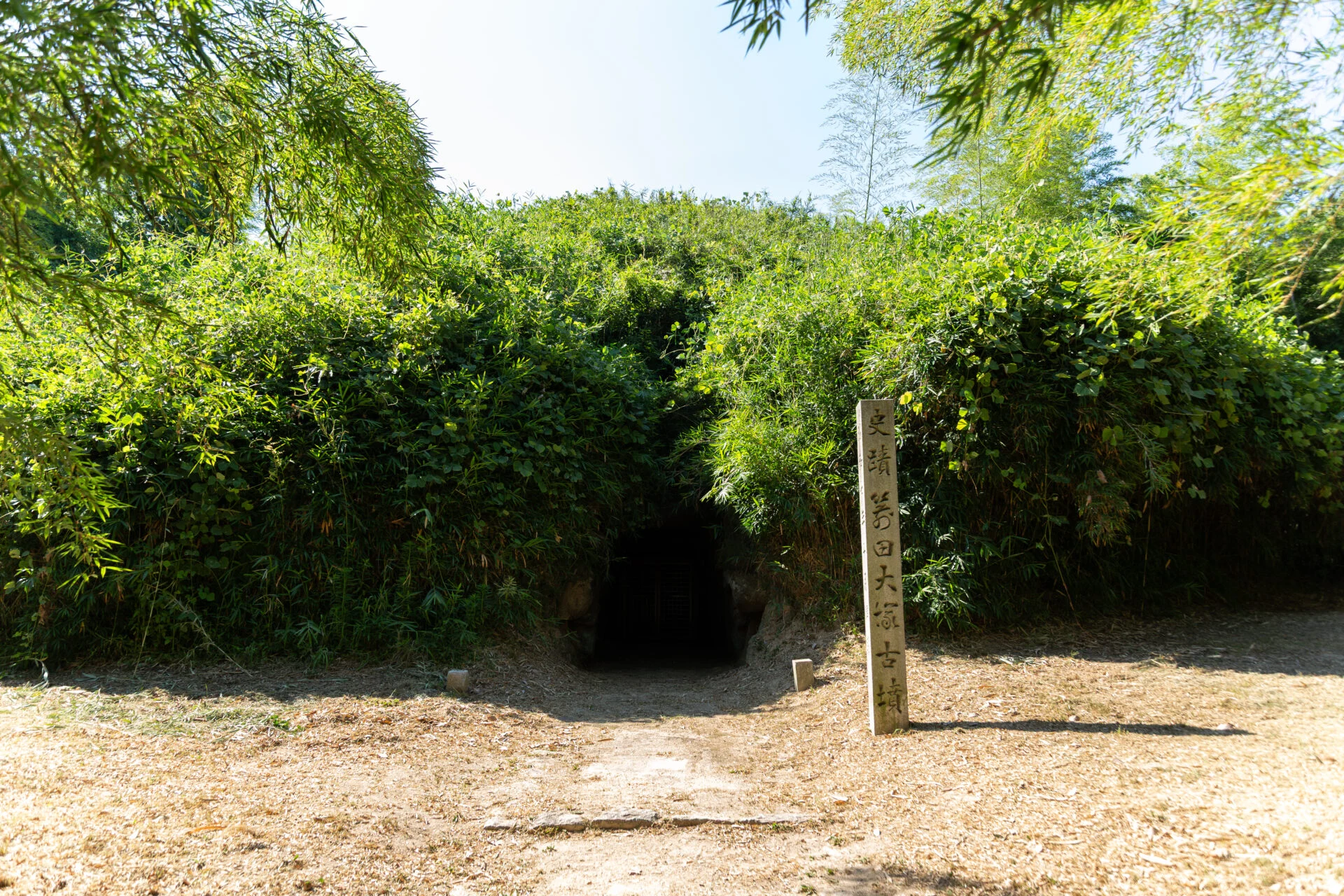
From a distance, it looks like a forest, but Yata Otsuka Burial Mound lies within it.


There is an opening at the side of the burial mound, allowing visitors to enter the stone chamber.

One of Okayama Prefecture’s three great megalithic burial mounds

The stone chamber is 19.1 meters long, making it one of the five longest in Japan. Along with Musa Otsuka Burial Mound (Okayama City) and Komorizuka Burial Mound (Soja City), it is counted among Okayama Prefecture’s three great megalithic burial mounds.
Yata Otsuka Burial Mound has a ceiling made of four megaliths and a rear wall made of a single megalith. Its dimensions are as follows:
- Total length: 19.1 m
- Main chamber, where the coffin was placed: 8.4 m
- Height: 3.8 m
- Width: 3.0 m
The stone chamber is usually kept locked.
It was specially unlocked for us to take photographs for this article.
Some grave goods designated as Kurashiki City Important Cultural Properties
Yata Otsuka Burial Mound has been known since ancient times, and an excavation survey was conducted in 1901.
Weapons, horse tack, beads, and other grave goods discovered during the survey are held by Kibidera Temple and the Tokyo National Museum.

Among them, the pommel of a single-phoenix ring-pommeled sword held by Kibidera Temple was designated a Kurashiki City Important Cultural Property in 2020.

Interview with a Kurashiki City official

We spoke with Fujiwara Noriyoshi of the Kurashiki City Cultural Properties Protection Division about why Yata Otsuka Burial Mound is protected as a nationally designated historic site, among other topics.
I’ve heard that Yata Otsuka Burial Mound is a must-see historic site for fans of burial mounds.
Fujiwara (honorific omitted)
Yata Otsuka Burial Mound is a large burial mound with one of the five longest horizontal-entry stone chambers in Japan. It’s very unusual for a chamber to be spacious enough for an adult to stand upright inside without stooping.

Ishibutai Kofun in Nara Prefecture, said to be the tomb of Soga no Umako, who is believed to have wielded power comparable to that of the imperial family during Prince Shotoku’s time, also has a horizontal-entry stone chamber and is about the same size as Yata Otsuka Burial Mound.
It is very unusual to find such a large stone chamber in a rural area, so Yata Otsuka Burial Mound is known to many researchers of burial mounds.
What kind of person was buried at Yata Otsuka Burial Mound?
Fujiwara
It is thought that a powerful family from the Nara period, the Shimotsumichi clan, may have been buried there.
In ancient administrative divisions, the area around Yata Otsuka Burial Mound was called Shimotsumichi District in Bitchu Province, and Kibi no Makibi, a scholar and politician of the Nara period, is said to have been a descendant of the Shimotsumichi clan.

Are excavation surveys conducted regularly?
Fujiwara
The most recent survey was conducted in 1983 by the former Mabi Town Board of Education.
The extent of the burial mound was measured, and based on artifacts such as Sue ware that were unearthed, it is thought to have been built in the latter half of the sixth century and used for additional burials until the beginning of the seventh century.
The parking lot and the path from the parking lot to the burial mound were also improved at that time, and benches were installed around the mound.


In an excavation conducted earlier, in 1901, decorative items were also unearthed, including a single-phoenix ring-pommeled sword hilt, a cultural property designated by Kurashiki City.
Decorative items, including the single-phoenix ring-pommeled sword hilt, are held at Kibidera Temple, built on the site of Yata Abandoned Temple, and the Tokyo National Museum.
Finally, do you have a message for our readers?
Fujiwara
Kurashiki City has only two nationally designated historic sites: Yata Otsuka Burial Mound and Tatetsuki Site. They are extremely valuable, so I hope more local people will learn about them.
And I hope that the people of Kurashiki City will continue to protect these precious historic sites.
From the Writer

After visiting Yata Otsuka Burial Mound, stop by nearby Makibi Park. At Takenoko Chaya in the park, you can also find original masking tape and stamps featuring Yata Otsuka Burial Mound, making them nice souvenirs.


Yata Otsuka Burial Mound has been carefully preserved from 1,400 years ago to the present day.
It is one of Japan’s proud historic sites that we hope to pass on for another 1,000 years.
Articles about Kurashiki City’s Japan Heritage
Yata Otsuka Burial Mound Information

| Name | Yata Otsuka Burial Mound |
|---|---|
| Address | Yata, Mabi, Kurashiki City, Okayama Prefecture |
| Contact | 086-426-3851 |
| Website | Kurashiki City Official Website |




What would you like to know about Kurashiki?
Enter a search term to find articles on this site