
In 2019, the Mozu-Furuichi Kofun Group in Osaka Prefecture was registered as a UNESCO World Heritage Site, leading to increased attention on burial mounds.
When discussing burial mounds, one cannot avoid mentioning haniwa.
Did you know that the origin of haniwa is in Okayama Prefecture?
In fact, the Kibi region (spanning from Okayama Prefecture to the eastern part of Hiroshima Prefecture) is an area rich in ruins and burial mounds, alongside the Kinai region and Izumo.
Historically, Kibi was an area ruled by one of the most powerful forces in the country.
The Kurashiki Archaeological Museum showcases many valuable materials excavated from the ruins of the Kibi region.
The Kurashiki Archaeological Museum is one of the cultural facilities that represent the area around the Bikan Historical Area, alongside the Ohara Museum of Art and Kurashiki Museum of Folkcraft.
The Bikan Historical Area retains buildings and atmosphere from the Edo and Meiji periods, and among them, the Kurashiki Archaeological Museum stands out as a museum dedicated to materials from the Paleolithic to ancient periods.
Additionally, the building of the Kurashiki Archaeological Museum itself is noteworthy!
What is the Kurashiki Archaeological Museum? An archaeological museum displaying ruins from the Paleolithic to the Kofun period in the Kibi region
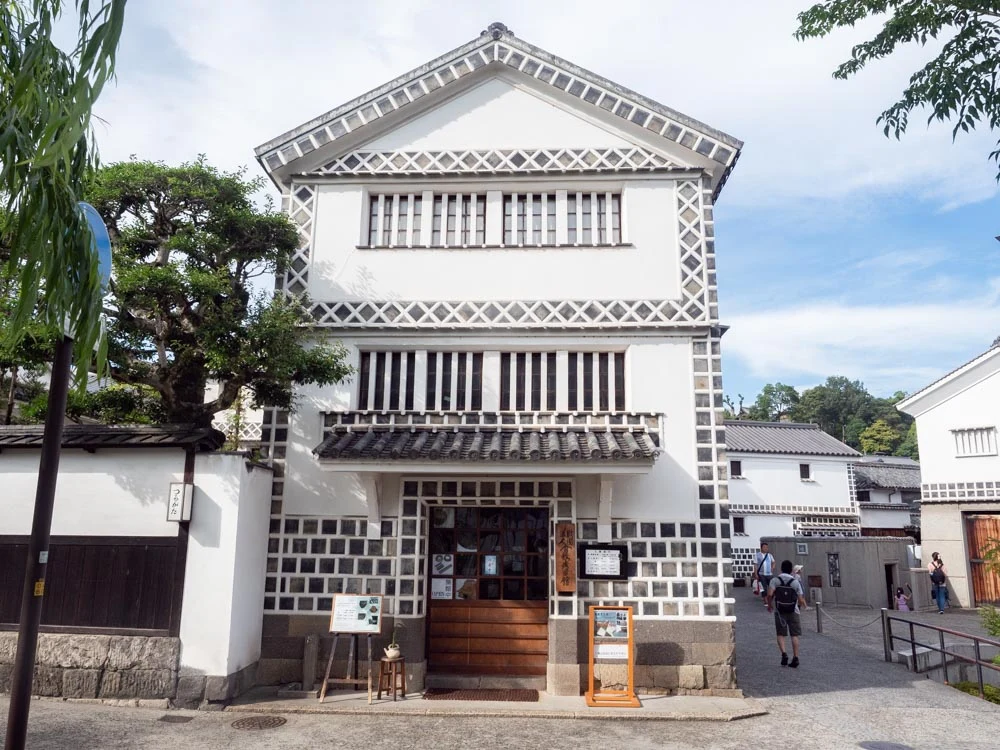
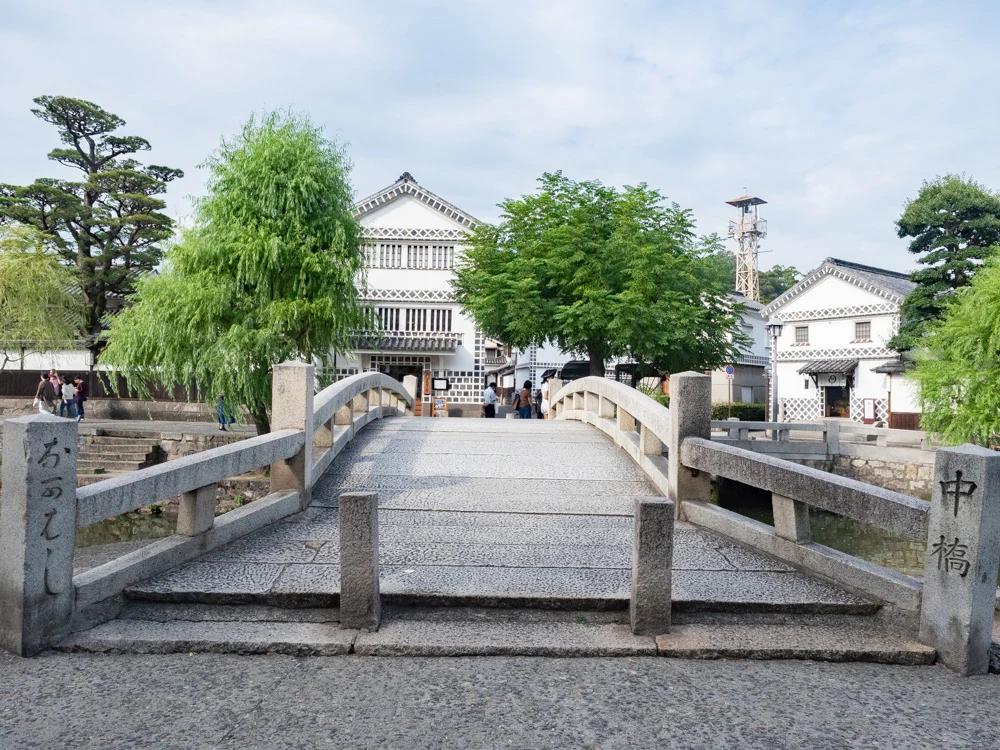
The Kurashiki Archaeological Museum is located almost in the center of the Kurashiki River area in the Bikan Historical Area.
In front of it is Nakabashi, and on the opposite side of the bridge is the Kurashikikan Tourist Information Office.
The Kurashiki Archaeological Museum is an archaeological museum that displays numerous ruins from the Kibi region within a building characteristic of Kurashiki, featuring namako walls.
The exhibits mainly consist of artifacts excavated from ruins in the Kibi region, which spread from Okayama Prefecture to the eastern part of Hiroshima Prefecture.
On the other hand, there are also exhibits from other prefectures and regions such as Peru.
The Kurashiki Archaeological Museum opened in November 1950.
It was proposed by Soichiro Ohara and Sumi Harada, with cooperation from Kuraray, KURABO INDUSTRIES LTD., the Kurashiki Chamber of Commerce, and Kurashiki City.
The preservation and maintenance of the Kurashiki River area began in 1955, and the "Kurashiki City Traditional Scenic Preservation Ordinance" was enacted in 1967.
The Kurashiki Archaeological Museum is one of the first facilities to preserve and utilize historical buildings.
The Kurashiki Museum of Folkcraft, which opened around the same time as the Kurashiki Archaeological Museum, and the Ohara Museum of Art, which opened before the war, are considered the three major cultural facilities in the Bikan Historical Area for this reason.
The building of the Kurashiki Archaeological Museum is a rice storehouse of a wealthy merchant from the Edo period, symbolizing the Bikan Historical Area
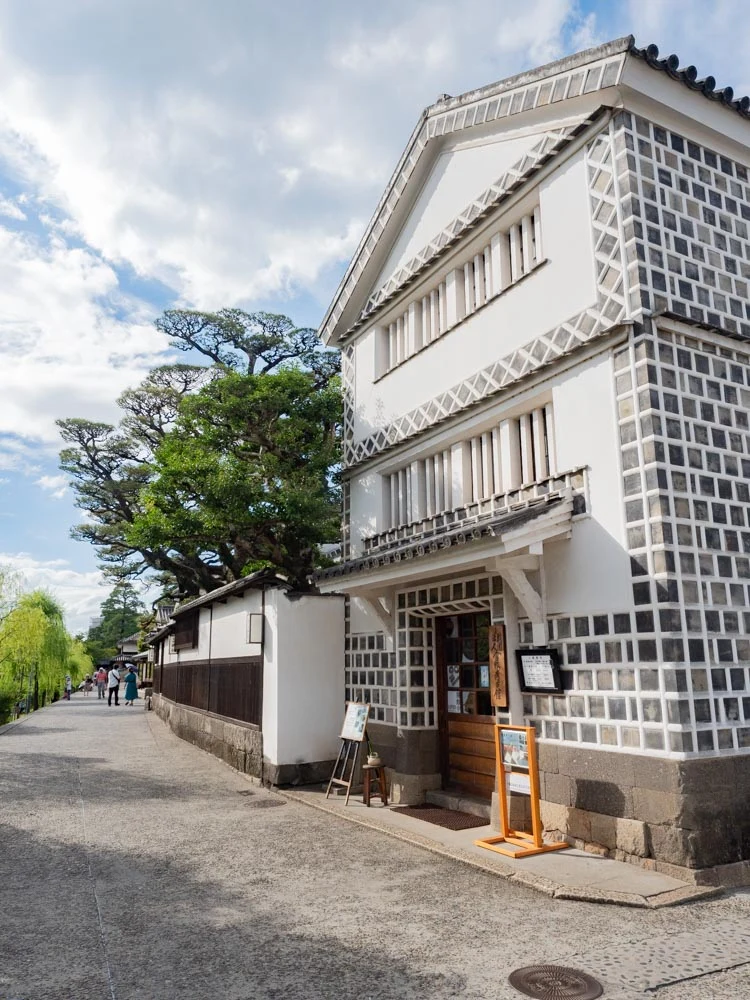
The Kurashiki Archaeological Museum is noteworthy not only for its exhibits but also for the historical value of the building itself.
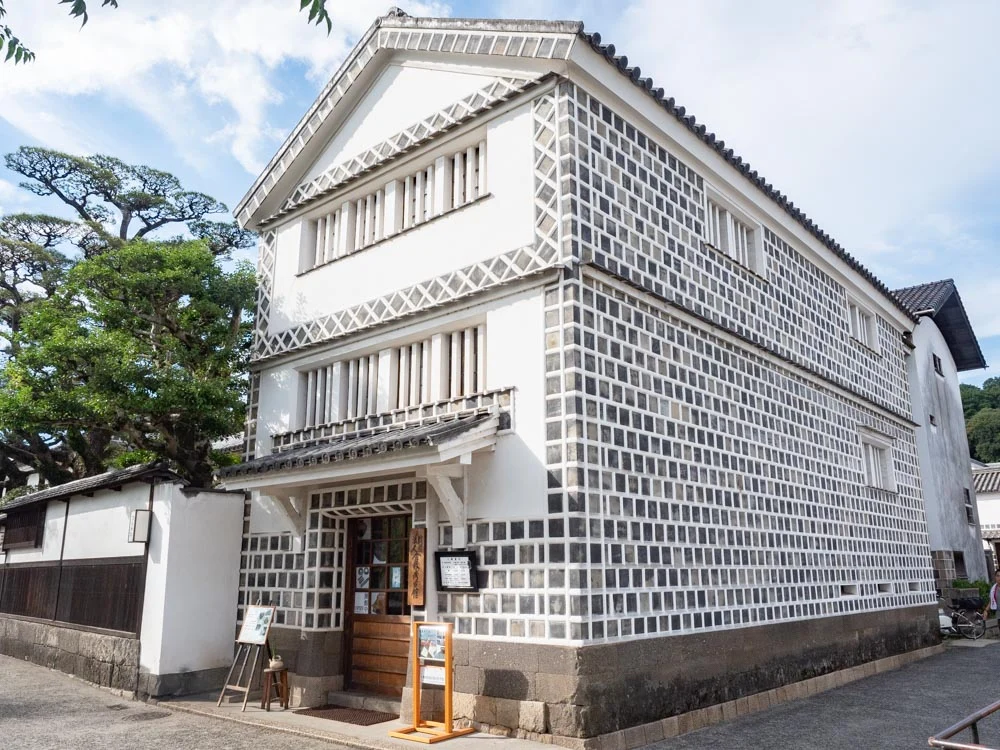
The building of the Kurashiki Archaeological Museum is a renovated storehouse (rice storehouse) of the wealthy merchant "Hamadaya" from the Edo period.
It is a building with a history dating back to the Edo period.
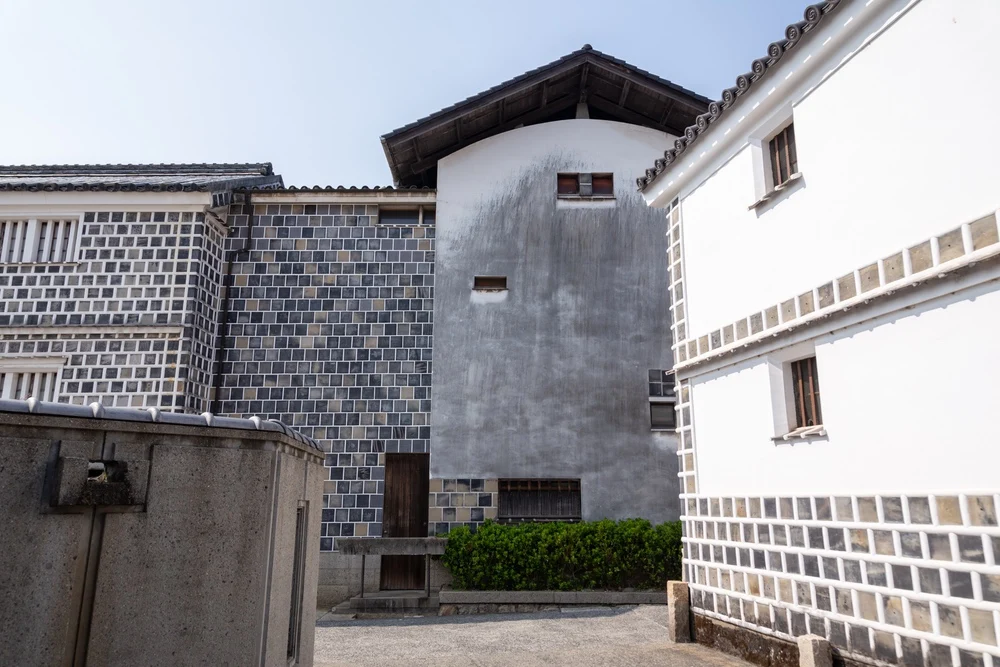
▼ The building features namako walls from top to bottom.
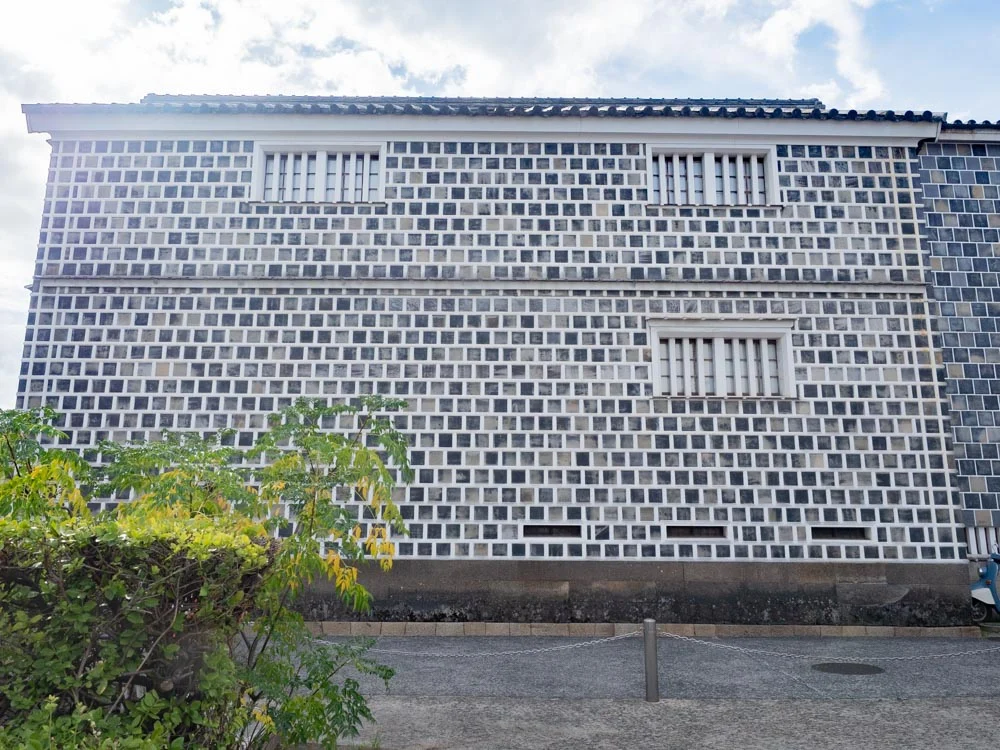
Among the visible storehouses around the Bikan Historical Area, this is the only one with namako walls from top to bottom.
Namako walls are expensive, indicating the financial power of Hamadaya.
The building of the Kurashiki Archaeological Museum is truly a symbol of the Bikan Historical Area.
Before entering, take a good look at the exterior of the building.
▼ The new wing of the Kurashiki Archaeological Museum (north side) was added during the Showa period.
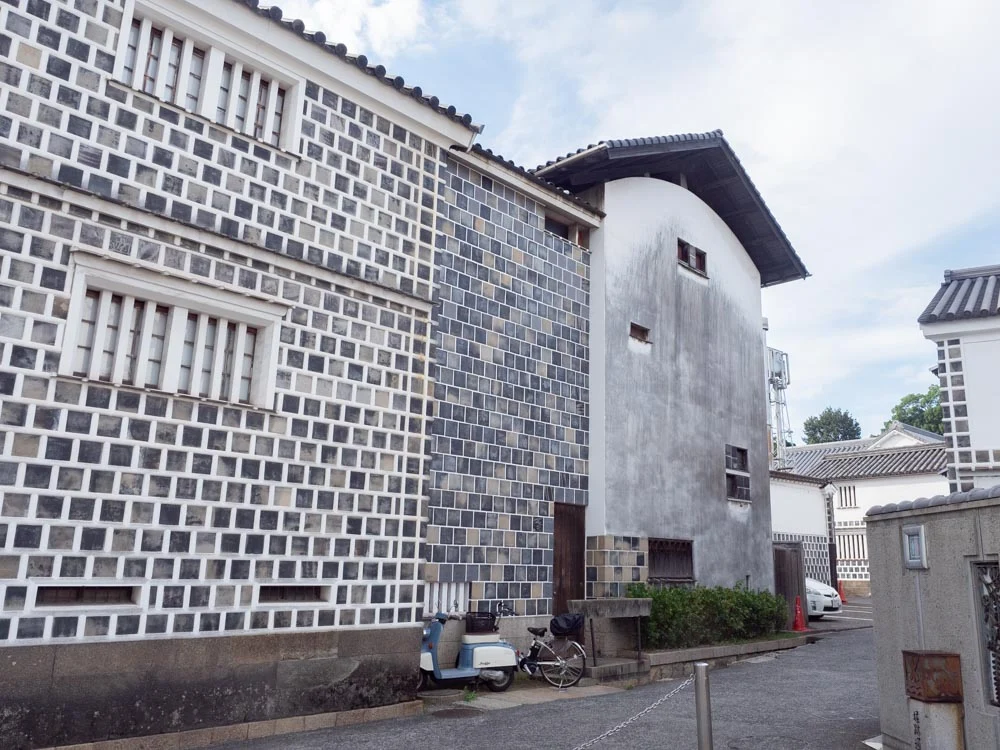
The front (south) side was once the rice storehouse.
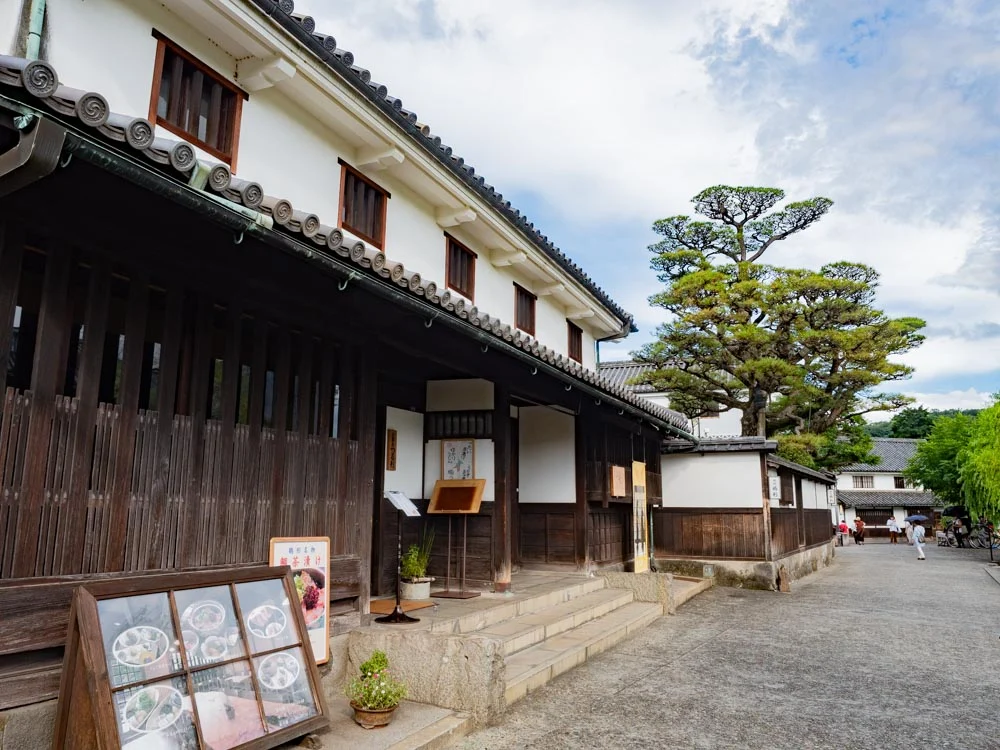
▼By the way, the "料理旅館 鶴形" (Ryori Ryokan Tsurugata), located to the west of the Kurashiki Archaeological Museum, was once the main house of the Koyama family.
The exhibits at the Kurashiki Archaeological Museum are divided into four spaces
The Kurashiki Archaeological Museum is a two-story building.
The first floor has the reception and office.
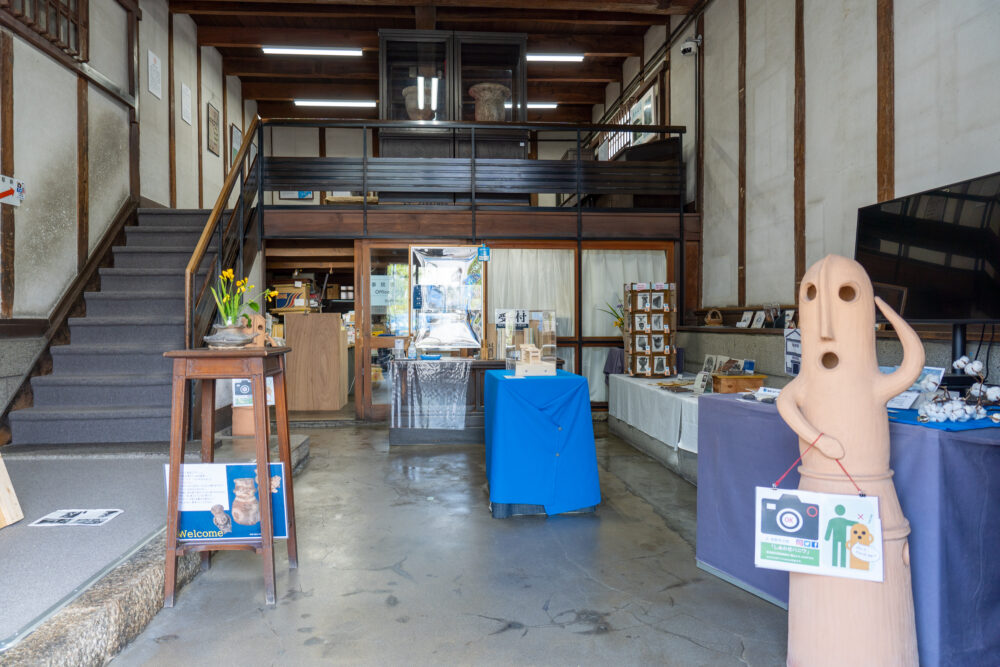
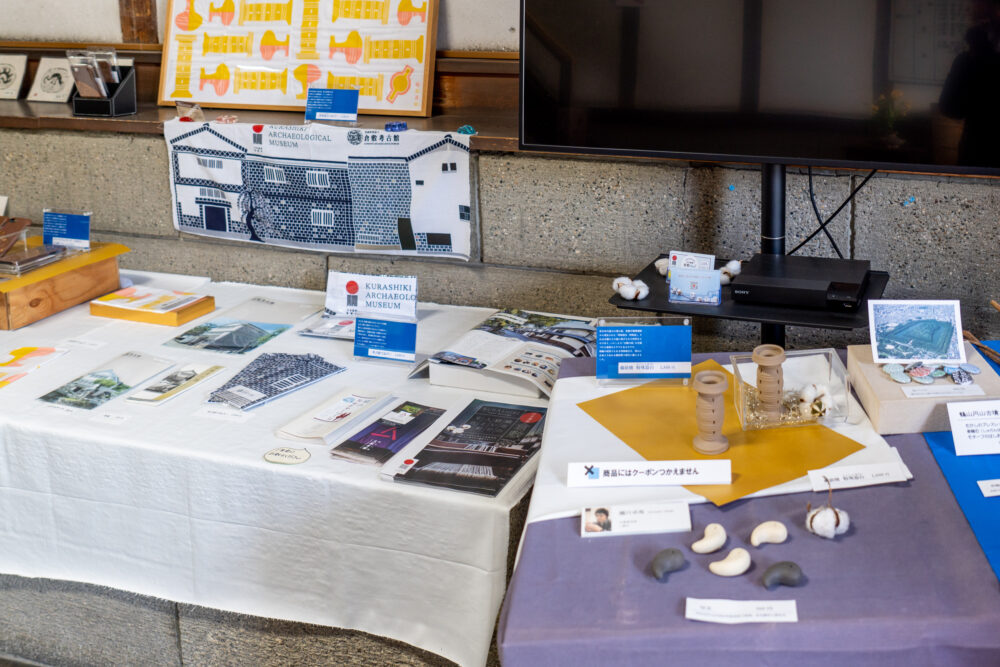
There are also "倉敷考古館限定の日本遺産グッズ" (Kurashiki Archaeological Museum limited Japan Heritage goods) that have been on sale since 2021.
By the way, some of you may feel like you have seen the "haniwa" at the entrance somewhere before.
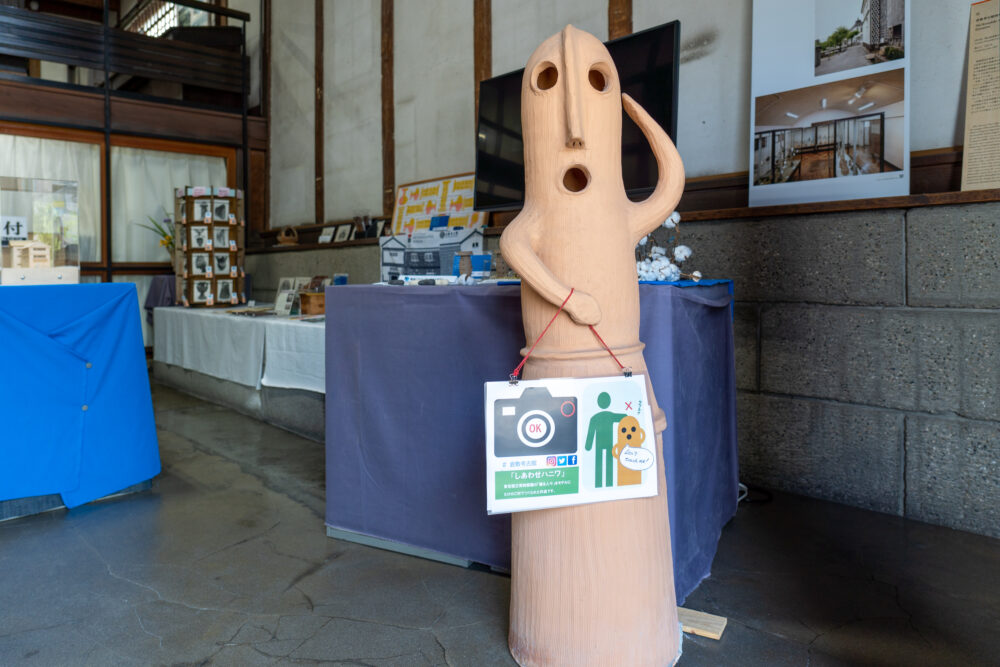
It was a mascot of "Gallery Takenoko Village," which was located in the Bikan Historical Area, but it closed at the end of 2021. After that, it was donated to the Kurashiki Archaeological Museum and is now active as the museum's mascot.
▼The exhibition rooms are divided into four spaces, with each room displaying different eras and themes.
| Room 1 | Paleolithic and Jomon Period |
|---|---|
| Room 2 | Yayoi Period |
| Room 3 | Kofun, Asuka, and Nara Periods |
| Room 4 | Exhibits from Peru |
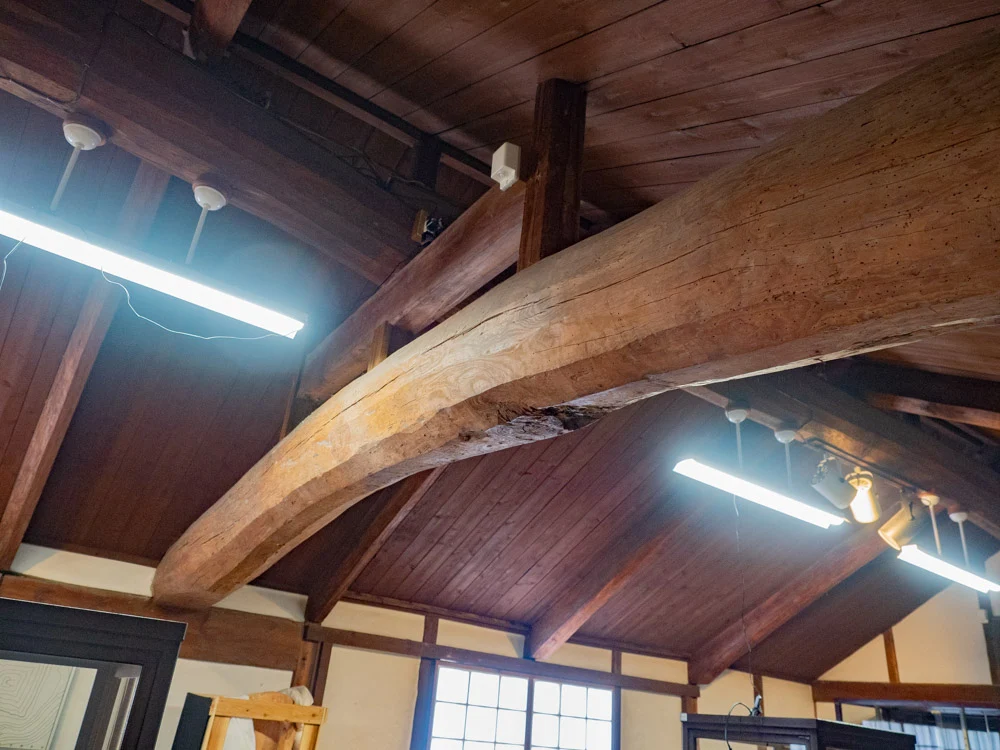
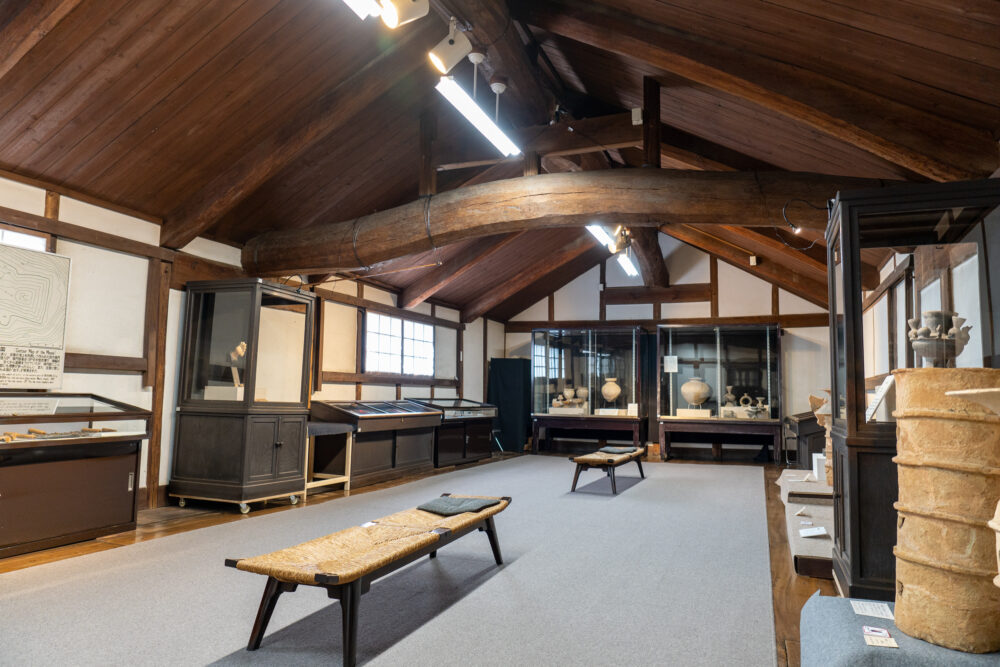
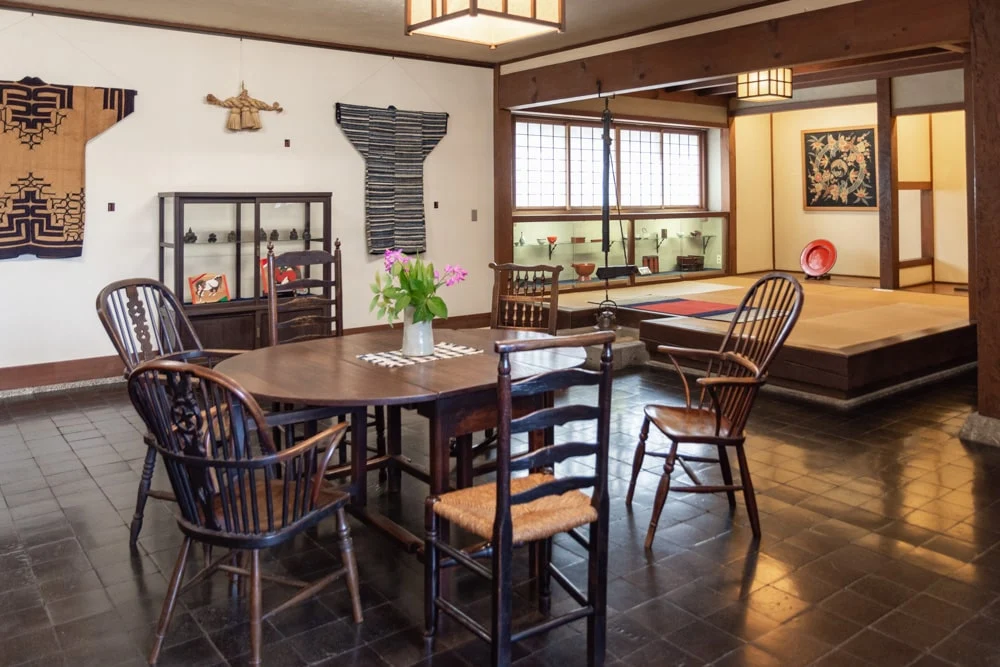
▼In the former rice storehouse section, there are beams and other parts that remain as they were in the past, giving a sense of history.
▼Additionally, pay attention to the cases and shelves displaying the exhibits at the Kurashiki Archaeological Museum.
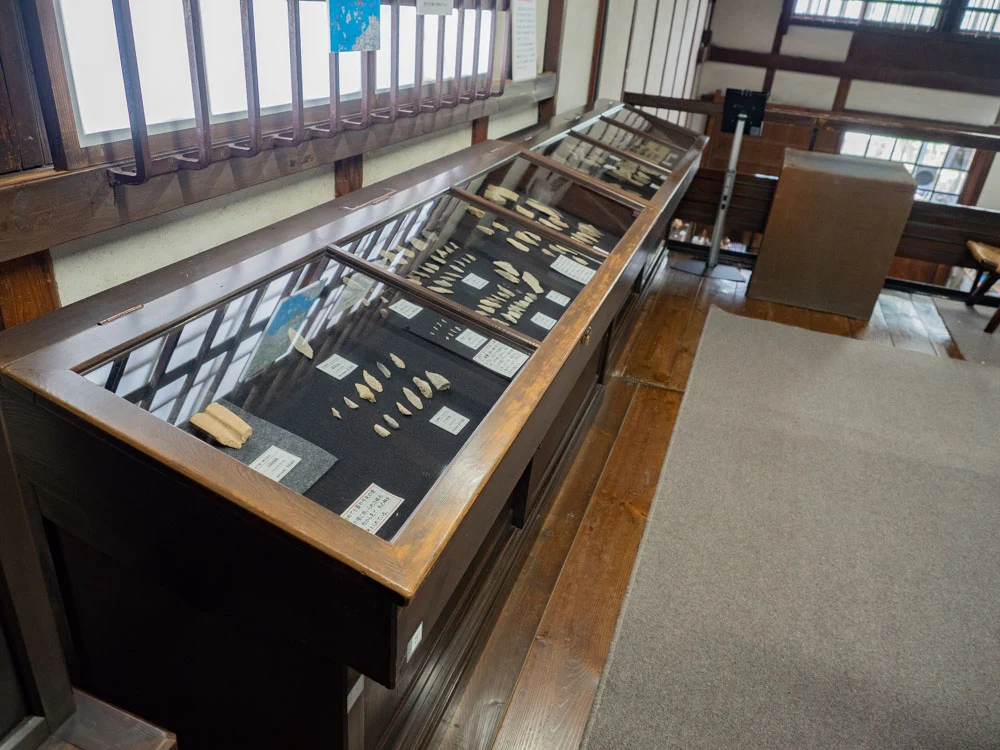
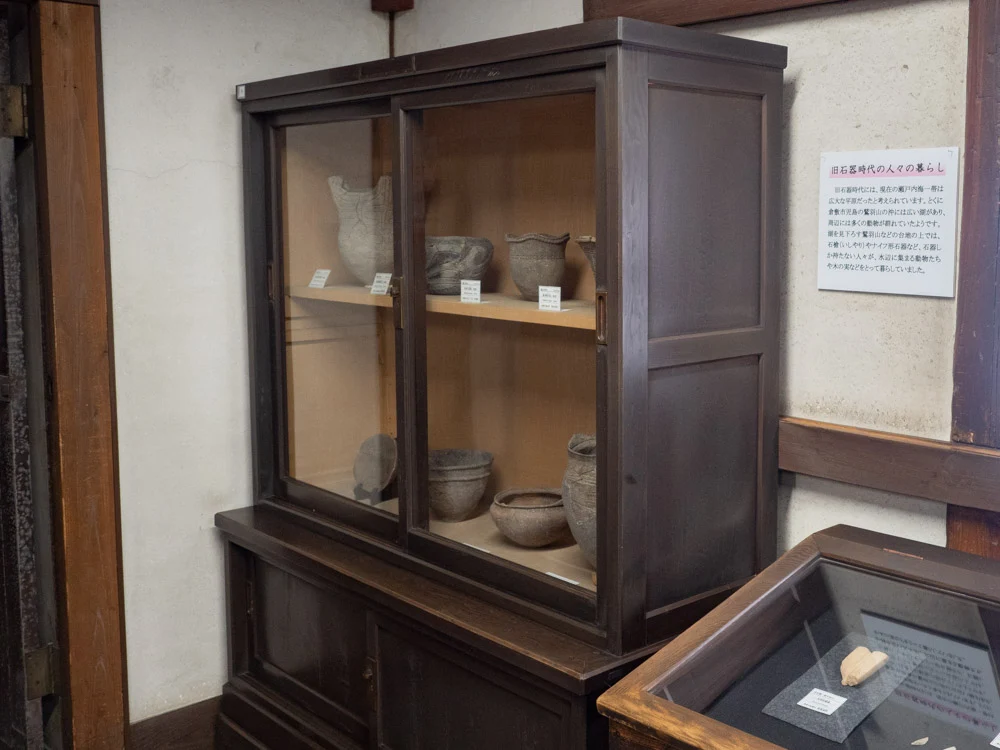
The wooden cases and shelves have been in use since the museum opened in 1950.
Therefore, they have historical value.
▼By the way, when you see the exhibits from Peru, you might wonder, "Why Peru all of a sudden?"
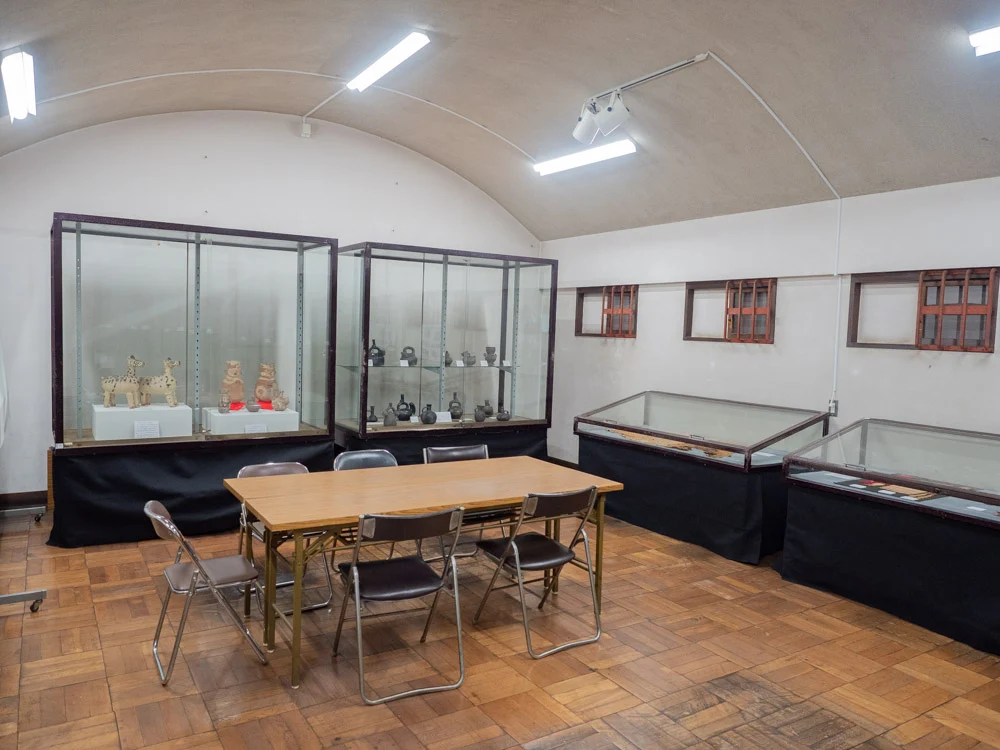
In fact, the Ohara family, who were involved in the establishment of the Kurashiki Archaeological Museum, received valuable materials from Peru from an acquaintance.
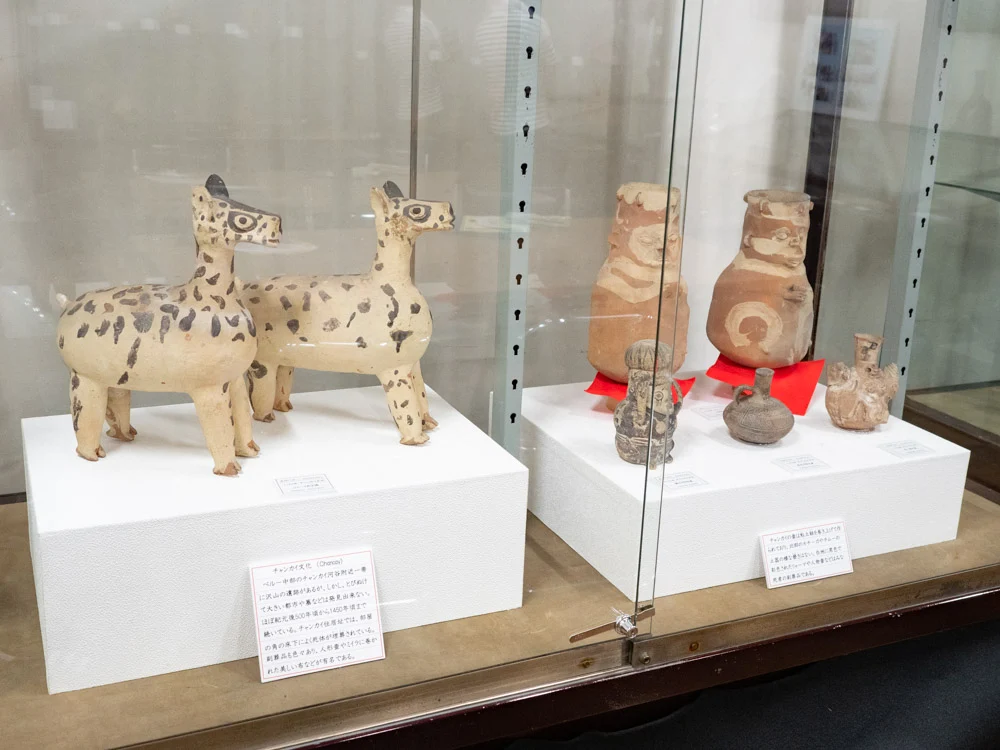
I think it would be interesting to compare materials and exhibits from various periods in Japan with those from different periods in Peru.
By the way, photography is allowed in the museum for purposes such as commemorative or note-taking, but only with restrictions.
If you wish to use the photos for a website or similar, please obtain permission from the staff in advance.
Kurashiki Archaeological Museum offers explanations by curators
Some of the exhibits in the archaeological museum can be difficult to understand without considering the historical context.
Therefore, at the Kurashiki Archaeological Museum, it is possible to receive a brief explanation from a curator.
If you are interested, please make a request at the reception.
However, please note that there may be times when a curator is not present.
If they are absent, you will not be able to receive an explanation.
Highlights of the exhibits at Kurashiki Archaeological Museum
The Kurashiki Archaeological Museum is characterized by its extensive collection of excavated items and materials.
From this collection, I will introduce highlights by period.
Paleolithic Era: Stone tools excavated from Washuzan Site
First, let's look at the highlights of the exhibits from the Paleolithic Era (also known as the Pre-Pottery Era).
▼ The highlight of the Paleolithic Era is the stone tools excavated from the Washuzan Site.
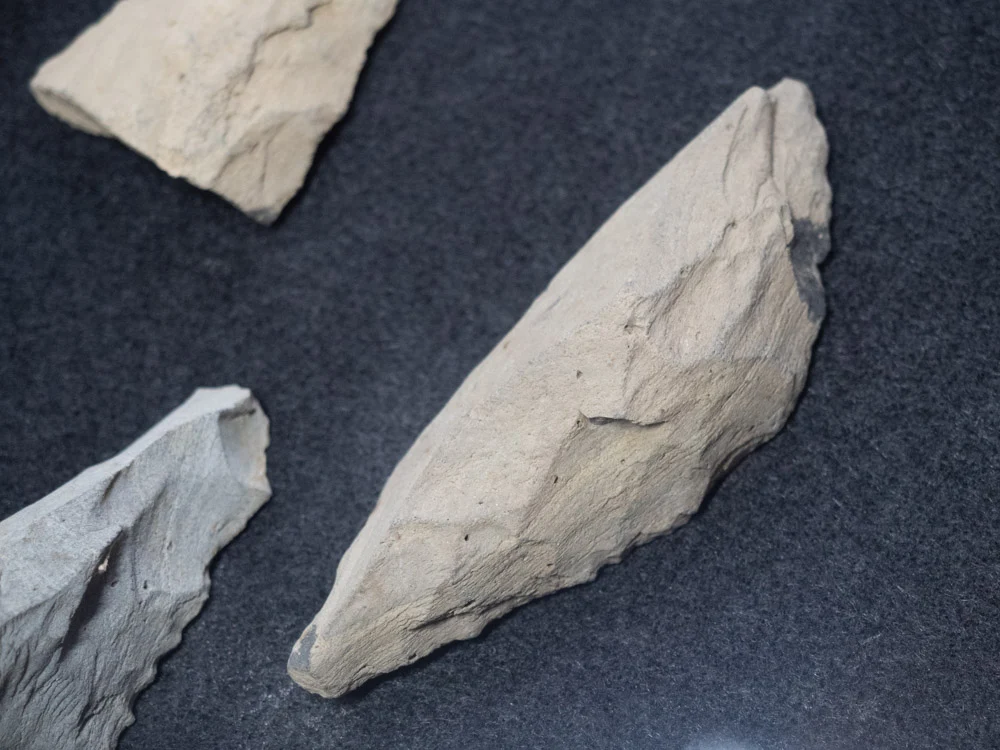
Washuzan is a mountain located in the southeast of Kurashiki City, where the Seto-Ohashi Bridge crosses.
It is the site of people who hunted in the Washuzan area during the Paleolithic Era.
The Washuzan Site is the first Paleolithic site confirmed in western Japan and is extremely important.
Numerous knife-shaped stone tools were excavated.
The stone tools from the Washuzan Site are made of a stone called sanukite.
The name comes from the fact that Sanuki was a representative production area.
The Kurashiki Archaeological Museum has also participated in excavations and research in other prefectures in the past.
▼ Due to this connection, stone tools from the Fukui Cave in Sasebo City, Nagasaki Prefecture, are also on display.
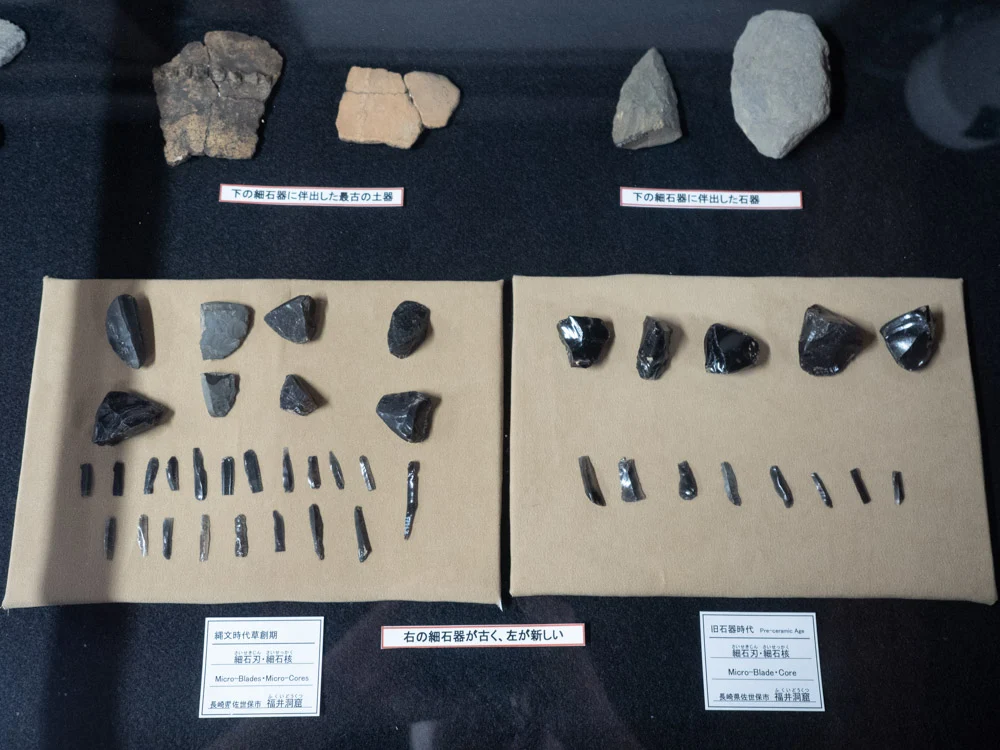
The stones used for tools differ by region.
The tools from Sasebo on display are made of obsidian.
The sanukite tools excavated from the Washuzan Site and the tools from Fukui Cave in Sasebo are displayed side by side.
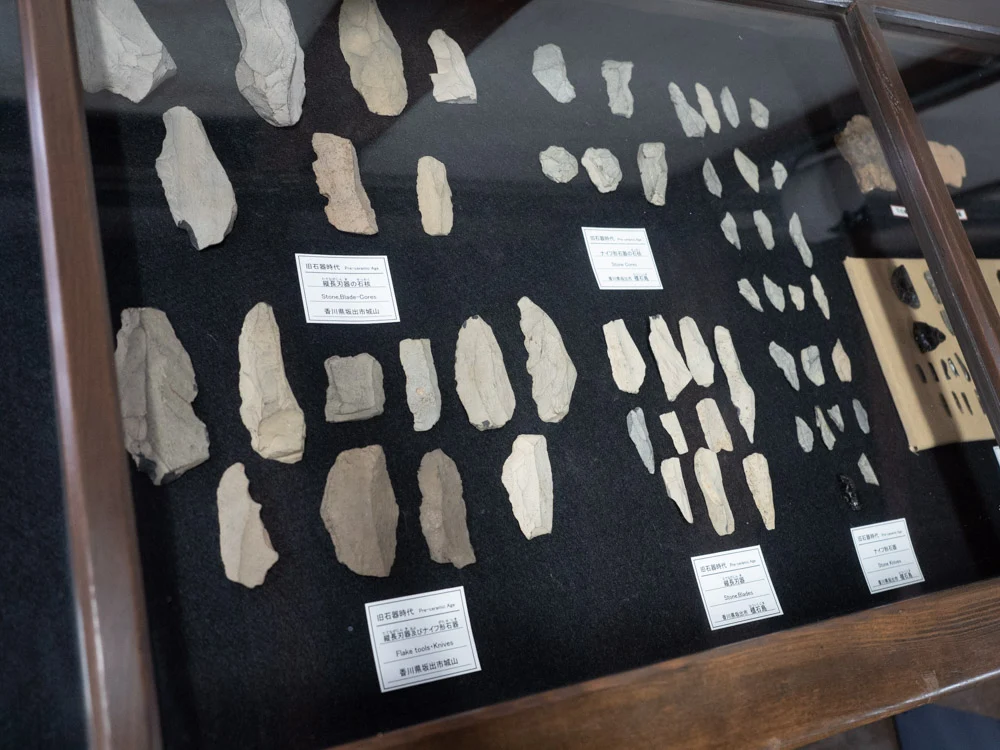
As a result, you can compare sanukite tools with obsidian tools.
By the way, don't you have the impression that stone knives don't seem very sharp?
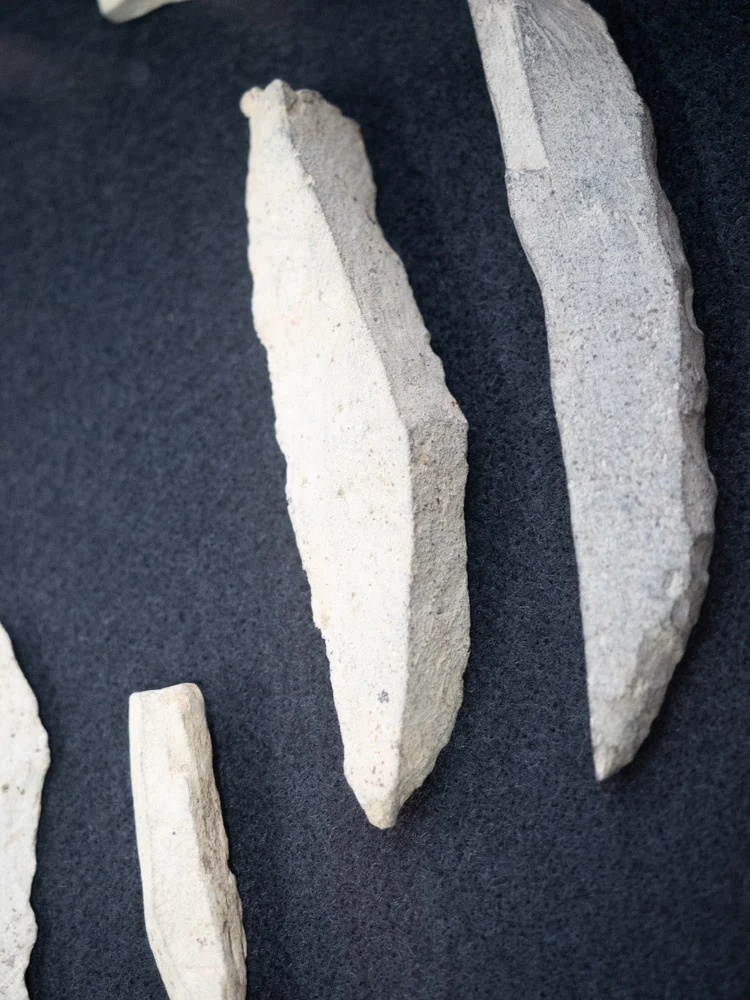
When you see them in their excavated state, they seem to have a poor cutting edge.
However, when the stone tools are actually recreated, they are said to have excellent sharpness.
Knife-shaped stone tools seem just right for cooking meat and other foods.
Jomon Period: Satogi Shell Mound and Jomon Pottery excavated from Kojima Bay
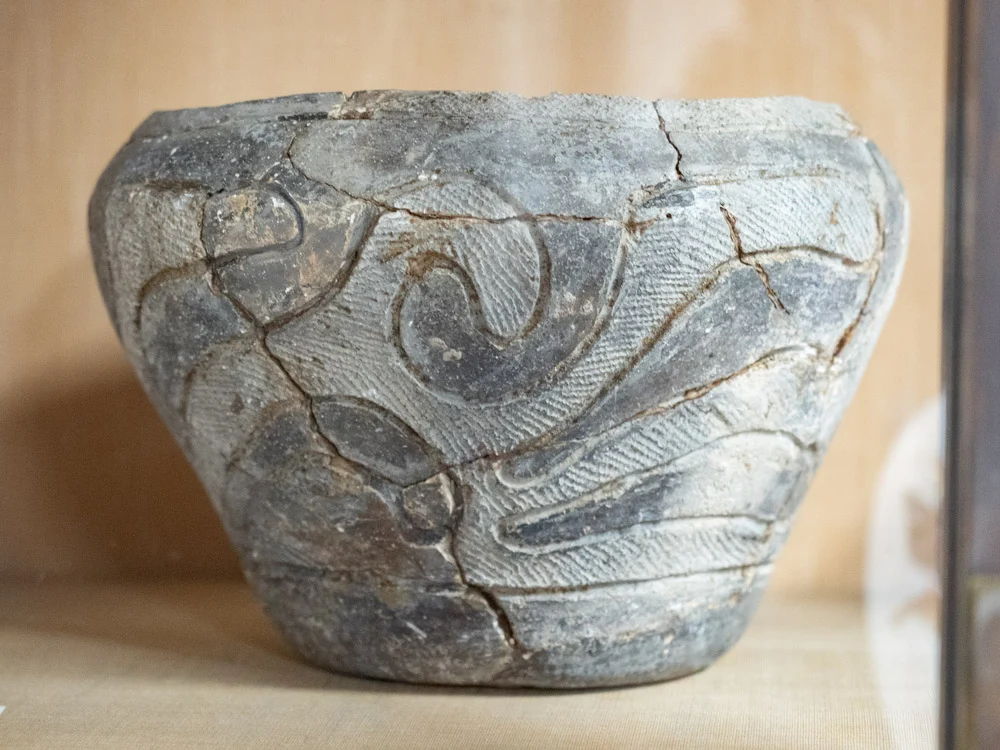
The highlight of the Jomon period exhibit is the Jomon pottery.
It is familiar as it is something that is definitely studied in elementary school.
In the Kibi region, many Jomon pottery pieces have also been excavated.
The Jomon period lasted for about 10,000 years.
Jomon refers to patterns made using ropes, and over the long Jomon period, the patterns also changed.
By looking at the patterns and shapes, one can infer when during the Jomon period the pottery was made.
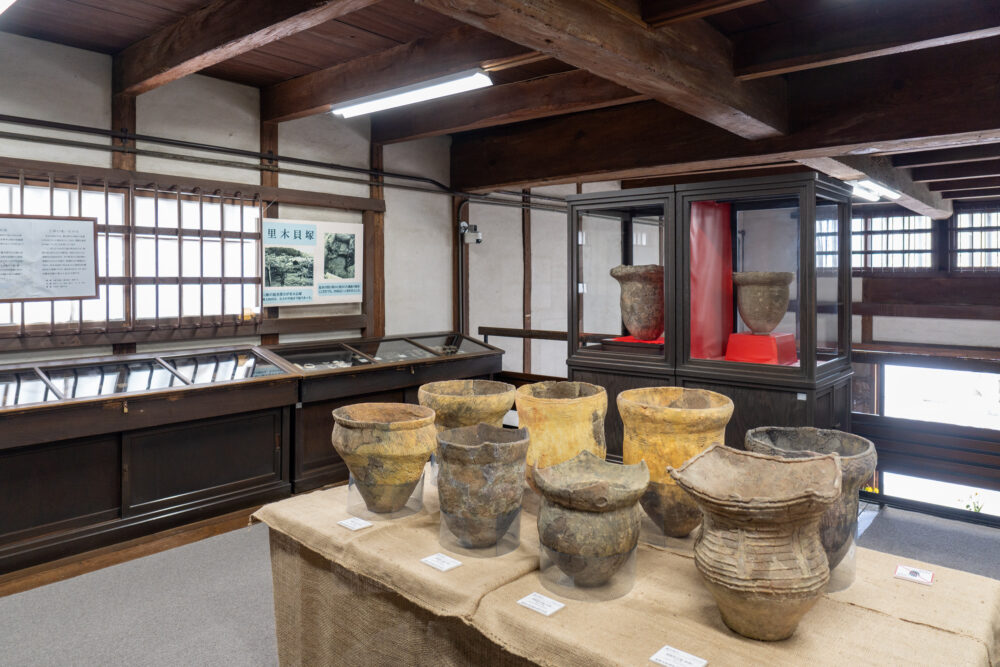
Among the Jomon pottery on display, notable pieces include the deep bowl-shaped pottery excavated from the Satogi Shell Mound in Funao Town and the bowl-shaped pottery discovered on the seabed of Kojima Bay.
▼ The deep bowl-shaped pottery from the Satogi Shell Mound is estimated to be from the middle Jomon period.
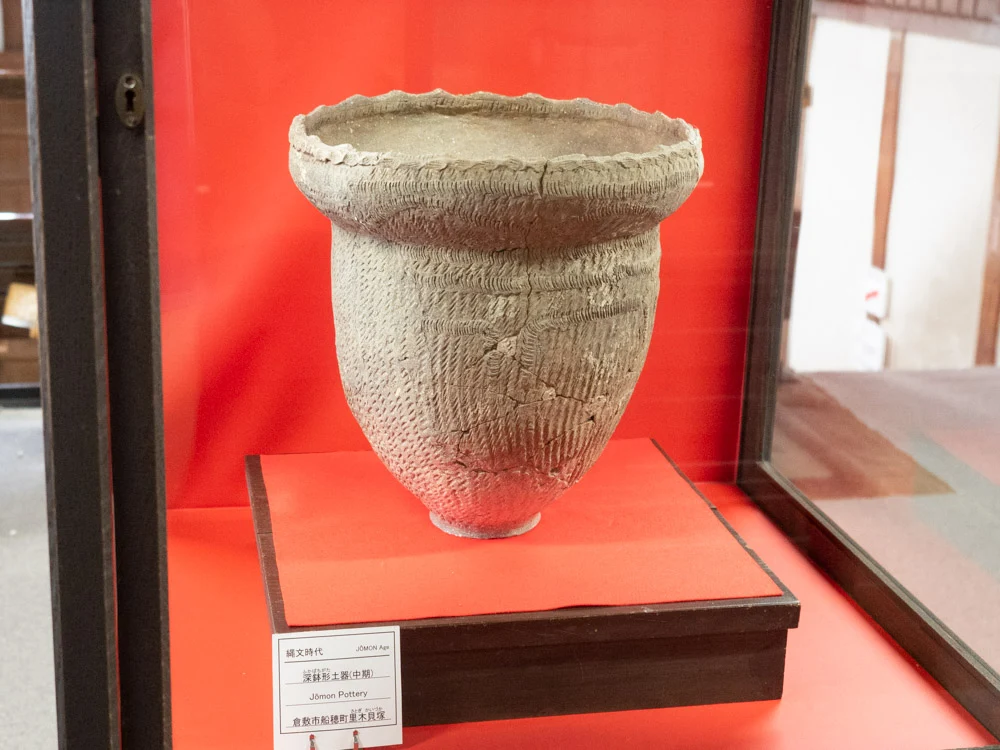
▼The combination of vertical Jomon patterns and thick, clear Jomon designs is impressive.
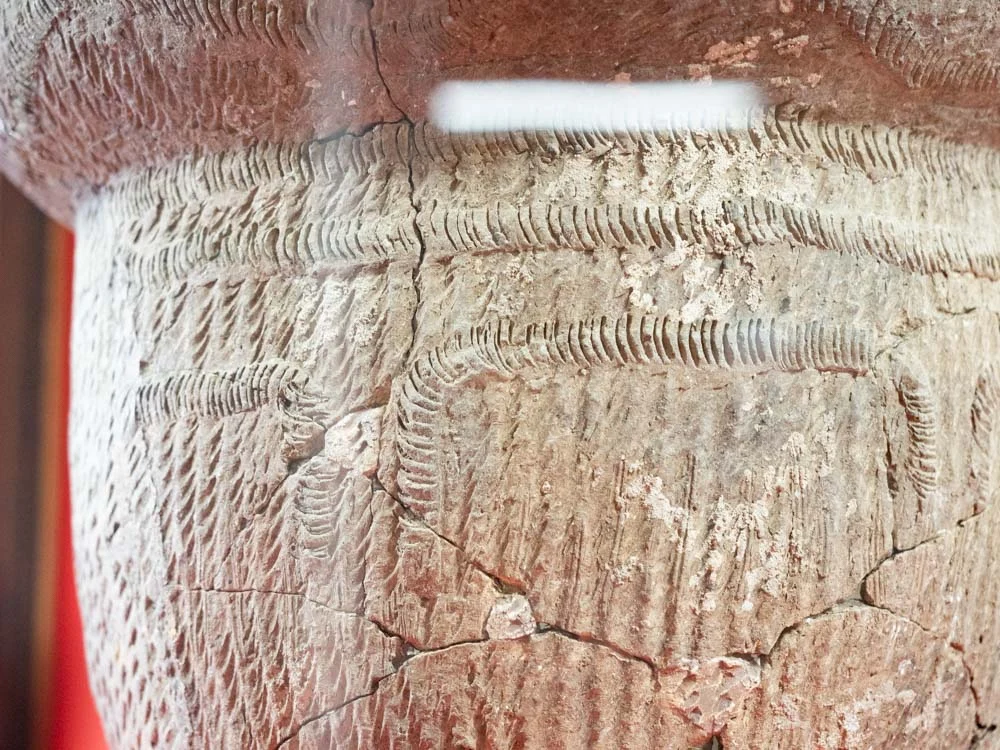
In addition, not only shells but also pottery, ornaments, and human bones have been excavated from the Satoki shell mound.
While shell mounds seemed like garbage dumps, it appears that various items are excavated beyond just shells.
▼The bowl-shaped pottery from the bottom of Kojima Bay is also from the Middle Jomon period.
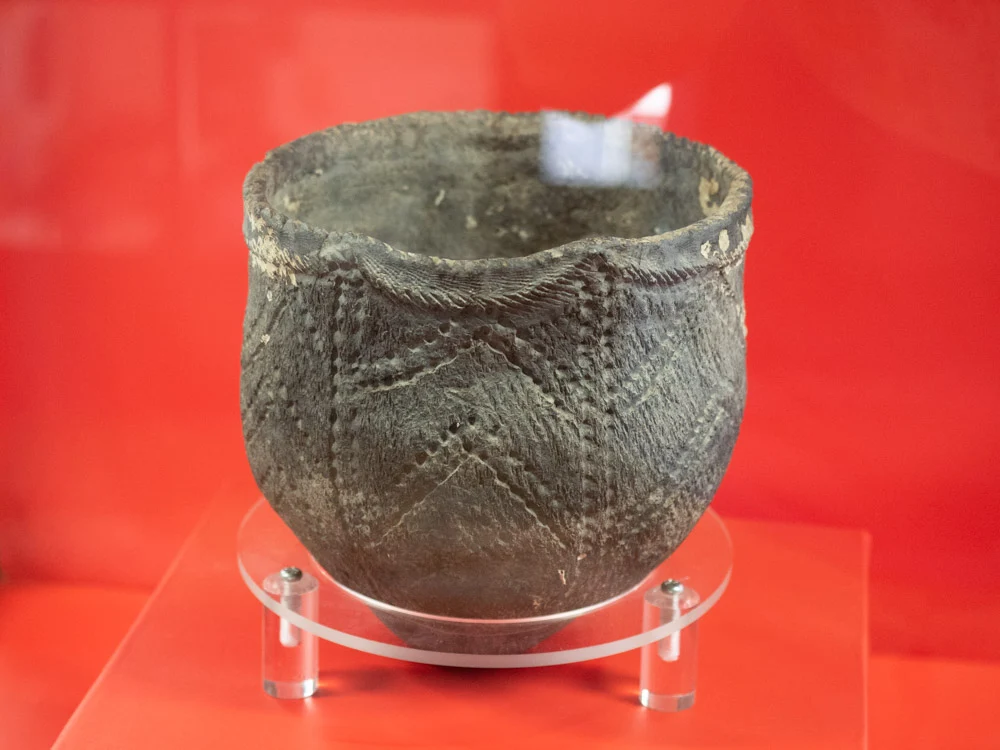
▼This pottery has a complex Jomon design, different from that of the Satoki shell mound.
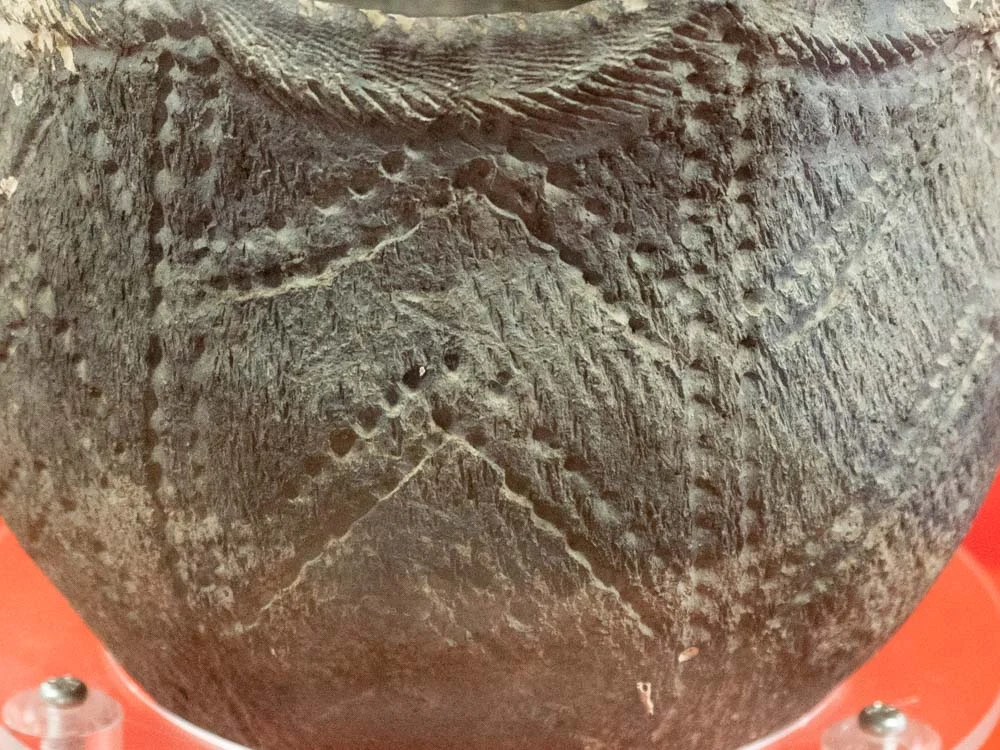
The bowl-shaped pottery from the bottom of Kojima Bay was discovered in an unbroken state.
Pottery is usually excavated in broken condition, so intact pottery is very valuable.
Yayoi Period: Special Stand Excavated from Kurokami Otsuka Tumulus
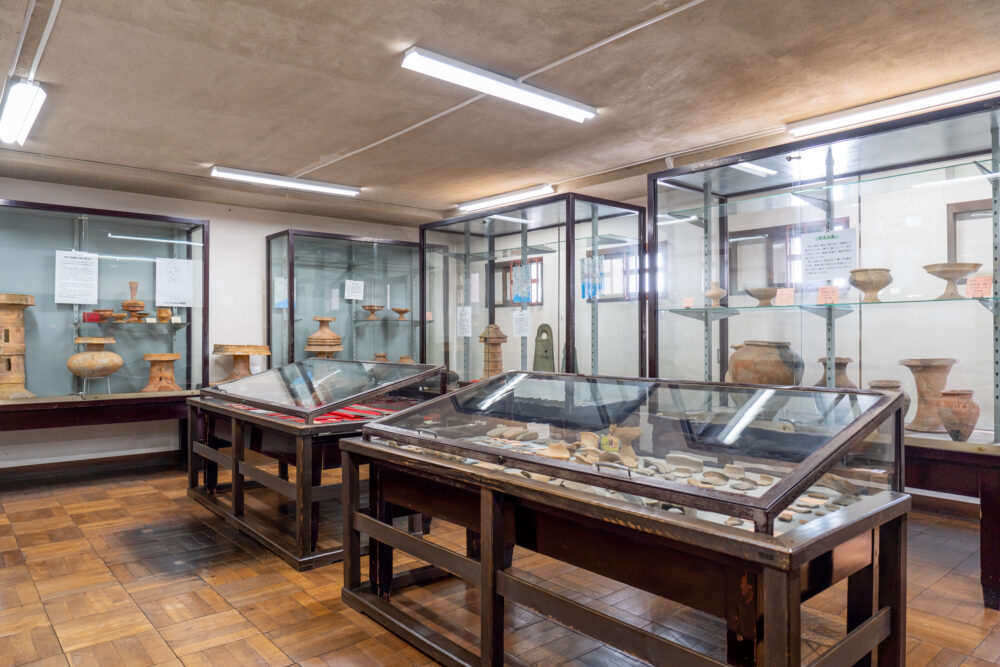
During the Yayoi period, iron and bronze tools began to be used, and rice cultivation became active.
The Kibi region had alluvial plains suitable for rice cultivation and large rivers, leading to the emergence of powerful forces.
Furthermore, the processing of iron and the production of salt also became active, leading to significant development in Kibi.
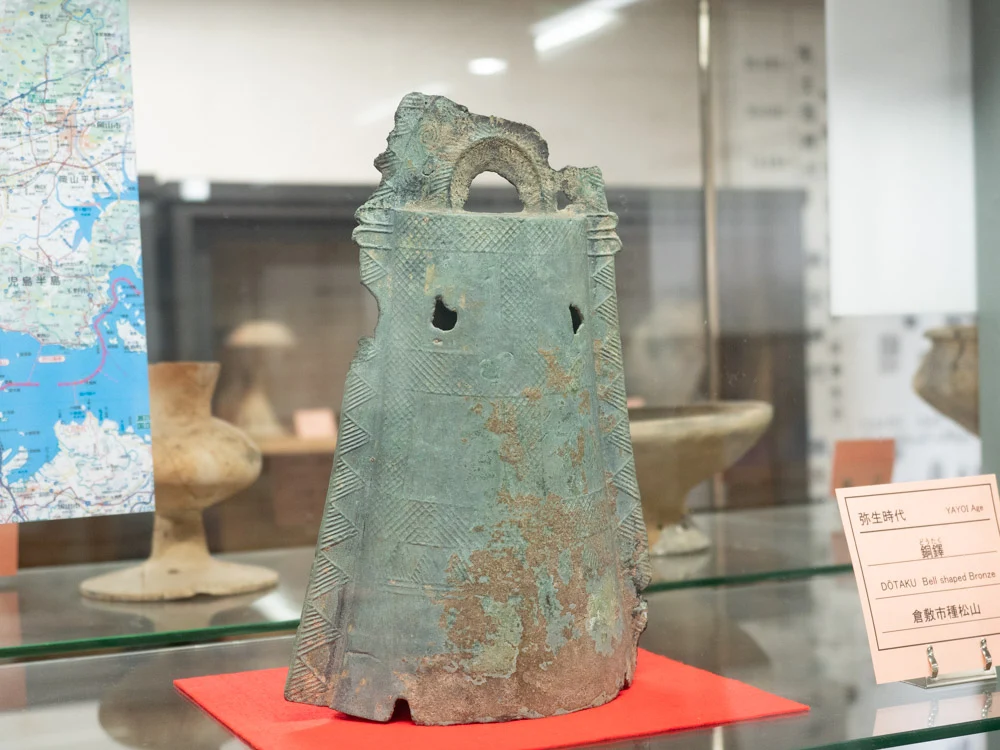
When thinking of the Yayoi period, don't you imagine the Yayoi pottery and bronze bells you learned about in textbooks?
▼Of course, Yayoi pottery and bronze bells have also been excavated in Kibi.
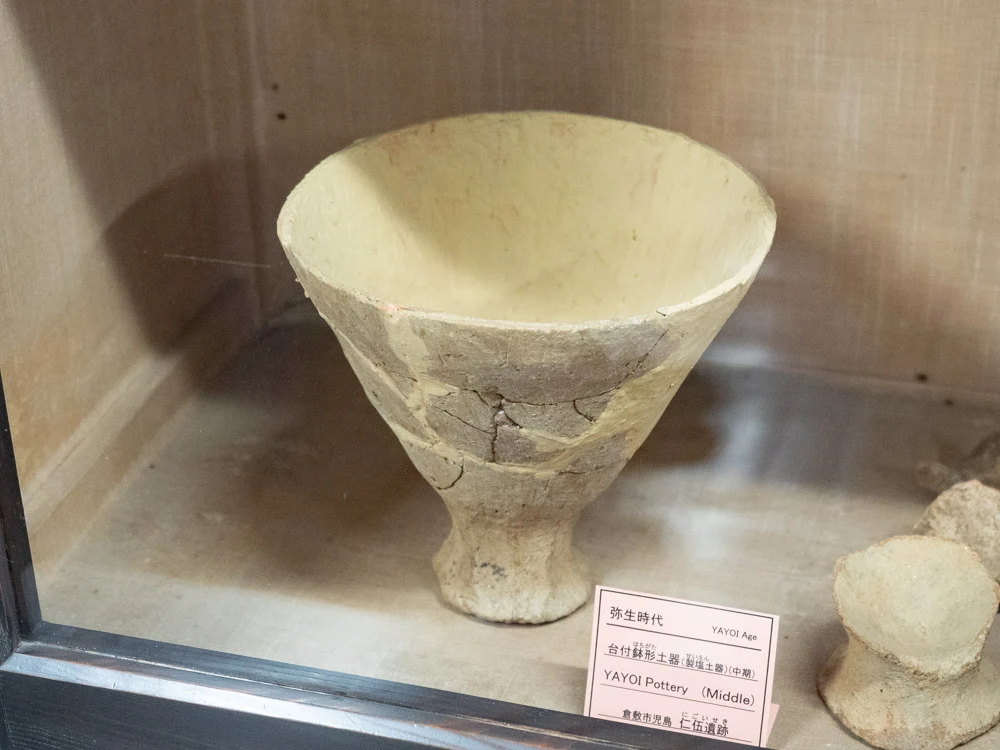
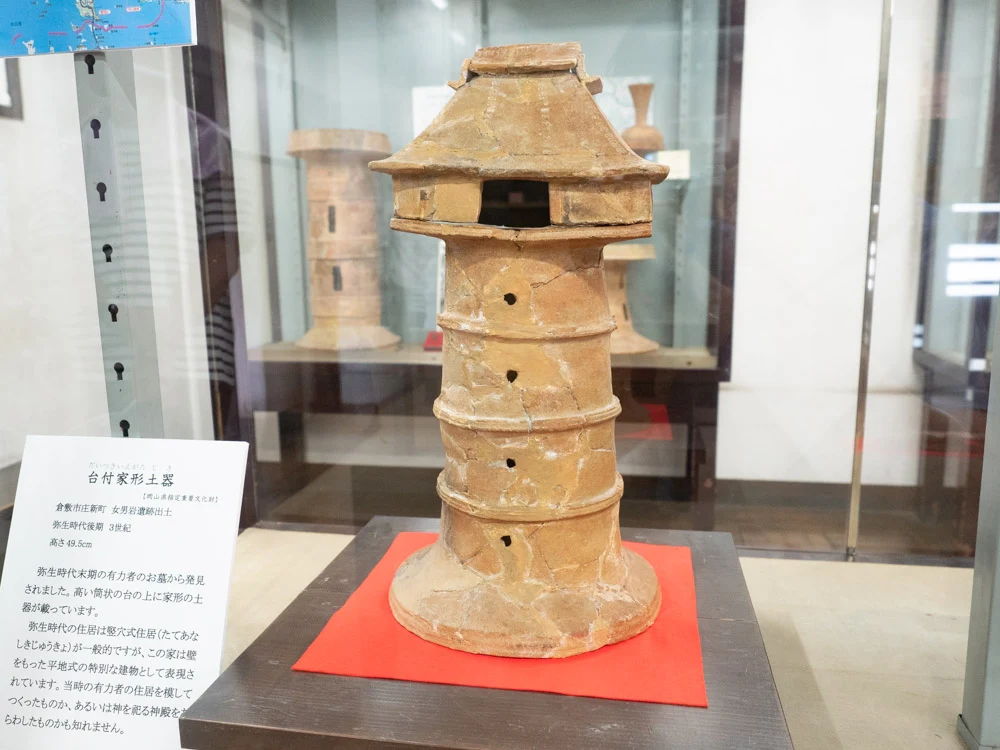
▼Additionally, from the Myotoiwa site in Shoshin-cho within the city, a stand-shaped house pottery was excavated, which was quite impactful.
However, the most notable point in the Yayoi period exhibition in Kibi is the special stand.
▼At the Kurashiki Archaeological Museum, a special stand from the late Yayoi period excavated from Kurokami Otsuka in Mabi Town, Ozaki is on display.
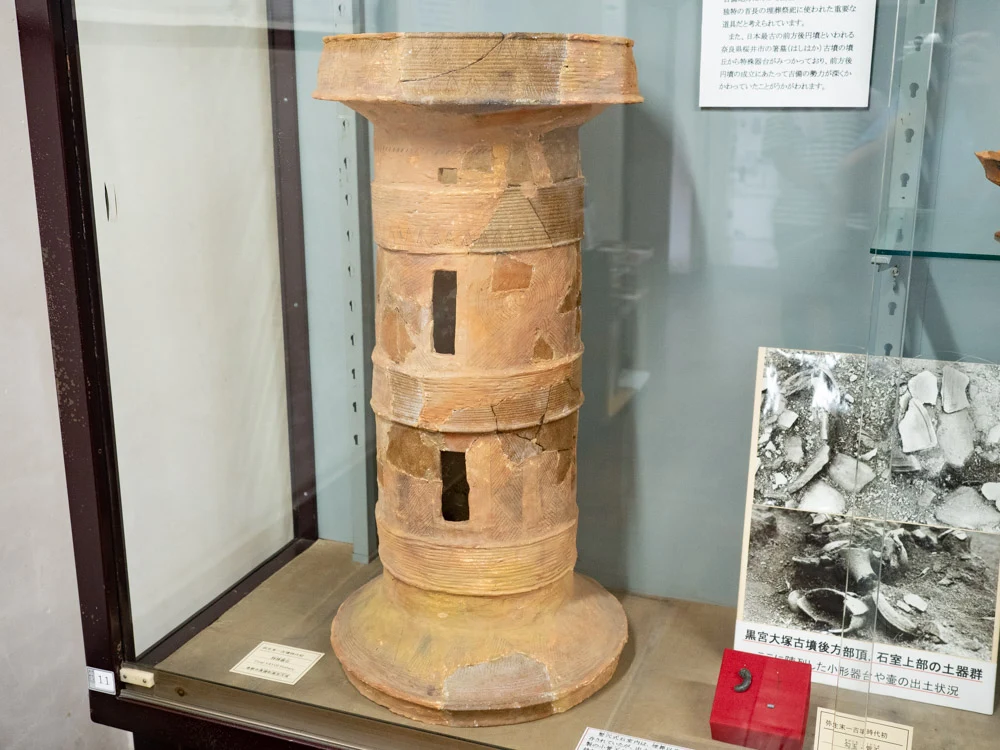
The special pedestal is a type of pottery that was born in Kibi during the late Yayoi period and began to be used.
A special jar (tokushu tsubo) was placed on the special pedestal and decorated the Yayoi burial mound (funkiubo), which is the precursor to the kofun.
Incidentally, special pedestals were also unearthed from the Tatetsuki Site (tate tsuki iseki) located in the Sho area of Kurashiki City, even earlier than Kurokami Otsuka.
The artifacts from the Tatetsuki Site are housed at Okayama University in Kita Ward, Okayama City.
Is Kibi the Origin of Haniwa!?
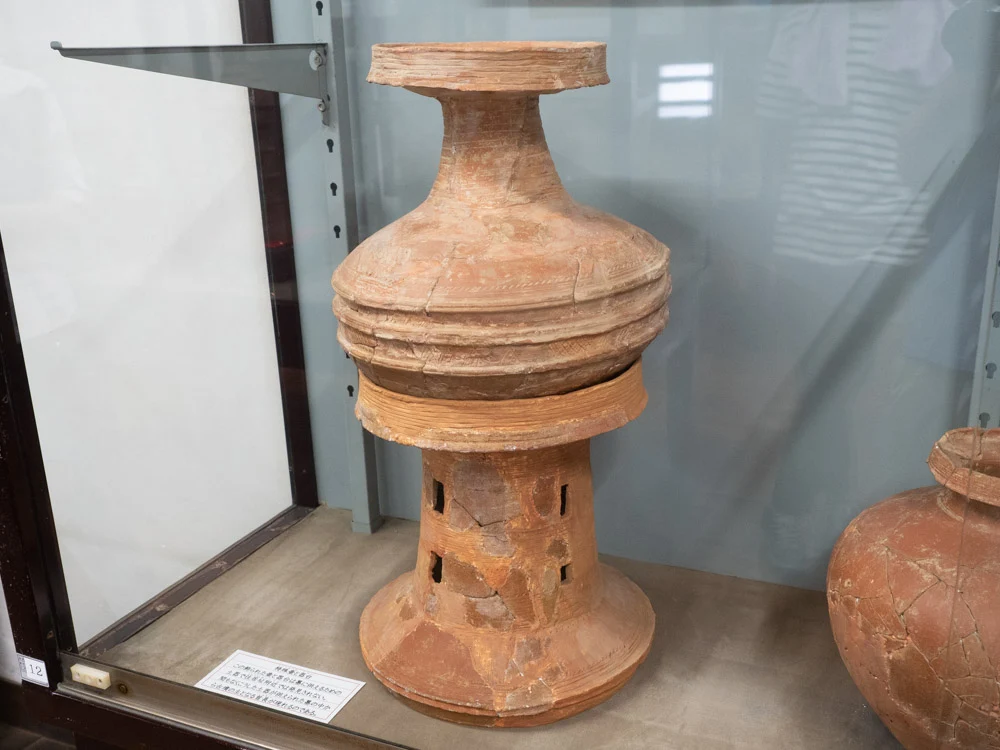
Why is the special pedestal a highlight?
That is because Kibi is the origin of haniwa.
Even if you know about the existence of haniwa, do you know that its origin is in Kibi?
The special pedestals used in Kibi eventually developed into cylindrical haniwa (entō haniwa) in present-day Nara and Osaka, and were placed around the kofun.
Furthermore, cylindrical haniwa developed into figurative haniwa (keishō haniwa) that modeled people, animals, and buildings.
Generally, when one hears "haniwa," they imagine haniwa in the shape of people, animals, and buildings.
In July 2019, the "Mozu-Furuichi Kofun Group" in Osaka Prefecture was registered as a UNESCO World Heritage Site, attracting attention.
The representative keyhole-shaped kofun of the Mozu-Furuichi Kofun Group is a culture that was born in Yamato.
On the other hand, the ancestors of the haniwa arranged on top of the keyhole-shaped kofun were a culture that was born in Kibi.
This suggests that Kibi had a deep connection with the Yamato regime at that time.
Kofun Period: Artifacts Unearthed from Kanakurayama Kofun
What stands out in the exhibition of the Kofun period is the artifacts from the Kanakurayama Kofun (kanakurayama kofun) in Naka Ward, Okayama City.
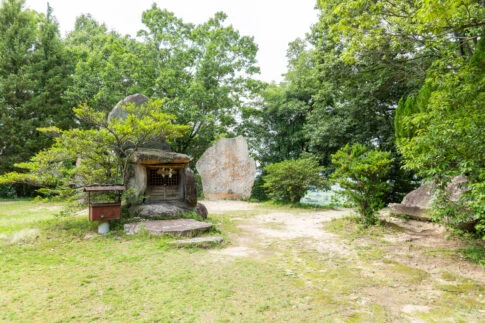
▼The Kanakurayama Kofun is a keyhole-shaped kofun located almost in the center of Misao Mountain (misao yama).
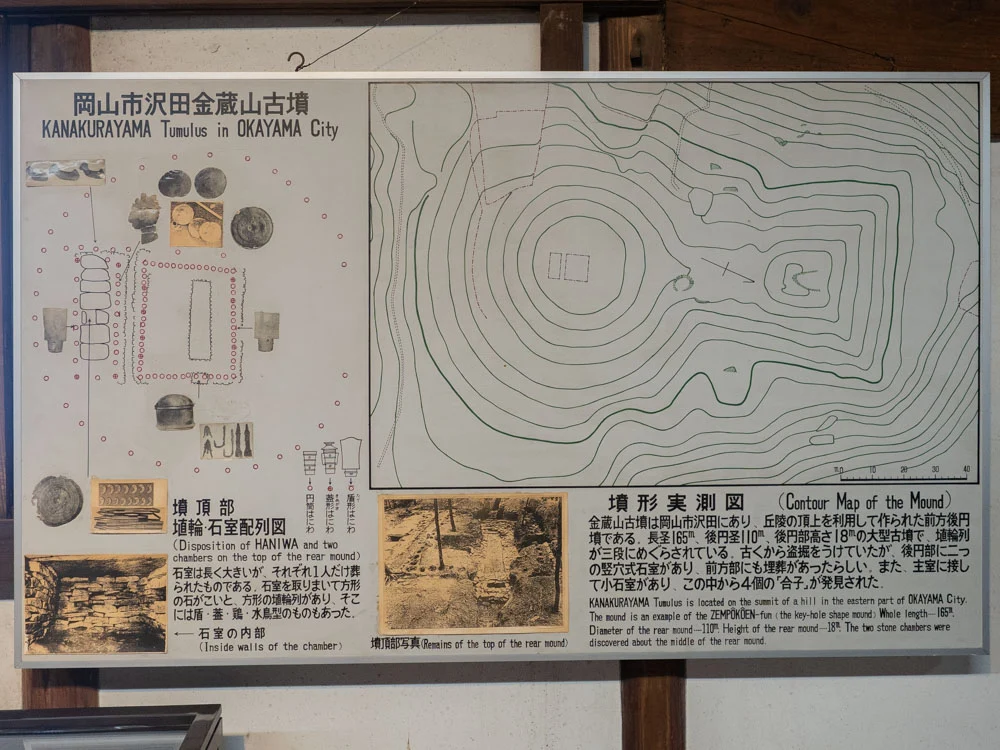
The Kanakurayama Kofun is the fourth largest kofun in Okayama Prefecture.
It is estimated to have been constructed during the early 4th to early 5th century of the Kofun period.
The Kanakurayama Kofun is approximately 165 meters in total length, making it the largest kofun of the same era west of the Kinki region.
Furthermore, as of 2019, it is the largest kofun that has been excavated and whose interior has been revealed.
▼Among the unearthed artifacts, many iron products are noteworthy.
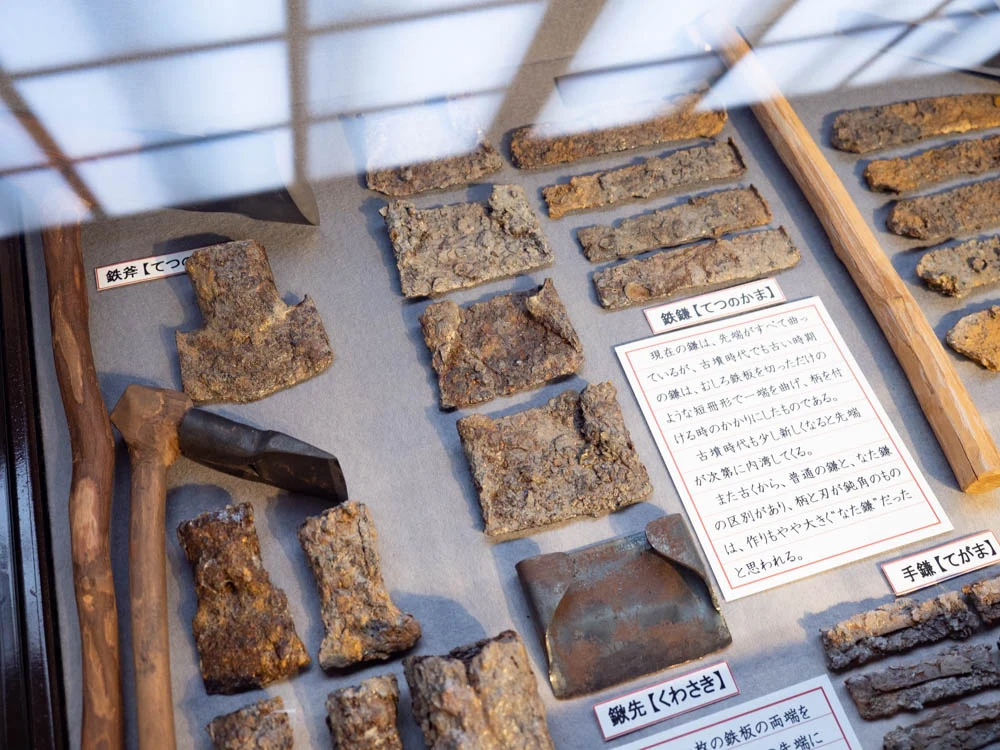
▼The focus is mainly on tools used for daily life, such as agricultural tools and carpentry tools.
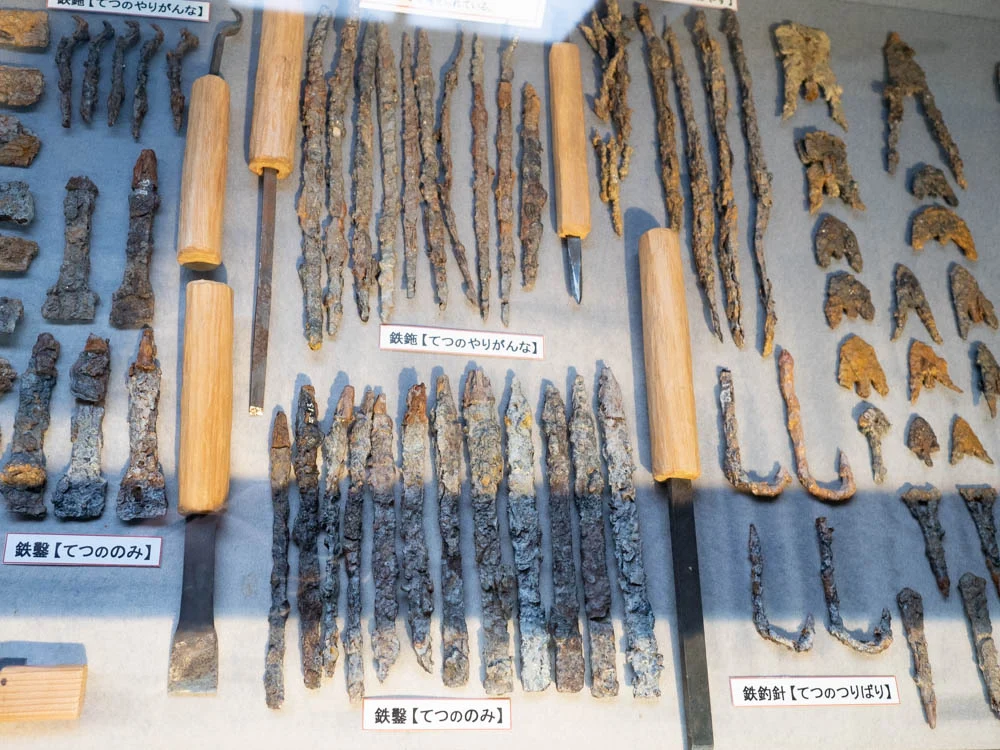
The following iron products are on display.
- Sickles and hand sickles
- Hoe tips
- Axes
- Yariganna (a type of chisel)
- Chisels
- Fishing hooks
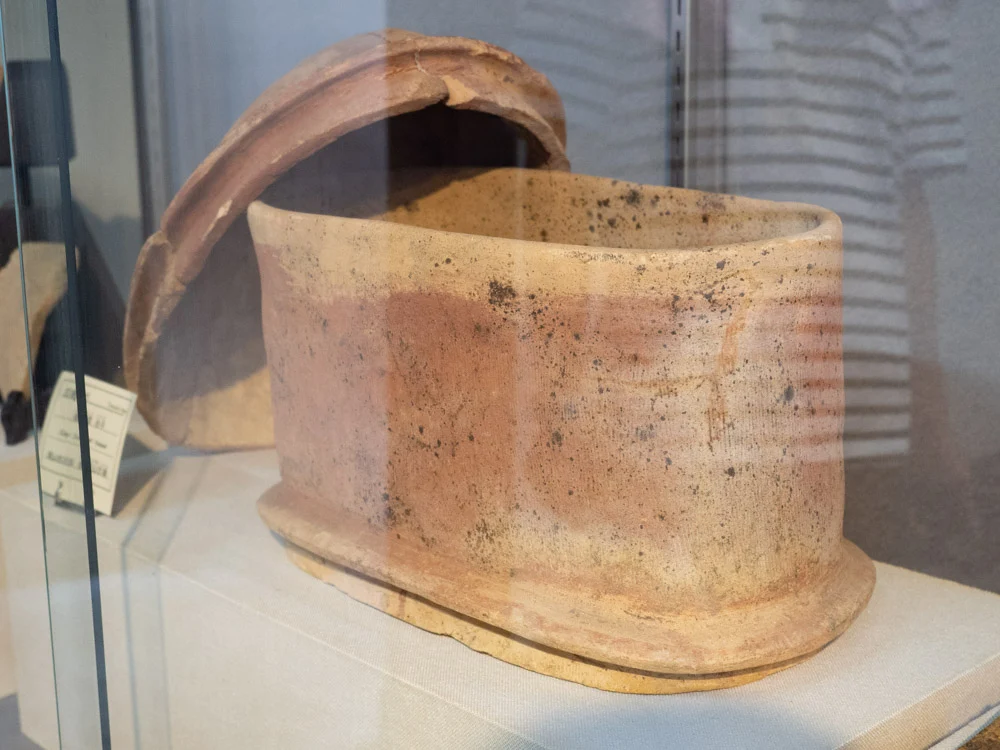
▼The iron products were placed in a container called haniwa shitsugōsu, which served as grave goods in the kofun.
▼Another noteworthy artifact is the "triangular rim three deities and three beasts mirror" (sankakubuchi sanshin sanjuu juutai kyou), whose place of origin is unknown.
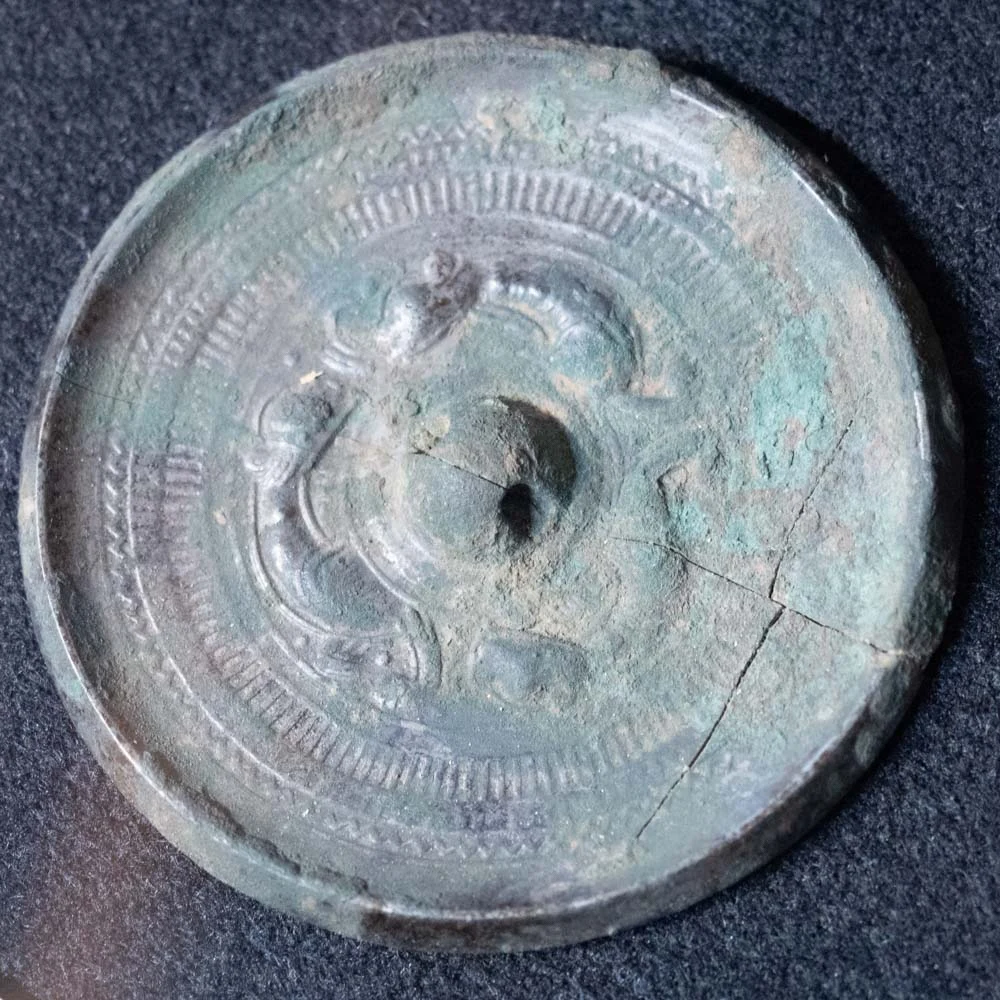
You may have seen or heard of the "Triangular Rim Beast Mirror" in textbooks.
The term "triangular rim" refers to the rim of the mirror protruding in a triangular shape.
Additionally, it is characterized by patterns of gods and beasts engraved on the mirror.
Was the Ironmaking in Kibi Earlier than Izumo!?
It is said that the Kibi region flourished due to its active ironmaking.
When it comes to ironmaking, the "tatara ironmaking" using sand iron from the Izumo region and the Chugoku Mountains is well known, but in fact, Kibi was engaged in ancient ironmaking earlier than Izumo.
Tatara ironmaking is believed to have started in the 11th century.
Kibi had already been using iron ore for ironmaking since the 6th century.
The "Senbiki Kanakuro Valley Site" in Soja City is said to be the site of that ironmaking.
It seems that Kibi at that time was a progressive region even within the country.
Nara Period: Yatabe Masutari's Land Purchase Certificate
The Kurashiki Archaeological Museum also has exhibits from the Nara period.
▼ Noteworthy is the "Yatabe Masutari's Land Purchase Certificate," which was excavated from Ozaki in Mabi Town within the city.
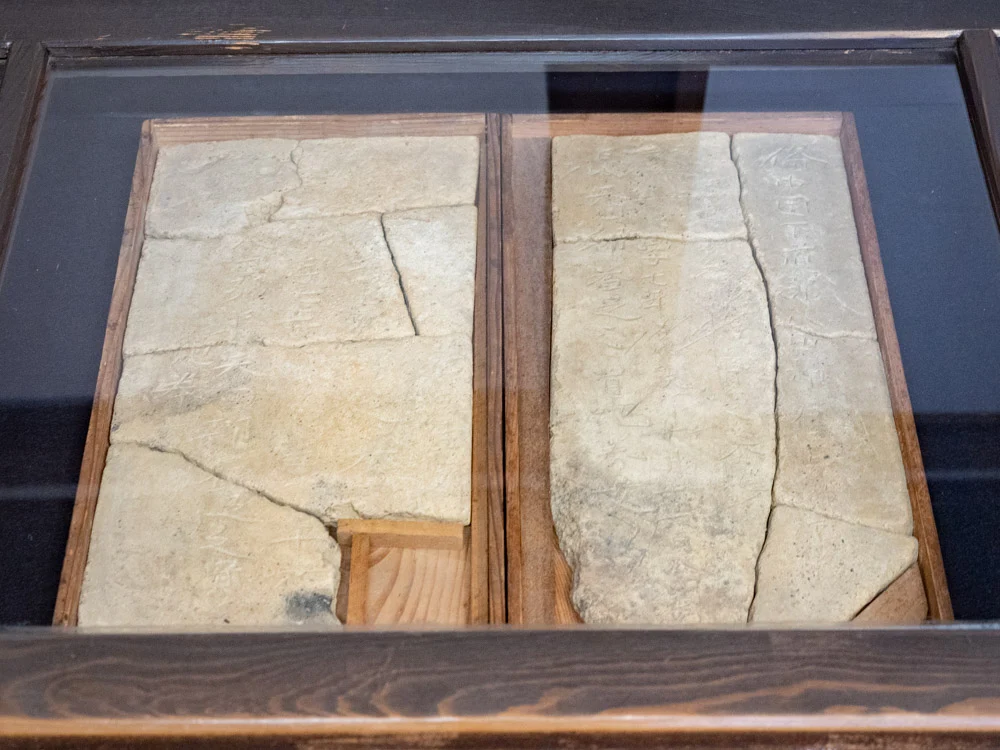
It means "the land purchase certificate of Yatabe Masutari."
The contents written are as follows.
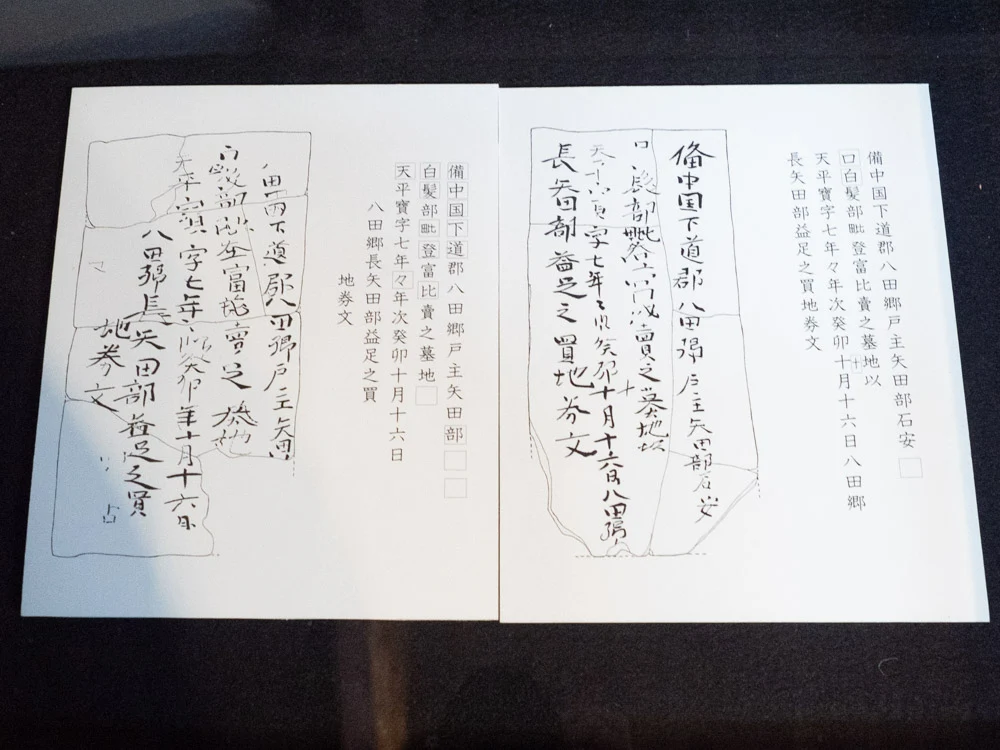
Furthermore, the meaning is as follows.
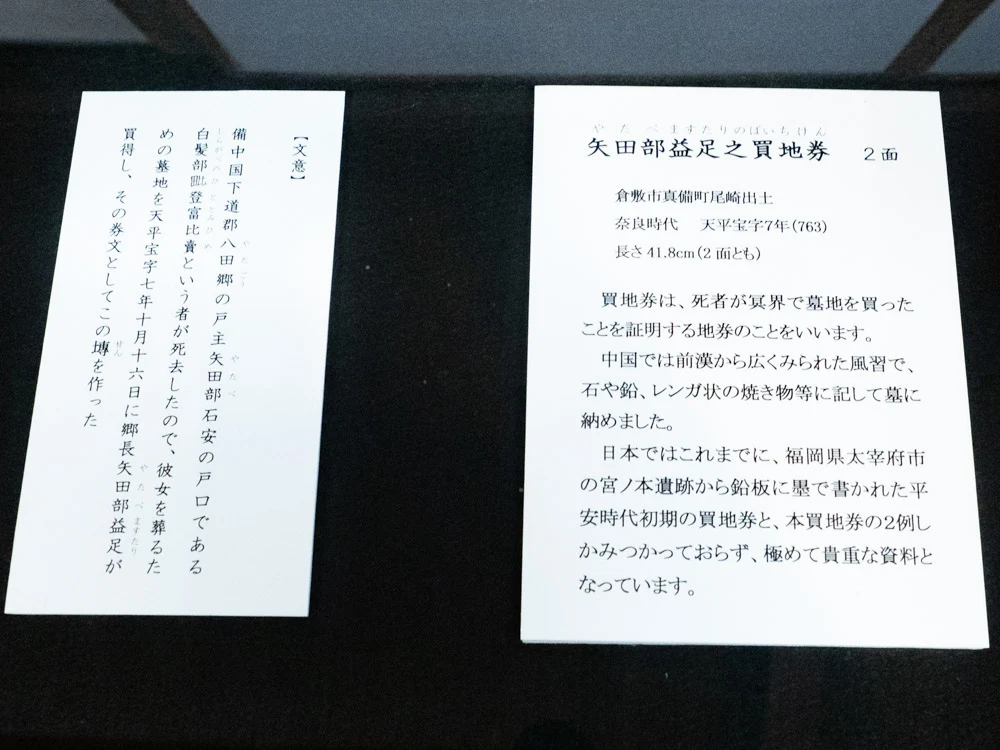
In the Kibi Province (Bitchu no Kuni), Shimotsumi District (Shimotsumi no Koori), Yatago (Yata-go), the head of the household Yatabe Ishi Yasune, and the white-haired Hito Tomihime passed away, so on the 16th day of the 10th month of the 7th year of Tenpyo Hoji (which corresponds to mid-November 763 in the current calendar), the head of Yatago, Yatabe Masutari, bought land for a grave, and made this brick as a certificate.
Note that Kibi Province, Shimotsumi District, Yatago corresponds to the area around Yata in Mabi Town, Kurashiki City today.
The meanings of proper nouns and terms are as follows.
| Kibi Province, Shimotsumi District, Yatago | A place name corresponding to the area around Yata in Mabi Town, Kurashiki City today |
|---|---|
| Head of Household | Head of a family |
| Household | One member of the family |
| Tenpyo Hoji | The era name during the Nara period, approximately from 757 to 765. The 16th day of the 10th month of the 7th year of Tenpyo Hoji corresponds to mid-November 763 in the current calendar. |
| Head of the District | The leader of a district, similar to a modern-day mayor |
| Brick | An ancient building material that is a type of brick |
Additionally, a land purchase certificate indicates that land (graveyard) was purchased to create a grave in the afterlife.
To last a long time, the land purchase certificate is made of brick that does not rot.
It can be understood that the concept of the afterlife already existed in this era.
There are only two known examples of land purchase certificates, including those from Yatago, across the country, making it a valuable item.
The Kurashiki Archaeological Museum has many other exhibits lined up.
If you just take a quick look, it may take about 20 minutes, but if you examine it thoroughly, an hour may not be enough.
I spoke with the curator of the Kurashiki Archaeological Museum, Ban Yuko.
Data of the Kurashiki Archaeological Museum
| Name | Public Interest Incorporated Foundation Kurashiki Archaeological Museum |
|---|---|
| Location | 1-3-13 Chuo, Kurashiki City |
| Contact | 086-422-1542 |
| Parking | None |
| Opening Hours | 9:00 AM - 5:00 PM (Admission accepted until 4:30 PM) |
| Closed | Monday, Tuesday If a holiday falls on these days, it will be open Closed during the New Year holidays |
| Admission Fee (tax included) | General: 500 yen (Group: 400 yen) High school and university students: 400 yen (Group: 320 yen) Elementary and junior high school students: 300 yen (Group: 240 yen) Disabled: 240 yen Preschool children: Free *Groups are 20 or more *Fees for special exhibitions may vary *Disabled rates require presentation of a disability certificate (applicable to the individual and one caregiver) |
| Payment Method |
|
| Reservation | Available |
| Smoking | Completely non-smoking |
| Restroom | Western-style restroom |
| Website | Kurashiki Archaeological Museum |








In the Kibi Province, Shimotsumi District, Yatago, the head of the household Yatabe Ishi Yasune
the white-haired Hito Tomihime has passed away, so on the 16th day of the 10th month of the 7th year of Tenpyo Hoji, the head of Yatago, Yatabe Masutari, bought land for a grave, and made this brick as a certificate.