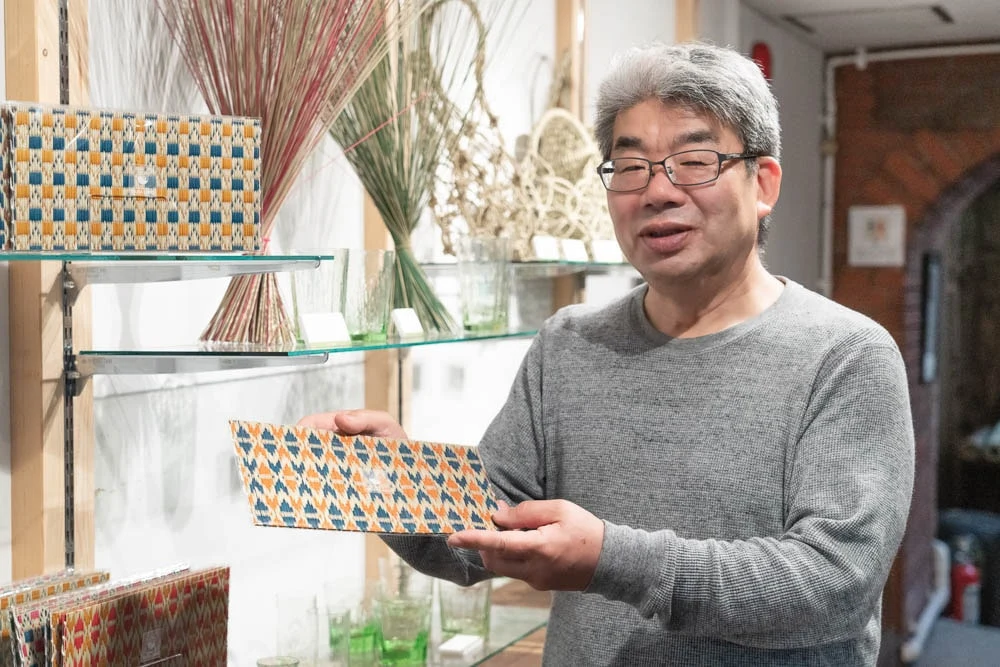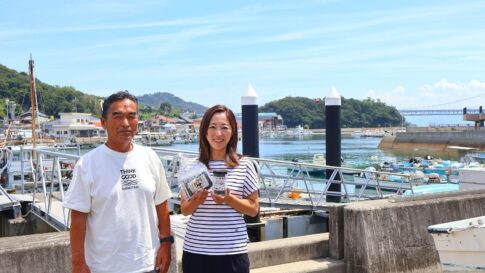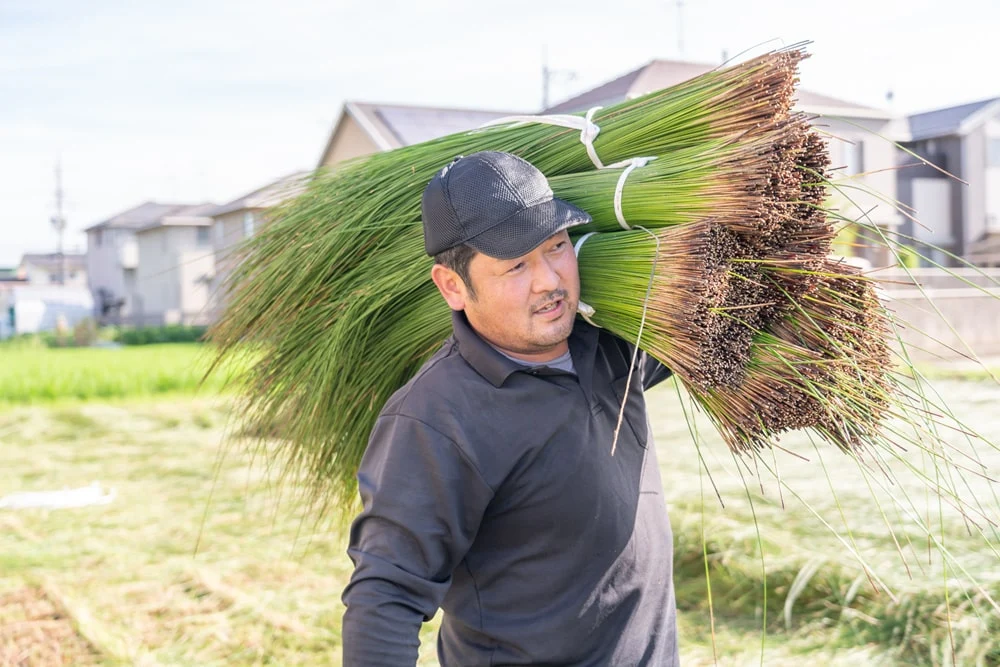
Interview with Imamiyoshi
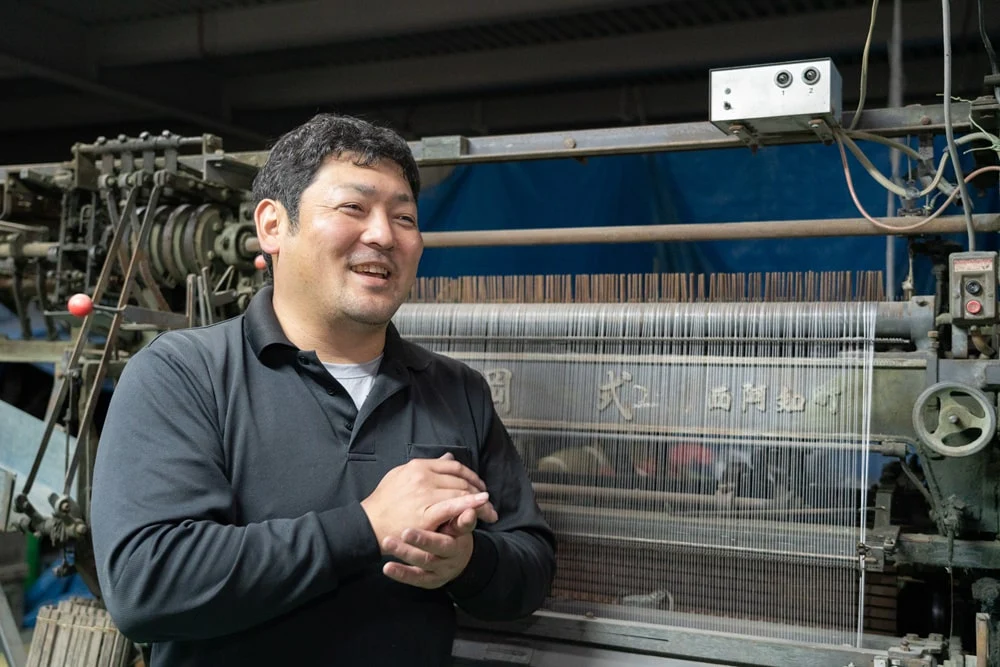
Imamiyoshi's Connection to Igusa
When did Imamiyoshi Shoten start making igusa products?
Imamiyoshi
When we were founded in 1897, we were a wholesaler dealing in tatami mats and flower mats.
During the time of my grandfather, the third generation, there was a movement to promote the Bikan Historical Area as a tourist destination, and there was a need for "souvenirs unique to Kurashiki" that could be taken home.
Due to requests, we shifted to the production of folk crafts.
In the Heisei era, the fourth generation changed the name to "Kurashiki Igusa Imamiyoshi Shoten."
The concept is to use igusa grown in Kurashiki, woven on looms made in Kurashiki, and crafted by artisans from Kurashiki.
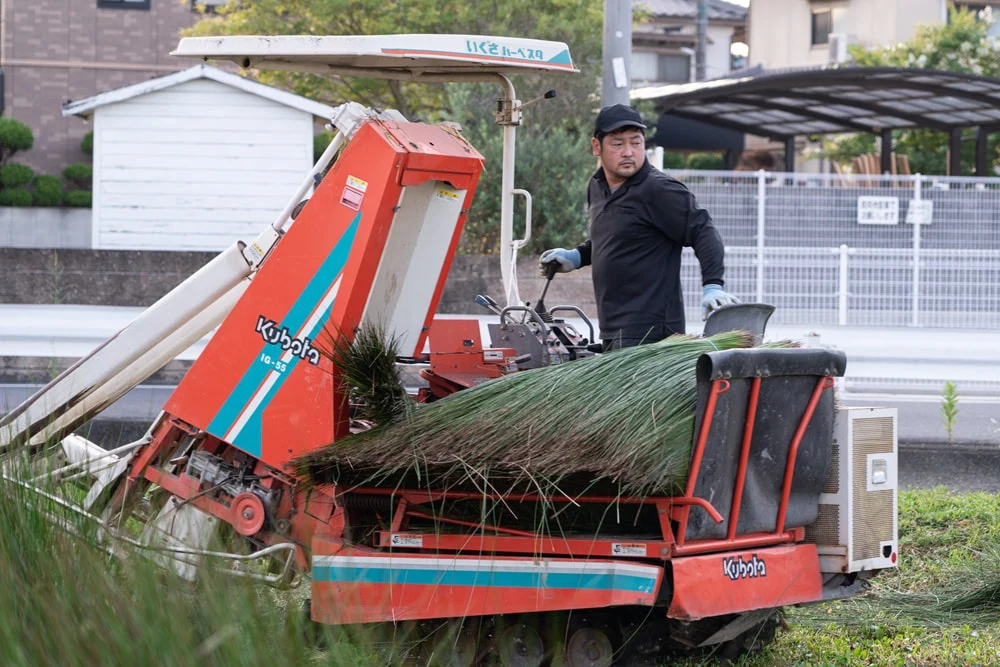
Why did the fifth generation, Imamiyoshi, start working with igusa?
Imamiyoshi
At first, I was working in agricultural machinery repair and sales.
At the time I was considering returning to Kurashiki, Imamiyoshi Shoten was short-staffed and struggling.
So I returned home and for a while, I was sewing coasters and weaving mats.
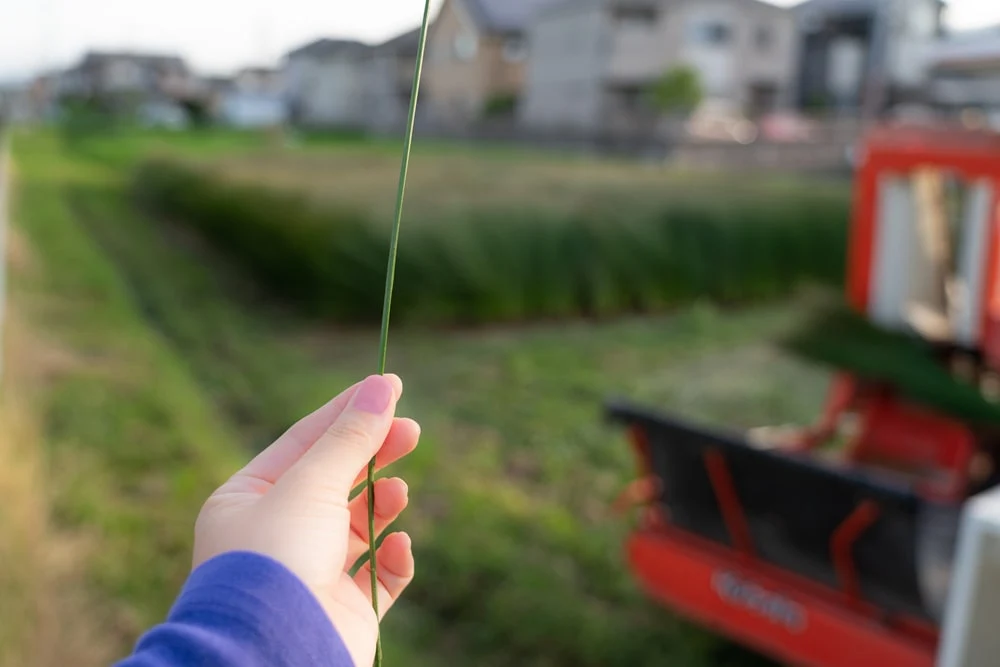
The aging of people involved in igusa is serious, and the situation was such that if it continued like this, there would be no igusa farmers left in Kurashiki.
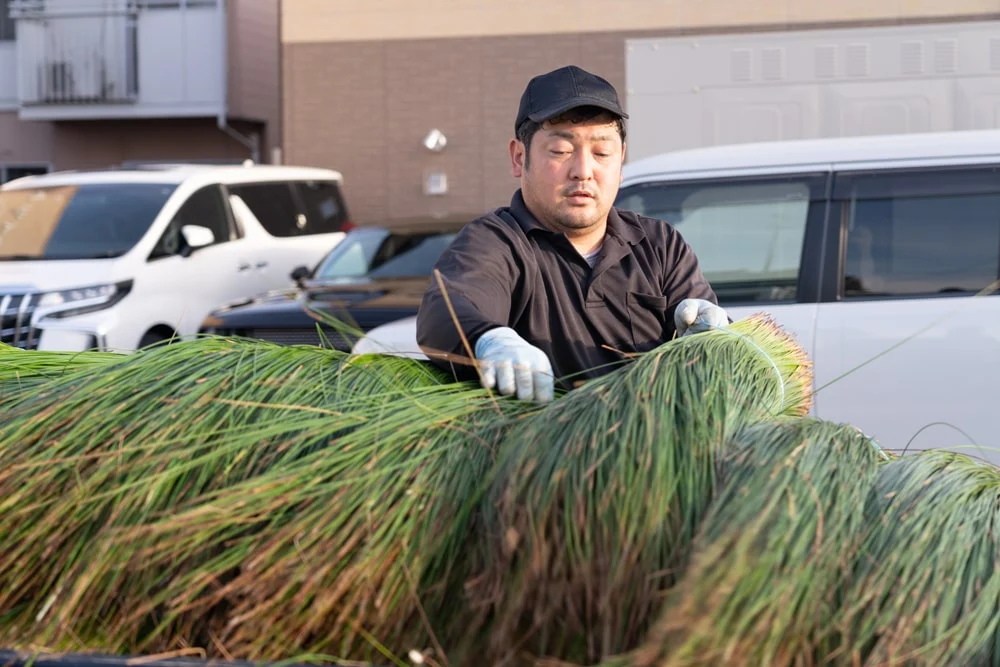
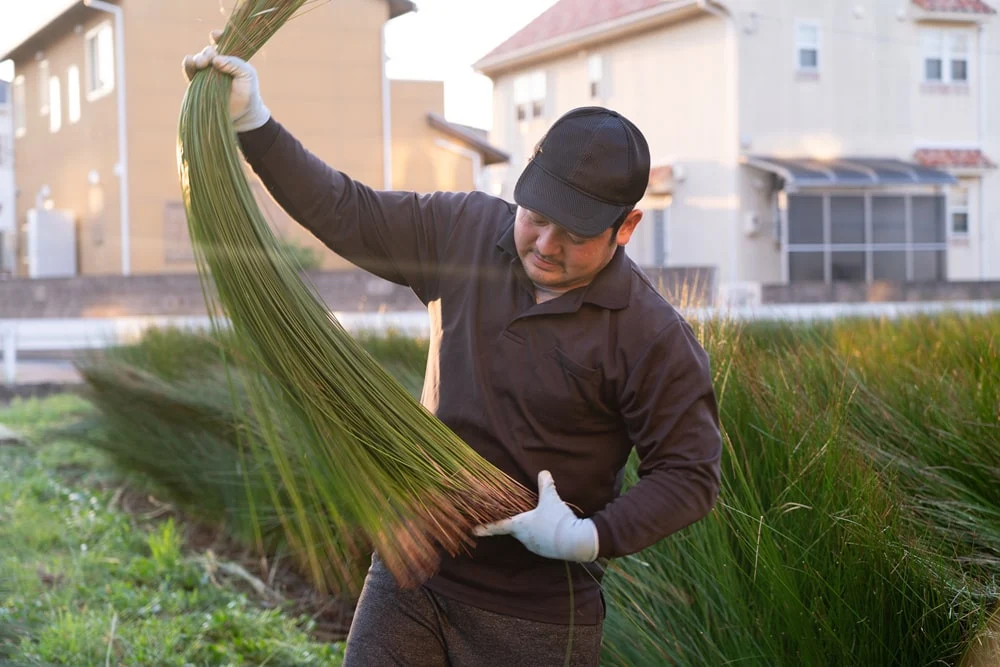
I thought, "If Kurashiki's igusa disappears, it would be a problem. I want to somehow preserve Kurashiki's igusa," and started cultivating igusa.
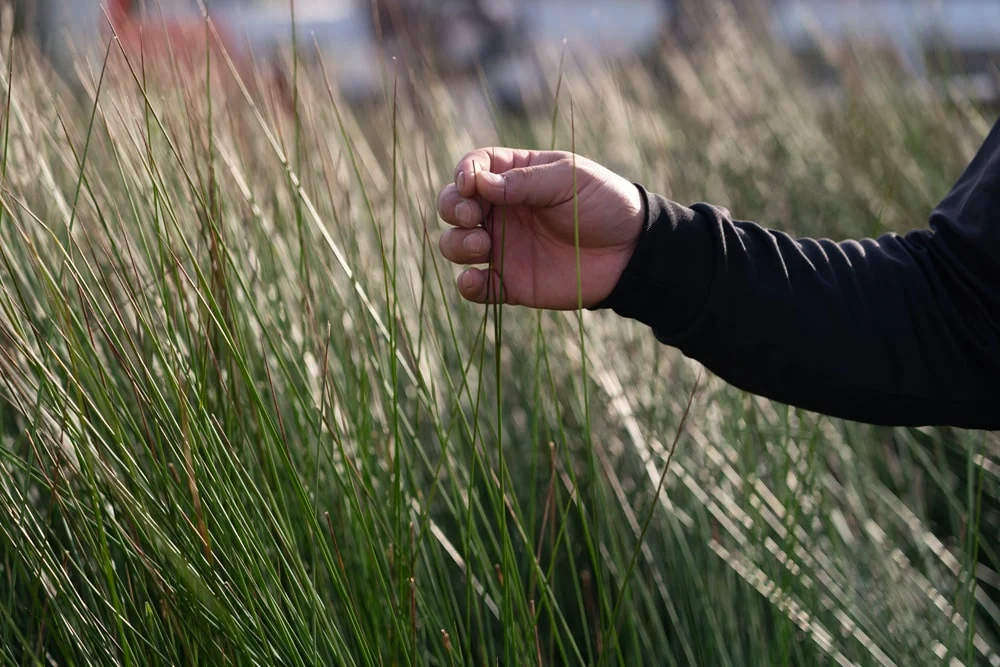
I apprenticed with someone in the Sho district who was making igusa, helping with the work in exchange for learning, and I was also growing igusa myself.
For about three years, I was making tatami omote (the surface of tatami mats).
Tatami omote is an agricultural product.
When combined with tatami edges and the floor, it becomes a tatami mat, and only then does it become a product for customers to use.
However, with flower mats, I can create products that customers use directly.
Kurashiki is the birthplace of flower mats, and it is an industry that my grandfather and father have been involved in, so we have the technology.
Therefore, I decided to shift to flower mats, aiming to become a unique entity that includes the production and processing of igusa.
I significantly reduced the cultivation amount to a quantity that I could process into products, aiming to create items of guaranteed quality.
Thus, IGUSA LABO was started.
I think it must be tough to do everything alone, but why do you do it by yourself?
Imamiyoshi
Because I process and sell it myself, I understand what kind of igusa becomes a good product.
There are things you can't understand just by growing, processing, or selling.
Also, I am not completely doing it alone.
Originally, I did all the work by myself.
However, when I thought, "I can't do this anymore, I can't continue," there were people who pushed me from behind and helped me, and there were people who earnestly thought about what to do next with me.
I am being helped by various people.
That said, we are doing what traditionally many companies were involved in, so it's not that easy.
I am the only one who makes and weaves, and I have to go out and sell and do sales as well.
I can only sell what I can produce, so I don't make much profit.
Still, I have gradually been recognized, so I am considering increasing the cultivation amount next year.
The Loom Created by the Community
You are using local looms, right?
Imamiyoshi
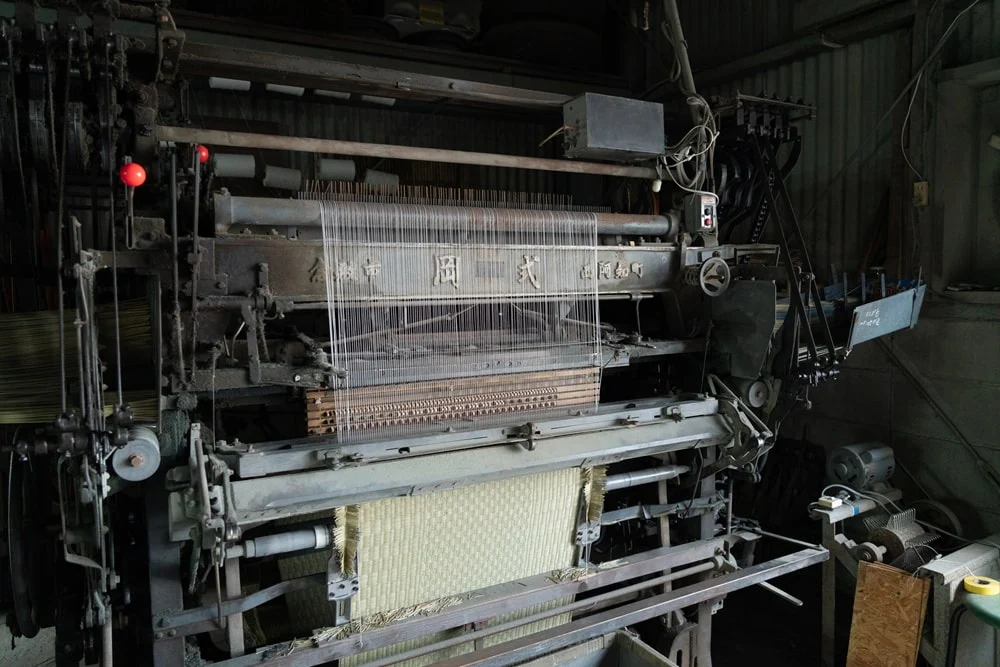
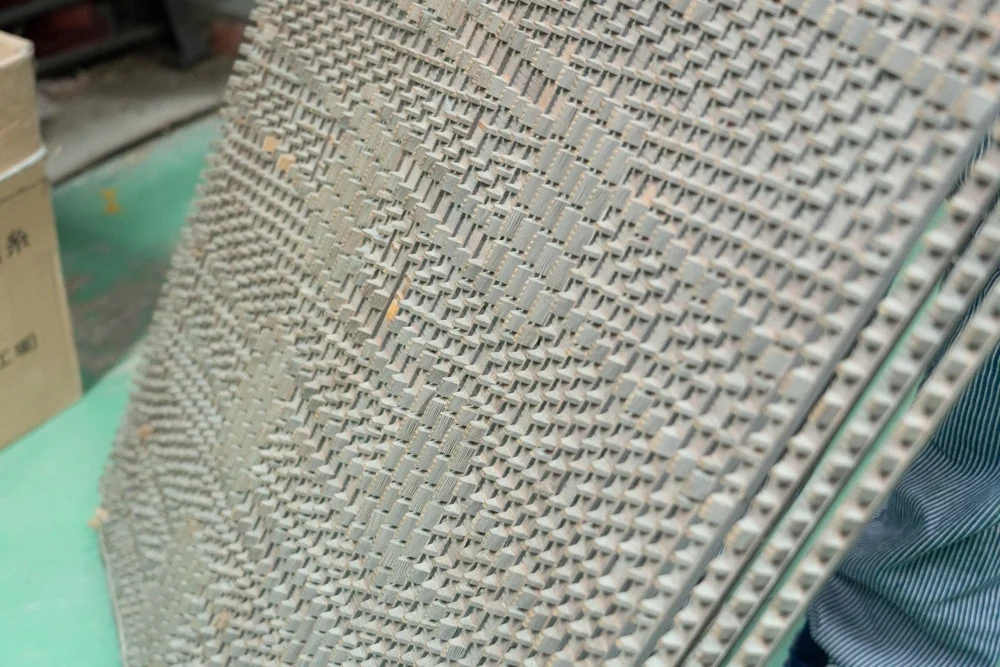
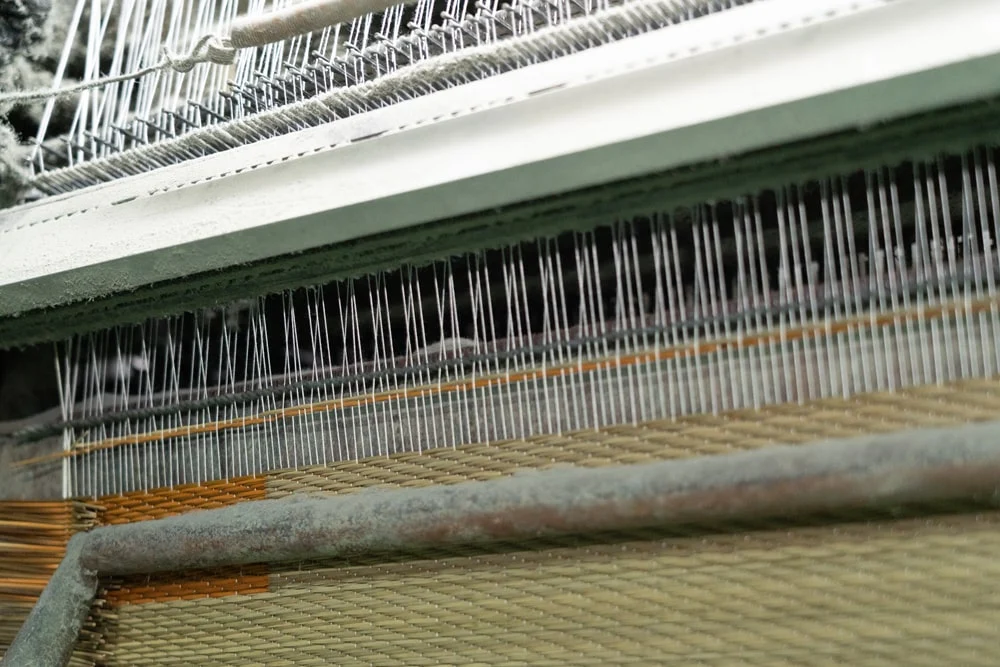
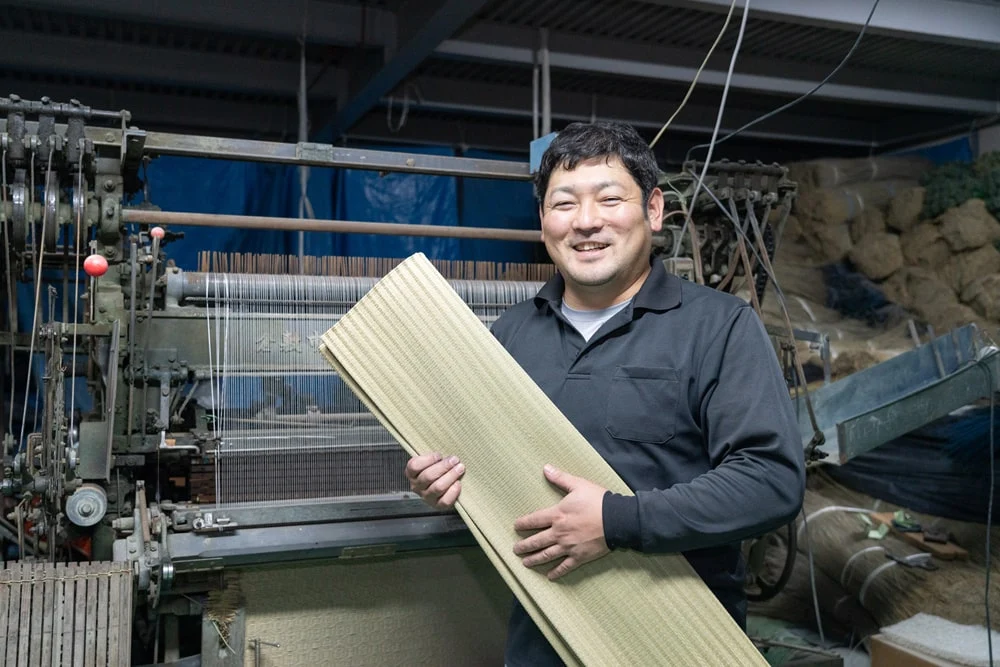
The type with wooden pegs is a loom that was born in the Nishi-Achi area.
Mechanization began around 1933, and this is the highest masterpiece that has gradually evolved.
At that time, many people were using this loom, and those weaving mats would modify the loom themselves.
They would think, "If I do this, the igusa will align more beautifully."
Then good improvements would be adopted by the loom makers and spread.
The community came together to create the loom.
Additionally, information like "That grandmother from that house can knit thread" was communicated in the neighborhood, leading to requests for home-based work, and children would help for pocket money, evolving as an industry in the area.
Many people in the community were involved in igusa, and a station for shipping flower mats was built at Nishi-Achi Station.
Since this loom was created in such a community, I want to use it with care.
The "Bichu Kaen" Flower Mat
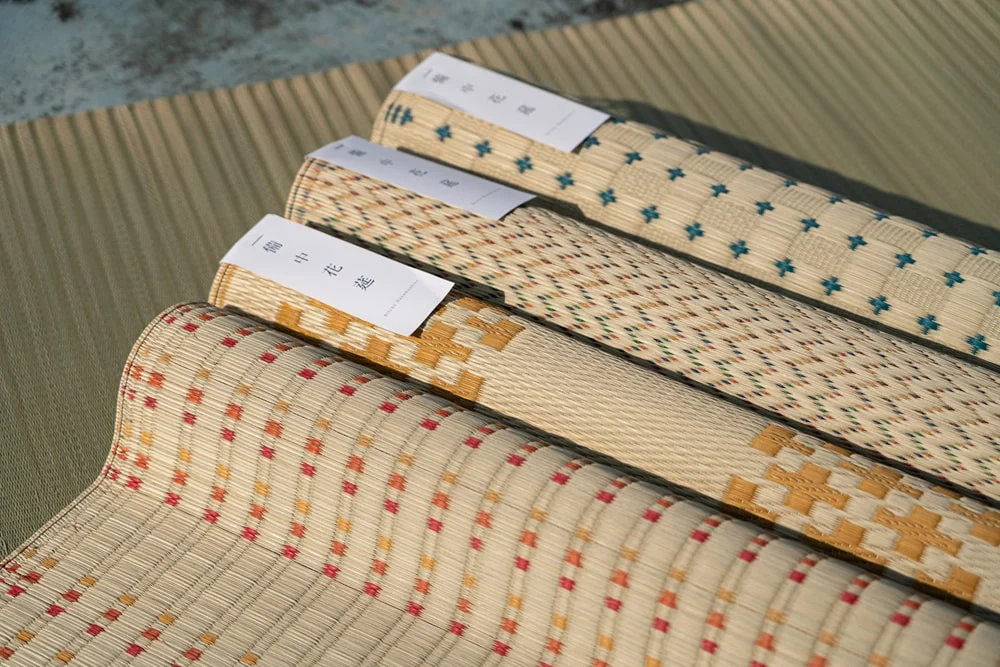
As "Bichu Kaen," you also participated in a folk craft sales event at a department store in Ginza. What kind of brand is "Bichu Kaen"?
Imamiyoshi
With "Bichu Kaen," I do not insist on the igusa I want to grow.
IGUSA LABO is 100% igusa that I produced.
What I want to do as IGUSA LABO is sleeping mats.
I want to convey who is making it and what feelings are behind its creation.
One of the concepts of Bichu Kaen is the preservation of flower mat techniques.
If the number of people sourcing igusa decreases, it becomes difficult for those producing igusa.
I absolutely want to preserve the igusa industry, so I will also engage in sourcing.
If I am too fixated on my own grass, the business won't operate, and I can't hire people with the revenue from only the amount of igusa I can harvest.
As the fifth generation of Imamiyoshi Shoten, IGUSA LABO, and Bichu Kaen, I have my own thoughts on each, and I am struggling with how to proceed.
While struggling, I am moving forward.
How was the response to the sales event?
Domestic flower mats are produced in very small quantities.
Everyone looking for them has been searching, and the response was quite good.
I received courage, thinking, "I'm not wrong, it's okay."
Dyeing Techniques
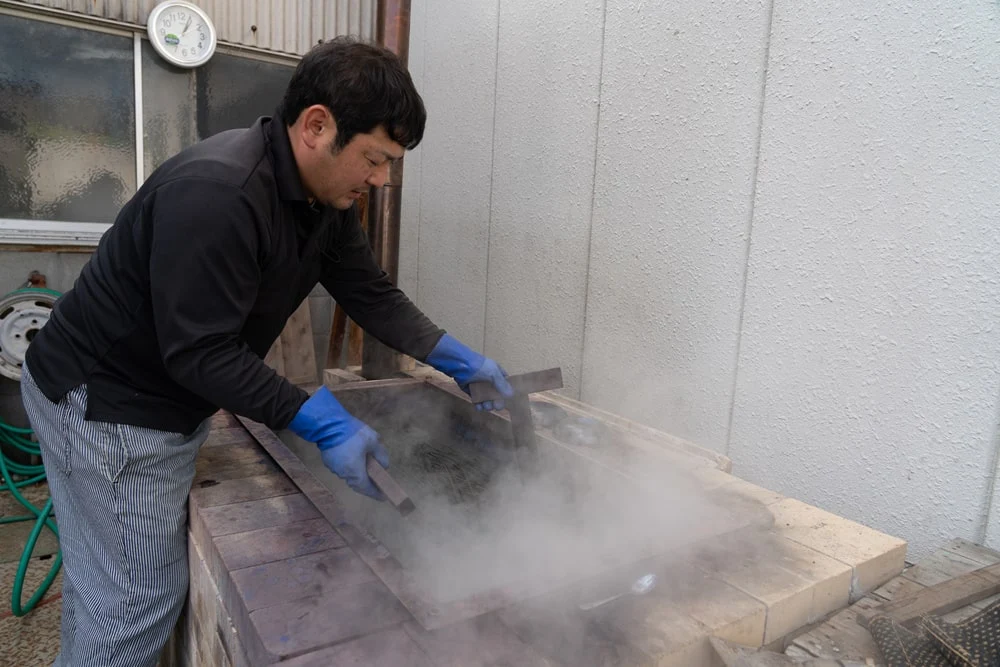
At IGUSA LABO, you are not using mud dyeing, right?
Imamiyoshi
I know that mud dyeing of igusa is harmful to the body of the processor, so I also disliked making it a product.
In the past, it was said, "Undyed igusa does not take dye."
But when I tried dyeing it, it dyed normally.
I thought, "What the heck is this?"
I think it was conveyed that it "does not take dye" because it did not dye in the same way as the igusa that was mud-dyed in the past.
You really have to try things yourself.
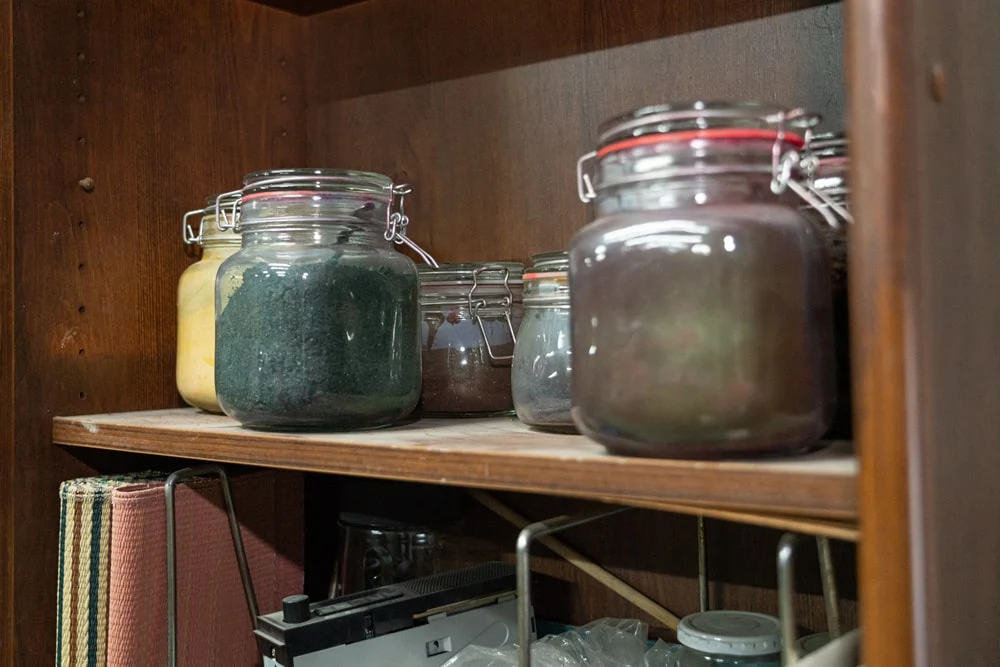
Is the method you are using for dyeing common?
Imamiyoshi
No, it is quite mechanized now.
There are methods to dye larger quantities at once, but with those methods, the colors from the first dyeing and subsequent dyeings inevitably differ.
Since the amount of igusa I produce is limited, it would be a waste to have a large loss.
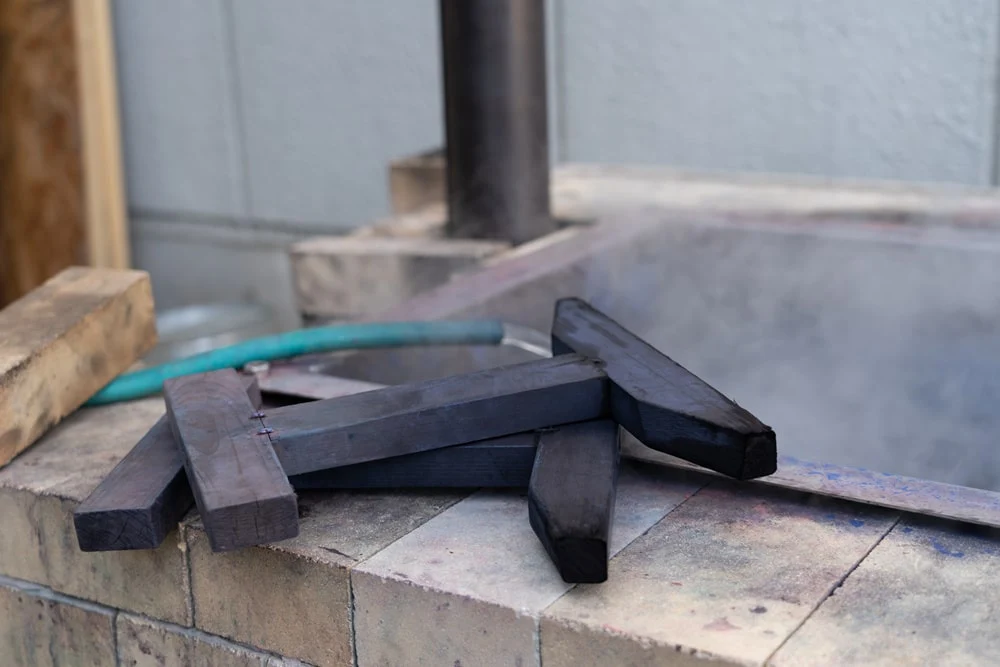
Therefore, I use the "boiling dyeing method with basic dyes," which originated in Kurashiki, using a handmade flat pot for dyeing.
In Okayama Prefecture, various dyeing methods have been tried, but no groundbreaking dyeing method has emerged to replace this dyeing method.
Other dyeing methods have constraints, for example, they can produce light colors but cannot produce deep navy colors.
With the boiling dyeing method using basic dyes, both deep and light colors can be produced.
The process is almost the same as it was in the 1950s and 1960s, so if you turn the photos of the dyeing process to black and white, you wouldn't be able to tell the era.
However, being able to adjust while observing the dyeing is one of the advantages of hand dyeing.
Dyeing is also an important keyword for my igusa.
Now, there are no longer people dyeing igusa.
So, if I don't dye it myself, I can't weave mats.
Until when were there people dyeing?
Imamiyoshi
Until very recently.
Usually, the work is divided, so the dyers only do dyeing.
If the weavers do not provide work, the dyers have no work.
As the industry itself declines, the jobs of those in the middle of the division of labor, such as dyers and those who wind the warp, disappear, and they can't make a living.
It can't be helped, but I think that from now on, the traditional division of labor won't work well.
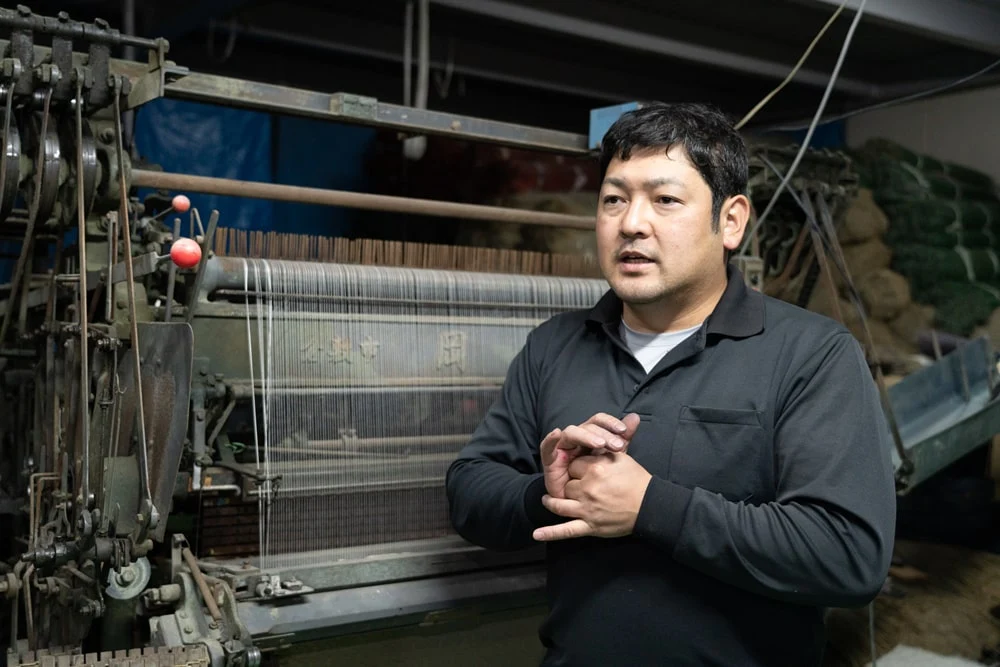
Did you have someone to teach you the dyeing techniques?
Imamiyoshi
Yes. I learned by being taught and by looking at photos that serve as materials.
To process, covering techniques are also important.
If the color doesn't turn out as expected, I can redye it.
However, for example, if I try dyeing with a dye that turns brown after a light blue, it turns purple instead of brown.
What colors will dye beautifully can be quickly understood by experienced artisans, but it is tough when you try it yourself.
Even small things are now taught by people in their 70s and 80s.
However, in ten years, there may not be anyone who can teach, even if you pay.
That's how desperate the situation is.
Preserving Igusa Production
The situation for preserving igusa in Kurashiki is very tough.
Imamiyoshi
I started with a feeling of "I have to do something, no matter what."
I might be the only one left in ten years.
At Imamiyoshi Shoten, we were making products from short igusa that did not reach tatami omote or flower mats.
In Kumamoto and Fukuoka, there is no such industry, so they can only be used as bedding straw or burned.
What farmers had to throw away can be turned into money.
From the perspective of those cultivating it, it is a valuable industry.
I think about what it means for me to be in Kurashiki, where it is easy to utilize short igusa.
My business is not the traditional way, so it is unconventional.
If you do the math, no one would do this kind of work.
Therefore, I think I will create for those who need it within that context.
Do you have any challenges you want to take on in the future?
Right now, I am doing everything from 1 to 10, but I am thinking it would be nice if we could establish a "division of labor" with a few teams.
I want to properly understand the previous and next processes, and be able to think about the people in other processes to come up with better ideas.
For that, the people involved must be able to eat well.
I have also held workshops for high school students.
If I am having fun, there may be people who want to work with igusa (rush grass).
Although the number of tatami mats and traditional Japanese houses is decreasing, it is not acceptable to say, "We cannot produce tatami mats or goza (straw mats) domestically" when the value is reassessed and demand increases.
I am doing my best to ensure that the technology remains at that time.
My dream is for Kurashiki to revive as a production area.
There are people who have taught me skills and knowledge, so I want to connect with them.
Let's Touch Igusa
When I interviewed "Igusa-ya Kaen" before, I heard that one reason for the decline of the igusa industry in Kurashiki was that "many parents said it was heavy labor and could not pass it on to their children, leading to an increase in businesses going bankrupt."
Even now, with the advancement of mechanization, it is said that igusa cultivation is harsh.
Still, Mr. Imayoshi is making igusa, dyeing it, weaving goza, and selling it with a passionate desire to "do something."
I feel that the circle of people who sympathize with his feelings, are moved by his actions, and like his products is gradually expanding.
The inheritance of skills and culture is very difficult to revive once it is interrupted.
I hope that people will feel healed by the scent of igusa, and feel good lying on tatami mats or goza.
I think, "I want the next generation to experience such things."
When you visit the Bikan Historical Area, please take a look at the products of IGUSA LABO at "Igusa-ya Kaen."
IGUSA LABO Data
| Organization Name | IGUSA LABO |
|---|---|
| Industry | Igusa cultivation, manufacturing and sales of igusa products |
| Representative Name | Imayoshi Toshifumi |
| Year Established | May 2018 |
| Address | 1007-33 Nishi-Achi-cho, Kurashiki City, Okayama Prefecture |
| Contact | 090-9502-4376 |
| Website | IGUSA LABO |