
Kojima Torajiro became known to the world through his work from his student days titled "The Garden of Compassion".
However, Kojima Torajiro's self-assessment as a student was strict, and the same was true for his representative works, "The Watermill of the Village" and "Going to School".
Typically, creators do not leave detailed accounts of their thoughts and processes regarding their works, or such accounts are rarely preserved.
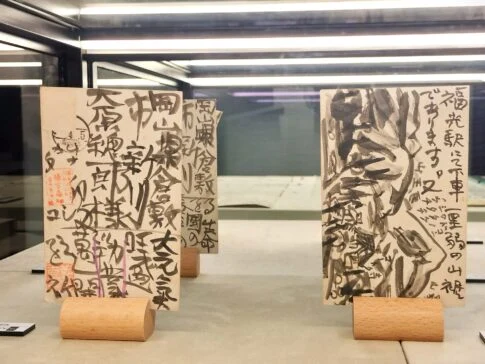
However, during his student days, Kojima Torajiro sent numerous letters to Ohara Magosaburo, who supported him as a scholarship student, and from these letters, we can decipher his creative process.
Here, we introduce an explanation of his works through the "Letters of Student Kojima Torajiro".
Overview of the 44th Kurashiki Future K Seminar Special Exhibition "Numerous Letters Remaining in the Ohara Family - Letters from Student Kojima Torajiro"
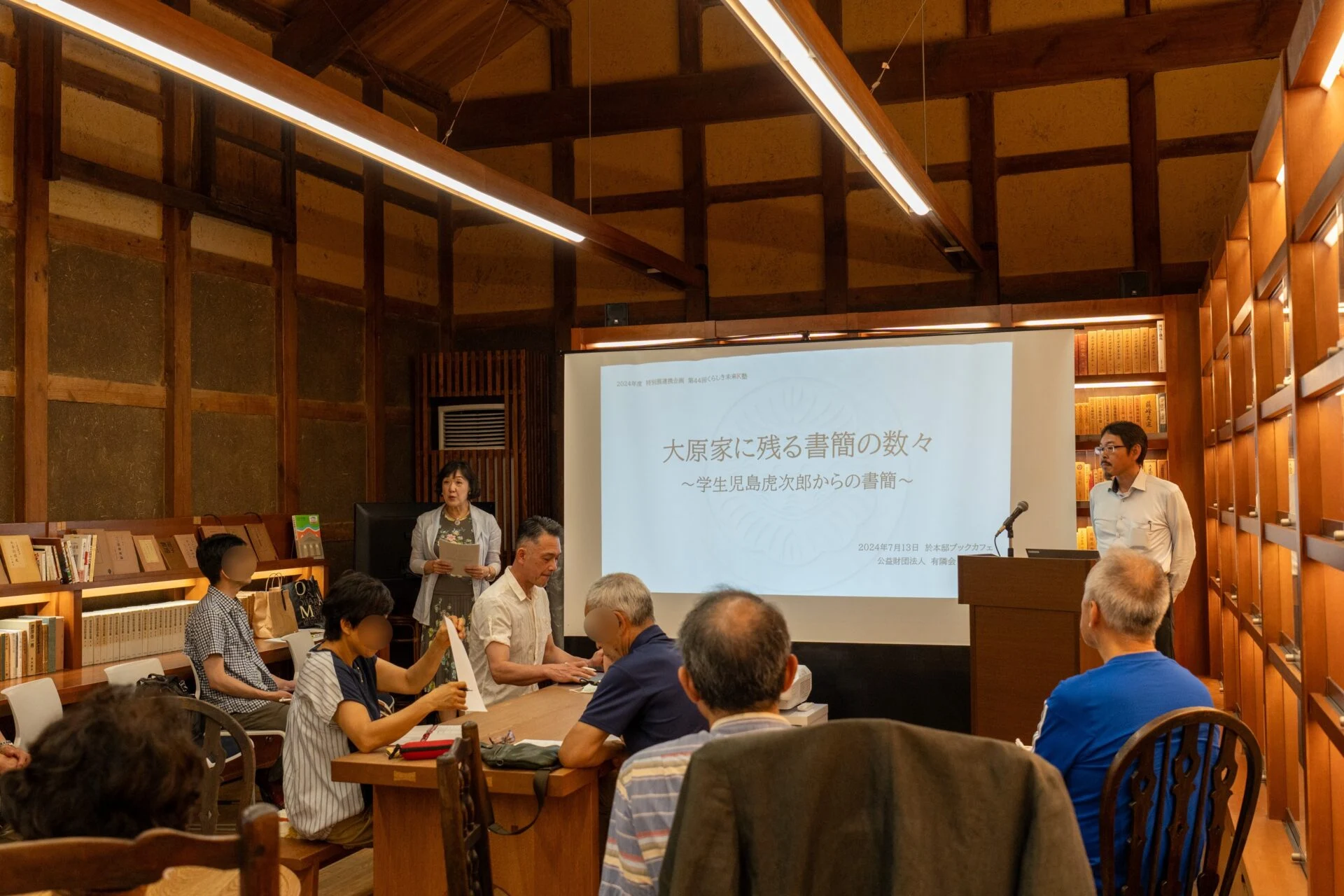
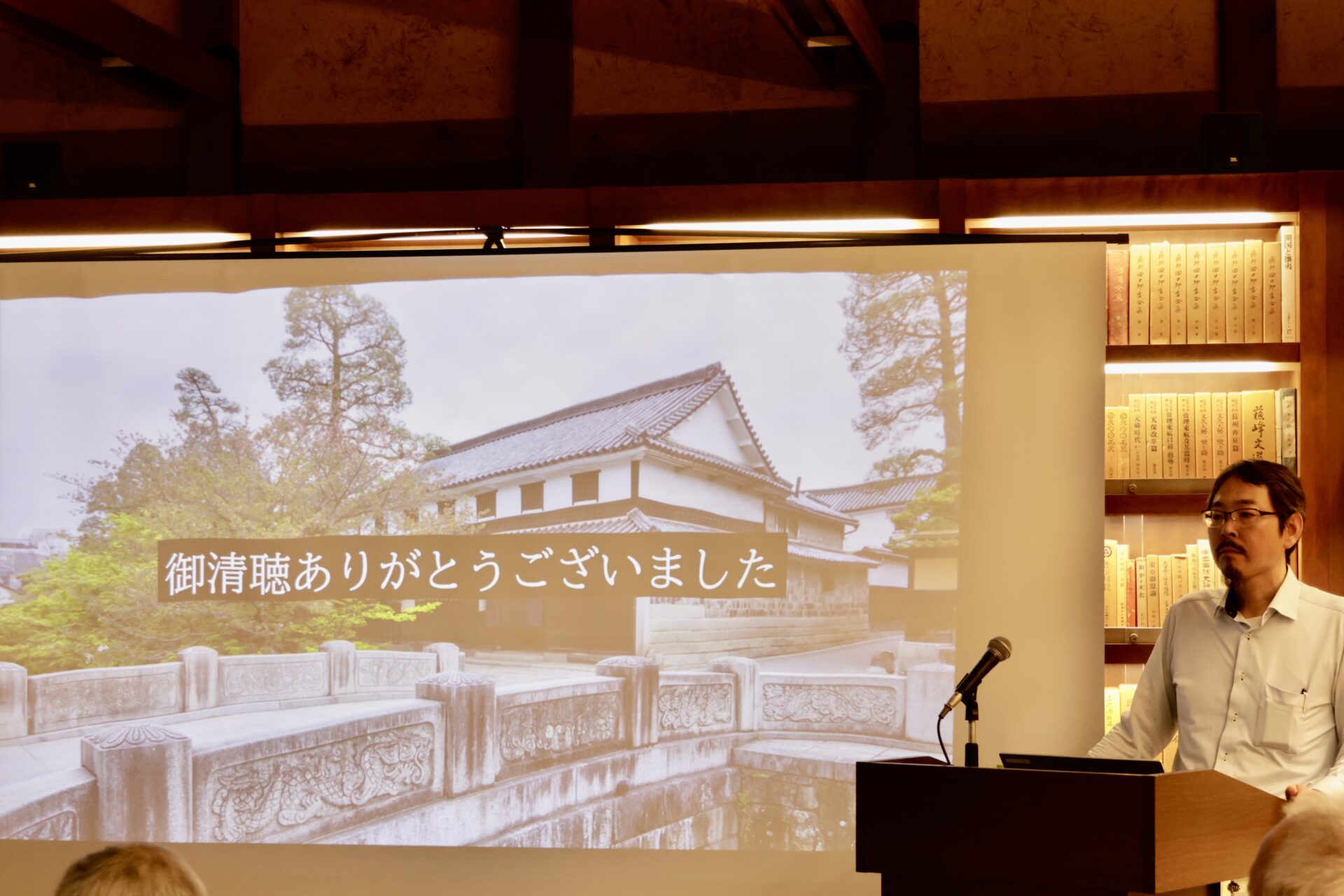
The 44th "Kurashiki Future K Seminar" is a seminar regularly held at the "Ohara House Katalyzer", and it was held on July 13, 2024 (Saturday) starting at 1 PM.
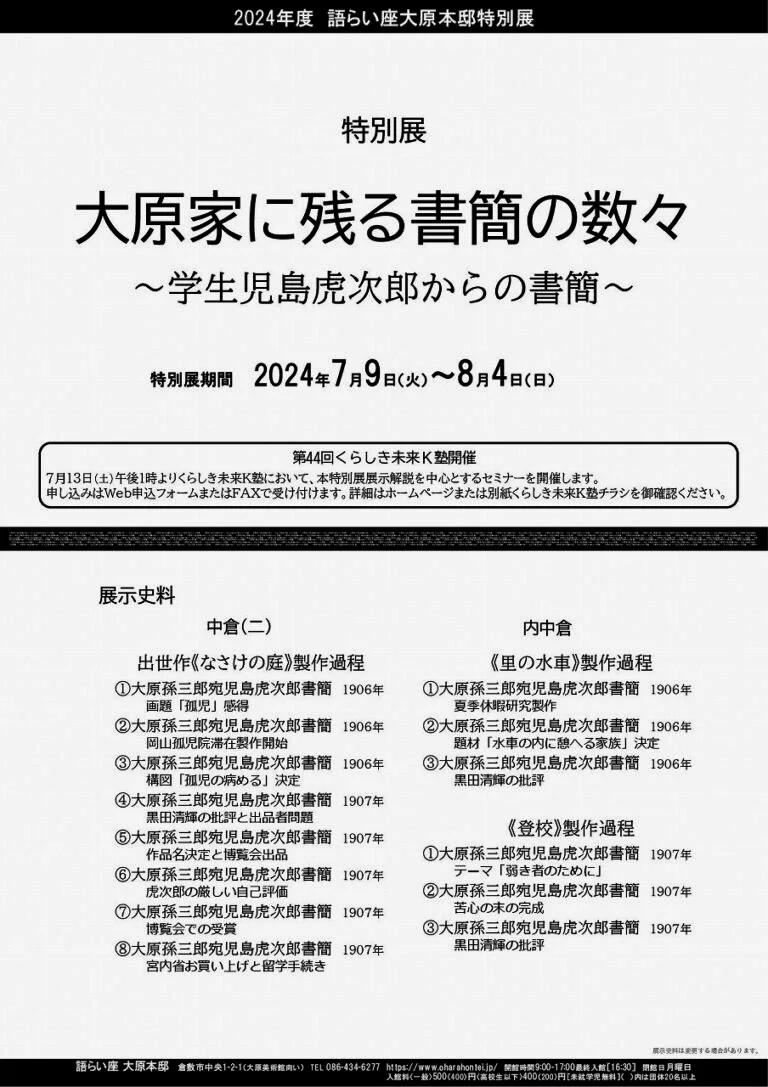
This is an explanatory lecture about the special exhibition "Numerous Letters Remaining in the Ohara Family - Letters from Student Kojima Torajiro", which was held from July 9 (Tuesday) to August 4 (Sunday), 2024.
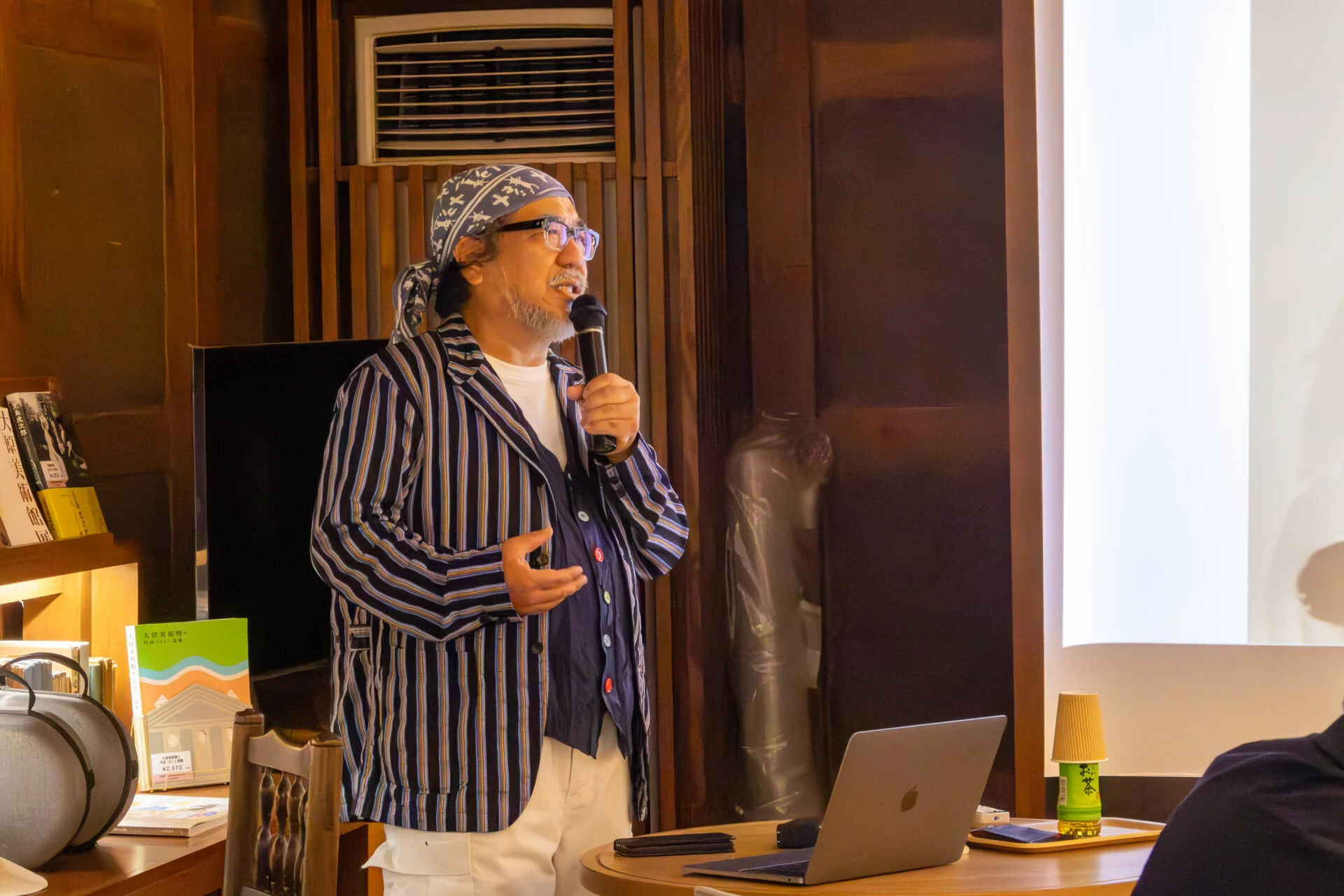
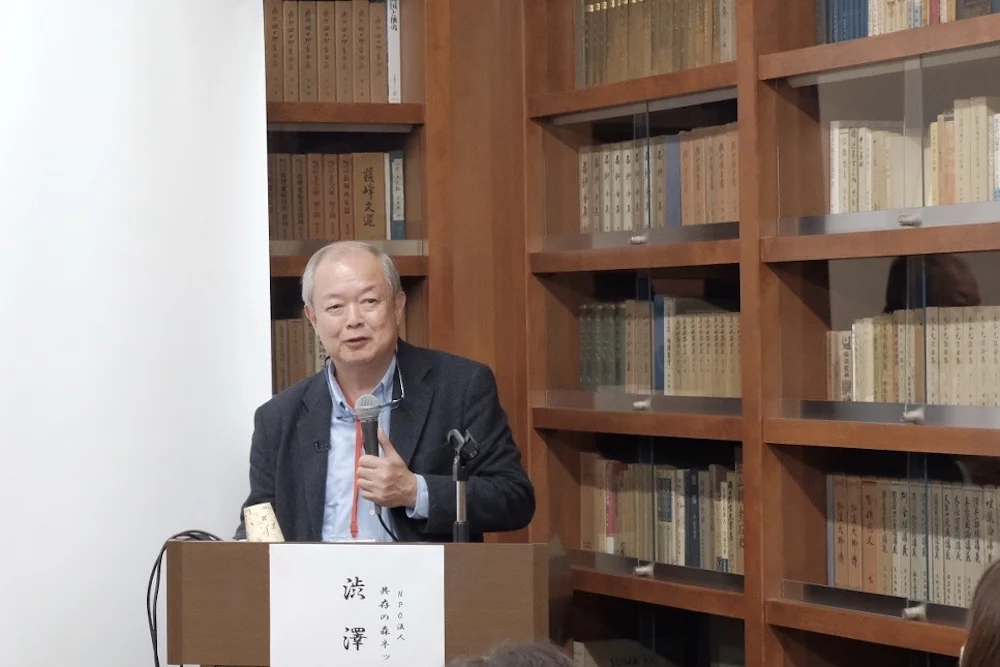
The lecturer is Hiroshi Mizushima, a curator at the Yu-rin Association.
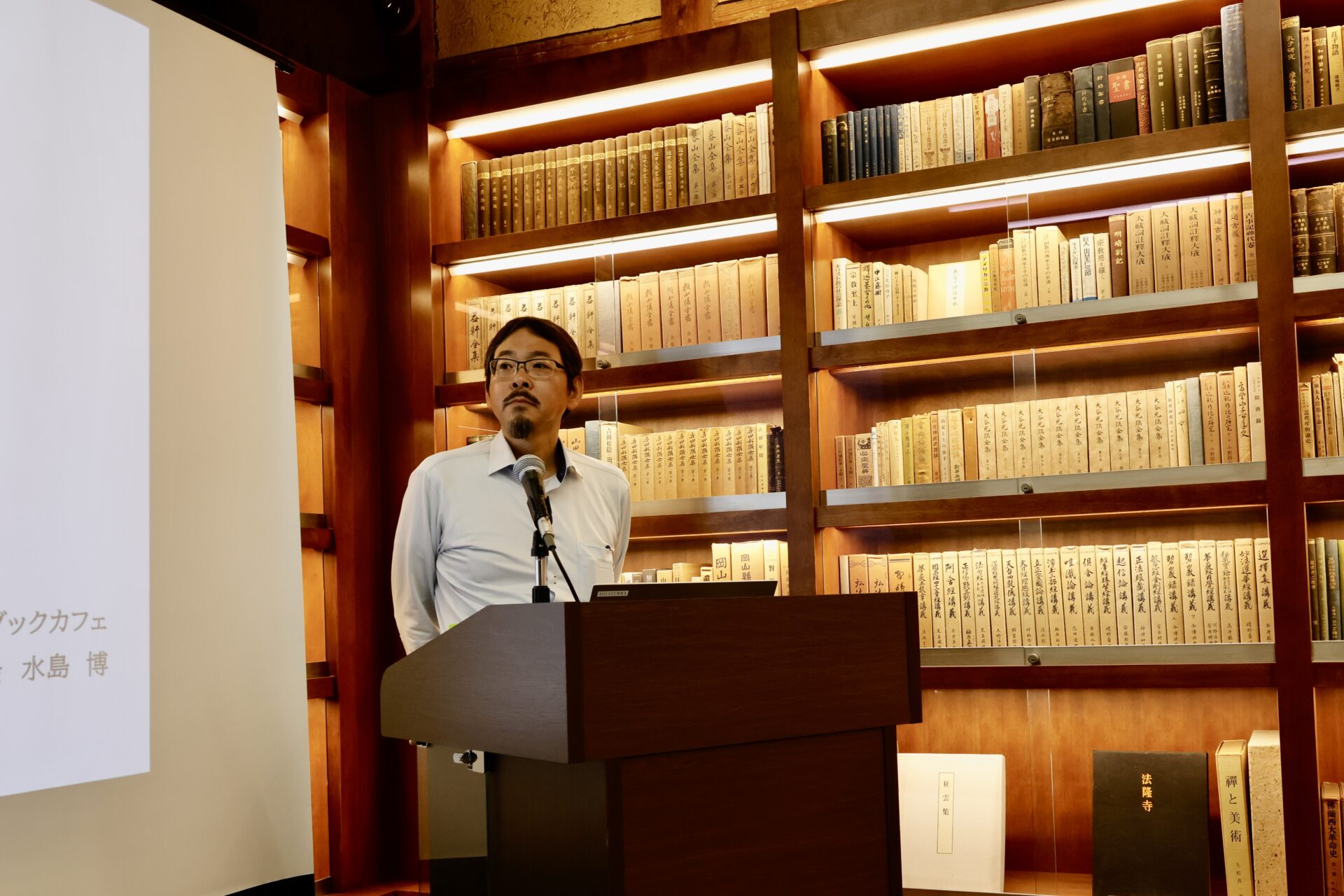
The lecture lasted about an hour, followed by a coffee time and a Q&A session in a friendly atmosphere.
The content of the lecture is as follows.
- Encounter with Kojima Torajiro
- Creative Process of "The Watermill of the Village"
- Creative Process of the Breakthrough Work "The Garden of Compassion"
- Creative Process of "Going to School"
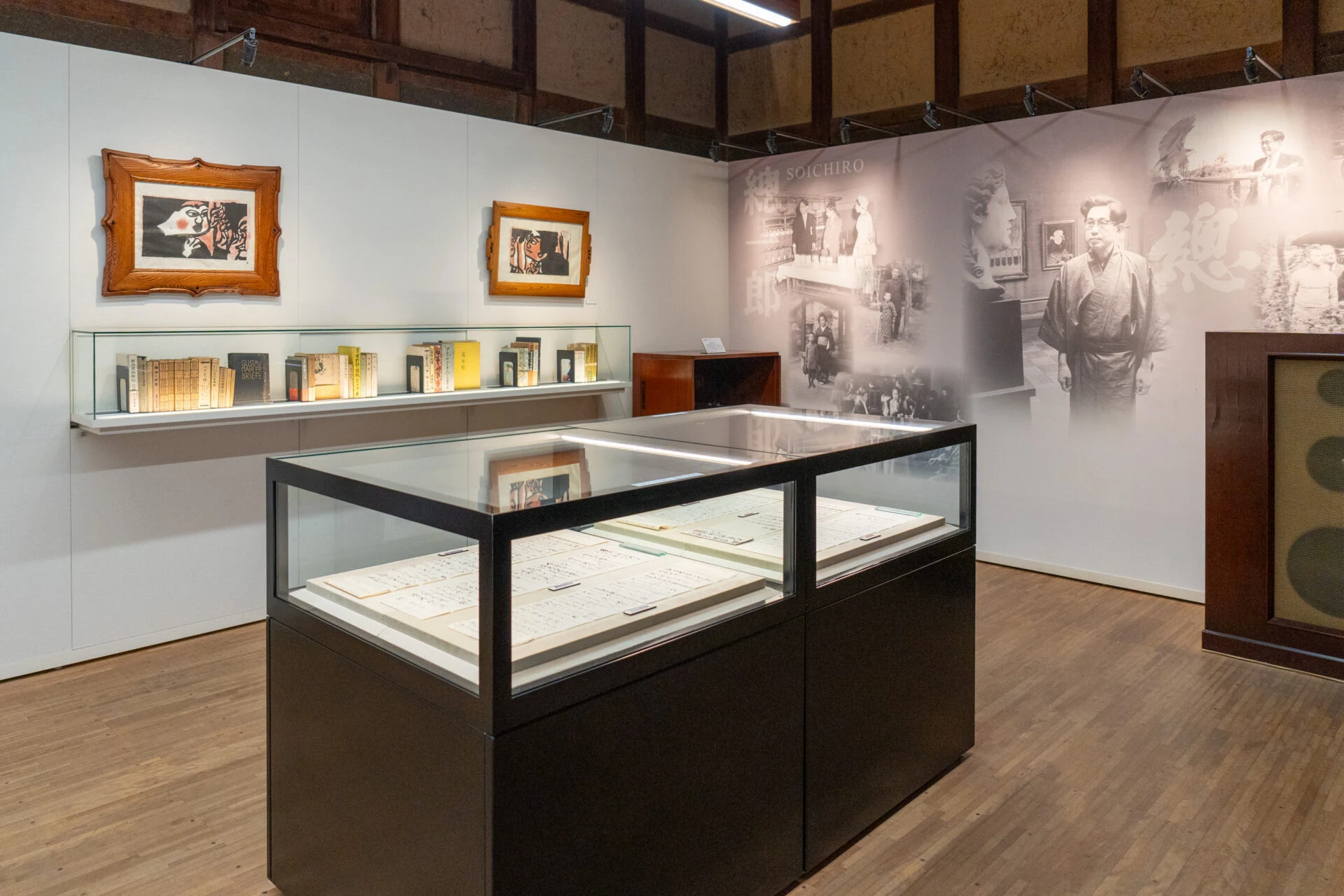
Encounter with Kojima Torajiro
Among the people surrounding Kojima Torajiro, the most important encounter was with Ohara Magosaburo. Kojima Torajiro was one year younger than Ohara Magosaburo and maintained a lifelong friendship with him.
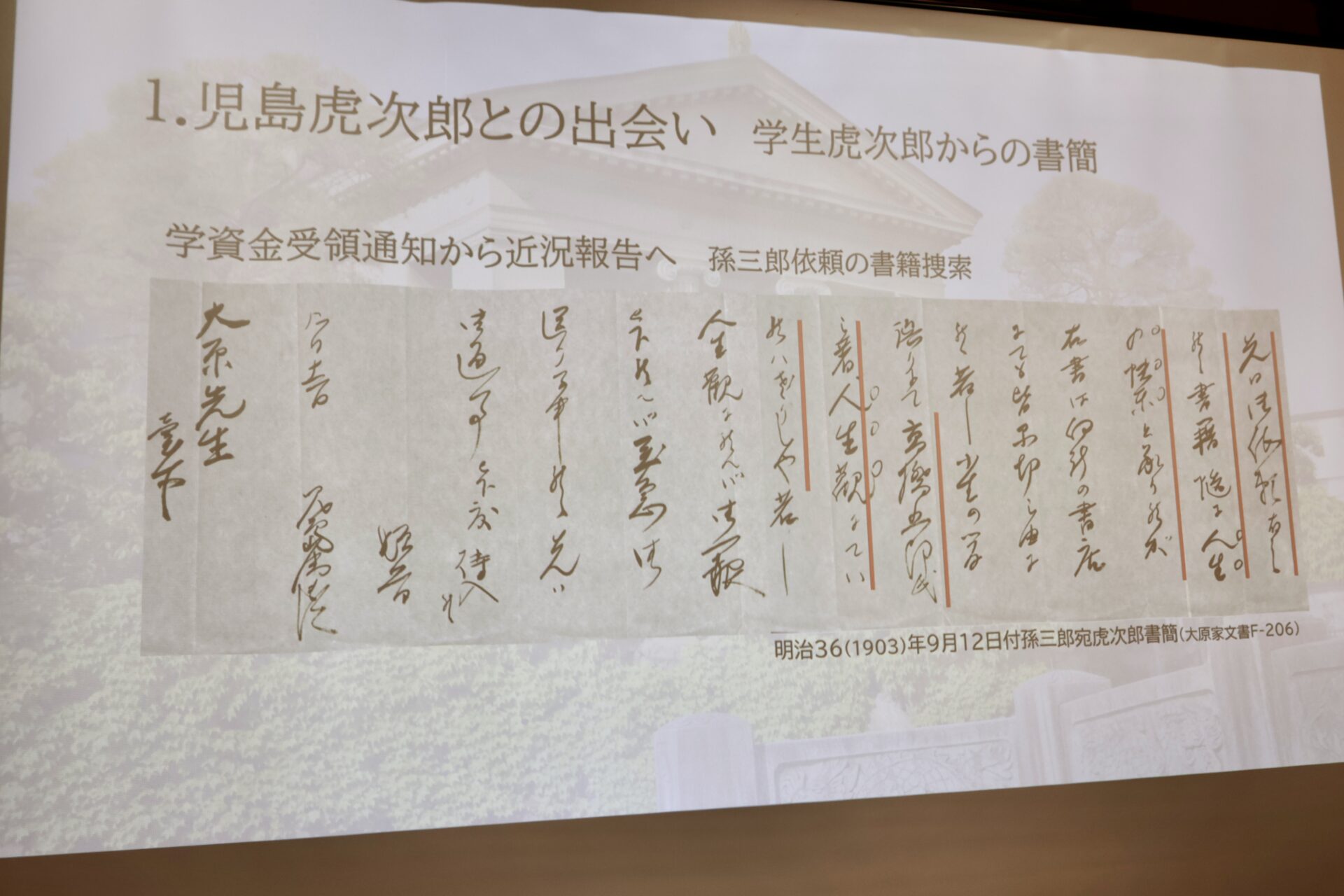
The two met when Kojima Torajiro, while attending the Tokyo School of Fine Arts (now Tokyo University of the Arts), submitted a request for a scholarship to become a scholarship student.
Ohara Magosaburo, a businessman, was running a scholarship system.
Torajiro submitted a request for a monthly scholarship of 6 yen for tuition on September 3, 1902 (Meiji 35). This was likely the first meeting with Ohara Magosaburo.
The receipt notification sent to the Ohara family on October 8 of the following month, after the scholarship was approved, is the first letter from Torajiro.
The content is quite simple, stating something like "I have received it," but as the relationship with Magosaburo deepened, the content of the letters also became more substantial.
Creative Process of the Representative Work "The Watermill of the Village"
The representative work "The Watermill of the Village" is part of the collection of the Ohara Museum of Art.
The "Watermill of the Village" was exhibited at the Tokyo Prefectural Industrial Exhibition held in 1907.
As the title suggests, it depicts the scene of a watermill, with a young woman sitting across from a woman holding a baby.
The location depicted is the Naruha River in Okayama Prefecture, which is also Torajiro's hometown.
The letters detail his decision to depict the watermill on the Naruha River and his return home. A frequently mentioned figure in the letters of student Kojima Torajiro is Kuroda Seiki.
Kuroda Seiki was Torajiro's mentor, who not only evaluated his works and pointed out corrections but also encouraged him to exhibit at exhibitions.
Summarizing Kuroda Seiki's critiques mentioned in the letters, they are as follows:
- It is depicted safely (which is a high evaluation)
- The figures originally depicted on the stone steps should be removed
- High praise for the fingers of the parent and child depicted
- The mother's face has some roughness, which is highly praised
- High praise for Torajiro's engagement with figure painting
- Encouraged to exhibit at the exhibition the following year (1907)
When actually viewing the work, it is indeed true that no figures are depicted on the stone steps, but one wonders what kind of figures were originally depicted.
Knowing the points praised by Torajiro's mentor when viewing this work makes one feel a sense of "I see" in a mysterious way.
Kuroda Seiki seems to have had a high evaluation of Torajiro, who engaged in figure painting amidst many landscape paintings.
Torajiro did not seem very interested in exhibiting at the exhibition, and it is written that he was genuinely pleased with Kuroda Seiki's high evaluation.
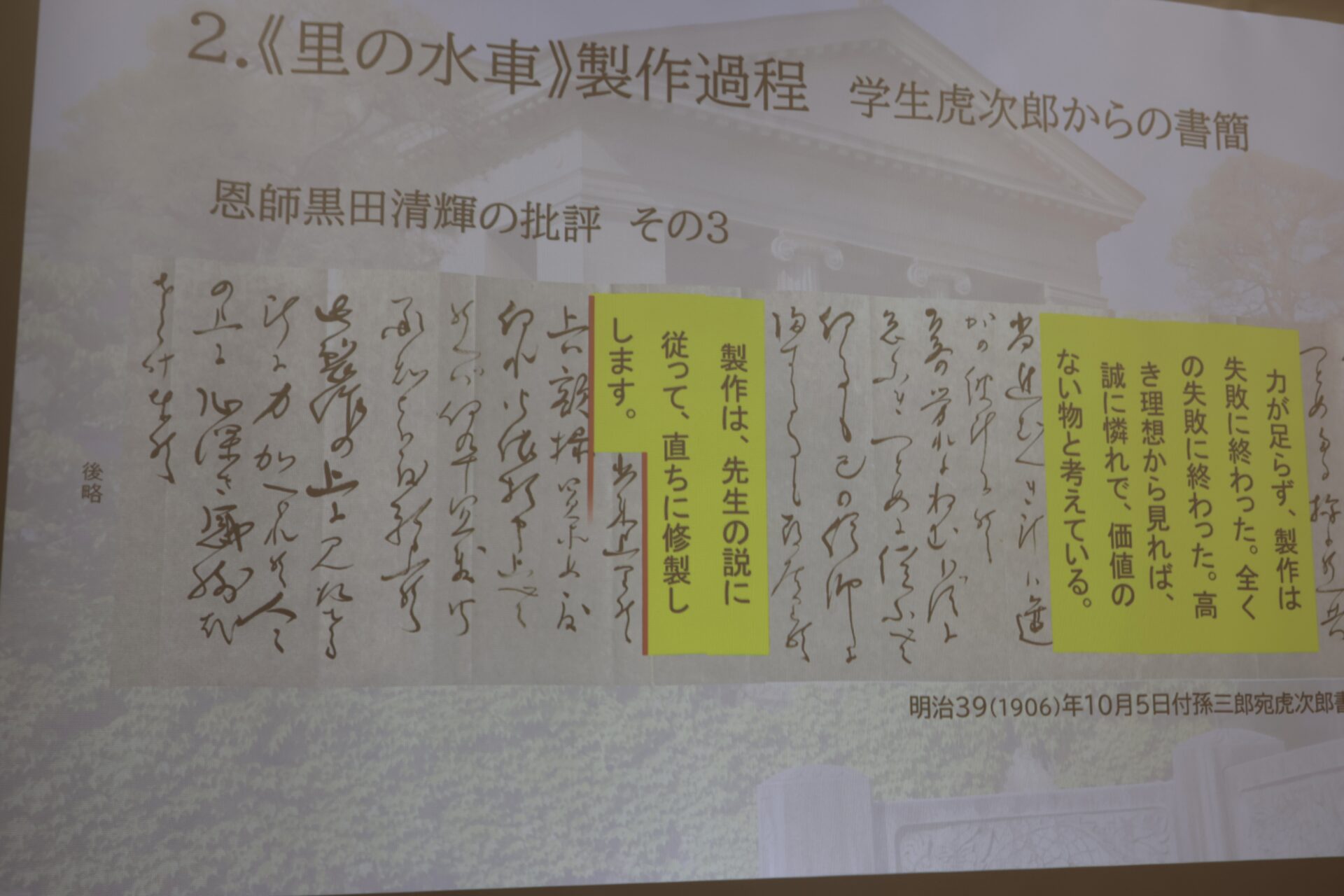
My strength was insufficient, and the production ended in failure. It ended in complete failure. From a high ideal, I consider it truly pitiful and worthless.
I will immediately revise the work according to the teacher's teachings.
Excerpt from a letter to Magosaburo dated October 5, 1906
However, his self-assessment was very low, and in the letters, he wrote phrases like "I lack strength," "failure," and "worthless," indicating that Kojima Torajiro was aiming for a higher standard.
He also wrote about following his mentor's advice (meaning persuasion and explanation) to make immediate corrections, as well as the struggles he faced in searching for models at the beginning of the production and detailed reports about requests for purchasing frames as he approached completion.
However, "The Watermill of the Village," which Torajiro struggled with and labeled a "failure," was highly praised at the exhibition.
Creative Process of the Breakthrough Work "The Garden of Compassion"
The breakthrough work "The Garden of Compassion" is part of the collection of the Imperial Palace San-no-Maru Museum.
This work also won first prize at the Tokyo Prefectural Industrial Exhibition in 1907. Coupled with the fact that it was purchased by Emperor Meiji, it became the work that led Ohara Magosaburo to decide on studying abroad in Europe.
Subsequently, Kojima Torajiro traveled to Europe three times, leading from studying painting to purchasing paintings, which became an important work that later contributed to the Ohara Museum of Art.
The scene depicted is that of an orphanage, with a woman caring for a sick child and children watching anxiously around her, with soft sunlight streaming in.
The place of creation was the "Okayama Orphanage," the first orphanage in Japan, founded by Juuji Ishii.
Juuji Ishii is particularly important among the people surrounding Torajiro, as his daughter, "Tomo," later became Kojima Torajiro's wife.
Determination for Creation and Subject Selection
In the letters from that time, it is written that the work he was undertaking was aimed at being exhibited at the exhibition, and he expressed his determination to strive for a creation that would surpass the already completed "The Watermill of the Village."
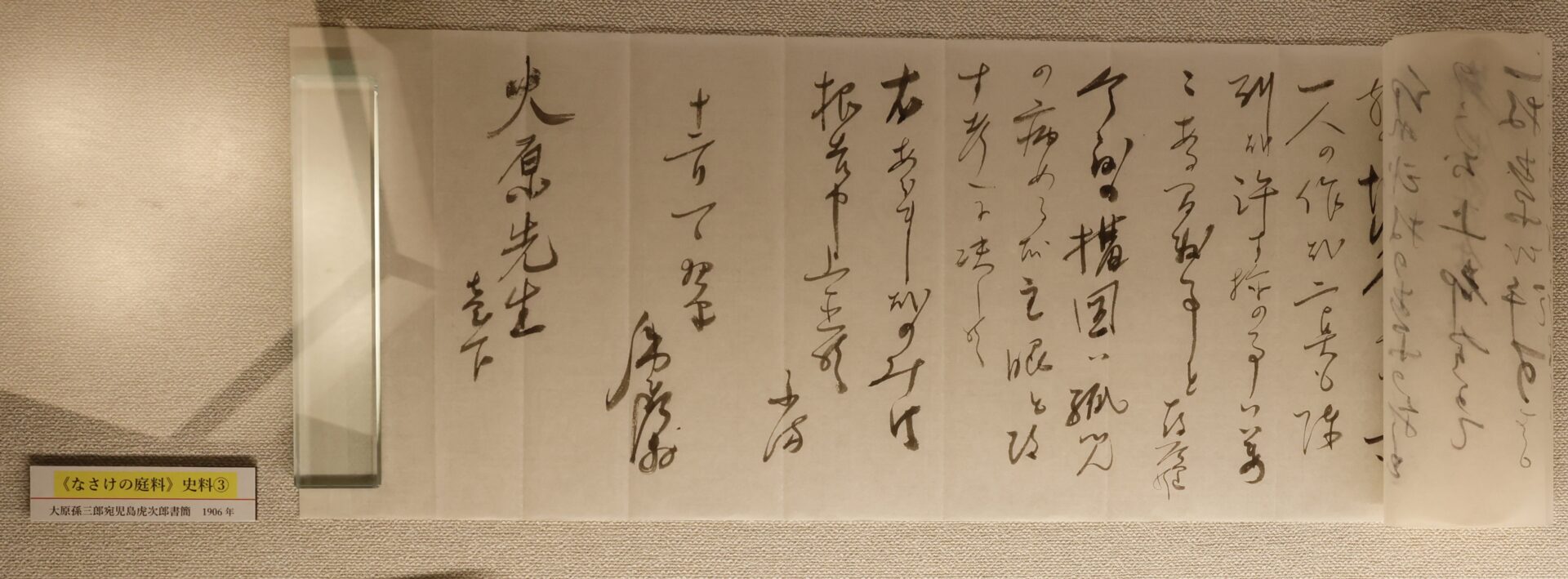
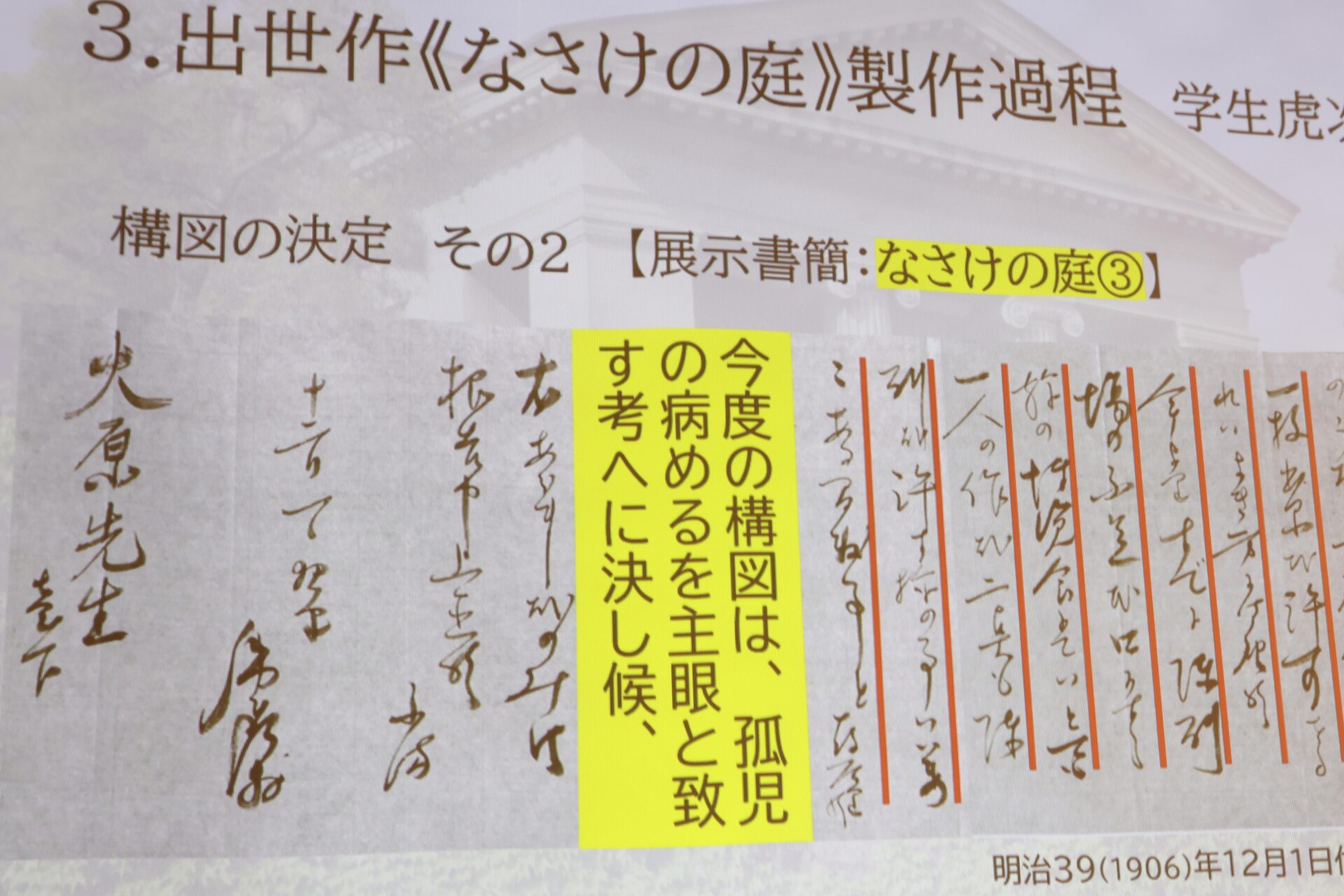
Torajiro struggled considerably and ultimately decided to focus on "orphans," the most vulnerable group. The trigger was seeing orphans in Okayama, his hometown, and in Ueno, where he studied.
Behind the Scenes at the Start of Creation
Although Torajiro decided on "orphans" as the subject, he was also troubled about which orphanage to depict. After consulting with Magosaburo about whether to choose Kamakura (Kanagawa Prefecture), Jomo (Gunma Prefecture), or Okayama, he ultimately decided on the Okayama Orphanage.
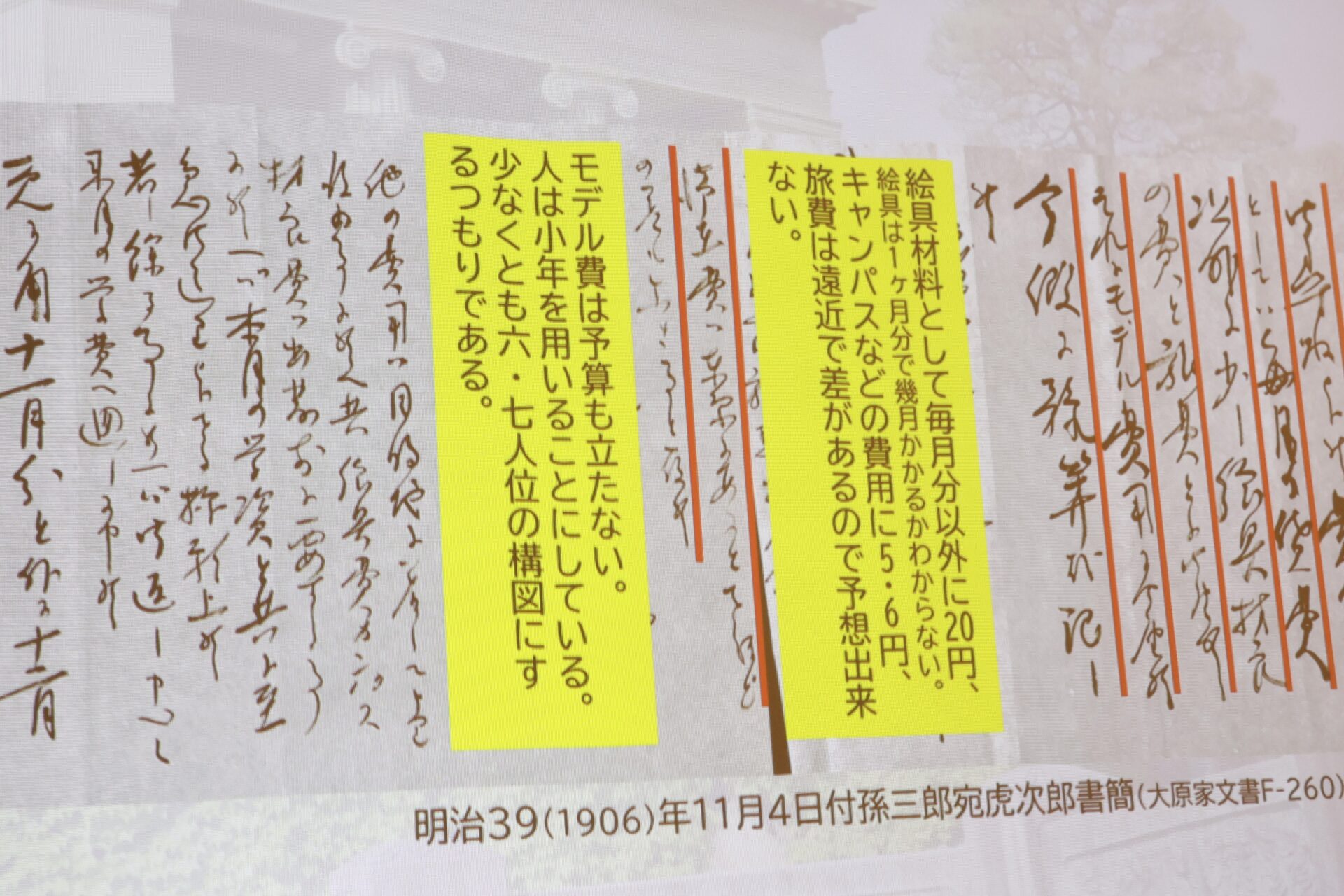
For Torajiro, Magosaburo seemed to be someone he could consult about anything, and he also discussed the expenses related to the production.
Of course, it is natural to consult about necessary expenses, but he detailed the costs of the production site (accommodation), composition (model fees), and materials in his letters.
It is surprising that such vivid information about the production remains.
Before starting the production, he had already envisioned 6 to 7 children as part of the composition, and he wrote that "the model fees are beyond budget," indicating that he seemed to have struggled significantly even in the preparatory stages of production.
Additionally, it is said that he wrote in a letter, "My work is dedicated to Magosaburo," revealing his passion for creation, deep trust in Magosaburo, and profound affection.
Struggles During Creation
Kojima Torajiro stayed at the Okayama Orphanage and began the actual production, but things did not go as he hoped, and he sent letters expressing his "complaints."
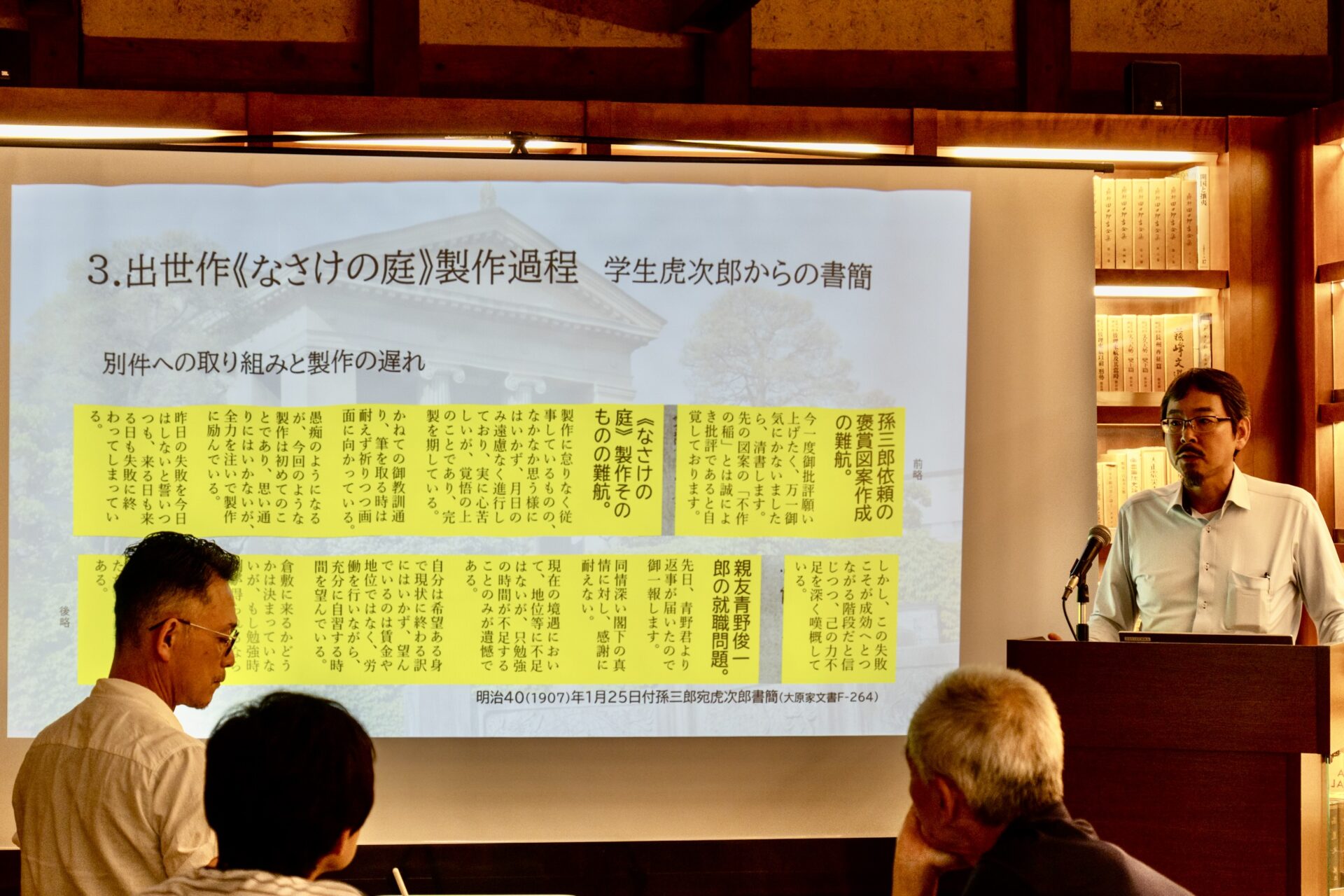
It may sound like a complaint, but this is my first time creating something like this, and it is not going as I hoped, yet I am pouring all my effort into the production.
I vow not to repeat yesterday's failures, yet day after day, I end up failing.
However, I believe that these failures are the steps leading to success, while deeply lamenting my lack of ability.
Excerpt from a letter to Magosaburo dated January 25, 1907
This work was created with the purpose of being Torajiro's first exhibition, and it seems he wrote about his struggles and frustrations, yet he continued to paint, believing that failures would lead to success.
In another letter, it is said that while staying at the orphanage, Torajiro was moved to tears listening to the orphans singing hymns on Christmas from the second floor, conveying his feelings for the orphans and his humanity.
Upon closely observing this painting, one notices that there is a painting of Christ behind the orphans, and it can also be understood from the works and letters that Juuji Ishii and Ohara Magosaburo had deep connections with Christianity.
Behind the Scenes at Completion
The completion of "The Garden of Compassion" can be deciphered from the letters in which Torajiro brought the work to Tokyo and received critiques from Kuroda Seiki.
The critiques indicated that there were almost no points for correction compared to "The Watermill of the Village," suggesting that "it would be better to brighten the area outside the glass window a little."
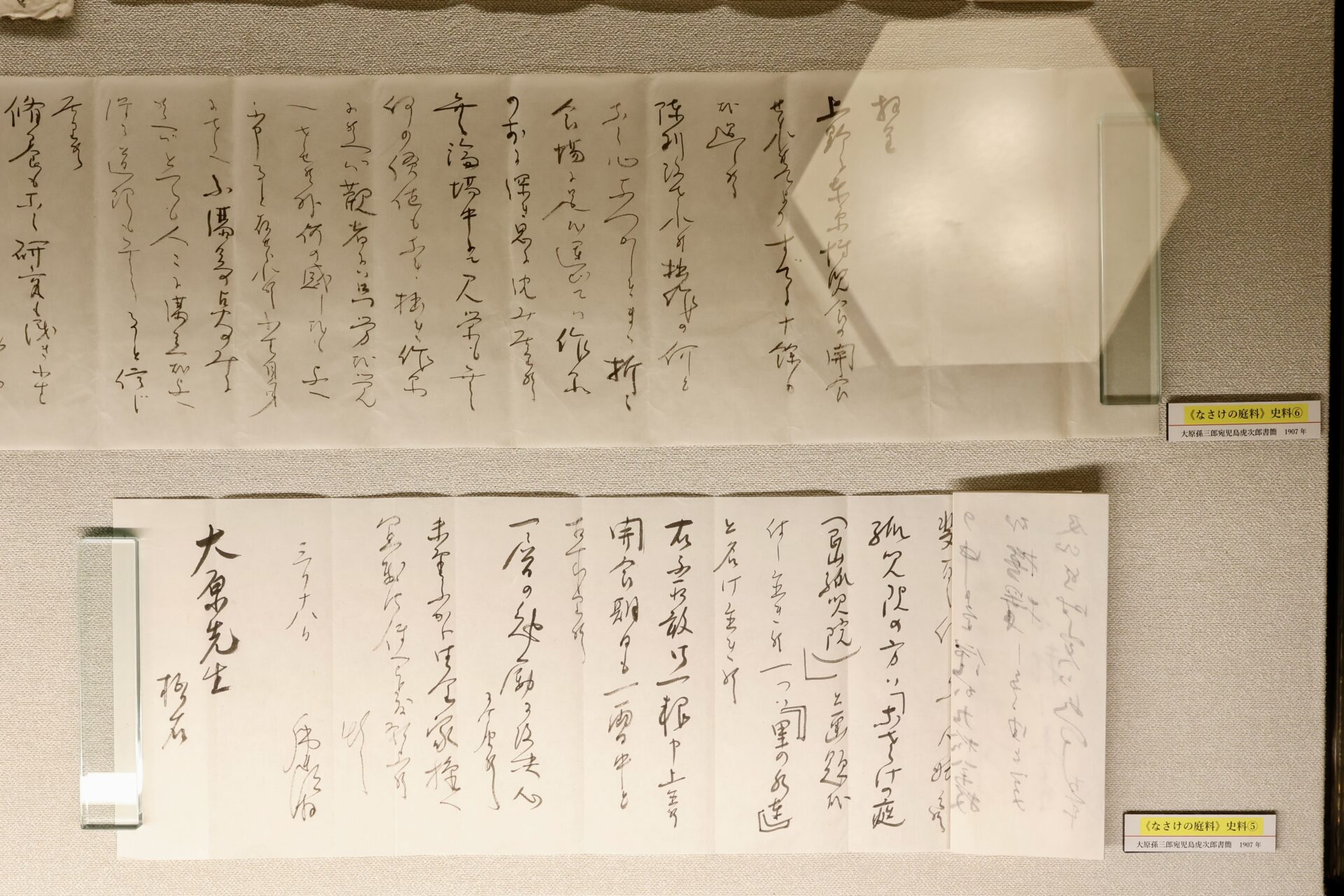
However, there was a exhibitor issue regarding whose name to use for the "Garden of Compassion" exhibition.
Juuji Ishii requested that it be exhibited under the name of the Okayama Orphanage, and Kojima Torajiro agreed, saying, "If the work is useful, I don't mind how it is presented," but it seems that Kuroda Seiki had a different opinion.
Since Torajiro had worked hard to complete the piece, he seemed to have recommended exhibiting it under "Kojima Torajiro," stating that "if it wins an award, it will ultimately make the name of the Okayama Orphanage known to the world."
It seems that Kuroda Seiki was confident about winning an award.
From the series of exchanges, it became clear that Kuroda Seiki had a very high evaluation of the work.
Torajiro asked Ohara Magosaburo to decline Ishii's request.
As for Torajiro himself, he could not bring himself to decline the Okayama Orphanage, so it would be very rude, but I would appreciate it if Magosaburo could convey this to Mr. Ishii.
This request is not a personal one from Torajiro, but rather a request from Kuroda-sensei, so I hope you will understand this.
Since there is not much time until the submission deadline, I would like you to urgently contact the Okayama Orphanage to decline.
I received instructions from Kuroda-sensei to refer to the work as related to the Okayama Orphanage.
Excerpt from a letter to Magosaburo dated February 28, 1907
It was a story that no one knew about the exchanges regarding the exhibition of "Garden of Compassion," which is famous as Kojima Torajiro's breakout work, and I learned about the valuable background of this masterpiece.
The work was purchased by Emperor Meiji, but the news of the purchase did not reach Torajiro immediately, and it seems he was not particularly interested in it.
The seminar also introduced the purchase amount.
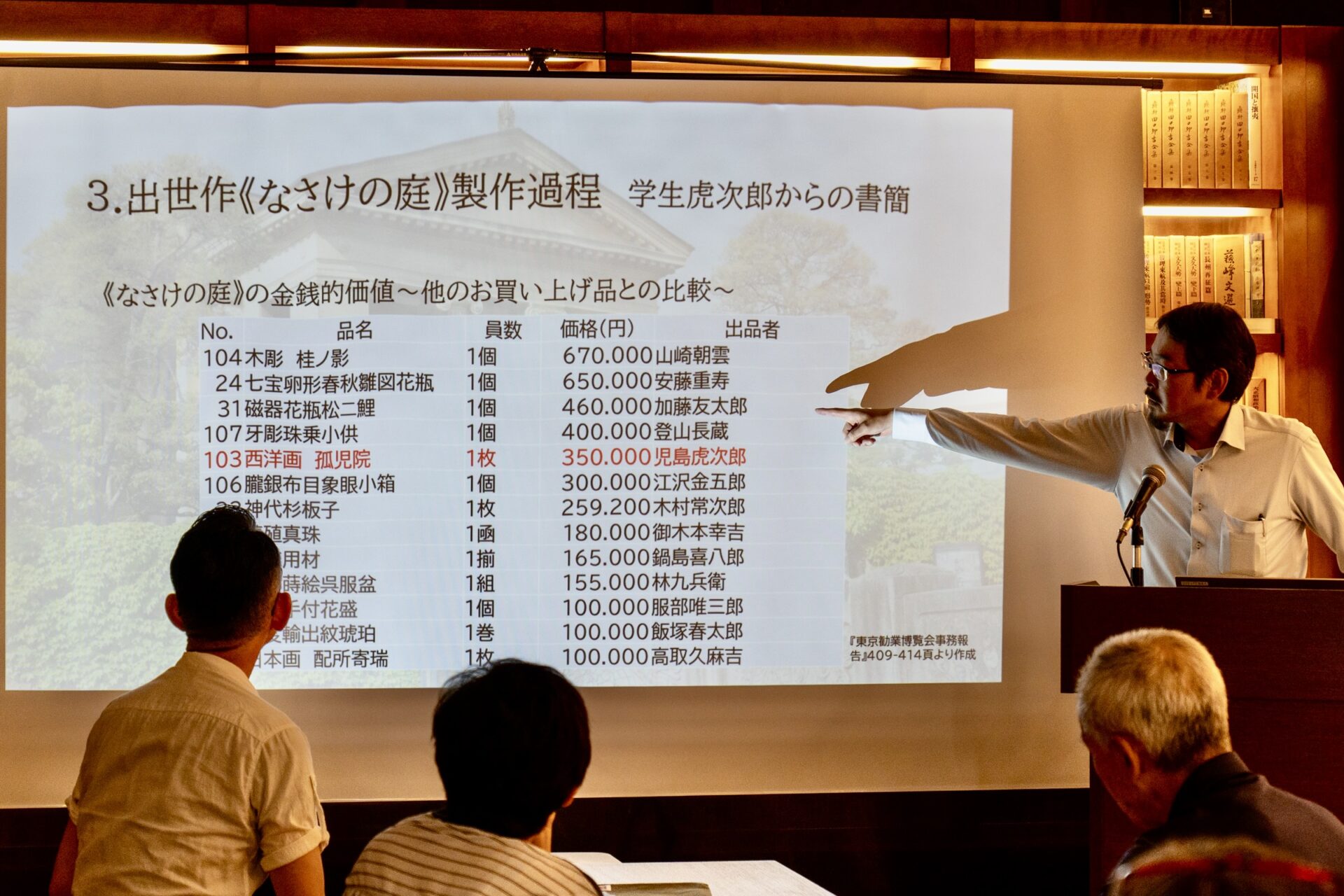
The letter states, "I heard from an acquaintance that it was valued at 350 yen, but since it is not mine, I would prefer it to be a donation," which highlights that Torajiro did not concern himself with money.
Moreover, the works and authors listed above were already well-known at the time, and it was remarkable that the name of student Kojima Torajiro was included among them.
This work led Torajiro to receive permission from Magosaburo to study abroad in Europe, which eventually connected to his later collection of overseas paintings.
Creation process of the representative work "Going to School"
The representative work "Going to School" is housed in the Nariwa Museum of Art in Takahashi City, and it is a piece he painted after returning to Nariwa immediately after winning an award at the aforementioned Tokyo Industrial Exhibition.
The theme is said to be "for the weak," depicting two schoolgirls on their way home from class. Personally, it is my favorite work among Torajiro's pieces.
In the letters at the start of production, it is noted that the two girls are depicted as returning home after finishing their classes at school, and that there are an elderly person and a child in the painting, and that the subjects chosen are from not very wealthy families.
There is a contradiction here. The title is "Going to School", but it mentions "after finishing class...", so it should be "Going Home", and it seems to be a valuable document for understanding this contradiction.
Regarding the "elderly person and child," it seems that Kuroda Seiki suggested removing them.
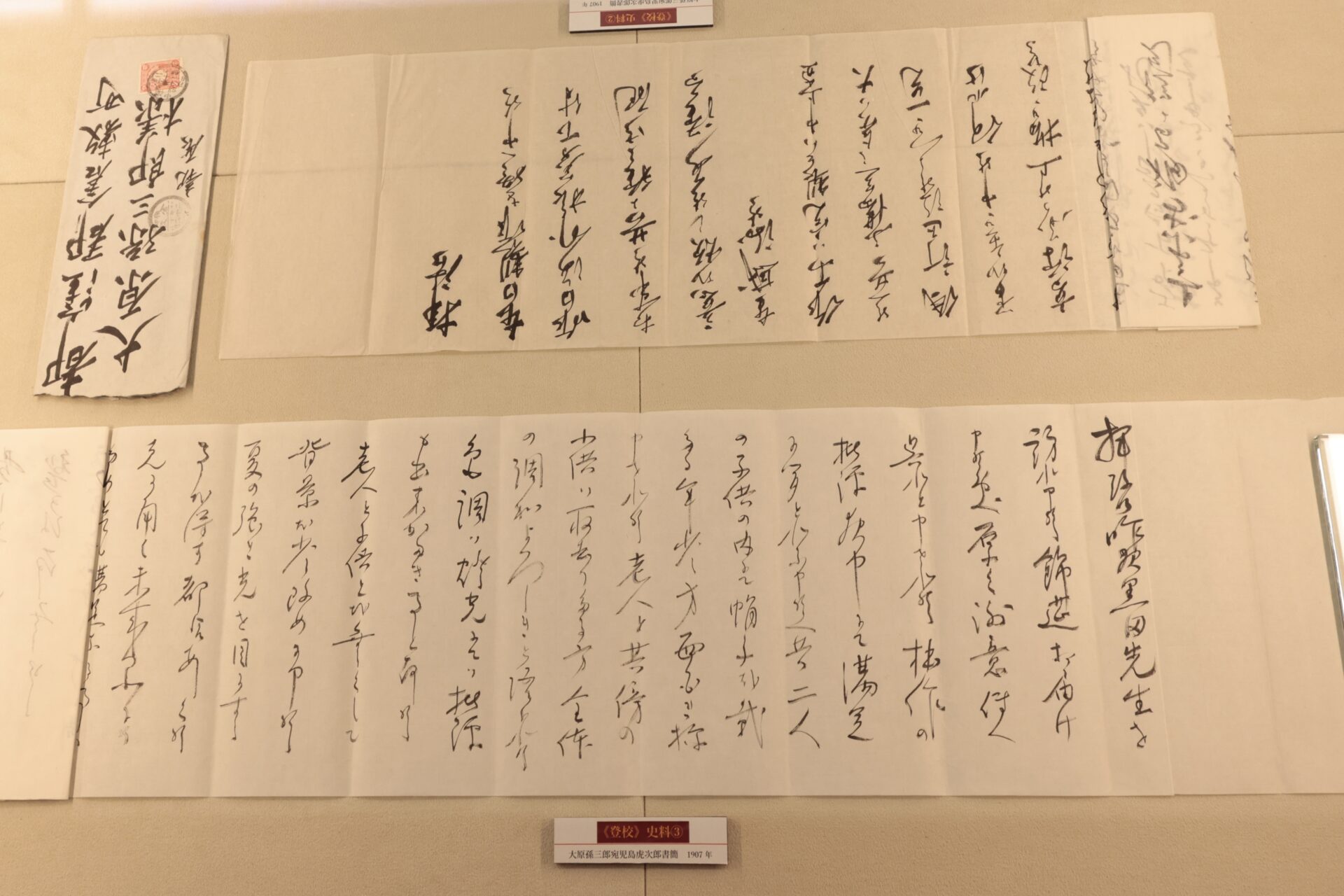
Last night, I visited Kuroda-sensei and delivered a brocade, and he expressed his deep gratitude.
~Omitted~
He mentioned that among the two children, the younger one wearing a hat seemed interesting. He said that removing the elderly person and the child would improve the overall harmony.
~Omitted~
Therefore, I will remove the elderly person and child and slightly alter the background.
In this season, it is not possible to see the strong summer light, which is inconvenient, but since it is still an unfinished piece, I think I cannot be very satisfied.
I believe that by spending another summer on this work, I will be able to complete this painting.
Excerpt from a letter to Magosaburo dated November 14, 1907
There is a sentence saying, "Another summer..." but the date of the letter is November 14, 1907. Since Torajiro was heading to Paris for study abroad in January of the following year, it may have been nearly completed.
In these letters, there are also mentions of language studies for studying abroad.
Additionally, while it mentions "not wealthy," looking at the actual painting, the girls' clothing seems to belong to a wealthy family.
I thought that contemplating the contradictions from the start of production to the completed work is one way to enjoy it.
Moreover, it seems he struggled with finding models until completion, as he wrote, "The younger model just won't come," and "The other model is also off today and is too busy playing to come."
From this seminar, I learned that Kojima Torajiro was always troubled by models, but I think that many artists have faced similar issues to some extent.
It was very educational to learn about the struggles and background of the creator.
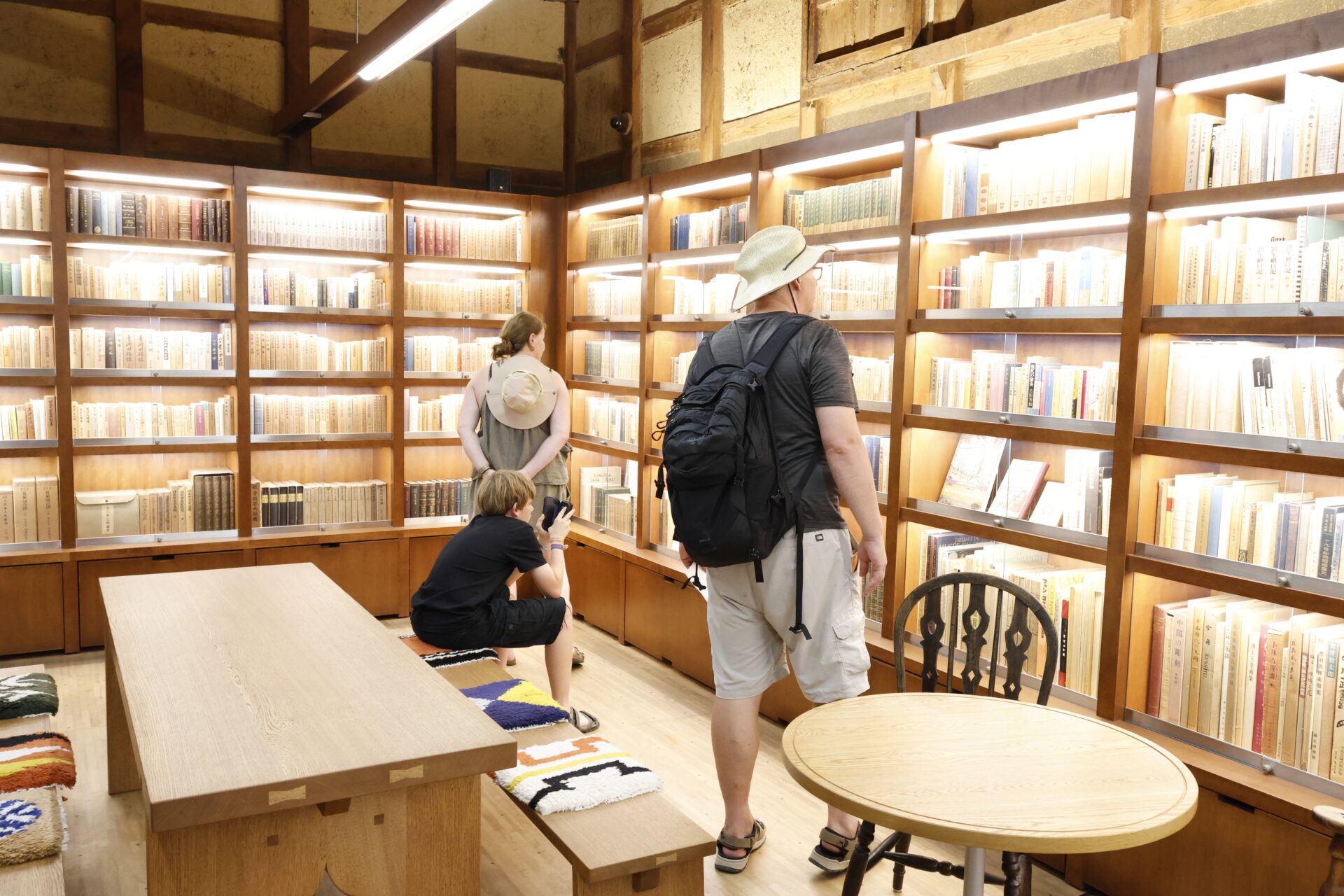
After the seminar, I noticed foreign tourists at the book café where the event was held, indicating a high level of interest in "Kurashiki."
Conclusion
The "letters from student Kojima Torajiro" were exhibited for the first time this time, and most of this information was still unknown.
Kojima Torajiro had a short life of 47 years, but through his numerous letters, he left us valuable information for the present day.
When I mention "numerous letters," it might sound somewhat difficult, but Torajiro was quite a prolific writer.
Thanks to "the prolific writer Kojima Torajiro," this seminar allowed us to learn many things in an enjoyable way, including details about his representative and breakout works, the historical background, his personality, and the characters surrounding him.
There still seem to be many things that are not yet known.
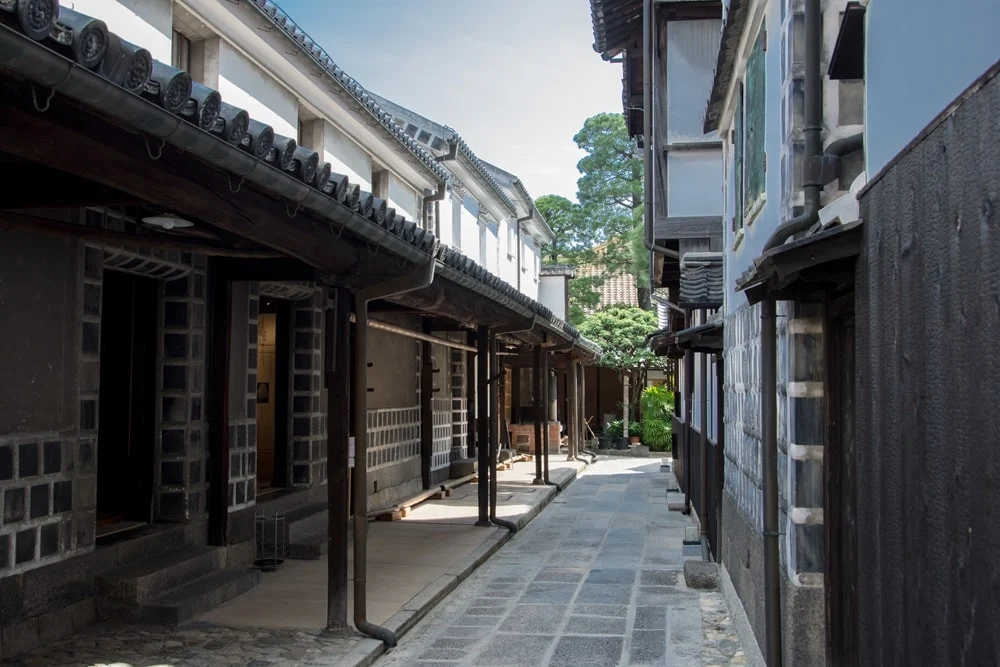
How about visiting the "Kurashiki Future K School" held at Ohara House Katalyzer, which provides such a learning environment?
The next session will be held on Saturday, August 24, 2024, featuring a lecture by Tawarata Koichiro.
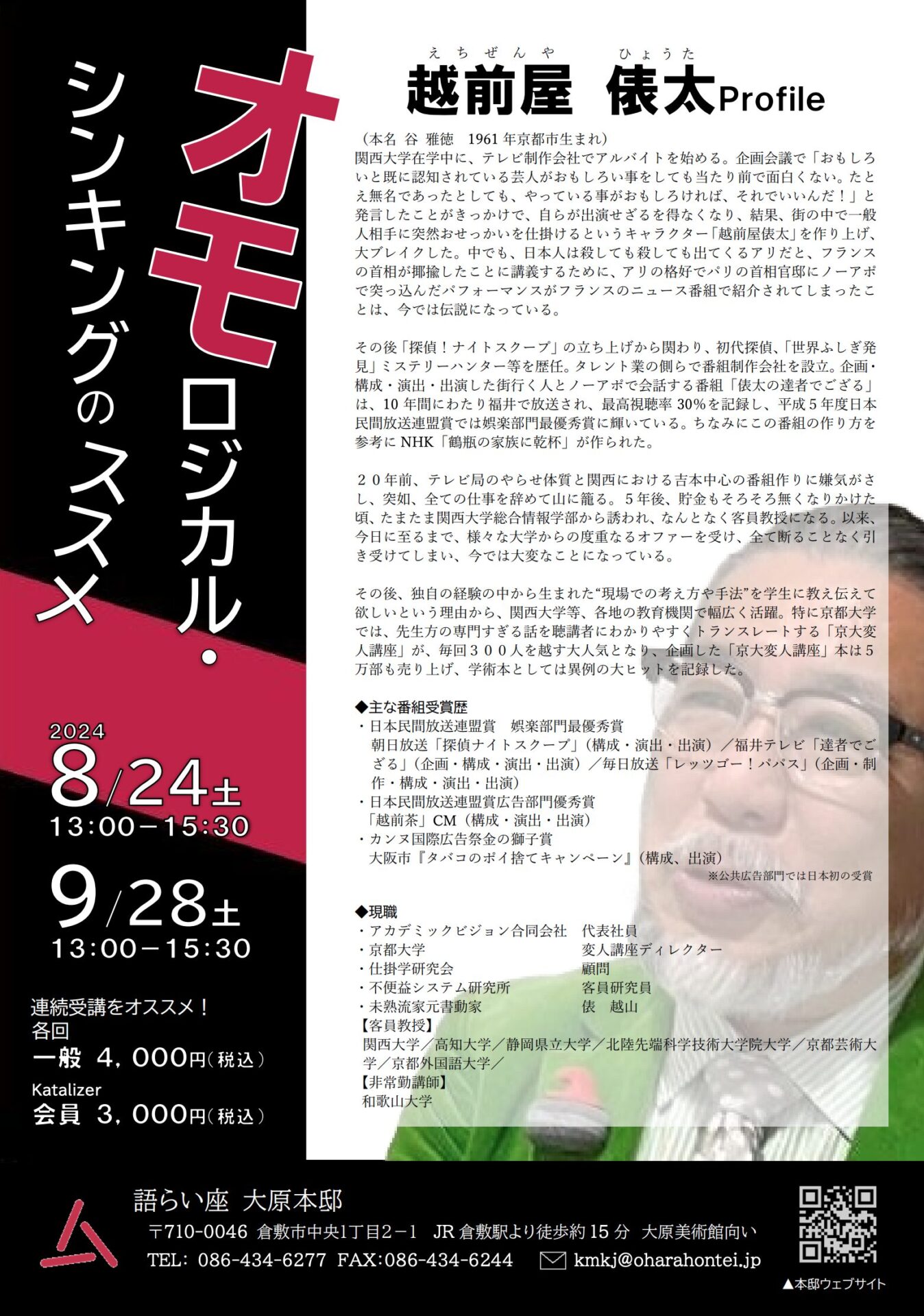
The content of the sessions varies, and they are held once a month. You might discover something new by attending.
After this seminar, I thought I would like to go see Kojima Torajiro's works again.
Articles about Ohara House Katalyzer
Data for the 44th Kurashiki Future K School "Numerous Letters Remaining in the Ohara Family" - Letters from Student Kojima Torajiro
| Name | 44th Kurashiki Future K School "Numerous Letters Remaining in the Ohara Family" - Letters from Student Kojima Torajiro |
|---|---|
| Date | July 13, 2024 (Saturday) from 1:00 PM |
| Location | 1-2-1 Chuo, Kurashiki City |
| Website | Ohara House Katalyzer |












Ohara Museum of Art: The Watermill of the Village