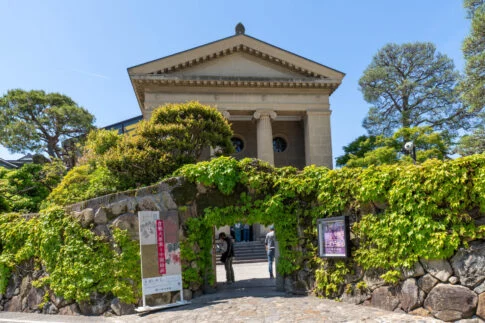
In the Bikan Historical Area stands a Renaissance-style bank building constructed during the Taisho era.
After extensive exterior and interior renovations, it was renewed as the Ohara Museum of Art’s new annex, “Shin-Kojimakan (provisional name).”
It opened provisionally on October 1, 2021.
Works by contemporary artist Kenji Yanobe are on display for a limited time.
The large statue of a girl that stands out in the spacious interior moves from time to time!
Admission is expected to be charged after the official opening, but admission is free for the time being.
What thoughts are embodied in the meditating statue of a girl?
We’ll explain why it opened provisionally, the works you can see right now, the museum shop pop-up store, and the back-of-house areas opened to the media.
The facility closed to the public on Wednesday, November 30, 2022, in preparation for its grand opening.
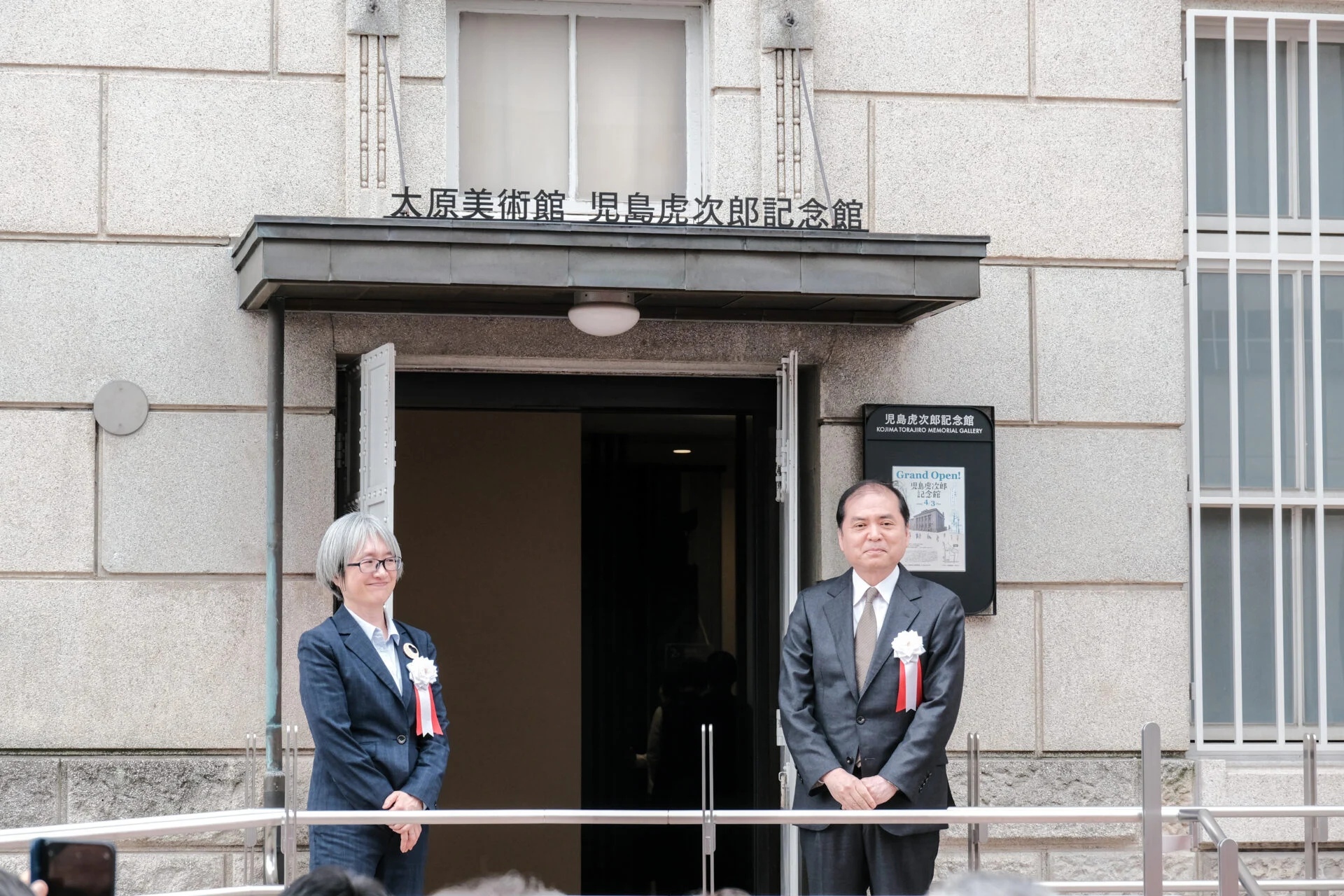
It has been decided that the facility will be named the “Kojima Torajiro Memorial Gallery,” and preparations are now underway for its grand opening at the end of fiscal 2024.
The information provided is as of the article’s publication in October 2021. Please note that it may differ from current information.
What is the Kojima Torajiro Memorial Gallery / Shin-Kojimakan (provisional name)?

The building, used as the “Chugoku Bank Kurashiki Honmachi Branch” until 2016, is a nationally registered tangible cultural property.
It is one of the facilities that supported the development of modern Kurashiki.
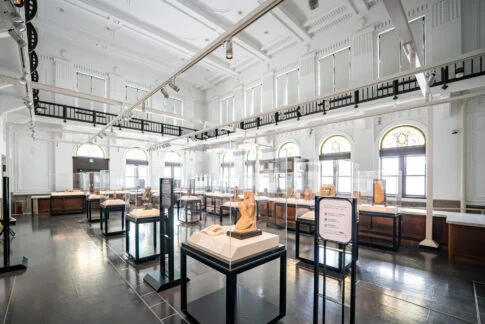
Its decorative columns and stained glass are beautiful and eye-catching.
It was designed by Yakushiji Kazue, who also designed the main building of the Ohara Museum of Art.
Ohara Museum of Art restored this bank building for use as an art museum, creating “Shin-Kojimakan (provisional name).”
For more about the building’s history, its connection with the Ohara Museum of Art, and details about the building, read the following article.
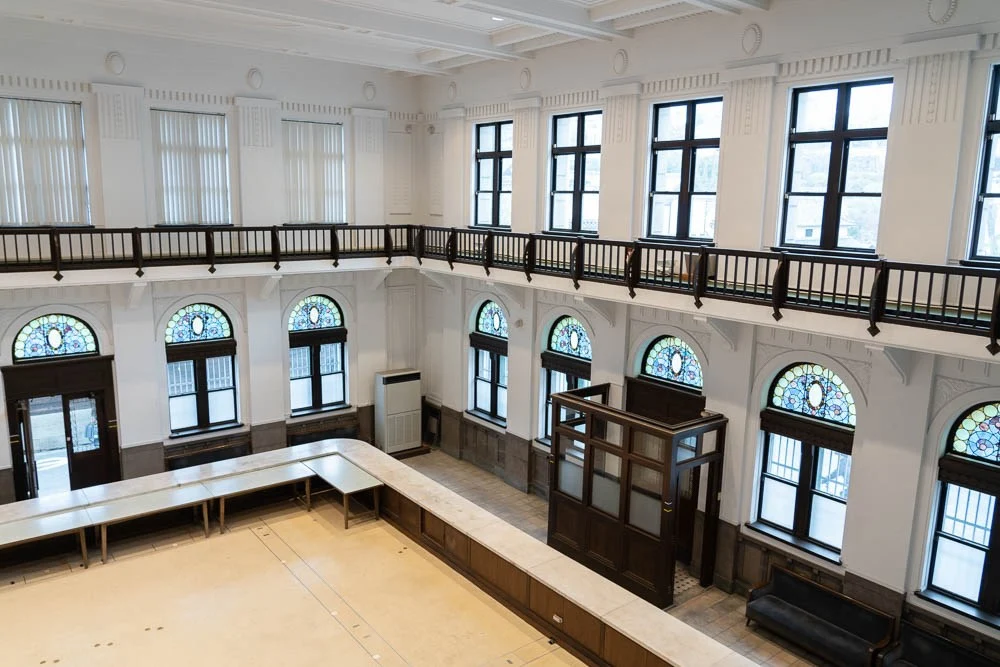
First, we’ll tell you about the plans for Shin-Kojimakan (provisional name) and its current status.
Plans for Shin-Kojimakan (provisional name)
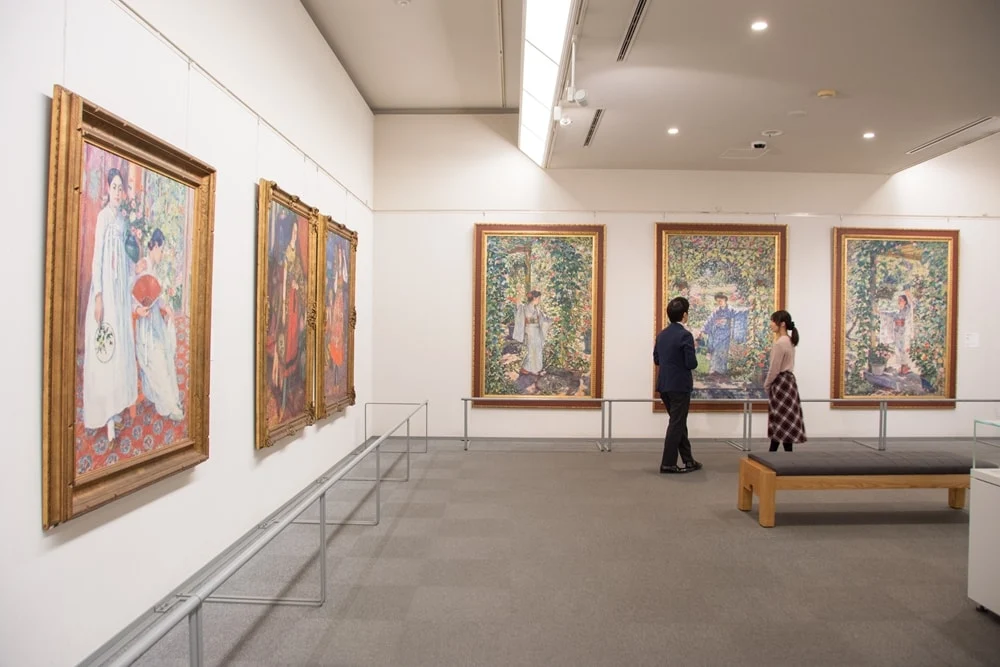
In January 2020, the Ohara Museum of Art announced its plans for the opening of Shin-Kojimakan (provisional name).
Shin-Kojimakan (provisional name) will serve the following functions:
- Exhibition and preservation of artworks
- A hub for education, outreach, and visitor support
- Research institution
- Preservation and use of the building
The following works are planned for exhibition and preservation:
- Antiquities from Egypt, West Asia, and elsewhere
- Works by Kojima Torajiro
Why it opened provisionally

Construction began as planned, but the spread of COVID-19 worsened the Ohara Museum of Art’s financial situation.
Before the pandemic, the Ohara Museum of Art had around 300,000 visitors a year, but visitor numbers plummeted to about 70,000 in fiscal 2020 (April 2020–March 2021).
They recovered slightly to around 100,000 in fiscal 2021, but that was still only one-third of the pre-pandemic figure.
For the privately run Ohara Museum of Art, which has relied on admission fees to cover most of its operating costs (about 80%), closures and visitor limits have been a major blow.
The museum has tried various measures and even held a crowdfunding campaign in 2020, but it is still in a difficult financial position.

Shin-Kojimakan (provisional name) was not originally built to display artworks.
To display artworks without allowing them to deteriorate in rooms exposed to direct sunlight, high-performance display cases and other equipment are needed.
Protecting artworks can be considered one of a museum’s missions.
However, it reportedly costs hundreds of millions of yen to acquire the necessary display cases.
For the following reasons, it opened provisionally without displaying the works that had been planned.
- Due to a lack of funds, the museum cannot begin installing display cases and other equipment
- The ideal environment for the works cannot be compromised. The planned exhibition cannot go ahead without high-performance display cases
- Now that construction on the building is complete, it is better to open it to the public than to keep it closed
According to Ohara Museum of Art staff, “It’s like having a bathroom and hot water, but no bathtub.”
The work to complete the exterior and interior—the “bathroom”—was designated Phase 1, while Phase 2, which would install display cases for the artworks—the “bathtub”—was postponed.
There is no timeline yet for the official opening, but the plans for the future remain unchanged.
One day, it will welcome many visitors as a museum where they can see works by Kojima Torajiro and precious antiquities.

Although the provisional opening was a difficult decision, there is more to see than just the building.
To make the visit enjoyable, works by Kenji Yanobe will be on display for a limited time, and the museum shop will also open!
Now, let’s take a look at what you can see during the provisional opening!
See works by Kenji Yanobe

The highlight of the provisional opening is the work of contemporary artist Kenji Yanobe.
Kenji Yanobe and the Ohara Museum of Art
Kenji Yanobe is a professor in the Department of Fine and Applied Arts at Kyoto University of the Arts.
He has exhibited at art festivals such as the “Aichi Triennale 2013” and held solo exhibitions in Japan and abroad.
He creates large-scale sculptures on the theme of science and technology and people.
At the “Setouchi Triennale 2013,” a collaborative work with Takeshi Kitano on Shodoshima Island in Kagawa Prefecture also attracted attention.
His large, robot-like works that evoke pop culture may also easily capture children’s interest.
Yanobe and the Ohara Museum of Art have been connected for some time.
In 2010, at a special exhibition held at Yurin-so Villa, owned by the Ohara Museum of Art, he exhibited the characters he created, “Lucky Dragon” and “Torayan.”
They are associated with Ohara Magosaburo and Kojima Torajiro, the people who laid the foundations of the Ohara Museum of Art.
Magosaburo was born in the Year of the Dragon and was fond of dragon motifs.
The dragon depicted on Imabashi Bridge in front of the Ohara Museum of Art is also there because Magosaburo liked dragons.

In 2011, inspired by the Great East Japan Earthquake, Yanobe conceived a monument of a boy called “Sun Child,” gazing resolutely toward the future.
It was also exhibited at a special exhibition at the Ohara Museum of Art in 2013.
Created to mark the 20th anniversary of the Great Hanshin-Awaji Earthquake, “Sun Sister” is like an older sister to “Sun Child.”
Sun Sister (Rebirth)
For Shin-Kojimakan (provisional name), “Sun Sister” has come to Kurashiki in a new guise.
It is “Sun Sister (Rebirth).”
Here is a message from Kenji Yanobe:
“Sun Sister” sits with her eyes closed in deep meditation, then rises, spreading her arms and opening her eyes. She repeats this movement, symbolically expressing the arrival of dreams and hope for rebirth.
At the request of the Ohara Museum of Art, I chose “transformation” and “rebirth” as the themes for reopening this bank building, loved by people for nearly 100 years, as a new museum facility, even though it is still a work in progress. I wanted to express the “transformation” of the building and the “rebirth” of Kurashiki and the Ohara Museum of Art, both of which have suffered a major blow during the pandemic. I therefore gave “Sun Sister” a new look as “Sun Sister (Rebirth),” using the phoenix, which rises from the ashes again and again, as its motif.
The costume was created in collaboration with students from Kyoto and Fukushima, and is adorned with many sacred beasts and guardian deities, including dragons, tigers, kirin, and turtles. The skirt rises like the feathers of a phoenix, as if taking flight in a wish for “transformation” and “rebirth.” I hope “Sun Sister (Rebirth)” will bring a bright sign of hope to the people of Kurashiki.
From materials distributed at the press tour
She is normally 4 meters tall, and reaches 5.6 meters when she stands up.
It’s a rare opportunity to see a three-dimensional work this large.

Take a look at the powerful dragons and tigers adorning her fluffy, charming outfit.
Could the white reliefs have been made with the architecture of Shin-Kojimakan (provisional name) in mind?
Mobiles sparkle at her feet.

At the time of our visit in September 2021, it had not yet been decided when “Sun Sister (Rebirth)” would stand up.
You might be lucky enough to see her with her eyes open.
Another nice feature is that photography is allowed inside.

Akauurushi Funamori Engi Neko

On display in a space that was once a bank vault is The Cat of the Red-Lacquered Boat Guardian.
Beyond the heavy door, a sleek cat made of lacquer sits elegantly.
It is a work created through a collaboration between Yanobe and Kyoto artisans.
During the Age of Exploration, rats that gnawed on cargo and ships and spread disease were a major threat to sailors.
Cats that kept rats away and protected the crew from disease were cherished as a source of comfort and as guardian deities of ships.
An amabie is depicted on the back of its head.
You can see the back of the sculpture at the venue, so take a good look.
Several other auspicious motifs are depicted, so the work is surely imbued with wishes for happiness.
Shop at the Ohara Museum Shop

While the museum is open provisionally, a pop-up store (a shop open for a limited time) from the Ohara Museum of Art is also operating.
It sells some items that are different from those at the “Ohara Museum of Art Museum Shop” next to the Ohara Museum of Art.
Goods featuring an illustration of Sun Sister, specially drawn by Kenji Yanobe, are also scheduled to be released.

For example, the following items were available:
- T-shirts exclusive to Shin-Kojimakan (provisional name)
- Original masking tape
- A Matisse picture book
- Earrings with parts you can assemble yourself
- A Gauguin coloring book
- Books about Japanese patterns and colors
They also make great souvenirs from Kurashiki.

See the empty galleries

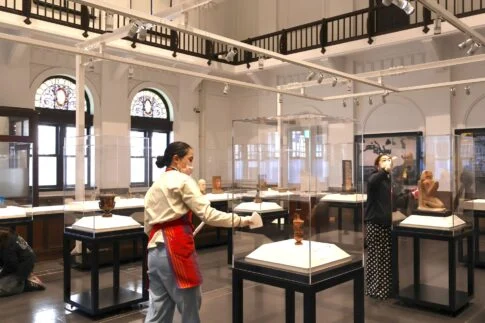
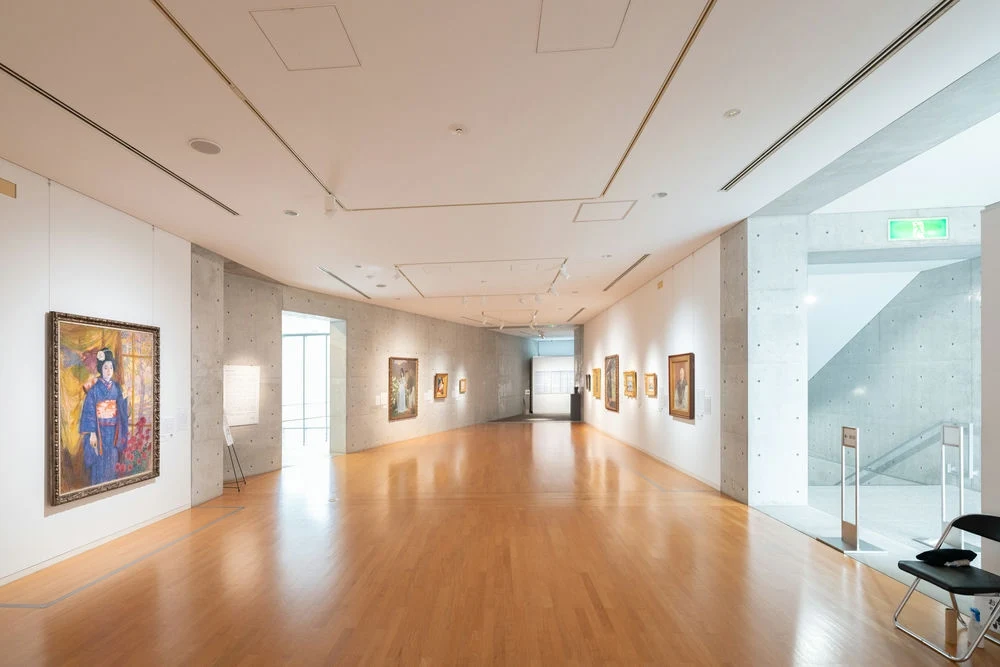
While the museum is open provisionally, works by Kojima Torajiro and antique art are not on display, but the galleries are ready.
It is a rare opportunity to see a gallery without any exhibits.
The first-floor gallery has light gray walls.

The second-floor gallery has distinctive red walls!
Works by Kojima Torajiro are scheduled to be displayed in this gallery.
You might think, “That’s bold.”
I was surprised at first sight.
However, the red walls and Kojima Torajiro’s paintings go very well together in the main building of the Ohara Museum of Art.
That is why they chose such a bold color, thinking that “the paintings will stand out at Shin-Kojimakan (provisional name), too.”
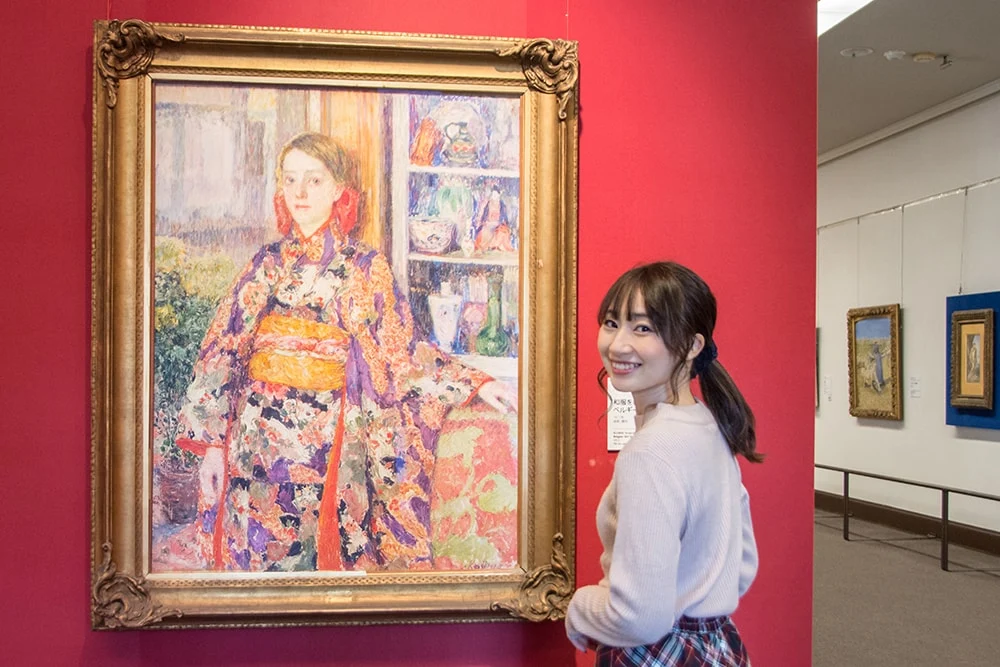
How will the works look when displayed in this red room?
I’m even more excited for the official opening.
There is also a lecture room that can accommodate about 50 people.

The wall beside the lecture room is made of bricks from the Taisho period.
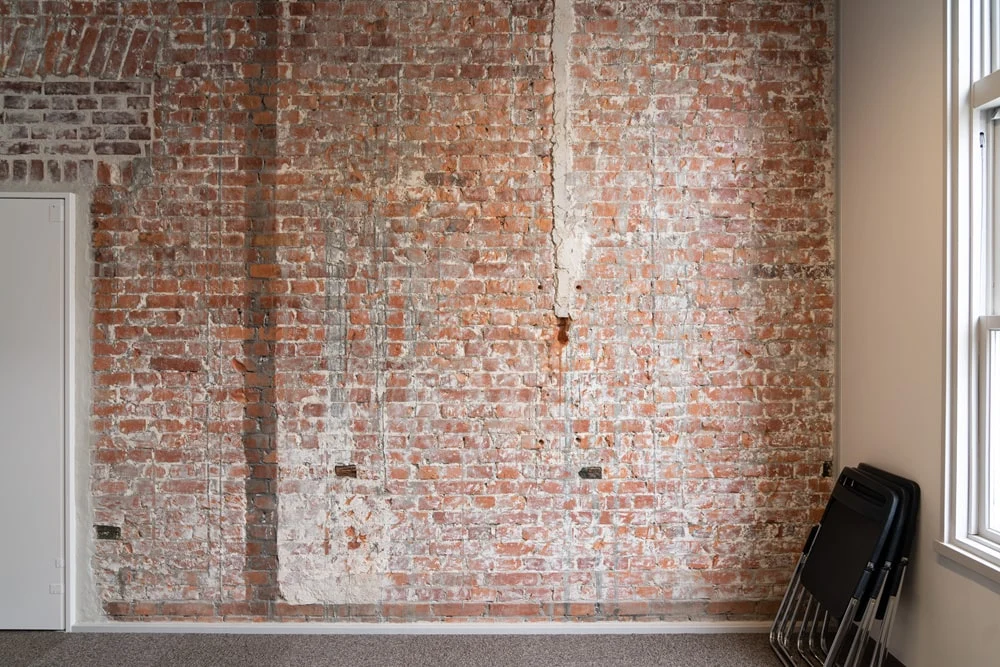
This is one way of preserving cultural properties.
Notice the building’s thoughtful design

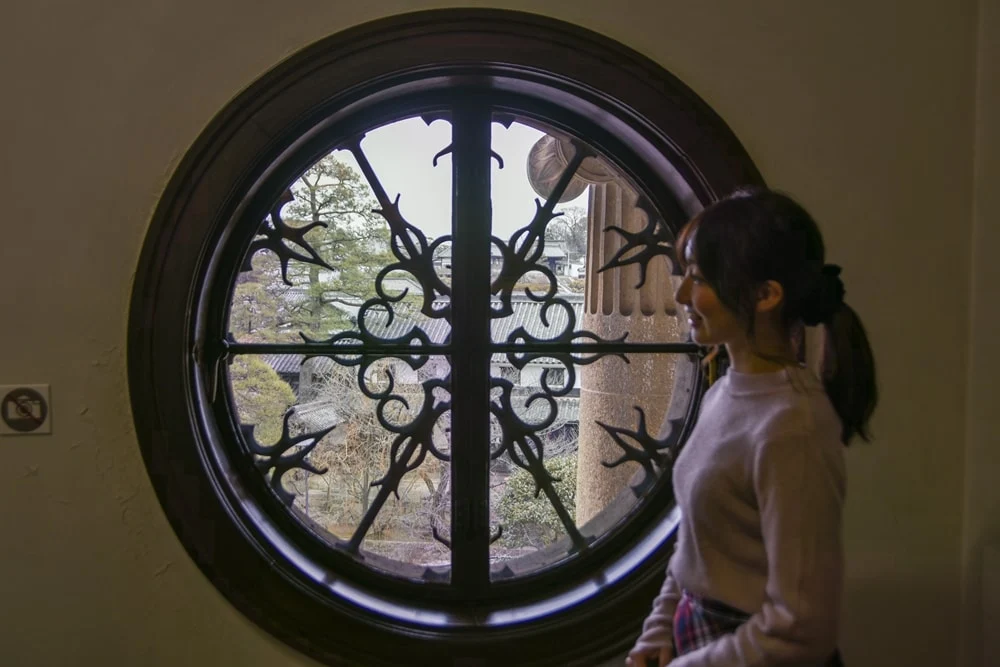
Though it is in an inconspicuous spot, the circular window catches the eye.
Through it, I could see the pine trees at Yurin-so Villa.
The main building of the Ohara Museum of Art also has distinctive circular windows.
It’s nice to feel the connection.
There is an elevator, two handrails on the stairs, and wide corridors, all designed with accessibility in mind.

The accessible restroom is also equipped with facilities for ostomates.
The upper part of the back of Shin-Kojimakan (provisional name) is mirrored to avoid making it feel imposing.
Be sure to walk along the road behind it, too.

In the second half, I’ll introduce features of the back-of-house areas that are not usually open to visitors.
September 7, 2021: Completion ceremony

On September 7, 2021, a completion ceremony was held. About 20 people involved in the project attended to celebrate its completion.
September 29, 2021: Press tour ahead of provisional opening

On September 29, 2021, a press tour for the media was held ahead of the provisional opening. We were also shown the back-of-house areas, which are not open to the public.
Because the Taisho-period section of the building is a cultural property and cannot undergo major renovations, functions related to preservation and research have been packed into the newly built section.

The first floor of the new section has a truck bay, essential for moving artworks in and out, as well as a loading area.
Artworks can be transported using the elevator.

It felt spacious, but according to the explanation, “the elevator is just large enough for a museum, and the truck bay can just fit a standard four-ton truck used to transport artworks onto the premises.”
There is also storage space and a room for carrying out minor repairs to artworks.
I realized that running an art museum requires all kinds of facilities in areas visitors never see, too.
Also, the back-of-house area is barrier-free, “so that a diverse range of staff can work here in the future.”
Even within the limited space, I was impressed by the emphasis on making the facilities accessible for staff.
Comments from Deputy Director Morikawa Masanori

With the COVID-19 pandemic, to be honest, we are still feeling our way forward, and the Ohara Museum of Art itself is in a difficult situation.
I believe that a museum for a new era is one that takes initiatives enabling us to move forward while sharing the difficulties.
Admission is currently free, so I hope many people will feel free to visit and see Sun Sister.
You can also take photos, and I hope you will use it as a meeting place, too.
Although we are in the midst of the COVID-19 pandemic, all of our staff sincerely look forward to welcoming you to visit and enjoy the museum.
Visit Shin-Kojimakan (provisional name) while it is temporarily open

Shin-Kojimakan (provisional name) has opened temporarily in a way that differs greatly from the original plan.
However, since you can see it for free only now, you could say that in a way, it is a good deal.
Sun Sister (Rebirth), which is said to represent “the arrival of dreams and hope for rebirth,”
fits beautifully in the atrium.
I felt that “even these days when it is difficult to move freely may lead to a day when we can stand up and look to the future.”

I feel that Shin-Kojimakan (provisional name) and the Ohara Museum of Art are seeking a better way forward, making various efforts for the local community and visitors.
It may seem obvious that “you can see authentic works when you visit a museum” and that “the works are preserved in good condition.”
But a great deal of effort goes on behind the scenes to make that “obvious” state possible.
They could have postponed the opening instead of opening temporarily.
Depending on how you look at it, they might even have “forced an exhibition to go ahead to save face, at the expense of the works’ preservation.”
However, the Ohara Museum of Art faced its works, the local community, and its visitors sincerely, and chose to open temporarily.
It has also prepared works that can only be enjoyed during this temporary opening.
I really admire the Ohara Museum of Art’s approach.
Even setting the circumstances aside, Kenji Yanobe’s works are simply enjoyable, and you are sure to find exciting items at the museum shop!
Enjoy this temporary opening while it lasts.
Articles about the Ohara Museum of Art

Shin-Kojimakan (tentative name) Information

| Name | Shin-Kojimakan (tentative name) |
|---|---|
| Location | 3-1 Honmachi, Kurashiki City, Okayama Prefecture |
| Contact | 086-422-0005 |
| Parking | None |
| Opening hours | 10:00 a.m.–4:00 p.m. |
| Closed | Monday |
| Admission (tax included) | Free only during the provisional opening |
| Reservations | Not available |
| Smoking | Entirely smoke-free |
| Restrooms | Western-style restroom, accessible restroom |
| Childcare | Nursing room, diaper-changing table |
| Accessibility | Ramp, accessible restroom, elevator During the provisional opening, please ask staff to use the restroom |
| Website | Ohara Museum of Art |

What would you like to know about Kurashiki?
Enter a word to search articles on this site