In the present day, when disasters occur almost every year, for social welfare councils, government, and citizens who establish disaster volunteer centers, disasters are not "events happening somewhere," but rather a "reality that must be kept in mind."
In preparation for such situations, on November 23, 2020 (Monday), a "Mutual Support Agreement in Times of Disaster" was concluded among the social welfare councils of Nara City, Kurashiki City, and Kochi City.
To strengthen collaboration, the "Disaster Volunteer Center Establishment and Operation Training" was conducted with the participation of staff from the Nara City Social Welfare Council and Kochi City Social Welfare Council.
Here is an introduction to the day's events.
Mutual Support Agreement in Times of Disaster among Nara City, Kurashiki City, and Kochi City Social Welfare Councils
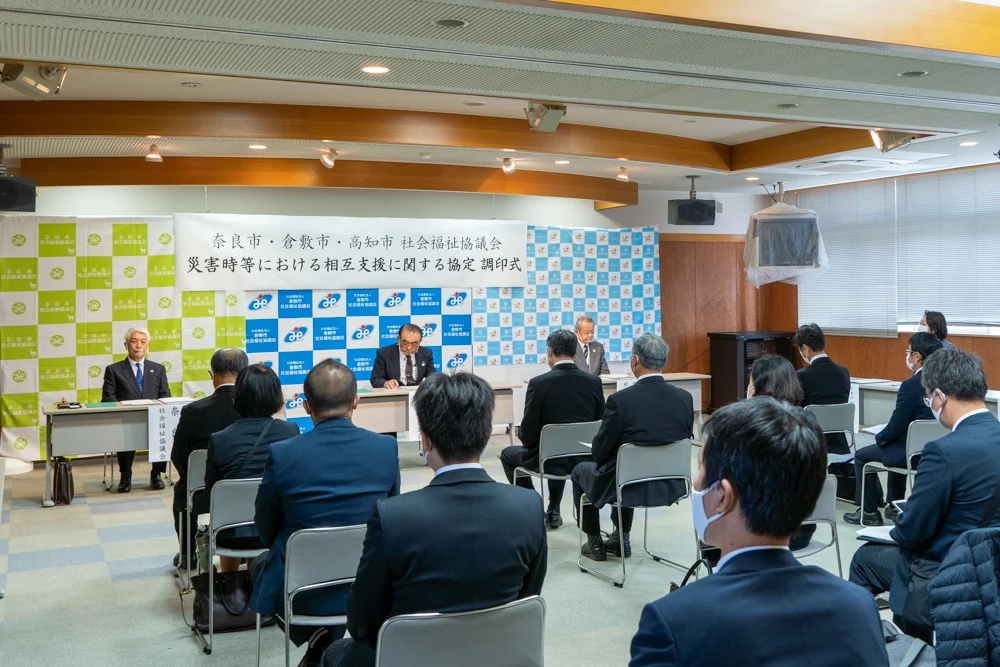
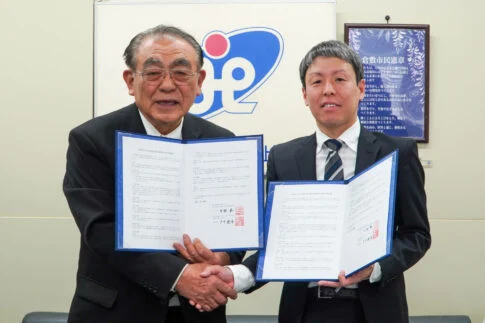
On that day (November 23, 2020), in the morning, the "Mutual Support Agreement in Times of Disaster" was concluded by the social welfare councils of Nara City, Kurashiki City, and Kochi City (hereinafter referred to as "social welfare councils").
The guests included Kurashiki City Mayor Kaori Ito and Okayama Prefecture Social Welfare Council Executive Director Toshio Ogawa (acting chairman).
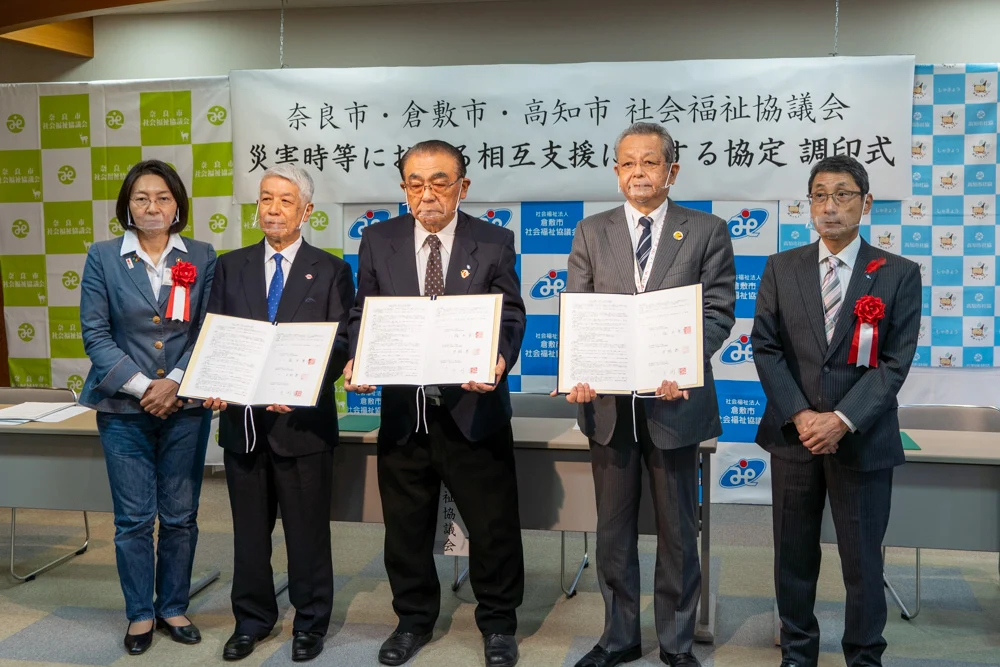
Kurashiki City Mayor: Kaori Ito
Chairman of Nara City Social Welfare Council: Shigetada Fukui
Chairman of Kurashiki City Social Welfare Council: Yasu Nakagiri
Chairman of Kochi City Social Welfare Council: Akira Yoshioka
Okayama Prefecture Social Welfare Council: Toshio Ogawa
Yasu Nakagiri, Chairman of Kurashiki City Social Welfare Council, stated, "I would like to build a strong relationship among the three cities with the signing of this agreement."
This agreement has two key points.
- In the event of a large-scale disaster, support will be provided immediately to the affected area.
- The three cities are located more than 100 kilometers apart, making the probability of simultaneous disasters low.
While operational support will likely focus on the management of the "Disaster Volunteer Center (DVC)," some may wonder, "Isn't there already a system in place for administrative support and other social welfare councils during disasters?"
Indeed, there are mutual support agreements among social welfare councils within the prefecture to support the councils in the disaster area, as well as a system called "block dispatch" within the Chugoku block, which can also provide support nationwide across blocks.
During the heavy rain in July 2018, support was provided to Kurashiki from social welfare councils in the prefecture as well as from the Kinki and Chugoku regions.
However, due to the time it takes to coordinate dispatched staff based on the needs of the affected area and to ensure that everyone agrees on the support (content), it becomes challenging to provide support immediately after a disaster when manpower is most needed.
The agreement among the three cities is unique in that it aims to act to support the affected area before relying on existing dispatch systems.
Disaster Volunteer Center Establishment and Operation Training
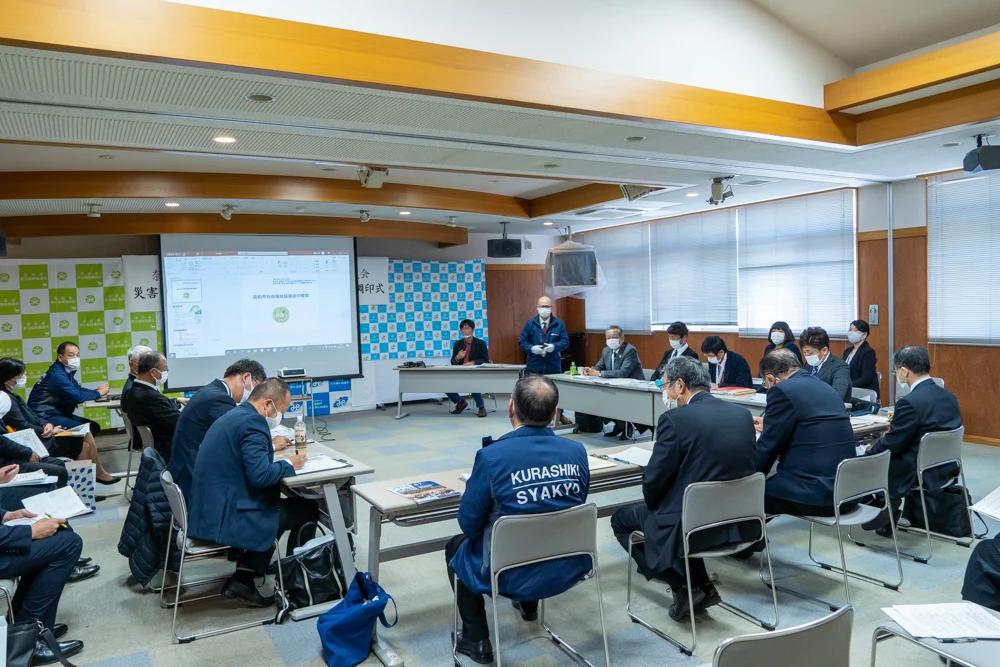
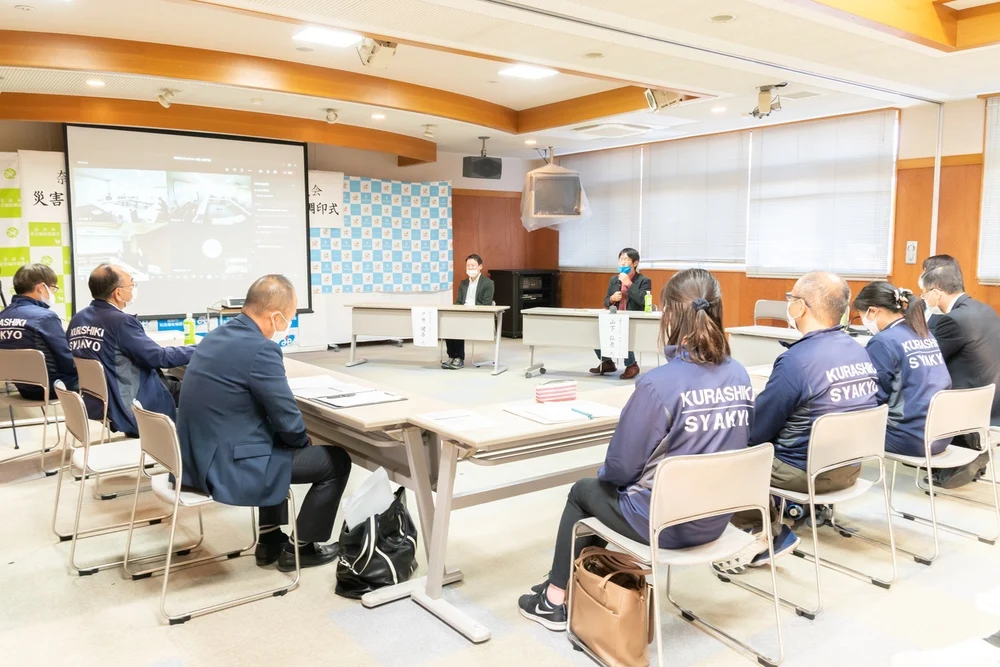
After the signing ceremony, an information exchange meeting among the three city social welfare councils was held, followed by the "Disaster Volunteer Center Establishment and Operation Training" in the afternoon.
| Order of Progress | Content | Speakers |
|---|---|---|
| 1 | Opening Remarks | Kurashiki City Social Welfare Council Secretary General Shinji Kawahara |
| 2 | Lecture "The Significance of Operating the Disaster Volunteer Center Centered on the Social Welfare Council" | Hirohiko Yamashita, Hino Volunteer Network |
| 3 | Simulated Establishment Training of the Disaster Volunteer Center | – |
| 4 | Reflection | – |
Opening Remarks
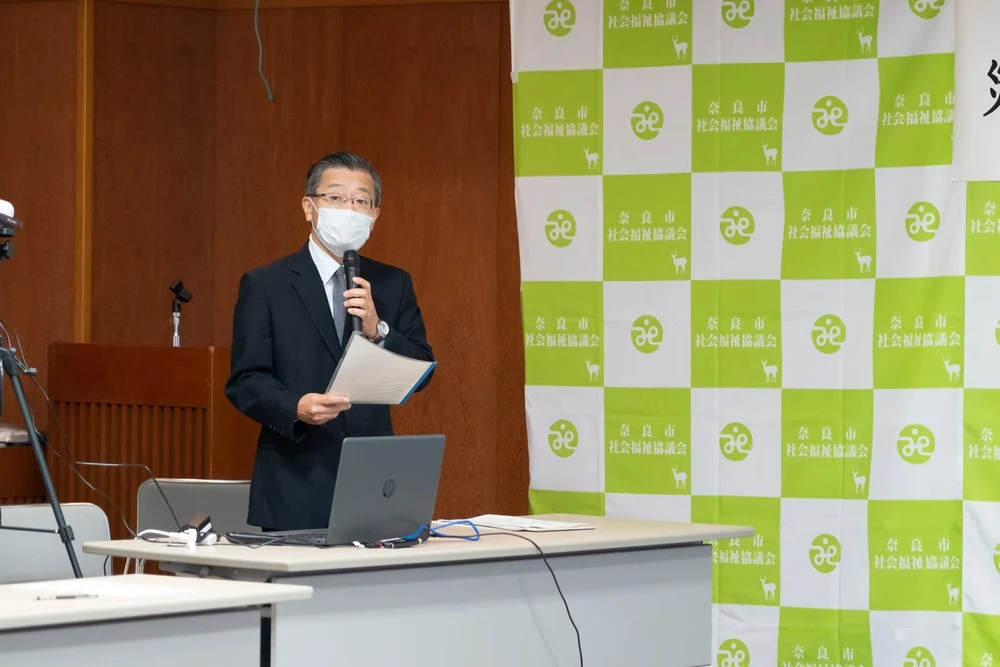
At the beginning of the meeting, Shinji Kawahara, Secretary General of Kurashiki City Social Welfare Council, shared greetings and the purpose of the training.
Lecture "The Significance of Operating the Disaster Volunteer Center Centered on the Social Welfare Council"
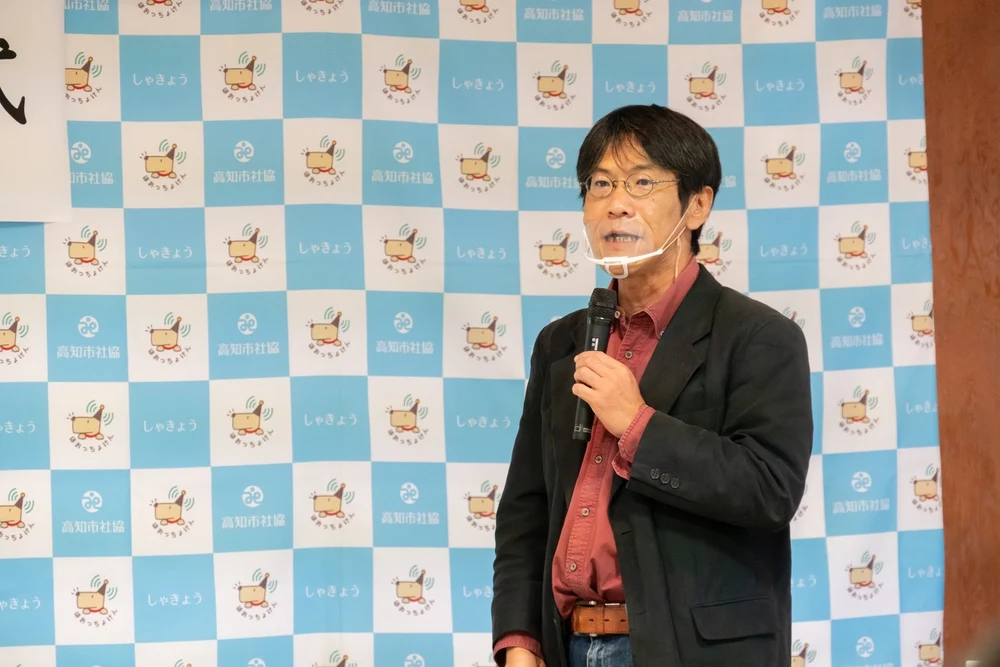
A lecture on "The Significance of Operating the Disaster Volunteer Center Centered on the Social Welfare Council" was given by Hirohiko Yamashita from the Hino Volunteer Network.
Mr. Yamashita also conducted support activities as part of the Disaster Volunteer Activity Support Project Meeting (Support P: a network organization collaborating with businesses, social welfare councils, and NPOs) during the heavy rain in July 2018.
Before introducing the content of the lecture, let me briefly introduce the organization known as the social welfare council.
Social welfare councils (shakyo) are private non-profit organizations with high public and civic nature that aim to create a community where everyone can live safely and comfortably in their familiar town, by considering various welfare issues occurring in the community together with local residents and obtaining cooperation from stakeholders in health, medical care, and welfare, as well as administrative agencies.
Source:Kurashiki City Social Welfare Council HP
I myself misunderstood this in 2018, but social welfare councils are not government organizations, but "private organizations."
In other words, they operate based on private economic logic, and the staff working there are not "public servants."
Furthermore, it is not predetermined that "the Disaster Volunteer Center is operated by the social welfare council."
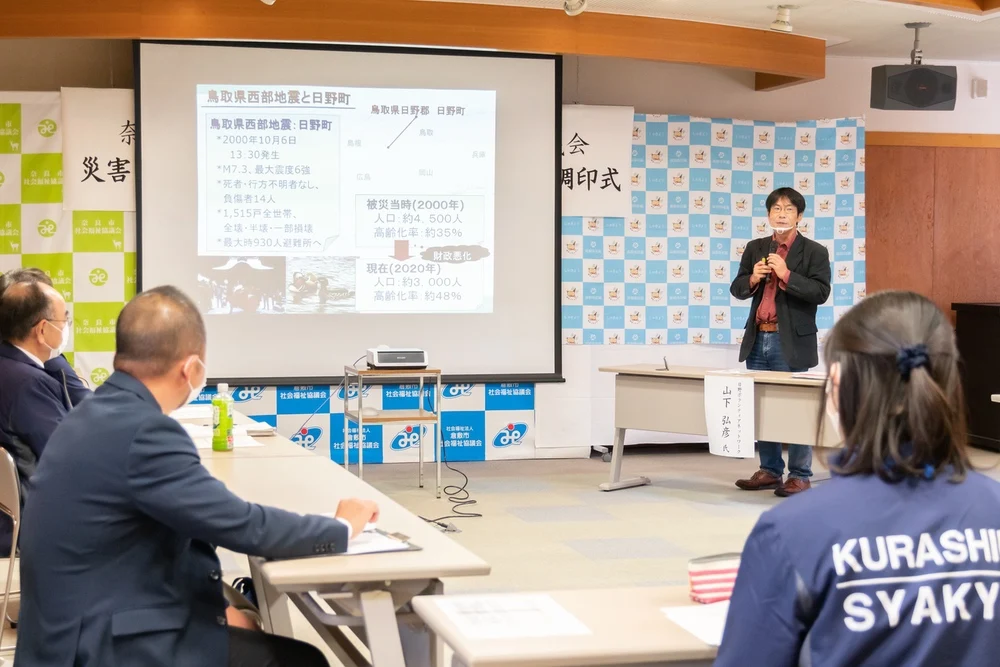
So, why is the Disaster Volunteer Center operated by the social welfare council?
Here are some points from the lecture.
- Support during disasters involves assisting the affected area and residents.
- The operation of the Disaster Volunteer Center is not a monopoly of the social welfare council; collaboration and cooperation are necessary.
For example, social welfare councils communicate with residents who need support even in normal times, and they are engaged in activities rooted in the local community.
During disasters, physical labor such as debris removal tends to be highlighted, but it is essential to support victims in a long-term manner until they can regain their original lifestyle, rhythm, and community.
For this reason, social welfare councils have gradually taken on the role of operating the Disaster Volunteer Center.
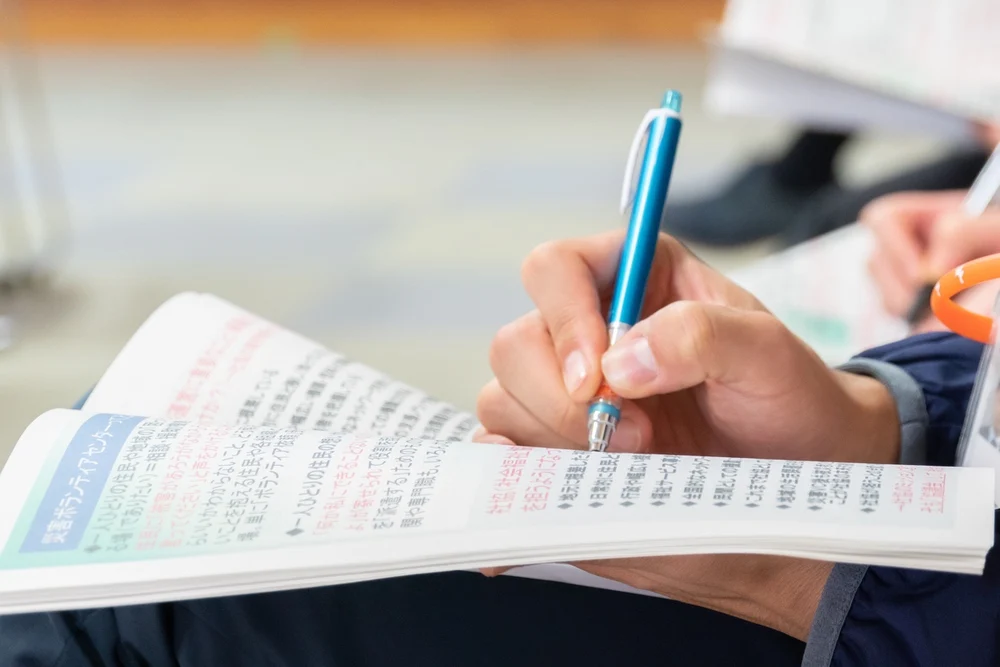
What is required of social welfare councils in the Disaster Volunteer Center is to not do everything themselves, but to demonstrate comprehensive strength while collaborating and cooperating as a "council."
My own experience at the Kurashiki City Disaster Volunteer Center, where I supported the setup of ICT equipment and introduced web registration for volunteers using Peatix, is precisely such an example.
In emergency situations like disasters, there are cases where social welfare council staff are also affected.
I felt that the perspective of supporting the community as a "team" is important.
Simulated Establishment Training of the Disaster Volunteer Center
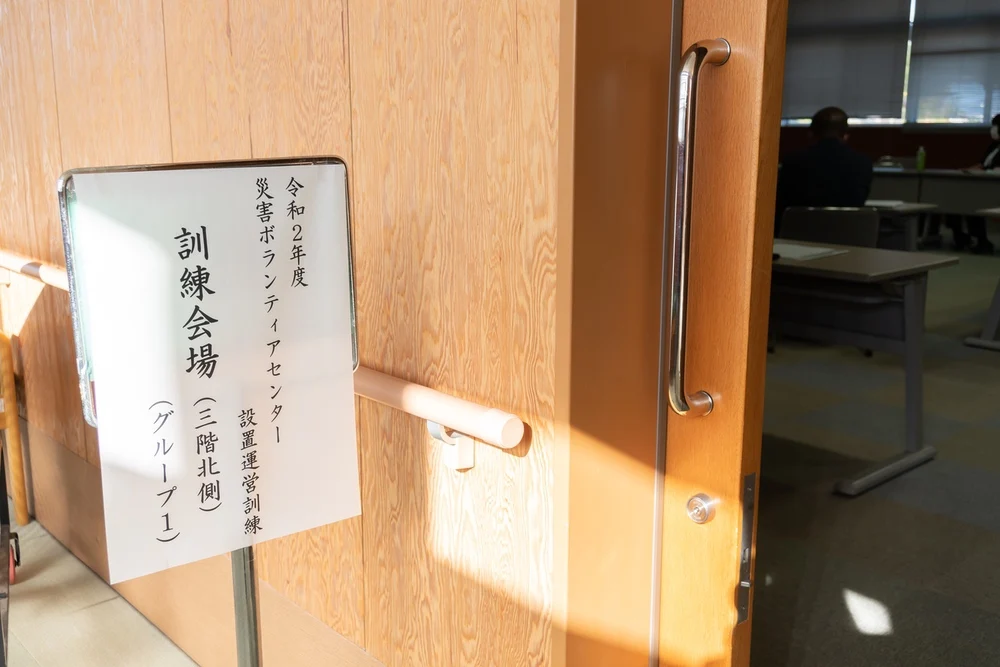
Next, a brief explanation of the use of ICT tools and important points was given, and the training was conducted.
The premise was as follows.
On the fourth day after the disaster [July 10, 2018 (Tuesday)], the location for the Disaster Volunteer Center headquarters was decided, and it was determined that the Disaster Volunteer Center would be opened the following day. A simulated discussion will be held regarding the division of roles, confirmation of business content, and preparation items for the establishment.
Assuming that the establishment of the Disaster Volunteer Center has been decided for "tomorrow," participants were divided into groups by the establishment base (satellite) to discuss and decide on necessary matters.
This is based on the scenario during the heavy rain in July 2018, but the difference from that time is the COVID-19 pandemic, which means instead of "all stakeholders gathering," groups are dispersed, and those bases are connected remotely (via network).
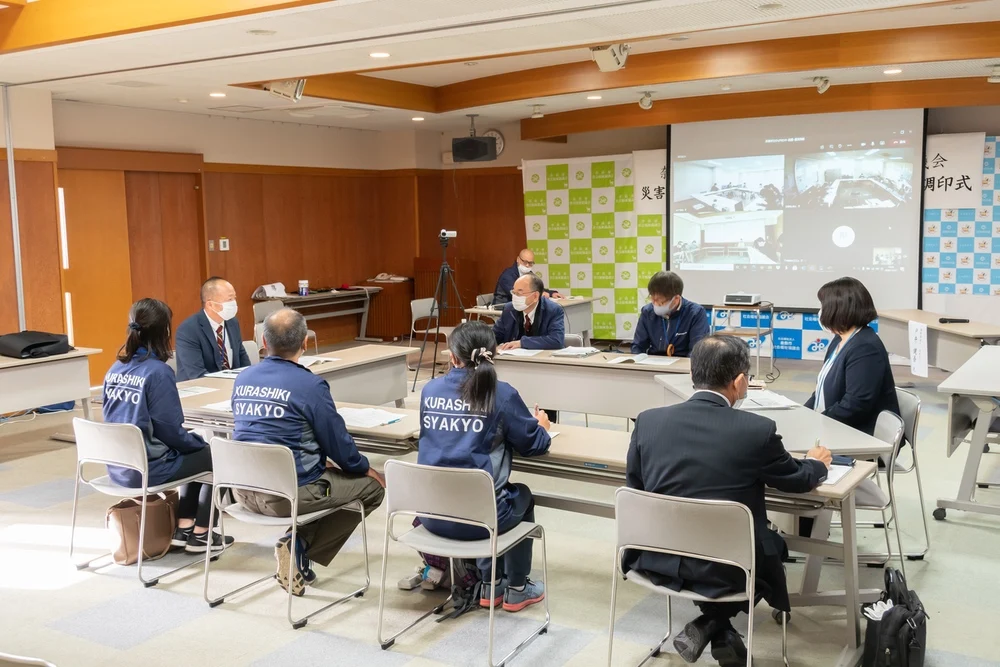
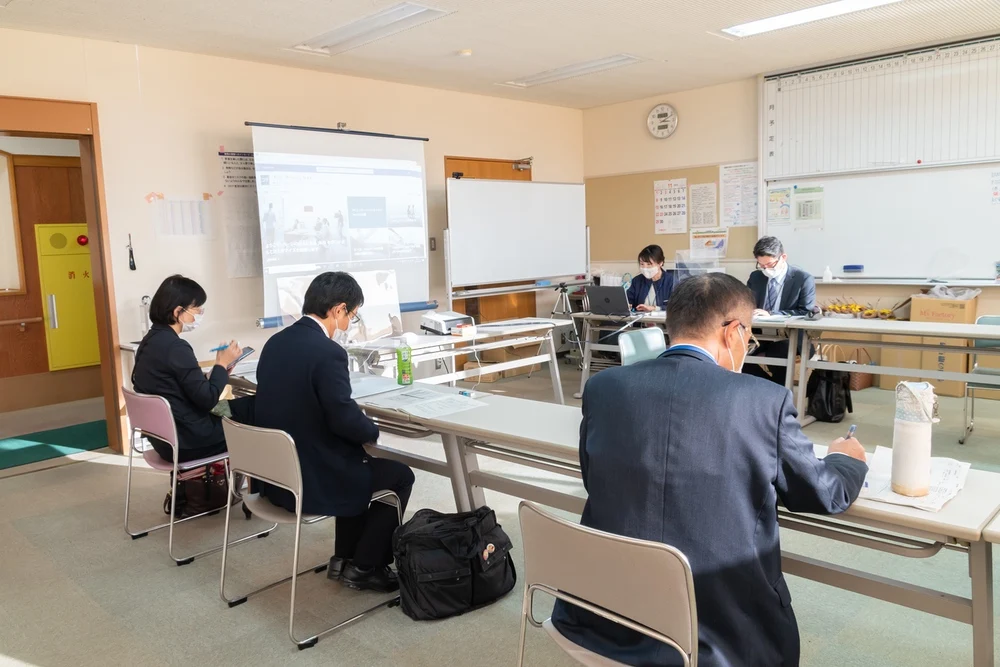
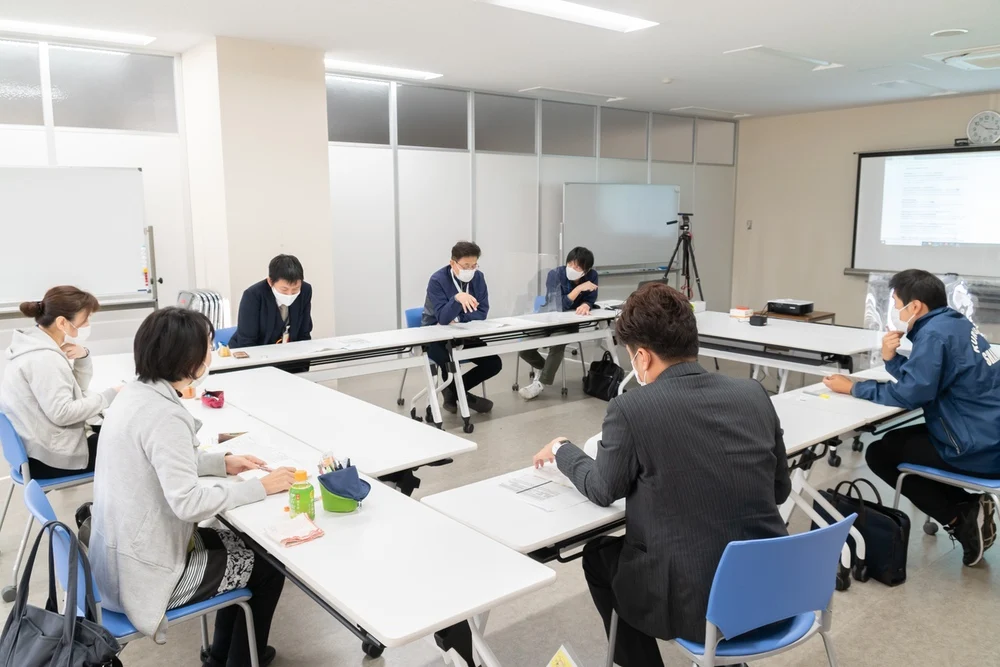
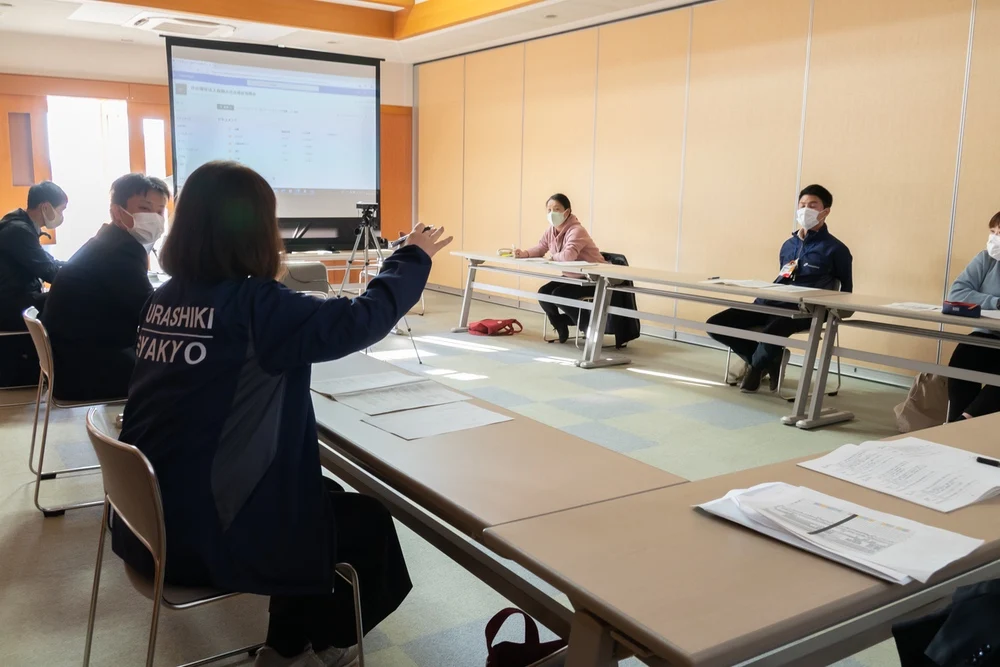
Discussions were held at each base, and reports were made afterward.
- Since the expected number of volunteers significantly exceeds the number of needs (support requests), we will consider conducting a "needs survey."
- We would like to allocate personnel to other bases.
- How will we procure the communication lines necessary for information sharing?
Various reports were made, and during that time, there were also incidents such as "communication lines being cut," which could happen in real situations, and everyone was seriously engaged in the training.
Conclusion
Two years have passed since the heavy rain in July 2018.
The appearance of the town has largely returned, and residents are gradually coming back. However, there are still many vacant lots, and the scars of the disaster remain, with not all residents having regained their "original lives."
The Kurashiki City Social Welfare Council has also changed the name of the "Kurashiki City Disaster Volunteer Center" to the "Mabi Reconstruction Support Volunteer Center" and operated the volunteer center until March 2020, and is currently continuing to provide living support as the "Kurashiki City Mabi Support Center."
In parallel, activities are also being conducted with consideration for "what to do when the next disaster occurs."
I believe that the collaboration among social welfare councils will be strengthened as a result of the "Mutual Support Agreement in Times of Disaster," and the "initial response" will become quicker.
However, it is not something that can be left to others. There are many things about the community that only we understand and can decide.
In fact, when I was involved in disaster volunteer work during the heavy rain disaster in July 2018, I heard a story like this.
The basics of disaster support are in the order of "self-help → mutual aid → public assistance."
The disaster volunteer center operated by the social welfare council falls under the categories of mutual aid and public assistance.
So, when asked, "Does self-help mean that I have to manage everything on my own?" the answer is no, not in that sense.
I believe that by knowing about the community and being involved in activities, the range of what we can do expands.
The social welfare council is also an organization that actually engages in and supports such activities, so I felt it would be good to effectively utilize it to enhance the community's disaster resilience.
- Photography: Yoshino Nako
Articles about Kurashiki City Social Welfare Council